Language

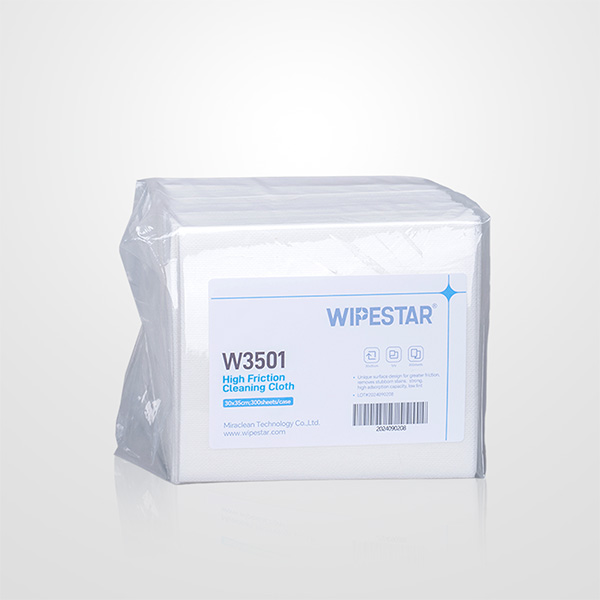
<p style="text-align: center;">Analysis and selection guide for woven dust-free cloth and knit dust-free cloth</p><p><br/></p><p>As the core products in the field of clean room consumables, woven dust-free cloth and knitted dust-free cloth assume key cleaning functions in high-end industrial scenarios such as semiconductor manufacturing and precision electronics. This article provides professional selection guidance for engineering and technical personnel through technical parameter comparison and practical application scenario analysis.</p><p style="text-align: center;"><a href="https://www.wipestar.com/products/921.html" target="_self" title="Knitted clean cloth"><img alt="The difference between woven clean room cloth and knitted cloth? Selection tips that engineers must read.(pic1)" src="https:https://img.wipestar.com/uploads/allimg/20250423/1-2504231341302O.png" title="Knitted-clean-cloth" width="449" height="381"/></a></p><p><br/></p><ol style="list-style-type: decimal;"><li><p>Analysis of production process differences Comparison of weaving process The weaving process adopts the weaving method of vertical interweaving of warp and weft yarns. Products represented by the KM750 series are formed into a stable mesh structure through high-density weaving. This process mostly uses 80-120g/m2 gram of fiber weight, and the warp and weft yarns adopt a 1:1 balance configuration, and the finished product has excellent mechanical strength.</p></li><li><p>The knitting process is based on loop-forming structure weaving, and the yarn cross-linking is achieved through a single/double-sided knitting machine. Typical products use 60-100g/㎡ gram of fiber, and the unique coil structure gives the material 15-25% elastic deformation ability. The two materials can be intuitively distinguished through simple tensile testing: woven fabric can only extend 3-5%, while knitted fabric can reach more than 20%.</p></li><li><p>Comparison of physical performance parameters 1. Structural characteristics The surface density of <a href="https://www.wipestar.com/products/850.html" target="_self"><strong>woven dust-free cloth</strong></a> can reach 300-500 pieces/square centimeter, and the pore diameter is controlled in the range of 5-10μm, which complies with the ISO Class 5 clean room standards. Its planar structure is particularly suitable for blocking suspended particles above 0.3 μm.</p></li><li><p>The typical porosity of knitted dust-free cloth is 35-45%, and the fiber gap forms a three-dimensional adsorption space. The electrostatically treated microfiber knitted fabric can capture efficiency of 0.1μm particles up to 98.5%, which is outstanding in the field of optical component cleaning.</p></li><li><p>Durability parameters wear resistance test shows that the woven fabric only loses 5% of its mass after 5,000 Martingale frictions, while the loss rate of knitted fabric reaches 12% under the same conditions. In terms of temperature resistance, all-nylon woven fabrics can withstand high temperature environments of 200℃, and the recommended use temperature of polyester blended knitted fabrics shall not exceed 150℃.</p></li><li><p>Industrial application decision model 1. Recommended application scenarios for surface treatment scenarios for woven dust-free cloth: – Removal of residual glue for engine parts in automobile manufacturing (contact pressure > 3N/cm²) – Removal of flux after welding of PCB board (wiping frequency > 50 times/hour) – Grinding and polishing of metal processing parts (surface roughness Ra>0.8μm)</p></li><li><p>Precision cleaning requirements are preferred for <a href="https://www.wipestar.com/products-wipe-papers/" target="_self" title="knitted dust-free cloth"><strong>knitted dust-free cloth</strong></a> working conditions including: – Free particle collection in wafer production environment – Adsorption of biological pollutants in the assembly area of medical equipment – Dust capture in the LCD panel process (cleanness requirements are ISO Class 3 or above)</p></li><li><p>The memorandum of selection technology suggests that woven fabrics are regarded as "industrial armor" and are suitable for working conditions where mechanical strength is preferred; while knitted fabrics are like "NATO sponges" and are specially designed to solve the needs of precision adsorption. For clean environments below 10,000, the economy and durability of woven fabrics are given priority; in clean rooms of 100 to 100, anti-static treatment knitted microfiber products are recommended.
In the cleaning process in the field of precision manufacturing, the choice of dust-free cloth directly affects product yield. Taking semiconductor wafer wipe as an example, the knitted dust-free cloth made of microfibers shows the advantages of 0.3-0.5dtex (1dtex = 1 g/10,000 meters) due to its unique coil interlocking structure. This microfiber can effectively capture submicron particles. Compared with the warp and weft interwoven structure of traditional woven dust-free cloth, the three-dimensional structure formed by the knitting process can improve the liquid absorption efficiency by more than 30%.</p></li></ol><p><br/></p><p>In the optical component cleaning scenario, the actual data of an international lens manufacturer shows that when using knitted dust-free cloth to treat mirror fingerprint pollution, the number of residual particles on the surface is controlled within 5 pieces/cm², which is better than the 15 pieces/cm² of woven products. This is due to the elastic deformation characteristics of the knitted structure, its contact area increases by about 40% compared to the rigid woven fabric, which is similar to the principle of memory foam to fit the skin and can evenly disperse the wipe pressure.</p><p><br/></p><p>From the analysis of material characteristics, the warp-weft weaving structure of woven dust-free cloth has higher mechanical strength and is suitable for PCB board drilling and dust removal and other processes that require physical polishing. The coil interlocking structure of knitting non-woven is better at handling curved surface cleaning, accounting for 68% of the application in the medical device field, especially in the cleaning process of endoscopic lenses, which exceeds 90%.</p>
Tags:No tag
RELATED RESOURCES
Sub-fine Cleanroom Wipes: How ...
Asia Dirtless Cloth: Cleaning Innovation Solutions...
More
Pharmaceutical Equipment Clean...
Pharmaceutical Equipment Cleaning Validation: TOC ...
More
Industrial wipes: technologica...
In the fields of industrial equipment maintenance ...
More
4-inch dust-free cloth micron-...
In the fields of precision manufacturing and micro...
More
The Cleaning Revolution of Pow...
How Industrial Wipes Revolve ManufacturingIn the e...
More
Precision manufacturing worksh...
Analysis on upgrading equipment cleaning standards...
More
Related Products
Room 101, Building 1, Angeer Factory, No.4, Hetian Road, Shatian Community, Kengzi Street, Pingshan District, Shenzhen, Guangdong, P.R. China 518122
info@wipestar.com
+86-755-89616775
+86-755-89616773
Related Products
RELATED RESOURCES