English
 Chinese


Walk into any body shop after a paint job goes wrong and you’ll hear the same conversation. The painter swears the mix was right — correct ratio, correct pressure, correct booth temperature. The finish looked perfect for about ten minutes. Then the fisheyes appeared. Or the orange peel got worse instead of better. Or the clear coat lifted in sheets three days later.
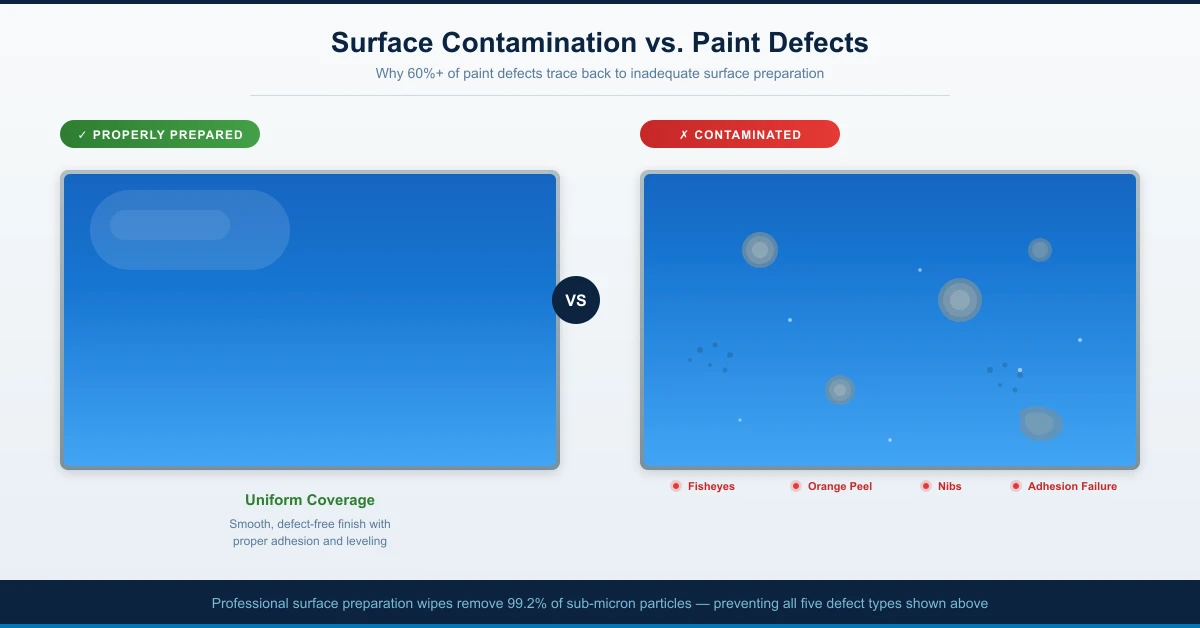
The cause is almost never the paint itself. It’s what was on the surface before the paint went on. Industry data from automotive refinish operations shows that over 60% of paint defects trace back to inadequate surface preparation — invisible contamination that standard cleaning methods miss entirely.
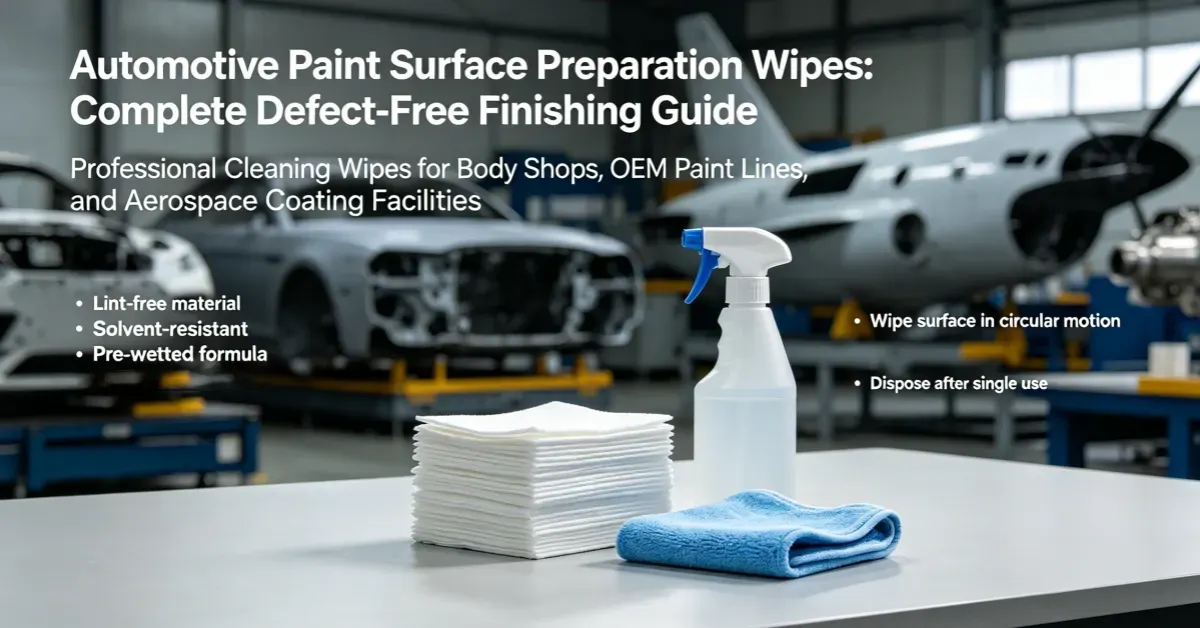
This guide covers the science behind surface contamination, the preparation process that actually works, and how to select the right surface preparation wipes for your specific application — whether you’re running a collision repair shop, an OEM paint line, or an aerospace coating facility.
📌 Key Takeaways
- 60%+ of paint defects are caused by surface contamination — not paint formulation or application technique
- Professional surface preparation wipes remove 99.2% of sub-micron particles vs. 78% for conventional cleaning methods
- The three-stage preparation process (degrease → wipe → tack) eliminates the top three contamination types in sequence
- Optimal preparation window: 15–30 minutes before paint application — too early risks residual solvent under the paint film, too late risks re-contamination from airborne particles
- Switching to professional wipes reduces rework rates from 18–25% down to 3–5% in body shop environments
Why Surface Contamination Causes Paint Defects
Here’s what’s actually happening at the molecular level. A freshly sanded or stripped automotive panel looks clean to the naked eye. Under magnification, it’s a landscape of microscopic trouble. The surface carries three categories of contamination that standard wiping can’t remove:
The Three Contamination Layers
Layer 1 — Silicone and mold release agents. These are the most dangerous contaminants in automotive painting. Silicone compounds migrate from body shop plastics, detailing products, and even airborne overspray from nearby operations. At concentrations as low as 0.01 mg/m², silicone causes fisheyes — circular craters in the paint film where the coating literally repels itself from the contaminated spot.
Layer 2 — Oils and fingerprint residues. Human skin transfers approximately 1–2 μg of oil per cm² per second of contact. A single fingerprint on a door panel deposits enough sebum to disrupt paint adhesion in that area. These oils aren’t water-soluble — they require solvent-based removal.
Layer 3 — Sub-micron particles and sanding dust. Even after compressed air blow-off, particles smaller than 10 μm remain electrostatically bonded to the surface. These particles get trapped under the paint film, creating nibs (tiny bumps) that show up under inspection lighting and require wet-sanding to correct.
Why Standard Cleaning Methods Fail
| Cleaning Method | Silicone Removal | Oil Removal | Particle Removal | Residue Left Behind |
|---|---|---|---|---|
| Compressed air only | 0% | 0% | ~45% | Re-deposits particles |
| Water wash + dry | ~15% | ~30% | ~65% | Water spots, mineral deposits |
| Shop rag + solvent | ~40% | ~55% | ~50% | Lint fibers, detergent residue |
| Professional surface preparation wipe | ~95% | ~99% | ~99.2% | None (controlled evaporation) |
The gap between conventional methods and professional surface preparation is dramatic. A shop rag with solvent sounds like it should work — it’s what most painters grew up using. But the rag itself introduces new contamination: lint fibers, residual detergent from laundering, and silicone from fabric softeners. You’re cleaning one problem while creating three others.
5 Paint Defects Caused by Poor Surface Preparation
Every paint booth operator has seen these. The frustrating part is that each one is preventable — and the fix always starts with better preparation, not better paint.
| # | Defect | Root Cause | Cost to Fix |
|---|---|---|---|
| 1 | Fisheyes | Silicone contamination (0.01 mg/m² triggers it) | Full strip and repaint — $800–$2,500 per panel |
| 2 | Orange peel (excessive) | Surface oils disrupting paint flow and leveling | Wet-sand and buff — $200–$600 per panel |
| 3 | Adhesion failure / clear coat lifting | Fingerprint oils, wax residue, or silicone barrier | Full strip and repaint — $1,200–$4,000 |
| 4 | Nibs and surface bumps | Sub-micron particles trapped under paint film | Wet-sand and spot-repair — $100–$300 per area |
| 5 | Solvent popping / pinholes | Residual moisture or solvent trapped under paint | Sand and repaint affected area — $300–$900 |
A mid-size collision shop doing 40 vehicles per month spends an average of $8,000–$15,000 monthly on rework. At least half of that is traceable to surface preparation failures. Professional surface preparation wipes cost roughly $0.30–$0.80 per wipe — the math isn’t close.
Preparation Tools Compared: Wipes vs. Solvent Spray vs. Tack Cloths
“I’ve been using a tack cloth and solvent spray for 20 years — why switch?” Fair question. Here’s how the three approaches actually compare in practice.
Tack Cloths: The Traditional Approach
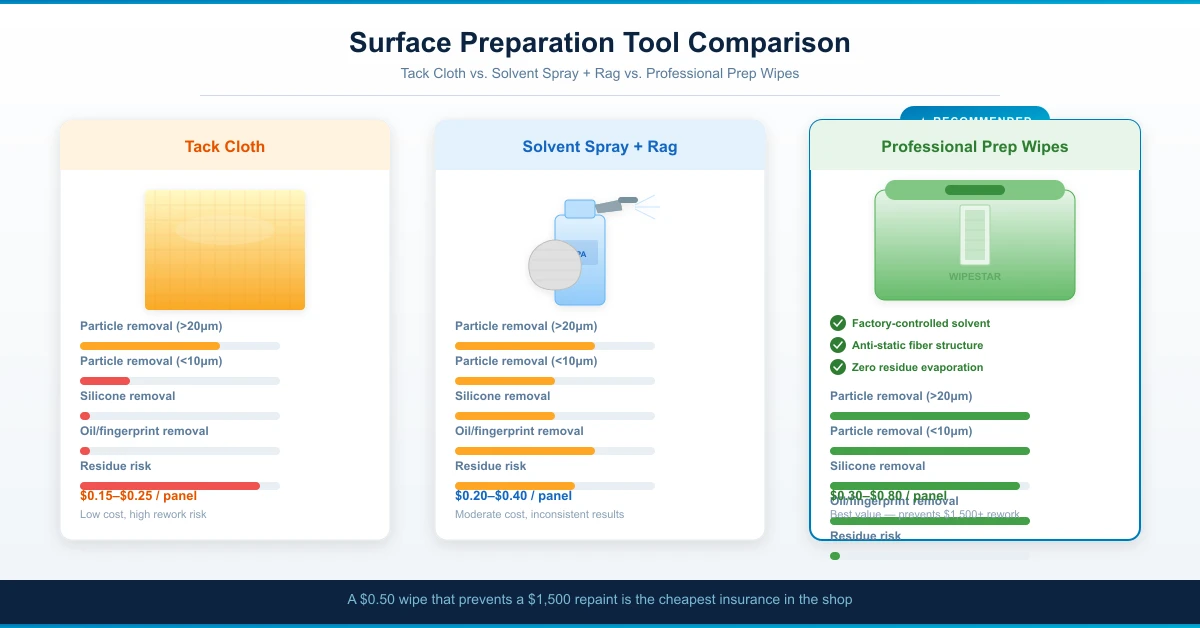
Tack cloths are sticky gauze sheets designed to pick up particles. They work — for particles larger than about 20 μm. Below that threshold, the adhesive isn’t aggressive enough to pull particles off the surface. More critically, tack cloths do nothing for silicone or oil contamination. If your surface has any fingerprint, any silicone overspray, any residual wax, the tack cloth glides right over it.
There’s also a transfer risk. In humid environments, tack cloth adhesive can transfer to the surface, creating its own contamination problem. We’ve seen shops where the tack cloth was the primary source of defects — the very tool meant to prevent them was causing them.
Solvent Spray + Wipe: Better, but Inconsistent
Spraying solvent from a bottle and wiping with a clean cloth is a step up. The solvent dissolves oils and silicone. The cloth picks up particles. But the results depend entirely on technique: how much solvent, what type of cloth, how much pressure, how many passes. In practice, operator variability introduces inconsistency — one painter’s preparation might be excellent, another’s mediocre, using the same materials.
Professional Surface Preparation Wipes: Controlled and Repeatable
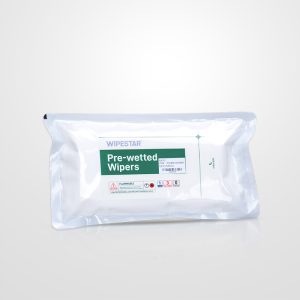
Professional-grade surface preparation wipes solve the consistency problem. Each wipe delivers the same solvent volume, the same fiber structure, and the same cleaning performance — regardless of who’s using it.
- Controlled solvent delivery — pre-saturated at the factory with a precise solvent-to-wipe ratio, eliminating the guesswork of spray bottles
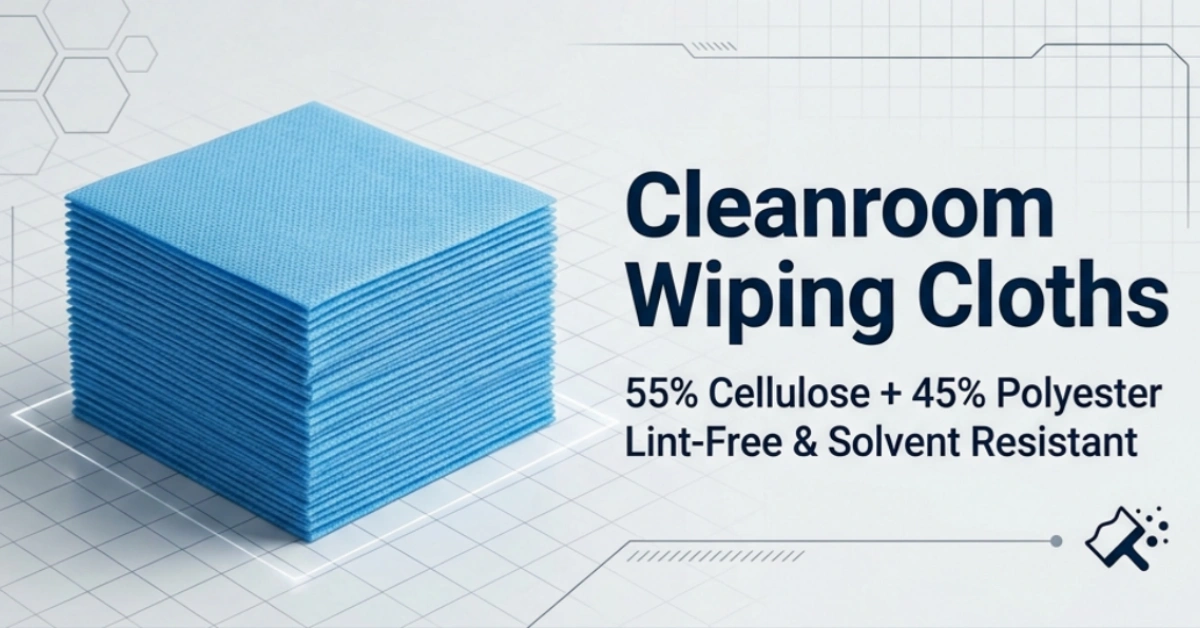
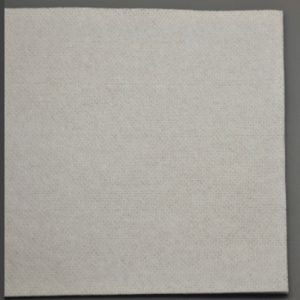
- Engineered fiber structure — Cellulose/Polyester or Rayon/Polyester blends with optimized particle capture at the sub-micron level
- Anti-static properties — reduces electrostatic re-attraction of airborne particles after wiping
- Zero-residue evaporation — the solvent blend evaporates completely, leaving nothing behind for paint to react with
| Factor | Tack Cloth | Solvent Spray + Rag | Professional Preparation Wipe |
|---|---|---|---|
| Particle removal (>20 μm) | Good | Good | Excellent |
| Particle removal (<10 μm) | Poor | Moderate | Excellent |
| Silicone removal | None | Moderate | Excellent |
| Oil/fingerprint removal | None | Good | Excellent |
| Residue risk | Adhesive transfer | Varies by cloth | Zero |
| Consistency | Good | Operator-dependent | Consistent (factory-controlled) |
| Cost per panel | $0.15–$0.25 | $0.20–$0.40 | $0.30–$0.80 |
The real cost isn’t the wipe — it’s the rework. A $0.50 wipe that prevents a $1,500 repaint is the cheapest insurance in the shop.
How to Prep a Surface for Painting (Step-by-Step)
The process follows a deliberate sequence. Skipping steps or reordering them is where most shops go wrong.
Before You Start
Environment matters. Surface preparation should happen in a clean area — ideally the paint booth anteroom or a dedicated preparation station. Open doors, overhead fans, and nearby grinding operations introduce airborne contamination faster than you can remove it.
The Three-Stage Preparation Process
- Stage 1 — Degrease. Take a surface preparation wipe and fold it into a pad (roughly 4″ × 4″). Wipe the panel in a single direction — left to right, top to bottom — with moderate pressure. Flip the wipe and repeat. The goal is to dissolve and lift silicone, oils, and wax residues. Use one wipe per 2–3 panels; replace immediately when the wipe picks up visible contamination.
- Stage 2 — Particle removal. Using a fresh wipe, go over the same panels with lighter pressure (0.3–0.5 N/cm²). This pass targets the sub-micron particles that survived Stage 1. The wipe’s fiber structure physically lifts particles off the surface. Again, single-direction strokes — back-and-forth grinding pushes particles into surface scratches.
- Stage 3 — Final tack (optional but recommended). In high-finish applications (show cars, OEM clear coat), follow with a tack cloth pass to catch any particles that settled during the wipe process. This is a single, light pass — the tack cloth is insurance, not the primary cleaning tool.
The Three-Zone Approach for Complete Coverage
| Zone | Panel Areas | Technique | Pressure |
|---|---|---|---|
| Primary | Hood, roof, doors, fenders (flat surfaces) | Single-direction overlap strokes | 0.5–0.8 N/cm² |
| Secondary | Door jambs, edges, trim lines, body lines | Folded wipe edge, detail strokes | 0.3–0.5 N/cm² |
| Tertiary | Under mirrors, around badges, antenna bases | Swab or folded wipe tip | 0.2–0.4 N/cm² |
Timing: The 15–30 Minute Window
After wiping, the solvent needs time to fully evaporate — typically 5–8 minutes at 20°C. The optimal painting window opens 15–30 minutes after the final wipe pass. Before 15 minutes, residual solvent may be trapped under the paint film, causing solvent popping. After 30 minutes, airborne particles begin re-settling on the clean surface.
In humid environments (above 65% RH), shorten the evaporation window and consider wiping immediately before entering the booth. In dusty environments, cover the prepped panel with a clean booth blanket if the paint session is delayed.
Surface Preparation Wipe Types Explained
Not all preparation wipes are built the same. The material, solvent, and construction determine which contamination types a wipe handles best.
| Wipe Type | Material | Best For | Key Property |
|---|---|---|---|
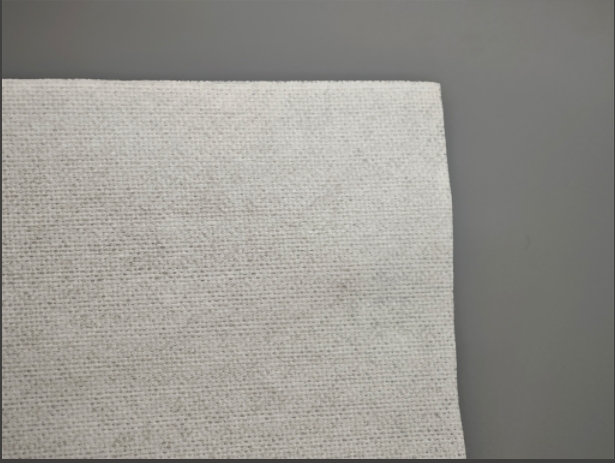
| High-friction wipes | Cellulose/Polyester | Heavy contamination, adhesive residue, heavy oils | Textured surface creates mechanical scrubbing action |
| Ultra-soft wipes | Rayon/Polyester | Delicate surfaces, fresh clear coat, polished metal | Ultra-fine fibers prevent micro-scratching |
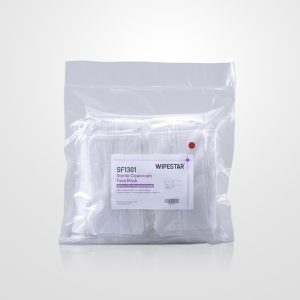
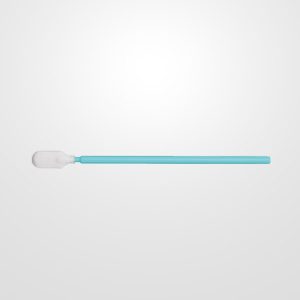
| Mesh adhesive-removal wipes | Wood-pulp/Polypropylene | Masking tape residue, adhesive removal, heavy-duty degreasing | Open mesh structure traps adhesive particles |
| Anti-static wipes | Conductive fiber blend | Electrostatic-sensitive environments, powder coat preparation | Dissipates static charge to prevent particle re-attraction |
High-Friction vs. Ultra-Soft: When to Use Which
Use high-friction wipes when the surface has visible contamination — wax buildup, adhesive residue from masking, heavy fingerprints, or visible dust accumulation. The textured surface provides mechanical cleaning action that dissolves and lifts stubborn contaminants.
Use ultra-soft wipes on surfaces that scratch easily — polished aluminum, fresh clear coat (24–48 hours old), chrome trim, or any surface where the finish is the priority. The Rayon/Polyester blend has a fiber diameter small enough that it won’t create micro-scratches, even under moderate pressure.
The combination approach works best: high-friction for the initial degrease pass, ultra-soft for the final particle removal pass. This addresses both chemical contamination and particulate contamination with the right tool for each job.
Industry Applications & Case Studies
Surface preparation requirements vary significantly by industry. A collision repair shop and an aerospace coating facility face different contamination profiles, different finish standards, and different cost structures.
🚗 Collision Repair & Body Shops
Environment: Mixed contamination — silicone from detail products, body filler dust, oils from handling
A 12-bay collision shop switched from tack cloths + solvent spray to professional surface preparation wipes. Monthly rework dropped from 18% to 4.2% of completed jobs. Fisheye-related repaints fell from 6–8 per month to zero. Annual savings: approximately $25,000 in rework labor and materials — against an annual wipe cost of $3,500.
🏭 OEM Paint Lines
Environment: Controlled but high-volume — stamping oils, phosphate residue, electro-coat imperfections
An automotive OEM plant integrated surface preparation wipes into their pre-paint inspection stations. Surface cleanliness improved by 340% compared to the previous compressed-air-only method. First-pass yield on exterior panels increased by 8.3 percentage points.
✈️ Aerospace Coatings
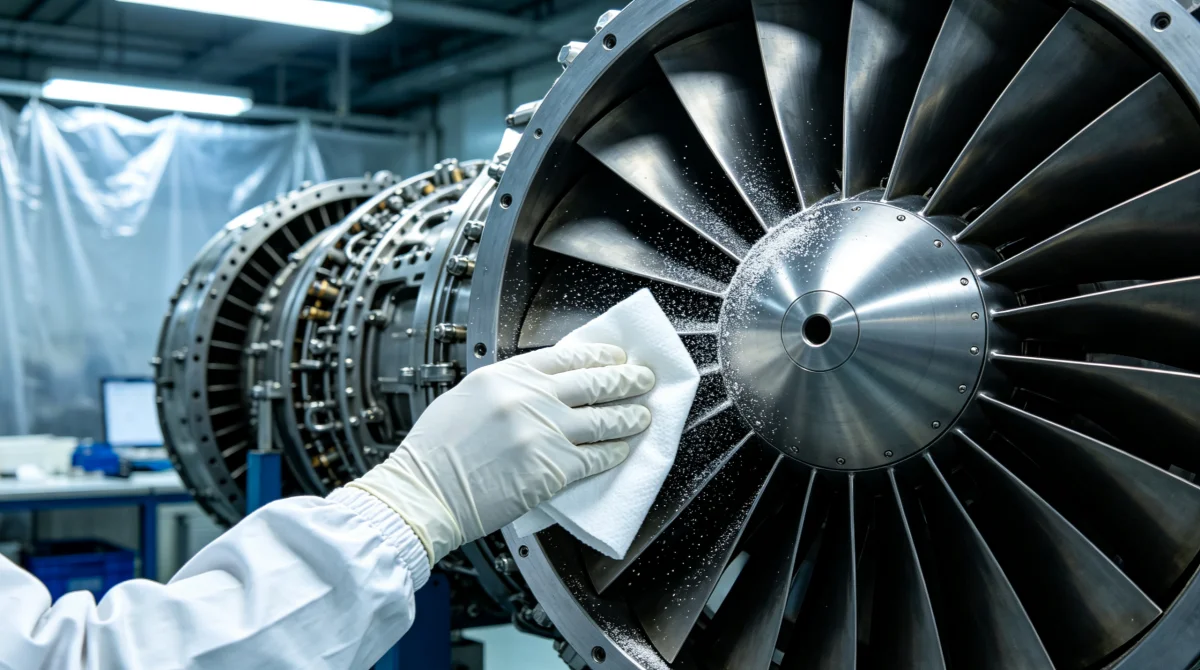
Environment: Extreme standards — any particle above 5 μm is a reject criterion for flight surfaces
An aircraft maintenance facility using ultra-soft wipes for composite surface preparation before primer application reported zero coating adhesion failures over a 14-month period — compared to 3 failures in the prior 12 months with conventional methods. Each avoided repaint saved $15,000–$40,000 in labor and downtime.
🏍️ Motorcycle & Powersport Refinishing
Environment: Complex geometry — curved surfaces, tight spaces, mixed materials (plastic, metal, carbon fiber)
A specialty motorcycle paint shop found that folded surface preparation wipes outperformed spray-and-wipe on curved fenders and tank surfaces. Orange peel complaints dropped by 71%.
🪑 Industrial & Furniture Coatings
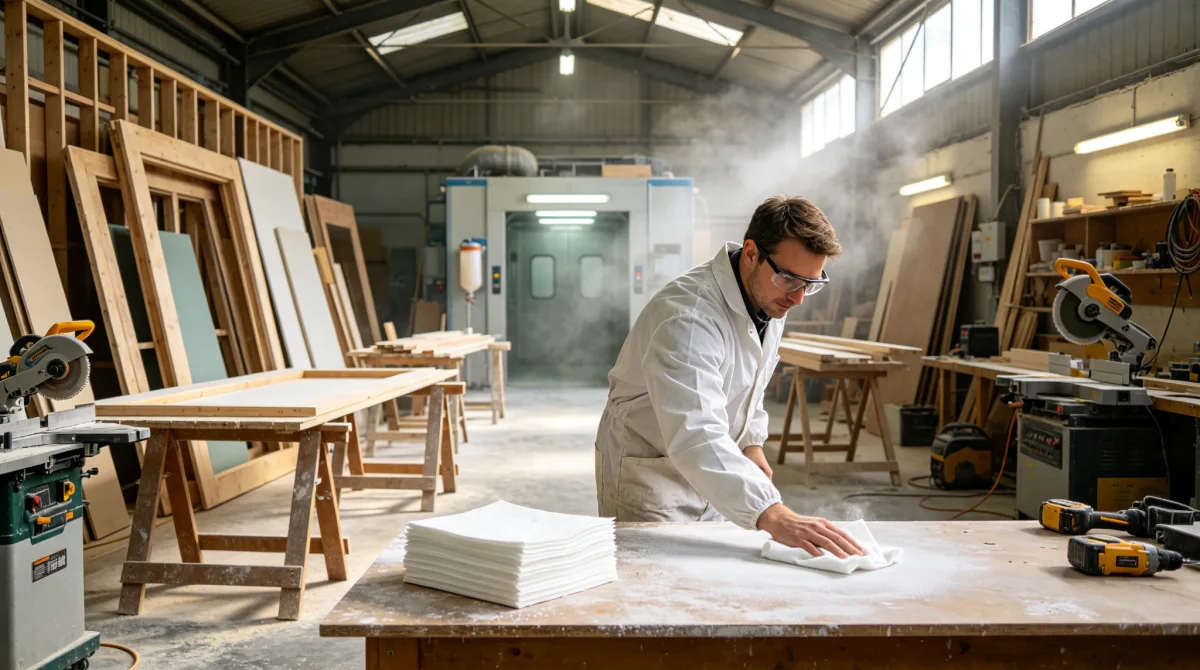
Environment: Wood dust, silicone from polishes, cross-contamination from adjacent finishing operations
A wood-furniture manufacturer added surface preparation wipes to their pre-stain workflow. Stain absorption consistency improved by 45%, eliminating the blotchy appearance that had been their top customer complaint.
How to Choose the Right Surface Preparation Wipes
Match the wipe to your contamination profile and finish requirements. Here’s what to evaluate:
Key Specifications
| Specification | What to Look For | Why It Matters |
|---|---|---|
| Material composition | Cellulose/Polyester blend (standard) or Rayon/Polyester (delicate) | Determines particle capture ability and scratch risk |
| Solvent type | IPA-based (general) or acetone-based (heavy contamination) | IPA is safer for most surfaces; acetone attacks silicone more aggressively |
| Fiber structure | 3–5 μm fiber diameter, high-density weave | Smaller fibers capture smaller particles; dense weave holds more contamination |
| Solvent volume | Consistent pre-saturation (factory-controlled) | Eliminates operator variability in solvent application |
| Lint generation | Less than 0.1 mg/m² per wipe pass | Any lint left behind becomes a paint defect |
| Certifications | ISO 9001, RoHS, REACH | Quality assurance and environmental compliance |
Matching Wipes to Application
| Application | Recommended Wipe | Why |
|---|---|---|
| Collision repair (general) | High-friction Cellulose/Polyester | Handles mixed contamination from body fillers, sanding, and handling |
| OEM paint line | Standard Cellulose/Polyester | Consistent performance at volume; optimized for stamping oil removal |
| Aerospace / precision | Ultra-soft Rayon/Polyester | Zero scratch risk on composite and polished metal surfaces |
| Adhesive removal | Mesh Wood-pulp/Polypropylene | Open structure traps adhesive particles without smearing |
| Powder coat preparation | Anti-static formulation | Prevents particle re-attraction via static dissipation |
Environmental & Sustainability Considerations
- Low-VOC formulations — reduces workplace solvent exposure and meets tightening emissions regulations
- Biodegradable substrate materials — PLA-based wipes decompose naturally within 12 months
- Minimal packaging waste — bulk dispensing systems reduce plastic packaging by 60% vs. individual wraps
- Solvent recovery compatibility — some wipe materials can be processed through solvent recovery systems
Frequently Asked Questions
About WIPESTAR — WIPESTAR is a professional manufacturer of cleanroom consumables and surface preparation solutions, serving automotive, aerospace, electronics, and industrial coating industries worldwide. With over 20 years of experience and ISO 9001 certification, WIPESTAR supplies surface preparation wipes to enterprise clients in 50+ countries.