English
 Chinese


I’ve spent the better part of a decade talking to cleanroom managers, process engineers, and procurement leads. And if there’s one thing I’ve learned, it’s that the wipe in your hand matters more than most people realize — until it doesn’t.
When a semiconductor fab loses an entire wafer batch because a single fiber landed on a chip, that wiper mattered. When a pharmaceutical facility fails an aseptic media fill test and has to destroy an entire production run, that wiper mattered. When an aerospace manufacturer finds a particle trace on a precision optical component that has already been shipped to a satellite, that wiper mattered enormously.
Cleanroom wipers are one of the most cost-effective contamination controls in any controlled environment. They’re also one of the most misunderstood. This guide is here to fix that — so whether you’re specifying wipers for a new cleanroom build or auditing your current supply chain, you walk away knowing exactly what you’re buying and why.

What Are Cleanroom Wipers and Why Do They Matter?
A cleanroom wiper is a specialized wiping material engineered to remove microscopic contamination from surfaces — without introducing new particles, fibers, or chemical residues in the process. Unlike household paper towels or general-purpose shop rags, cleanroom wipers are manufactured under tightly controlled conditions and tested against documented cleanliness standards before they ever reach your facility.
The stakes are real. In semiconductor fabrication, a particle smaller than a micron can destroy an entire batch of chips — the cost of a single contamination event can run into millions of dollars. In pharmaceutical production, a stray fiber landing on a sterile surface can compromise drug safety and trigger a product recall. In aerospace assembly, contamination on a precision sensor can cause catastrophic system failure. These aren’t edge cases — they’re documented causes of yield loss, product recalls, and regulatory action across every industry that operates in controlled environments.
Cleanroom wipers serve three primary functions:
- Particle removal — physically lifting and trapping dust, fibers, and microscopic debris from surfaces without redistributing them
- Liquid absorption — soaking up spills, solvents, and cleaning solutions efficiently without leaving residue behind
- Surface preparation — creating a clean, consistent baseline before coating, bonding, or assembly processes begin
The right wiper, used correctly, is one of the most cost-effective contamination controls available. The wrong wiper — or the right wiper used incorrectly — can be worse than using nothing at all. Understanding the difference is what this guide is built to deliver.
Cleanroom Classifications: ISO 14644 and FED-STD-209E
Before you can select the right wiper, you need to understand the cleanliness class of your environment. Cleanroom classifications are determined by the concentration of airborne particles per cubic meter, and these classes directly dictate what grade of wiping material is acceptable.
ISO 14644-1 Classification System
The international standard divides cleanrooms into nine classes. ISO 1 is the cleanest environment currently defined; ISO 9 is equivalent to ordinary outdoor air.
| ISO Class | >0.1 µm | >0.2 µm | >0.3 µm | >0.5 µm | >1 µm | >5 µm | FED-STD-209E |
|---|---|---|---|---|---|---|---|
| ISO 1 | 10 | 2 | — | — | — | — | — |
| ISO 2 | 100 | 24 | 10 | 4 | — | — | — |
| ISO 3 | 1,000 | 237 | 102 | 35 | 8 | — | Class 1 |
| ISO 4 | 10,000 | 2,370 | 1,020 | 352 | 83 | — | Class 10 |
| ISO 5 | 100,000 | 23,700 | 10,200 | 3,520 | 832 | 29 | Class 100 |
| ISO 6 | 1,000,000 | 237,000 | 102,000 | 35,200 | 8,320 | 293 | Class 1,000 |
| ISO 7 | — | — | — | 352,000 | 83,200 | 2,930 | Class 10,000 |
| ISO 8 | — | — | — | 3,520,000 | 832,000 | 29,300 | Class 100,000 |
| ISO 9 | — | — | — | 35,200,000 | 8,320,000 | 293,000 | Room Air |
What this means for wiper selection: The cleaner your environment, the higher-grade wiper you need. An ISO 5 semiconductor fabrication facility requires ultrasonically sealed polyester or microfiber wipers with documented APC and LPC test data. An ISO 8 packaging area can use standard nonwoven wipers without compromising product quality. Matching the wiper to the environment isn’t optional — it’s the baseline requirement.
The Fundamental Rule
A wiper used in a cleanroom must be at least as clean as the environment itself. Using a low-grade wiper in a high-class cleanroom introduces more contamination than it removes. This sounds obvious, but in practice, procurement decisions driven purely by unit price often violate this principle — and the hidden cost shows up in yield loss, rework, and failed audits.
Types of Cleanroom Wipers by Material
The material composition of a wiper determines its cleanliness performance, absorbency, durability, and chemical compatibility. Here’s a detailed breakdown of the main categories available:
Polyester Wipers (100% Polyester Knit)
The workhorse of cleanroom wiping. Polyester fibers are inherently clean, naturally resistant to most solvents, and produce minimal particle shedding when manufactured under controlled conditions.
- Best for: General-purpose cleanroom cleaning, PCB assembly, equipment wipe-down, initial surface cleaning
- Strengths: High cleanliness, cost-effective at volume, excellent solvent resistance, durable wet and dry
- Limitations: Lower absorbency than microfiber; less effective on oil-based contaminants without pre-wetting
Sub-Microfiber Wipers (100% Polyester, Finer Denier)
A finer version of standard polyester knit. The individual fibers are thinner in diameter, creating a denser surface with better particle-trapping capability across a larger contact area.
- Best for: Touchscreens, LCD panels, camera lenses, precision metal parts, spray painting surfaces
- Strengths: Softer than standard polyester, better particle removal, still cost-effective
- Limitations: Slightly higher cost than standard polyester; requires correct edge sealing for cleanest performance
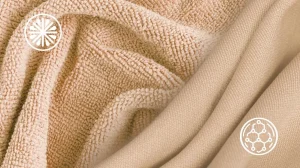
Microfiber Wipers (80% Polyester / 20% Nylon)
The split-fiber construction creates thousands of microscopic hooks per fiber bundle, dramatically increasing surface contact area. This makes microfiber the top choice for removing oils, fingerprints, and film-like contamination that polyester struggles with.
- Best for: Glass surfaces, optical components, precision instruments, fingerprint removal, display cleaning
- Strengths: Superior oil and fingerprint removal, excellent capillary action, fast solvent uptake and drying
- Limitations: Higher cost per sheet; nylon component may not be compatible with all aggressive chemicals
Woven Wipers (80% Polyester / 20% Nylon, Woven Construction)
Woven construction provides higher tensile strength in both warp and weft directions, making these wipers resistant to deformation during aggressive scrubbing — a capability that knitted wipers don’t have.
- Best for: Adhesive removal, LCD COG (Chip on Glass) processes, applications requiring physical scrubbing force
- Strengths: High tensile strength, excellent for removing sticky residues, dimensional stability
- Limitations: More expensive than knitted alternatives; slightly higher particle generation risk from woven edges
ESD (Anti-Static) Wipers (99% Polyester / 1% Conductive Fiber)
The conductive fiber network dissipates static charge build-up, preventing electrostatic discharge that could damage sensitive electronic components during wiping.
- Best for: Semiconductor chips, LED displays, precision instruments, any ESD-sensitive environment
- Strengths: Anti-static properties without compromising cleanliness, abrasion resistant, durable
- Limitations: Slightly higher cost; must verify conductive fiber compatibility with specific processes
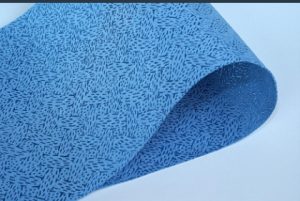
Nonwoven Wipers (Cellulose + Polyester, Hydroentangled)
Nonwoven construction provides high absorbency at lower cost. The manufacturing process creates a sheet structure from entangled fibers rather than woven or knitted yarn.
- Best for: Large-area wiping, pre-cleaning, non-critical zones, high-temperature surfaces, bulk contamination removal
- Strengths: High absorbency, economical at scale, good for heavy-duty bulk cleaning tasks
- Limitations: Higher particle shedding than knitted wipers; not suitable for ISO 1–5 critical environments
Wiper Textures, Forms, and Sizes
Texture Patterns
The weave or knit pattern of a wiper affects its cleaning performance, strength, and surface compatibility:
| Texture | Description | Best For |
|---|---|---|
| Straight knit | Uniform parallel fibers in a circular or warp-knit pattern | General cleaning, lint-sensitive environments |
| Mesh weave | Open grid pattern with visible gaps between fibers | Scrubbing tasks, adhesive removal, where drainage matters |
| Twill weave | Diagonal fiber pattern creating a diagonal rib texture | Balanced strength and softness, general-purpose wiping |
| Random entanglement | Non-directional fiber arrangement in nonwoven sheets | High absorbency, bulk cleaning, economical large-area use |
Common Forms
Wipers come in several dispenser formats, each suited to different operational needs:
- Single sheets — individual wipers packaged in a bag or sealed box
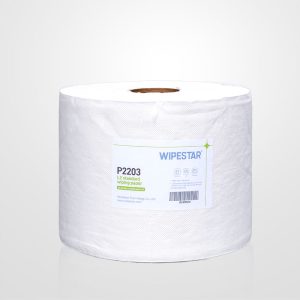
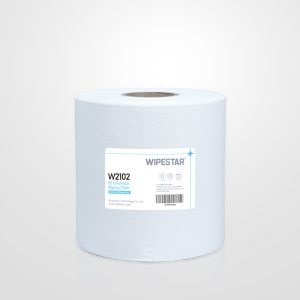
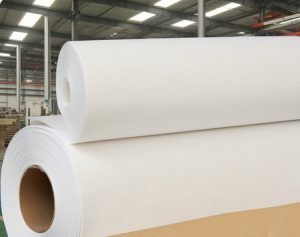
- Perforated roll (jumbo roll) — continuous sheet with tear-off perforations; ideal for automated lines or high-volume use
- Centerfeed roll — pull-from-center dispenser format that reduces contamination risk during dispensing
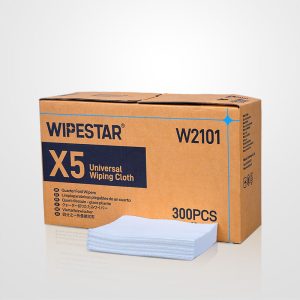
- Quarter-fold (1/4 fold) — pre-folded for one-hand dispensing; each fold exposes a fresh clean surface
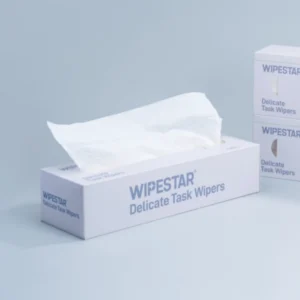
- Brag box (pop-up box) — stacked sheets in a rigid pop-up dispenser; most common format in cleanrooms
Standard Sizes
| Size (inches) | Metric | Common Application |
|---|---|---|
| 4″ × 4″ | 10 × 10 cm | Small components, swab replacement, precision parts |
| 6″ × 6″ | 15 × 15 cm | Medium equipment, hand wiping, instrument cleaning |
| 9″ × 9″ | 23 × 23 cm | Most popular — general surface cleaning, industry standard |
| 12″ × 12″ | 30 × 30 cm | Large surfaces, workstations, equipment wipe-down |
The 9″ × 9″ (approximately 23 cm × 23 cm) is the industry standard for general cleanroom use. It folds comfortably in the hand and provides the optimal balance of cleaning surface area and maneuverability per wipe. For more guidance on selecting the right size for your application, see our cleanroom wipers for medical device manufacturing guide.
Edge Sealing Processes: Which Matters and Why
How a wiper is cut and sealed at the edges directly affects particle generation during use. An improperly sealed edge releases fibers every time you wipe — contaminating the very surface you’re trying to clean. This is the detail most procurement specifications miss.
| Process | Seal Quality | Particle Release | Cost | Best Use |
|---|---|---|---|---|
| Cold cut | ❌ None | High | Lowest | Non-critical environments only — edges fray badly |
| Laser cut | ⚠️ Moderate | Medium | Low | Economy applications — edges may yellow over time |
| Heat cut | ✅ Good | Low | Medium | ISO 6–8 environments, general use |
| Narrow ultrasonic seal | ✅✅ Very good | Very low | Higher | ISO 4–5 environments — best cost-to-quality ratio |
| Wide ultrasonic seal | ✅✅✅ Excellent | Minimal | Highest | ISO 1–3 critical environments — maximum edge protection |
Practical recommendation: For ISO 5 and cleaner environments, always specify ultrasonically sealed wipers. The extra cost per sheet is trivial compared to the cost of a contamination event. For ISO 6–8 controlled areas, heat-sealed wipers are typically sufficient and represent the best value. If you’re not sure what edge sealing method a product uses, ask the manufacturer — if they can’t tell you, that’s a red flag.
Performance Testing: What the Specs Actually Mean
When evaluating cleanroom wipers, you’ll encounter technical specifications that can look like alphabet soup. Here’s a plain-language guide to what each test measures and why it should matter to you:
| Test | What It Measures | Why It Matters |
|---|---|---|
| APC — Airborne Particle Count | Particles released into air during simulated use | Determines if the wiper is clean enough for your ISO class |
| LPC — Liquid Particle Count | Particles released when wiper is immersed in liquid | Critical for wet-wiping and solvent application processes |
| NVR — Non-Volatile Residue | Residue remaining after solvent evaporation | Residue on surfaces can interfere with coating, bonding, and assembly processes |
| FTIR — Fourier Transform Infrared | Identifies organic compounds (silicone, plasticizers, oils) | Silicone contamination destroys semiconductor wafer yields — this test catches it |
| IC — Ion Chromatography | Concentration of anions and cations (chlorides, sulfates, etc.) | Ionic contamination corrodes metal surfaces and affects semiconductor processes |
| GSM — grams per square meter | Wiper weight per unit area | Heavier = more absorbent, but also more expensive and less economical at scale |
| Absorbency Capacity | Maximum liquid held per wiper (per IEST-RP-CC004.4:2019) | Determines how much spill a single wiper can handle before saturation |
| Absorbency Rate | Speed of liquid uptake (per IEST-RP-CC004.4:2019) | Fast absorption means fewer passes needed, reducing process time |
Key takeaway: Don’t evaluate wipers by price per sheet alone. A cheaper wiper with higher LPC and NVR values costs more in process rework, rejected batches, and cleaning validation failures. Always request the manufacturer’s test data and match it against your ISO class requirements before making a purchasing decision.
How to Choose the Right Wiper for Your Application
By Contamination Type
| Contamination | Best Wiper Type | Why |
|---|---|---|
| Oil and fingerprints | Microfiber > Sub-microfiber | Split fibers create maximum surface contact for oil pickup |
| Adhesive residue | Woven > Polyester (mesh) | Needs abrasion resistance and high tensile strength |
| General dust and particles | Polyester | Inherently clean, cost-effective for particle removal |
| Solvent residue | Sub-microfiber > Polyester | Fine fibers absorb residue more effectively per pass |
| Heavy liquid spills | Nonwoven | Highest absorbency for bulk liquid removal |
By Cleanroom Class
| ISO Class | Recommended Wiper | Edge Treatment |
|---|---|---|
| ISO 1–3 | Ultramicrofiber, ultrasonically sealed | Wide ultrasonic seal |
| ISO 4–5 | Polyester or microfiber, ultrasonically sealed | Narrow or wide ultrasonic |
| ISO 6–7 | Polyester, heat-sealed or ultrasonic | Heat cut or narrow ultrasonic |
| ISO 8 | Nonwoven or polyester | Heat cut acceptable |
By Industry Requirement
| Industry | Key Requirement | Recommended Wiper |
|---|---|---|
| Semiconductor | Silicone-free, low particles | Polyester or microfiber, ESD-safe |
| Pharmaceutical | Sterile, low endotoxin | Gamma-irradiated polyester |
| Biopharma | Sterile + low extractables | Sterile polyester, validated packaging |
| PCB / SMT Assembly | Solvent compatible, durable | Polyester or sub-microfiber |
| Aerospace | Precision cleaning, traceable | Microfiber, certified lot-tracked |
| Food Processing | FDA-compliant, lint-free | Nonwoven or polyester |
For a detailed comparison across all major cleanroom wiper materials, download our cleanroom wipers selection guide for medical device manufacturing, which includes material-by-material breakdowns and application decision trees.
Cleanroom Wiper Usage Techniques for Newcomers
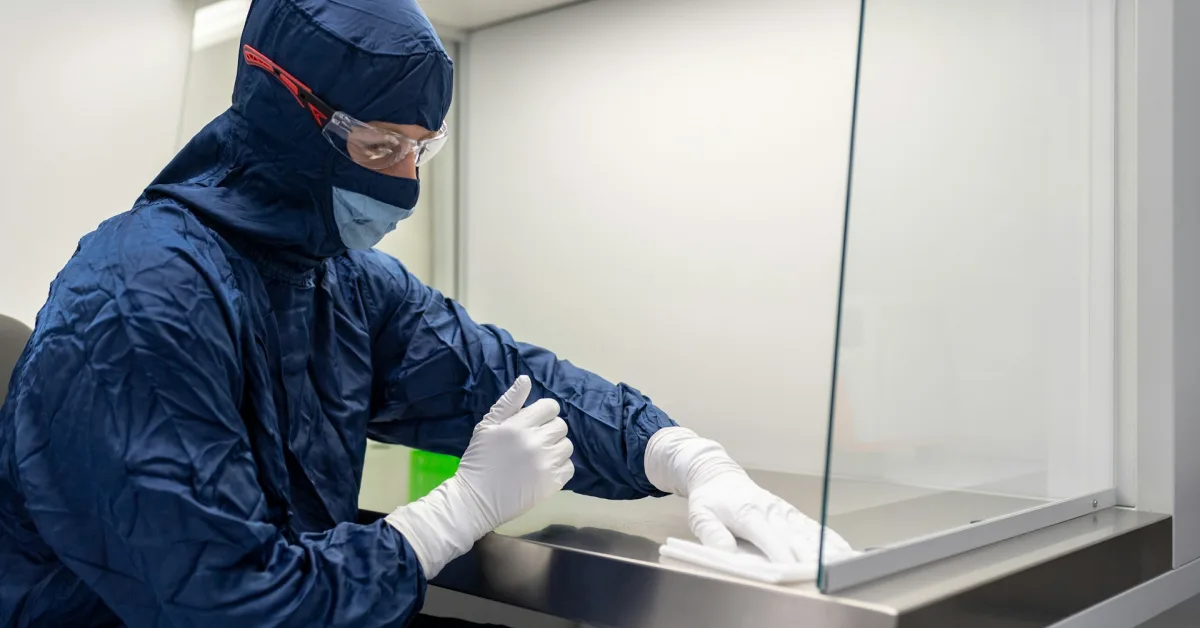
Using the right technique is as important as choosing the right wiper. I’ve seen facilities invest in premium ultrasonically sealed wipers, then undermine the whole investment with poor wiping technique. Here’s how to do it properly:
The IEST Quarter-Fold Method
The Institute of Environmental Sciences and Technology (IEST) recommends a standard folding protocol that maximizes the number of clean surfaces available from a single wiper:
- Lay the wiper flat on a clean, gloved surface
- Fold in half (left to right) — you now have 2 clean outer surfaces
- Fold in half again (top to bottom) — you now have 4 clean outer surfaces
- Flip the folded wiper over — you now have 8 usable surfaces total
Each surface is used once and discarded. This isn’t about economy — it’s about contamination control. Every time you wipe and flip, you’re using a fresh, uncontaminated surface.
Wiping Technique — Six Rules
- Start clean, move dirty. Always wipe from the cleanest area toward the dirtiest — never the reverse
- Apply consistent, gentle pressure. Pressing harder doesn’t clean better; it generates more particles and can damage delicate surfaces
- Use parallel, overlapping strokes. Cover the surface systematically in one direction — don’t skip areas or use random circular motions
- Switch folds after each pass. Never re-wipe with a contaminated surface — flip to a fresh fold every time
- Wipe in one direction. Avoid back-and-forth scrubbing motions, which redistribute contamination instead of removing it
- Dispose immediately. Used wipers go straight to the waste container — never set them down on clean or in-process surfaces
Dry vs. Pre-Saturated Wipers
| Type | Best For | Advantages |
|---|---|---|
| Dry wipers | Quick spills, pre-cleaning, solvent application | Versatile, longer shelf life, lower cost per sheet, user controls saturation level |
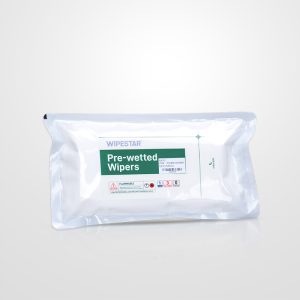
| Pre-saturated wipers | High-frequency cleaning, consistent results, solvent precision | Ready to use, eliminates solvent handling hazards, consistent saturation every time |
Pre-saturated wipers are particularly valuable in pharmaceutical environments where precise solvent concentration matters for cleaning validation. Inconsistently applied solvent (too wet or too dry) can affect the outcome of surface bioburden tests.
Cleanroom Wipes for Pharmaceutical and Sterile Environments
Pharmaceutical cleanrooms have requirements that go well beyond what most industrial cleanrooms demand. In sterile drug production, a wiper isn’t just a cleaning tool — it’s a critical component of your contamination control strategy, and regulators will hold you to that.
Controlled Areas vs. Critical Areas
| Zone | ISO Class | Typical Tasks | Wiper Requirement |
|---|---|---|---|
| Controlled area | ISO 8 | Container handling, packaging, labeling, environmental monitoring | Standard cleanroom wiper |
| Critical area | ISO 5 | Sterilization loading, aseptic filling, disinfection of Grade A surfaces | Sterile, low-endotoxin wiper with validated sterility |
Sterility Requirements for Pharmaceutical Wipers
Wipers used in sterile environments must meet these criteria without exception:
- Sterility Assurance Level (SAL): 10⁻⁶ — meaning fewer than 1 in 1,000,000 wipers may be non-sterile
- Low endotoxin levels: Endotoxins from bacterial cell wall fragments can cause pyrogenic (fever) reactions in patients receiving injectable drugs
- Low extractable particles: Chemicals leaching from the wiper matrix can contaminate drug products and interfere with analytical methods
- Validated packaging: Sealed packaging that maintains sterility from sterilization through gamma irradiation to point of use in the cleanroom
Gamma Irradiation: The Preferred Sterilization Method
Gamma irradiation is the preferred sterilization method for cleanroom wipers because it offers several practical advantages over heat sterilization or ethylene oxide (EtO) gas:
- Fast and efficient — no heat damage to wiper material integrity
- No chemical residue left behind (unlike EtO, which requires aeration time)
- Better at reducing endotoxin levels than electron beam (e-beam) sterilization
- Penetrates sealed packaging completely, maintaining sterility through the entire distribution chain
Each shipment of sterile wipers should include a compliance certificate documenting sterilization date, batch number, dose delivered, and sterility validation data per ISO 11137.
The Aseptic Media Fill Test
Pharmaceutical facilities validate their aseptic manufacturing process through media fill tests — filling sterile containers with microbial growth medium to fully simulate production conditions. The FDA and EU GMP guidelines allow a maximum of 1 contaminated unit per 5,000 tested for conventional aseptic processing. Your choice of wiper — and how it’s used — directly impacts whether you pass or fail this twice-yearly validation.
Facilities that have experienced media fill failures often trace the root cause to inadequate cleaning procedures, including the use of non-sterile or inappropriate wiping materials in critical areas.
Need a GMP-compliant sterile wiper? Browse WIPESTAR’s sterile wiper product line →
WIPESTAR Cleanroom Wiper Product Series
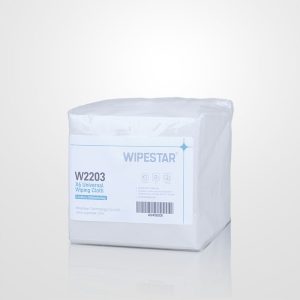
WIPESTAR manufactures a complete range of cleanroom wipers engineered to meet different application requirements and cleanliness levels. Here’s a direct comparison to help you specify the right product:
Polyester Cleanroom Wipers
Material: 100% polyester knit
Best for: PCB assembly, digital printing, equipment maintenance, initial surface cleaning
Key advantage: High cleanliness performance at competitive pricing — the default choice for most semiconductor and electronics applications
Sub-Microfiber Cleanroom Wipers
Material: Fine-denier 100% polyester knit
Best for: Touchscreens, LCD panels, camera lenses, precision metal parts
Key advantage: Softer surface than standard polyester, superior particle removal on scratch-sensitive components
Microfiber Cleanroom Wipers
Material: 80% polyester / 20% nylon knit
Best for: Optical components, fingerprint removal, precision instruments
Key advantage: Split-fiber technology delivers superior oil and film removal — fewer passes, better results
Woven Cleanroom Wipers
Material: 80% polyester / 20% nylon woven
Best for: Adhesive removal, LCD COG processes, scrubbing applications
Key advantage: High tensile strength in both directions — resists deformation under aggressive scrubbing
ESD (Anti-Static) Cleanroom Wipers
Material: 99% polyester / 1% conductive fiber
Best for: Semiconductor, LED manufacturing, ESD-sensitive environments
Key advantage: Static charge dissipation without sacrificing cleanliness performance
Roll Cleanroom Wipers
Material: 80% polyester / 20% nylon woven
Best for: Automated cleaning machines, LCD module terminals, wafer processing lines
Key advantage: Continuous roll format compatible with inline cleaning equipment
Browse the full WIPESTAR cleanroom wiper product catalog → with full specifications, test data sheets, and pricing for volume orders.
Industries That Rely on Cleanroom Wipers
Cleanroom wipers are essential across a surprisingly wide range of industries — anywhere that contamination control directly impacts product quality, safety, patient outcomes, or yield. Here’s a snapshot of where cleanroom wipers are non-negotiable:
🏭 Semiconductor & Microelectronics
Wafer fabrication, chip packaging, LED and OLED display manufacturing. Particle contamination at sub-micron scale directly determines yield — every wiper decision is a yield decision.
💊 Biopharmaceutical & Vaccine Manufacturing
Sterile drug production, vaccine fill-finish, biotech research labs. Aseptic process validation requires sterile, low-endotoxin wipers with full traceability.
🏥 Medical Devices
Implantable device assembly, surgical instrument cleaning, diagnostic equipment maintenance. FDA 21 CFR Part 820 requires documented contamination control procedures.
✈️ Aerospace & Defense
Satellite components, precision optics, avionics systems. Contamination on optical sensors can cause mission failure. Lot traceability and certification are mandatory.
📱 PCB / SMT Assembly
Circuit board cleaning, solder paste removal, stencil wiping, post-reflow cleaning. Consistent, low-residue wipers reduce rework rates on high-value assemblies.
🔬 Optoelectronics & Precision Optics
Fiber optic connectors, laser components, display panels. Fingerprint and oil contamination on optical surfaces degrades performance measurably.
For industry-specific selection guidance, see our cleanroom wipers for medical device manufacturing guide and food processing cleaning wipes guide.
Frequently Asked Questions
Ready to Specify the Right Cleanroom Wipers?
WIPESTAR offers a complete range of cleanroom wipers from standard polyester to sterile gamma-irradiated options, with full test data sheets and technical support for your validation process.
Last updated: April 27, 2026 · Published by WIPESTAR