English
 Chinese



The complaint was not a complaint. It was three operators in a Grade B change room saying the new masks felt “hot,” and one supervisor noticing, over two weeks, that people were pulling them down under the chin between interventions to catch a breath.
That site makes vaccine filling media fills once a quarter, and it had just approved a lower-cost sterile mask on the strength of one number: bacterial filtration efficiency. BFE was excellent. Everything else was unexamined, and the purchased mask turned out to have a much higher differential pressure than the previous SKU — meaning it was harder to breathe through. Operators solved that problem themselves, in the way operators do, by wearing the mask incorrectly. The media fill passed, narrowly, and the site now specifies breathability in the purchase order.
Face mask selection is three specifications, not one: what it filters, how hard it is to breathe through, and whether it stays on the face through a full intervention. Most buying decisions cover the first and skip the other two. This guide covers all three, with the data that should appear on a spec sheet before a sterile mask is qualified for an aseptic suite.
Three Jobs, Three Numbers
A sterile face mask worn in a Grade A/B environment has to do three things at once, and each has its own measurement:
- Filter what the wearer exhales. That is bacterial filtration efficiency (BFE) and particle filtration efficiency (PFE). It is the number everyone buys on, and it is the one most masks pass.
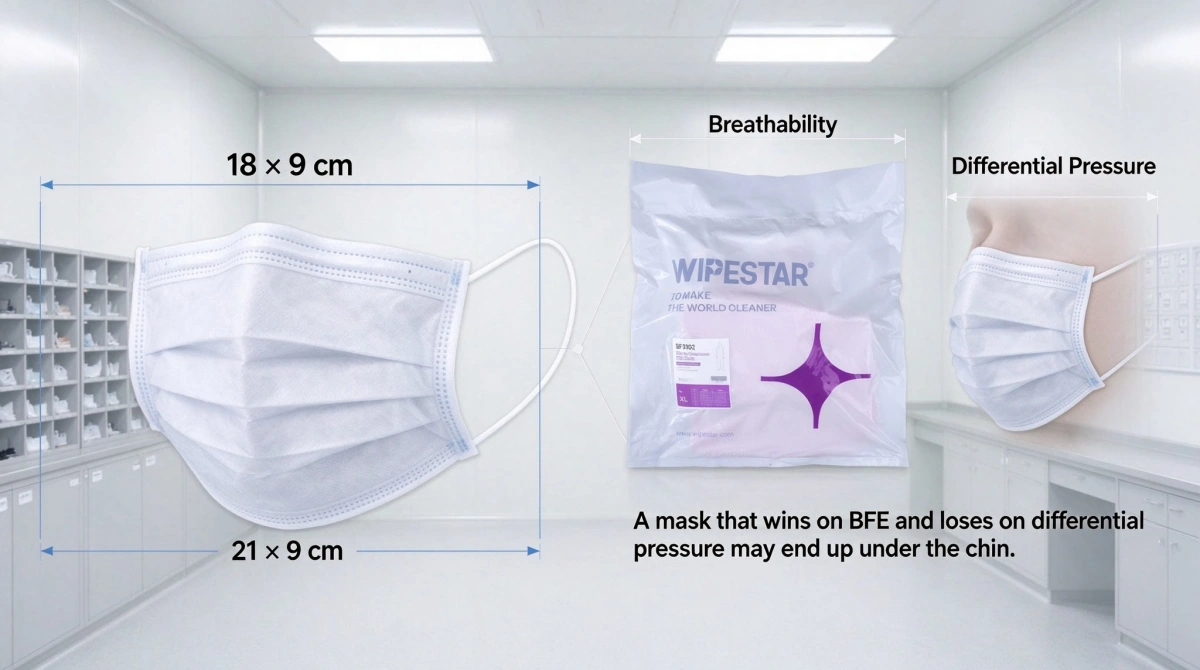
- Let the wearer breathe. That is differential pressure (ΔP) — the resistance of the mask to airflow. It is almost never in the purchasing spec, and it is the number that decides whether operators keep the mask on for hour six of a shift.
- Stay where it was put. That is fit: size, fastening style and coverage of the chin and jaw line through head movement. Fit is not a label on the box; it is what your own staff look like after four hours.
The three pull against each other. Higher filtration usually means tighter media, which raises ΔP. A very breathable mask can be breathable because the media is thin, which may reduce filtration. Qualification is the exercise of finding the point where all three are acceptable for your room — and then writing that point into the specification so the next purchase order cannot drift away from it.
BFE, PFE and Differential Pressure
When you ask a supplier for mask data, these are the figures that should come back together:
| Metric | What It Measures | Typical Units | Why It Matters in a Cleanroom |
|---|---|---|---|
| BFE | Percentage of bacteria-sized aerosol retained by the media | % at a defined challenge | Directly limits the oral flora a wearer can shed toward an open product |
| PFE | Percentage of sub-micron particles retained | % at 0.1 micron | Particles are often the carrier; PFE is the finer-grained view of the same barrier |
| ΔP (differential pressure) | Resistance to airflow through the mask | mmH₂O/cm² or Pa/cm² | The breathability number — high ΔP is why operators pull masks down mid-shift |
| Splash resistance | Resistance to liquid penetration at pressure | mmHg | Relevant where liquids are handled near the face, and required at higher protection levels |
Ask also for the test method behind each figure. BFE, PFE and ΔP are defined by the standard the mask claims to meet, and a number without a method is a marketing claim. Two suppliers can both quote “99% BFE” while measuring different things at different challenge levels.
ASTM F2100 and EN 14683: What the Levels Mean
The two standards you will meet in international procurement are ASTM F2100 (US) and EN 14683 (EU). They are not interchangeable, and a mask certified to one is not automatically compliant with the other.
ASTM F2100 sets three performance levels. At Level 1, BFE and PFE must each be at least 95%, with ΔP below 5.0 mmH₂O/cm² and splash resistance at 80 mmHg. Level 2 raises BFE and PFE to 98% and ΔP to below 6.0, with splash resistance at 120 mmHg. Level 3 keeps BFE and PFE at 98% and raises splash resistance to 160 mmHg, with the same ΔP ceiling. The pattern is useful: filtration and splash resistance rise across the levels, while breathability is allowed to degrade only slightly.
EN 14683 uses types rather than levels. Type I requires BFE of at least 95%; Type II requires 98%; Type IIR requires 98% plus splash resistance at 120 mmHg. Differential pressure limits are 40 Pa/cm² for Type I and II, and 60 Pa/cm² for Type IIR. EN 14683 also has an annex covering sterility, which is the part that matters here — a mask can be a compliant Type II and still not be a sterile product unless the sterility claim is made and validated.
For an aseptic suite, the practical requirement is a mask that is both sterile and rated at a filtration level your contamination control strategy accepts. In most cases that means Type IIR or ASTM Level 2/3, with ΔP verified against your own comfort threshold — not the standard’s ceiling.
The Five Formats and Where They Fit
WIPESTAR’s sterile face mask range covers five models across two sizes. The size difference is not cosmetic — it decides coverage on different face shapes, and it is the specification most often left to “whatever was in the store room.”
| Model | Size | Where It Fits | Notes for Qualification |
|---|---|---|---|
| SF1302 | 21 × 9 cm | Grade A/B interventions where chin and jaw coverage must hold through head movement | Broader coverage; confirm fastening style and ΔP on the spec sheet before the SOP is written |
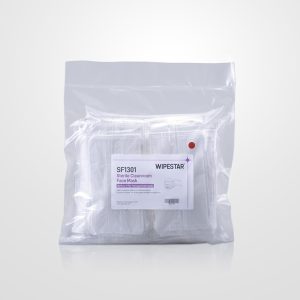
| SF1301 | 18 × 9 cm | Smaller face shapes and outer Grade C/D zones | Same construction family, narrower coverage — verify it holds the chin line on your staff |
| SF1202 | 21 × 9 cm | General aseptic and support-area use | Compare ΔP against the SF1302 when both are stocked — two “21 × 9” masks can feel very different |
| SF1201 | 18 × 9 cm | Support zones and shorter-duration tasks | Useful where a full-coverage format is over-specified, but keep the SKU separated by zone |
| SF1101 | 18 × 9 cm | Routine Grade C/D gowning | Confirm sterile claim and packaging before it goes anywhere near a Grade A transfer |
A stockroom carrying all five models is a stockroom with five different fit profiles and no rule about which goes where. Two is usually right: a full-coverage model for the critical zones, and one narrower model for support areas, each written into the zone SOP by part number.
Fit, Facial Hair and the Donning Sequence
Facial hair is the part of mask performance that no filter media can fix. A beard or heavy stubble at the mask edge creates a leak path that bypasses the media entirely, and no BFE number applies to air that never went through the mask. Where facial hair is permitted, the mask selection has to be paired with a beard cover, and the cover has to go on before the mask, not after.
The donning sequence matters too, and it is the step most easily broken by a well-meaning supervisor. The mask goes on before the hood, so the hood contains the mask’s fastening rather than the mask sitting on top of the hood fabric and being tugged into place afterward. Gloves go on last, after the mask, because a gloved hand adjusting a mask strap is a gloved hand that then touches product tooling.
Two checks belong in the gowning qualification, not in the training slides: the operator should be able to turn their head fully left and right without the mask lifting at the chin, and to speak a full sentence without the mask shifting upward toward the eyes. Both are easy to observe at the mirror, and both predict what happens during a two-hour intervention.
Change Frequency and Packaging Discipline
One mask per entry, and a new one after any break that involves leaving the classified area. A mask that has become damp — from speech, from breathing through a high-ΔP media, or from a humid room — loses its filtration performance and its shape at the same time. “It’s still on my face” is not a criterion for continuing to wear it.
Packaging is part of the specification. Sterile masks should arrive individually wrapped or in a pack whose inner bag is opened only at the point of use, so the stack is not exposed to the room before each mask is taken. A bulk bag of sterile masks opened at the start of a shift is a bulk bag of masks that stops being sterile the moment the seal is broken. If the outer bag is removed at the transfer boundary and the inner opened at the mirror, the packaging did its job.
None of this is exotic. It is simply the difference between buying a mask and qualifying one.
Who You’ll Work With at WIPESTAR
We manufacture sterile masks and the rest of the aseptic consumable set — so the conversation can cover filtration data, packaging format and the gowning SOP in one sitting.

Carolina — Product Specialist
Carolina pulls the filtration and differential-pressure data for each mask model and checks it against what your team will actually wear for four hours — the number on the box and the experience at the mirror are two different tests.

Ethan — Sales Director
Ethan has over 20 years in industrial wiping and cleanroom consumables — he writes the supply agreements that lock a qualified mask part number in place so a procurement substitution cannot quietly change what your operators breathe through.

Daisy — Sales Support
Daisy keeps mask orders and lot documentation moving — the certificate that belongs with a qualified lot arrives with the shipment because she tracks it, not because someone asks later.
Get Started with Sterile Face Masks
Send us your gowning SOP and the room grades you staff, and we will return two or three mask models with BFE, PFE, ΔP and packaging details so your team can run a real fit trial before committing to a stockroom list.
- SF1302 Sterile Face Masks — 21 × 9 cm, full coverage for Grade A/B.
- SF1301 Sterile Face Masks — 18 × 9 cm for smaller faces and support zones.
- Request a Technical Consultation — send the SOP; we will match masks to zones.
Browse Sterile Face Masks → Request a Custom Quote
Frequently Asked Questions