English
 Chinese



The defect showed up at end-of-line functional test: intermittent sensor resets, one or two modules per shift, nothing visible under the microscope. An automotive camera module plant I visited last winter blamed the IC supplier first, then the reflow profile, then the conformal coating. Eleven weeks of quarantine and retest later, an ESD engineer walked the line with a field meter and stopped at the cleaning station — the one where operators swabbed FPC connector sockets before lamination. When an operator pulled a standard foam swab from its tube and wiped a dry socket, the polypropylene handle read a field just over 2 kV.
The modules weren’t failing because of dirt. They were failing because every socket cleaning was a small, unmeasured discharge event.
The fix was underwhelming to look at: a box of ESD-safe cleanroom swabs with static-dissipative stems, a grounded mat refresh, and a line in the ESD control program naming the swab as a controlled item. Defects dropped to near zero within a month. One box of swabs cost less than a single quarantined shift.
That’s the gap this guide closes. Manual cleaning is one of the last uncontrolled static events inside most EPA (ESD protected areas) — because the swab is an insulative plastic wand that a person rubs against a sensitive assembly, dozens of times per shift, and almost no ESD program lists it.
Why Ordinary Swabs Charge: The Triboelectric Problem
Static builds whenever two dissimilar materials touch and separate. A swab multiplies that three ways before it ever reaches your part: the handle slides against the packaging tube when pulled (charging the wand), the tip rubs across a dry surface (transferring charge), and the whole assembly is held by an operator whose wrist strap may or may not be doing its job that day.
Standard polypropylene handles are insulative — they hold whatever charge they pick up instead of bleeding it. The failure mode that catches electronics assemblers follows the charged-device model (CDM): the charged swab handle passes close to an exposed pin or connector, and the discharge happens through the part, not through the air. Damage can be latent — the module passes test and fails in the field, which is exactly the intermittent pattern the camera module plant spent eleven weeks chasing.
It’s worth separating the terms during any investigation. EOS (electrical overstress) comes from sustained overvoltage — a mis-set soldering iron, a leaky supply. ESD is the rapid arc. A swab points at ESD, and the signature is the same one the plant saw: no visual residue, scattered failures, and a root cause that hides until someone measures the cleaning station itself.
What “ESD-Safe Swab” Actually Specifies
The label means three concrete things, and a buyer should check all three rather than take the box artwork’s word for it.
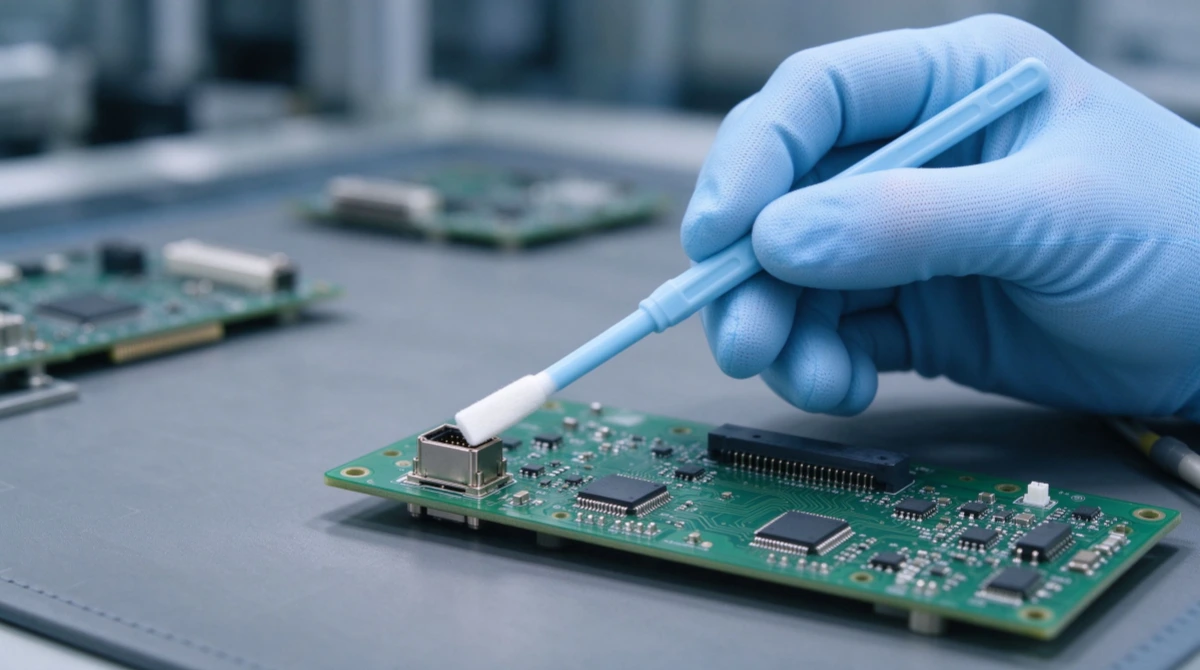
A dissipative handle. The stem material sits in the static-dissipative range — not conductive (which could short exposed traces), not insulative (which stores charge). When the operator’s grounded hand grips the handle, any charge bleeds away through the contact instead of waiting for a pin to discharge it into. Surface resistance is verified with a proper measurement method — ANSI/ESD STM11.11 is the standard most suppliers cite — and that data belongs on the spec sheet, not in a brochure claim.
A low-lint tip that suits the surface. ESD safety doesn’t excuse contamination. The WEPS740 pairs its dissipative stem with a polyester tip, which keeps fiber release low around connectors and optics. The ESD rating and the tip cleanliness are separate specs; a swab can pass one and fail the other.
Program-level recognition. ANSI/ESD S20.20 and IEC 61340-5-1 both work on the same principle: every item that enters the EPA is either grounded, dissipative, or documented as harmless. Listing the swab SKU in the ESD control program — with its resistance data — is what turns “we bought ESD swabs” into an auditable control.
The Swab Lineup by Zone Sensitivity
Not every cleaning task on an electronics floor happens inside the EPA, and over-specifying wastes budget just as under-specifying invites risk. A workable split:
| Zone / Task | Swab | Why This One |
|---|---|---|
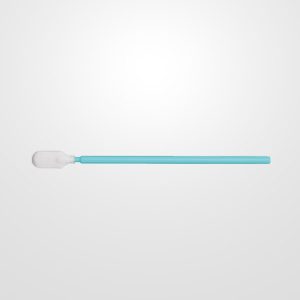
| Inside the EPA: connectors, sockets, sensor packages, powered subassemblies | WEPS740 ESD Swab (polyester tip, 160–180mm) | Dissipative stem + long reach for recessed connectors; the only format that belongs near exposed pins |
| EPA boundary work: housings, fixtures, carriers that touch sensitive parts | WPS741 Polyester Swab (80–100mm) | Low-lint polyester tip for detail work where static is managed by other means; small head for tight features |
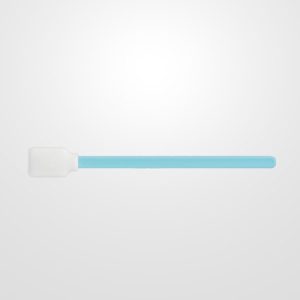
| Outside the EPA: benches, enclosures, general fixture cleaning | WFS707 Foam Swab (120–140mm) | The economical general-purpose foam workhorse — no dissipative premium where no sensitive parts live |
| Full range browsing | Cleanroom swabs catalog | All tip materials and sizes in one place, with spec sheets per model |
Station Practices That Make the Swab Safe
A dissipative swab can’t rescue a bad station, and a good station doesn’t need heroics. Four habits cover most of it:
- Ground the grip. The dissipative stem bleeds charge through contact with a grounded hand — wrist strap on, tested, and actually plugged in. A dissipative wand in a floating hand stores charge exactly like an insulative one.
- Briefly ground the handle after pulling it from the tube. One touch to the grounded mat before wiping discharges whatever the packaging friction built. It costs a second per swab.
- Wet where the surface allows. Dry rubbing charges fastest. Where the process permits a solvent-wetted swab, tribocharging drops sharply. Dry wipes on dry plastic are the worst combination on any line.
- Spot-check with a field meter. Add the cleaning station to the periodic verification route. When the swab SKU changes — by choice or by a buyer’s “equivalent” substitution — the reading is what catches it, not the part number on the box.
Who You’ll Work With at WIPESTAR
We build swabs for electronics floors where a static event and a lint event look identical at final test — so the recommendation starts with your EPA boundaries and ends with the right stem and tip for each station.

Carolina — Product Specialist
Carolina runs the material-side verification for ESD swabs — surface-resistance data, tip fiber release and solvent compatibility — so the SKU that enters your EPA is backed by test results, not box artwork.

Ethan — Sales Director
Ethan has over 20 years in industrial wiping and cleanroom consumables — he structures supply agreements so the ESD-listed swab SKU never silently changes on a qualified line.

Zac — Customer Service
Zac handles samples, quotes and spec-sheet requests — ask him for the surface-resistance data and lot documentation before your next ESD audit, not after.
Get Started with ESD-Safe Swabs
Whether you’re closing an ESD audit finding, qualifying consumables for a new EPA, or standardizing swab SKUs across lines, we can supply samples with resistance data and lot documentation.
- WEPS740 ESD Swabs — dissipative stem, low-lint polyester tip, 160–180mm reach.
- WPS741 Polyester Swabs — precision detail at the EPA boundary.
- Request a Technical Consultation — send your line map; we’ll assign swabs by zone.
Browse Cleanroom Swabs → Request a Custom Quote
Frequently Asked Questions