English
 Chinese



A commercial laundry in Dubai—processing about 40 tons of hotel linen daily—had a problem that drove the operations manager crazy. Wash formulas were dialed in. Water quality tested weekly. Mechanical action on the tunnel washers within spec. Chemical supplier just did their quarterly audit. Everything checked out.
Yet the rewash rate kept creeping up. 3%, sometimes 4%. Oily smears and grey marks on supposedly clean white hotel sheets, and nobody could figure out where they were coming from.
They tested everything. Water chemistry, chemical dosing, extractors, dryer temperatures. Nothing.
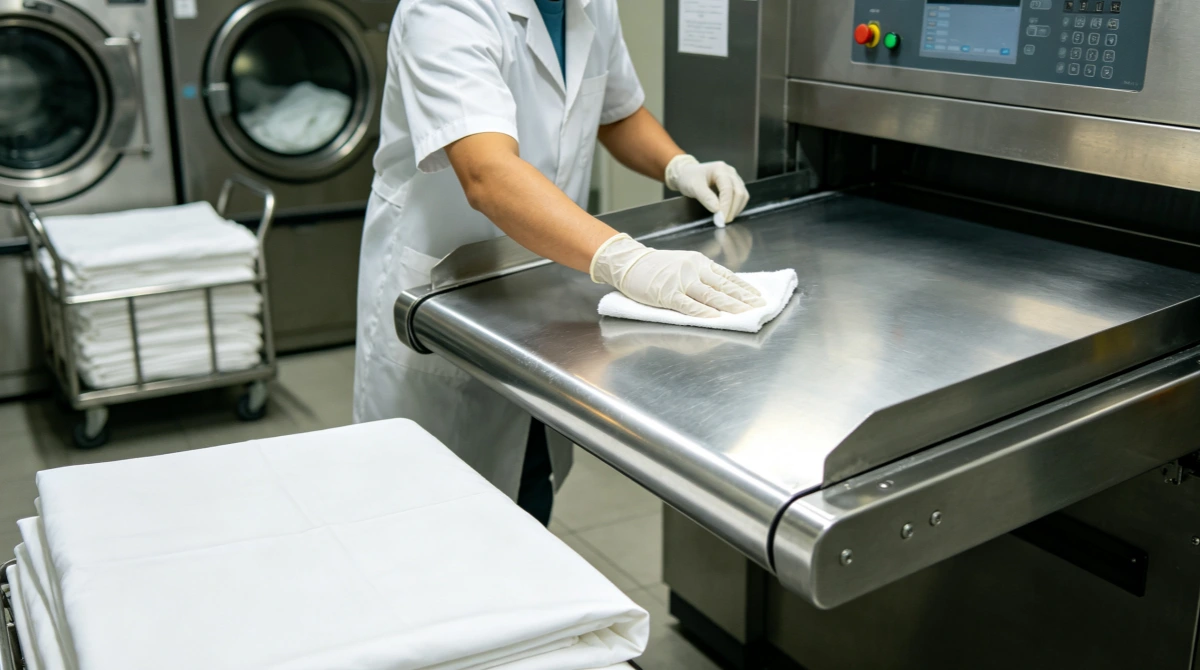
The answer came during a shift change when the ops manager watched the maintenance crew wipe down a flatwork ironer with generic industrial rags from the general supply closet. Those rags were transferring oil residue and fiber fragments to the ironer chest. The next batch of clean white sheets picked it all up.
One switch to lint-free, chemical-resistant wipes dedicated to the finishing equipment, and the rewash problem disappeared. Completely. The operations manager told me he’d spent three months chasing a problem that a $150/month consumable change would have fixed on day one.
That story captures something I see in commercial laundries everywhere—the industry that cleans for a living often overlooks its own equipment cleaning. And in a laundry, the consequences show up immediately on your finished product.
This guide is for laundry operations managers, hotel engineering teams, and healthcare textile processing supervisors. We’ll cover wipe selection for every area of your facility, the chemistry your consumables need to survive, lint control that actually works, and the healthcare standards that layer on top of everything else.
The Laundry Environment: Tougher on Consumables Than You’d Think
Most people don’t realize how aggressive the commercial laundry environment is on materials. A typical hotel laundry running two shifts processes 10,000–50,000 pounds of linen per day. The wash chemistry includes caustic soda (NaOH) at 2–4 g/L for heavy soil loads, sodium hypochlorite at 100–200 ppm for stain removal, hydrogen peroxide for brightening, plus optical brighteners, fabric softeners, and starch.
The finishing equipment—flatwork ironers, presses, dryers—runs with surface temperatures between 150°C and 200°C. The air is hot, humid, and saturated with chemical aerosols.
That combination destroys consumables that aren’t designed for it. A wipe that handles room-temperature cleaning just fine will melt, degrade, or fall apart on a 180°C ironer chest. A wipe compatible with dilute bleach will disintegrate when it contacts concentrated alkali residue on a press platen.
And—this is the part that causes rewash—a wipe that sheds fibers onto finishing equipment transfers those fibers directly to the next batch of clean linen. You’ve just turned your cleaning consumable into a contamination source.
Facility Areas and Their Wipe Requirements
Not every part of a laundry facility has the same wipe requirements. The wash floor is dirty, wet, and chemically aggressive. The finishing department is the clean side where contamination has direct consequences. Housekeeping operates more like a hotel. Here’s the breakdown:
Wash Floor
This is the gritty end of the operation. Tunnel washers, extractors, chemical dosing systems, conveyors—they all need regular wipe-down. The environment is wet, hot, and saturated with chemical aerosols.
Your wipes need chemical resistance to bleach, alkali, and acid at wash concentrations, plus high absorbency for water and chemical spills. Honestly, the cleanliness of the wipe itself matters less here—the environment is dirty enough that a general-purpose synthetic wipe does the job. Focus on chemical resistance and durability under heavy soiling.
Finishing Department — Where It Matters Most
Finishing is where clean linen meets the equipment that irons, presses, and folds it. Press platens, ironer chest surfaces, feed rolls, folder belts—every surface that contacts clean linen must be spotlessly clean. Any residue, any fiber, any chemical film transfers directly to your finished product.
This is the area where your wipe choice has the highest consequence. What you need: lint-free construction (fiber transfer to white linen is a rewash), chemical residue-free performance (softener and starch residue on press surfaces causes staining on the next batch), and heat resistance at your actual operating temperature.
Ironer surfaces run 150–200°C; press platens 120–180°C. Verify the wipe survives at your temperature, not just the spec sheet number.
Hotel Housekeeping
Housekeeping uses wipes for bathroom cleaning, surface sanitation, glass cleaning, and general room maintenance. The requirements are similar to commercial cleaning: food-contact compliance for minibar surfaces, disinfectant compatibility for bathroom work, lint-free performance for mirrors and glass.
Individually packaged wipes are preferred for hygiene assurance—you don’t want a bulk bin of open rags sitting in a housekeeping cart.
Healthcare Textile Processing
Healthcare laundries that process surgical gowns, drapes, and patient linens operate under infection control standards that go well beyond hotel laundry. More on this in its own section below—it’s a significant topic.
| Facility Area | Primary Contamination | Recommended Wipe Type | Key Requirement | Storage Rule |
|---|---|---|---|---|
| Wash floor | Bleach, alkali, water, chemical spills | General-purpose synthetic (polyester/polypropylene) | Chemical resistance, high absorbency | Enclosed cabinet, away from finishing wipes |
| Finishing (presses, ironers) | Lint, chemical residue, softener film | Sealed-edge lint-free synthetic | Lint-free (<500 fibers/m²), heat-resistant (150–200°C) | Separate cabinet, white wipes only |
| Hotel housekeeping | General soil, biological contamination | Individually packaged synthetic | Food-contact compliant, disinfectant compatible | Clean enclosed storage in housekeeping carts |
| Healthcare textile processing | Bloodborne pathogens, MRSA, C. difficile | Low-bioburden sealed-edge synthetic | High-concentration disinfectant resistant, controlled TAMC | Separate storage for soiled vs. clean zone wipes |
Chemical Compatibility: Will Your Wipes Survive the Wash Formula?
Here’s a mistake I see constantly: facilities assume all wipes handle all chemicals. They don’t. And in a laundry environment, the chemicals are aggressive enough to degrade materials that work fine in other industries. Check this against your specific wash formulas:
| Chemical | Application | Safe Wipe Materials | Materials to Avoid |
|---|---|---|---|
| Sodium hypochlorite (bleach) | Stain removal, disinfection | Polyester, polypropylene | Cotton, cellulose — degrades rapidly |
| Caustic soda (NaOH) | Heavy soil wash, saponification | Polyester, polypropylene | Cellulose — degrades |
| Hydrogen peroxide (H₂O₂) | Brightening, sanitization | Most synthetic materials at use concentration | Generally safe for most materials |
| Acetic acid | Neutralization, sour rinse | Most materials at 1–3% use concentration | Generally safe at use concentration |
| Silicone softener | Fabric finishing | Most materials | Watch for silicone residue contaminating non-silicone surfaces |
Keeping Your Cleaning Wipes From Dirtying Clean Linen
Laundries generate enormous amounts of lint. That’s inherent to the process—washing and drying linen releases fiber fragments that accumulate on every surface in the facility. Inside dryers, on press platens, on ironer feed rolls, on folder belts. The lint load is constant and heavy.
Now add a cleaning wipe that sheds its own fibers into this environment. You’re not solving the lint problem. You’re adding to it. Those wipe fibers land on a press platen, and the next sheet of clean white hotel linen picks them up.
A single colored fiber on a white sheet is a rewash trigger—and in a high-volume operation, rewash costs add up fast. Some laundries report that lint-related rewash accounts for 60–70% of all rewash volume. That’s not a rounding error. That’s money walking out the door every shift.
Here’s what actually works for finishing equipment lint control:
Sealed-edge construction. Cut-edge wipes shed fibers from every cut edge. Those fibers transfer to press platens and ironer surfaces, then transfer to the next batch of clean linen. Sealed-edge wipes—laser-sealed or ultrasonic-sealed—eliminate fiber shedding at the edges. The incremental cost per wipe is small; the rewash savings are large.
Request lint test data. Ask your supplier for fiber count data per IEST-RP-CC004 or equivalent. For finishing equipment applications, target below 500 fibers per m². If your supplier can’t provide this data, that’s a red flag.
Color matters more than you’d think. Use white wipes on surfaces that contact white linen. A colored wipe fiber on a white hotel sheet is immediately visible and immediately a rewash. In white linen production areas, white-only wipes on all finishing equipment—no exceptions.
Healthcare Textile Processing: Where Infection Control Changes Everything
Healthcare laundries process surgical gowns, drapes, patient linens, and isolation garments that may carry bloodborne pathogens, MRSA, C. difficile, and other infectious agents. The processing equipment must be cleaned to infection control standards that layer on top of everything already discussed for commercial hotel laundry.
The differences are significant. Healthcare laundries use higher concentrations of bleach and peracetic acid than commercial hotel operations—sometimes 2–3x the concentration for surgical textile processing. Your wipes must survive these higher concentrations without degrading.
For equipment surfaces that contact clean surgical textiles, the wipe itself should have controlled microbial bioburden. Request Total Aerobic Microbial Count (TAMC) data from your supplier.
And critically: use separate wipe inventories for soiled-receiving areas and clean-processing areas. Cross-contamination between dirty and clean zones defeats the entire purpose of the wash process. This is basic infection control, and it applies to your cleaning consumables just as much as it applies to your linen flow.
Quality System Documentation
If you’re running a quality system—and at any serious laundry operation, you should be—here’s the documentation you need on file for your cleaning consumables. Keep it organized, keep it current, and keep it accessible to auditors:
A product specification sheet with material composition, chemical resistance data, heat resistance rating, and lint level. This is the foundation document.
A current, GHS-compliant SDS—required by OSHA for all workplace chemicals. Yes, wipes count. Auditors check dates.
Chemical compatibility data verified against your specific wash chemicals at your use concentrations. Generic compatibility claims aren’t enough if you’re running unusual formulas.
Lint test data for finishing equipment wipes—fiber count per m² per IEST-RP-CC004 or equivalent. This is your rewash prevention evidence.
Heat resistance verification for wipes used on ironer and press surfaces—verified performance at your actual operating temperature. If your ironers run at 185°C, test at 185°C—not at 150°C.
Mistakes That Keep Causing Rewash
These are the problems I encounter over and over in commercial laundries. Every one of them is fixable with the right consumable choice and a bit of process discipline.
Cotton rags on finishing equipment. Cotton sheds fibers that transfer to press platens and ironer surfaces, then transfer to clean linen. Cotton also degrades when exposed to the bleach and alkali residue that accumulates on finishing equipment. The fix is straightforward: sealed-edge synthetic wipes on all finishing equipment, no exceptions.
Same wipe for wash floor and finishing. This one is surprisingly common and surprisingly damaging. Wash floor rags carry chemical residue, soil, and lint from dirty linen. When a tech grabs one to wipe down a press platen, all of that transfers to the equipment—and then to the next batch of clean linen. Separate wipe inventories for each area, stored in separate locations.
Standard wipes on high-temperature surfaces. Ironer surfaces at 180°C melt or degrade many wipe materials that work fine at room temperature. Test your wipes at your actual operating temperature before committing to a product. What passes a bench test at 25°C may fail catastrophically on a hot ironer chest.
Colored rags on white linen equipment. Dye transfer from a colored rag to a press platen, then to a white sheet. It’s visible, it’s preventable, and it causes instant rewash. White-only wipes on all finishing equipment in white linen production areas.
No lint data on file. Your finishing equipment wipes might be adding more lint than they remove. Without lint test data from your supplier, you have no way to verify. Request the data, set a threshold (below 500 fibers/m² for finishing applications), and hold your supplier to it.
Who You’ll Work With at WIPESTAR
We work with commercial laundry facilities and hotel housekeeping operations that need consistent, lint-free cleaning performance at scale. Our team understands the chemical resistance and hygiene requirements of industrial textile care.

Zhen — Account Manager
Zhen has rich experience in cleanroom consumables and contamination control solutions, proficient in WIPESTAR’s full product line across industries including microelectronics, optics, and aerospace.

Daisy — Sales Support
Daisy provides efficient assistance for order follow-up, customer communication, and daily business operations at WIPESTAR.

Zac — Customer Service
Zac focuses on professional and efficient customer service, dedicated to responding to inquiries quickly, handling orders smoothly, and providing reliable after-sales support.
Get Started with Commercial Laundry Wiping Cloths
Whether you’re qualifying wipes for finishing equipment, upgrading consumables for healthcare textile processing, or implementing lint control programs for your laundry operation, we can help. Our industrial-grade wipes come with full documentation—chemical compatibility data, heat resistance verification, and lint performance data.
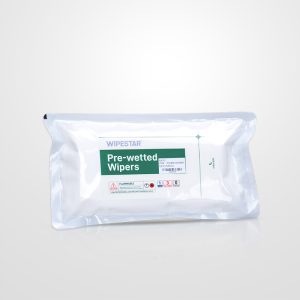
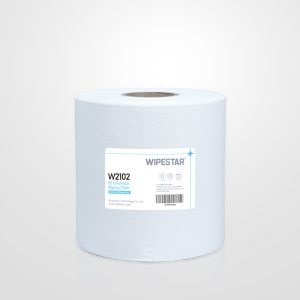
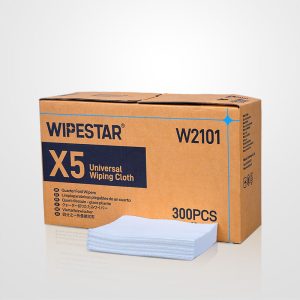
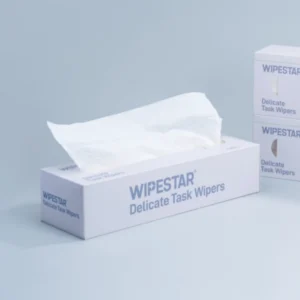
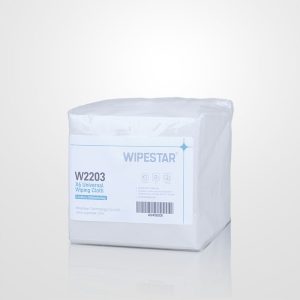
- Sealed-Edge Finishing Wipes — Lint-free synthetic wipes with fiber count below 500/m². Designed for press platens and ironer surfaces where one fiber on a white sheet means rewash.
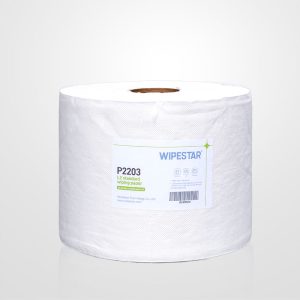
- Chemical-Resistant Wash Floor Wipes — Polyester or polypropylene wipes that survive bleach, alkali, and acid at wash concentrations. Durable enough for heavy soiling on tunnel washer components.
- Healthcare-Grade Low-Bioburden Wipes — Controlled TAMC, sealed-edge construction, resistant to high-concentration peracetic acid and bleach. For surgical textile processing equipment.
Browse Wiping Cloths Range → Request a Custom Quote
Frequently Asked Questions