English
 Chinese



Every coverall on the market has a spec sheet. Almost none of the spec sheets mention a human being. That gap is where gowning programs quietly fail.
I learned this on a vaccine filling floor. The site switched coverall suppliers to save roughly seven percent per suit. Both products were sterile, double-bagged, film-laminated polypropylene — the comparison table looked like a tie. Media fills were clean. For the first month, nobody noticed. Then the weekly gowning qualification records started showing the same failure point on three different operators: settle plates positioned near the RABS neck opening, trending up, always on the morning shift. QA pulled video. Under the new suit, the zipper storm flap ended two centimeters shorter. When operators leaned into the RABS, the flap gapped against the hood collar and exposed a strip of neck. Nobody was doing anything wrong. The construction had changed, nobody had been told, and the change notice clause in the quality agreement was one line nobody enforced.
They went back to the old supplier, rewrote the change-notification clause into something with teeth, and added a donning trial to every incoming garment qualification. The lesson I took from it: a coverall isn’t a fabric purchase. It’s a piece of contamination-control equipment that has to work while a person bends, reaches, sweats and hurries for eight hours. Here’s how to spec it that way.
Why the Person Wearing the Suit Is the Biggest Source in the Room
An adult sheds thousands of skin flakes per minute, most of them carrying resident microflora. Add hair, lint from underwear, and the particle plume generated by ordinary movement, and the operator standing nearest an open vial is the dirtiest “component” in the aseptic core. EU GMP Annex 1 treats gowning as a controlled process for exactly this reason — qualified garments, qualified procedure, qualified person.
A coverall has to do three jobs simultaneously:
- Contain. Hold the wearer’s particles and microbes inside the fabric system instead of releasing them into the room air.
- Protect. Resist splashes, aerosols and particulates coming from the process side, so the garment doesn’t become a transfer path.
- Behave. Stay low-linting, seam-sound and static-controlled through reach, kneel and glove movements for a full shift.
Fail one of the three and you don’t have a downgraded garment. You have a leak, positioned next to your most exposed product, worn by the person least likely to report a subtle fit problem because they’re trying to hit a batch target.
PP+PE Film, ESD Polyester, Spunbond: Pick by Dominant Risk
There is no universal cleanroom garment. Each construction answers a different primary risk, and most plants end up zoning two or three of them.
| Garment | Construction | Primary Strength | Where It Works |
|---|---|---|---|
| SF3103 Sterile Coverall | PP+PE film laminate, zipper with storm flap, low-lint | Liquid penetration resistance plus particle containment | Aseptic core and Grade B surrounds; splash-prone fill operations |
| SF3102 Sterile ESD Coverall | 100% ESD polyester with hood, 5mm conductive grid | Defined static-dissipative behavior inside a sterile envelope | Electronics, medical device and instrumentation rooms |
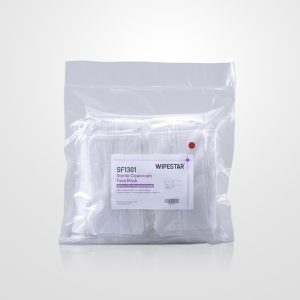
| Cleanroom cloth garments | Controlled-fabric SF3101 line | Lighter, economical option for controlled support zones | Grade C/D support areas, warehouses, controlled corridors |
The PP+PE laminate in the SF3103 does its best work where splash and bioburden dominate: a microporous or film-bonded layer stops liquid strike-through while the polypropylene backbone keeps wet strength. The SF3102 answers a different question. When the threat is a charged device or exposed electronics, the conductive grid gives the suit a measurable dissipation path — but static control only exists as part of a program per IEC 61340-5-1 or ANSI/ESD S20.20, wrist straps and flooring included. An ESD coverall is not a force field you put on by itself.
The Standards That Actually Mean Something on the Datasheet
Vendors throw around a lot of numbers. These are the ones worth checking, because an auditor knows them too:
- IEST-RP-CC003 governs garment system performance, including the Helmke drum test that tumbles a suit and counts the particles it releases. Ask which cleanroom class the suit’s Helmke result supports — and whether it was tested new or after laundering cycles for reusable programs.
- EN ISO 22612 / EN 14126 cover resistance to dry microbial penetration and to contaminated liquid penetration under contact. Aseptic and biohazard-adjacent work wants evidence here, not just the word “barrier.”
- AAMI PB70 classifies liquid barrier performance into levels 1–4. If splash is the risk, a stated PB70 level is more meaningful than “waterproof” marketing copy.
- IEC 61340-5-1 / ANSI/ESD S20.20 define the resistance ranges for static-dissipative garments. Get the actual point-to-point and surface-to-ground figures, not “ESD-safe.”
Fit and Donning: Where Good Specs Get Defeated
Both WIPESTAR coverall lines run S through XXXL. Sizing is not a comfort department issue. A suit cut tight splits at the crotch during the boot step or pulls the cuff up when an arm extends; a suit cut loose drags across handles and equipment. Both failures are particle events, and both are invisible on a bench test.
Three details I write into every gowning SOP:
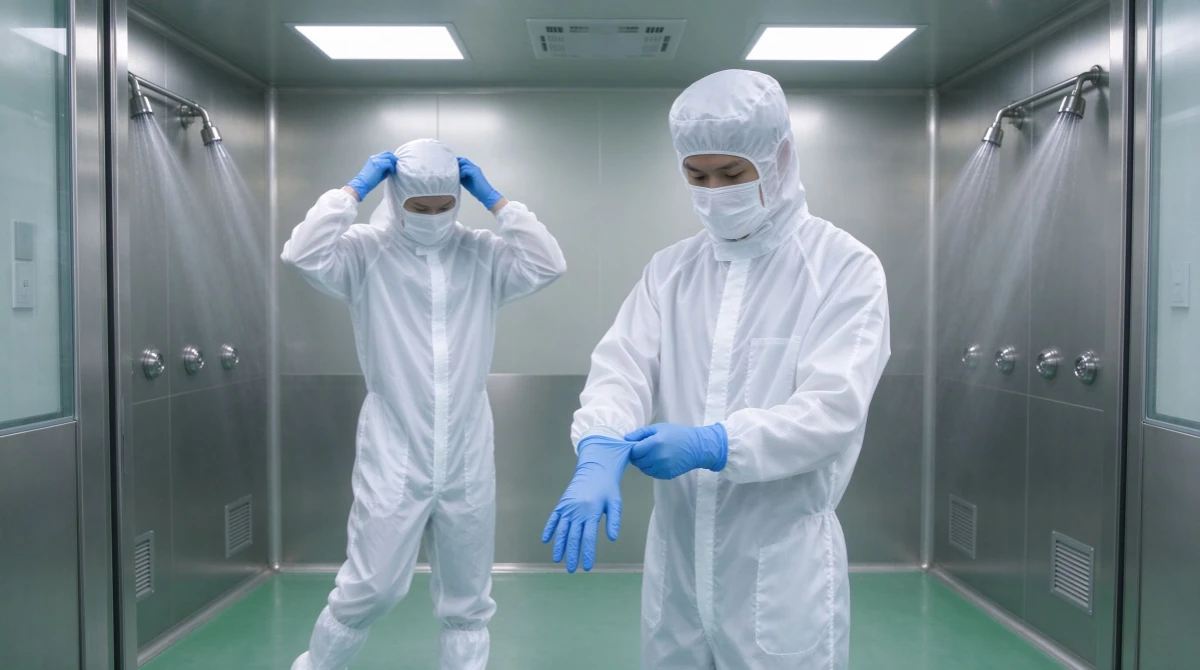
- Zipper and storm flap are barrier components. Full closure, flap seated flat against the hood collar. A half-zipped suit with the hood pushed back is a chimney for every particle the wearer generates.
- Glove goes over the cuff, sanitized at the overlap. Sleeve-over-glove opens a gap every time the arm reaches, and the reach happens constantly at a fill line.
- One garment, one entry. Film disposables are engineered for a single use cycle. A used coverall on a hook “for later” is a contaminated object waiting to be re-worn, and re-donning is exactly when suits tear and hoods touch floors.
Annex 1 also expects gowning to be periodically re-qualified — the person, not just the suit. Build the annual re-qualification into the training calendar, and retrain immediately after any EM excursion that points at gowning technique.
Zoning the Wardrobe Across Grades
One factory rarely runs one garment. A defensible wardrobe model:
- Grade A aseptic core / Grade B surrounds: sterile single-use barrier suits like the SF3103, full sterile gowning discipline, no jewelry, no cosmetics, no exposed skin.
- Grade C/D manufacturing: controlled garments with barrier selected by splash risk; head and facial hair fully covered.
- ESD-controlled rooms: dissipative suits like the SF3102 wherever sensitive hardware is exposed, integrated into the site static-control program.
- Corridors and warehouses: separate garments again — nothing crosses a grade boundary on a person without a change, or you’ve just connected two environments with a walking wipe.
Under the coverall the rest of the system still has to hold: zone-matched masks and covers from the cleanroom PPE range, sterile gloves for aseptic work, and a gowning room that’s itself cleaned and stocked like the controlled space it is. The suit is the layer people notice because they wear it, but a cleanroom runs on the full stack.
Supplier Qualification: The Five Things to Demand
- Barrier and durability data — tear, abrasion and liquid penetration for film suits; particle release and linting for every fabric, tested to a named standard.
- Static data where applicable — point-to-point resistance figures tied to your ESD program’s required range.
- Sterility package — gamma validation per lot, certificate of irradiation, SAL statement, full lot traceability.
- Presentation and logistics — double-bagging for aseptic transfer, box-level size labeling, packaging that survives your receiving and staging route intact.
- Written change notification. This is the one that bit the vaccine plant. Fabric weight, seam tape, storm flap geometry, zipper supplier — any of it changes, you get notice and samples before shipments, with the right to requalify. Put teeth in the clause: rejection and chargeback for undisclosed changes.
If you’re standardizing garments across grades or sites, start at the sterile products catalog and send us your zone map and workforce size profile — we’ll build the wardrobe and the documentation pack by SKU.
Who You’ll Work With at WIPESTAR
We manufacture cleanroom garments and the consumable stack around them, with the qualification documentation assembled before you ask for it, not during the audit.

Juan — Purification Industry Specialist
Juan has years of experience with clean process equipment and purification projects, coordinating customers, factories and suppliers when a gowning standard has to fit the actual room layout and gowning airlock flow.

Ethan — Sales Director
Ethan has over 20 years in the industrial wiping cloth and cleanroom consumables industry and leads the global team, including multi-site garment standardization with one specification across borders.

Daisy — Sales Support
Daisy runs order follow-up and day-to-day customer communication, which on garment contracts means keeping size ratios stocked so the gowning room never runs out of XL on a Friday night shift.
Get Started with Cleanroom Garments
Qualifying a suit for an aseptic suite, zoning a wardrobe for a new plant, or replacing a garment your operators quietly work around — we can send samples across the S–XXXL range with sizing charts and the full documentation set.
- SF3103 Sterile Coverall — PP+PE barrier laminate, double-bagged for aseptic transfer.
- SF3102 Sterile ESD Coverall — conductive-grid polyester for static-controlled rooms.
- Request a Technical Consultation — send the zone map and size profile; we’ll spec the wardrobe.
Browse Sterile Products → Request a Custom Quote
Frequently Asked Questions