English
 Chinese



Maintenance windows are the only chance most controlled rooms ever get properly deep-cleaned. They’re also the only time people in street clothes walk through your airlocks with angle grinders. One of those facts tends to cancel out the other.
A biologics plant I worked with learned this during an annual shutdown. The job list ran long — new dampers in the return risers, two HEPA housings opened, anchors drilled into a Grade C wall. The mechanical work was tidy. The cleanup SOP said “floors and walls,” so the night crew mopped floors and wiped walls. At-rest particle counts on Tuesday came back clean, the room released, and production restarted. Ten days later, contact plates along the wall-floor coving nearest the drilling came back hot, and a compounding suite went into investigation mode. The dust had gone exactly where demolition dust always goes — into the coving channel, the door tracks, and the gap behind the equipment base — and the checklist simply had no line for any of it.
Particle counts forgive a lot for a few days. Airflow is patient. That’s why shutdown cleaning is a project, not a mop-up: contain, clean in the right order, verify, then restart with a baseline. Here’s the checklist we hand customers before their window opens.
What a Shutdown Actually Deposits in Your Room
Routine cleaning handles skin flakes, wipe lint and the occasional spill. Shutdown work introduces a completely different contamination load:
- Construction particulate. Drilling, gasket scraping and metal cutting throw coarse dust that rides pressure differentials and tool traffic well past the taped-off zone.
- Stores nobody ever cleans. Sub-ceiling plenums, cable trays, return risers, equipment bases. Disturb them and years of settled deposit quietly join the supply air.
- Uncontrolled people and gear. Contractors, ladders, hire tools and cardboard packaging cross airlocks that normally see three gowned operators a shift.
- Chemical leftovers. Thread sealant, lubricating oil, marker pen, cutting fluid — maintenance chemistry that routine disinfectants were never chosen to remove.
More mopping doesn’t fix that list. Staging does: deciding in advance what gets sealed off, what gets wiped, in what order, with which material, and what evidence closes the job. IEST-RP-CC018 lays out exactly this operating-and-monitoring logic for cleanroom housekeeping; a shutdown is housekeeping with the stakes turned up.
Stage 1: Containment Before the First Tool Opens
Containment is the cheapest contamination control you will ever buy, and it only exists if it goes up before the work starts:
- Seal the work zone. Full-height soft-wall containment with taped seams, run negative where the AHU setup allows it, and put tacky mats at every transition in and out. Dust leaves in a sealed bag, not on someone’s boot.
- Wrap what matters. Product-contact parts, open panels, screens and exposed mechanisms get covered with clean film or sheeting. Covers come off after gross cleaning — not during, for “a quick look.”
- Control the traffic. Gowning rules apply to contractors too. Log names and times at the boundary; when counts drift later, “where did this come from” becomes a lookup instead of an argument.
- Position waste and segregate it by zone. Open skip bags inside the room mean airborne fibers every time something drops in. Seal and swap bags at the boundary.
Stage 2: Clean in the Only Order That Works
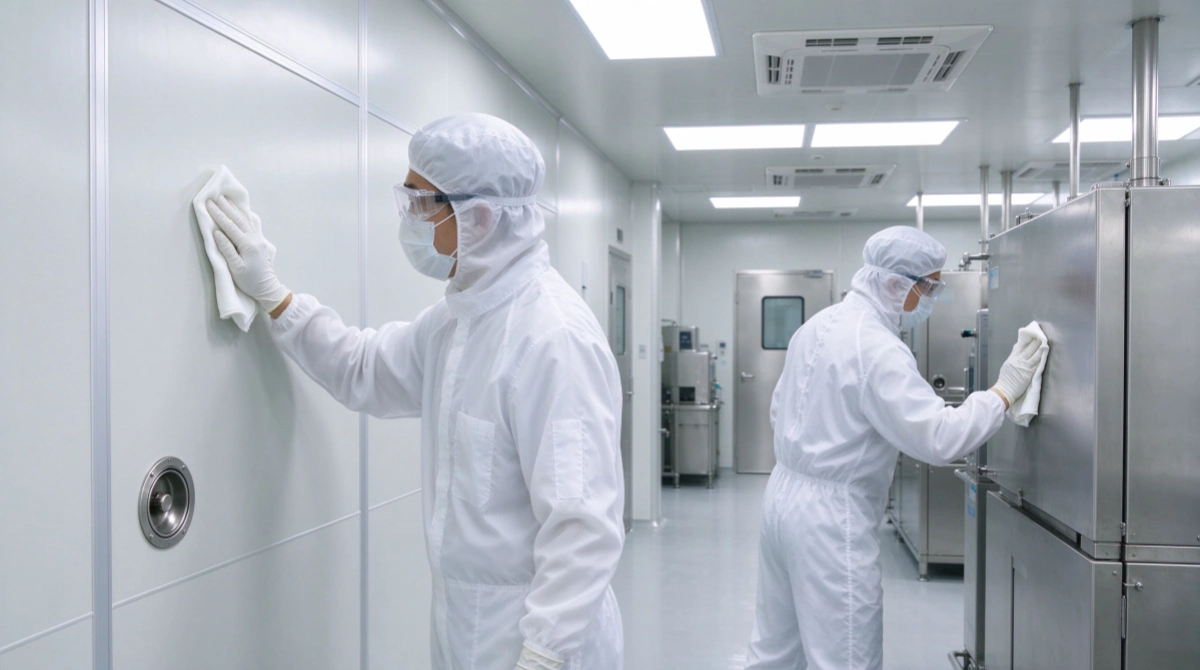
The order follows gravity and airflow: anything above the work gets cleaned first, or the first time the HVAC settles back to normal your finished surfaces get a free second coating.
- Sub-ceiling and voids. Above-ceiling surfaces, diffuser surrounds, cable trays and the inside of opened housings — before anything below them is touched.
- Equipment inside, then outside. Opened housings get cleaned interior-first with single-use wipes. Product-adjacent parts get your best materials; frames and bases get volume stock.
- Walls top to bottom, floors last. Overlapping strokes, fresh wiper per section, two-bucket discipline on mops, color-coded by zone so the floor head never touches a wall.
- Detail pass. Coving channels, door tracks, seams, HMI screens, switches, push-bars. This is the step the plant in my opening story skipped, and it was the whole ballgame.
Match the consumable to the job. One rag everywhere is how a controlled room gets cleaned with an uncontrolled material:
| Shutdown Task | Consumable | Why This One |
|---|---|---|
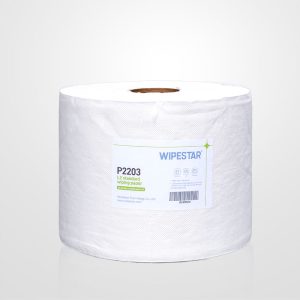
| Top-down wipe of frames, panels and large surfaces | W2203 Universal Wiping Cloths | Coverage and wet strength for volume work |
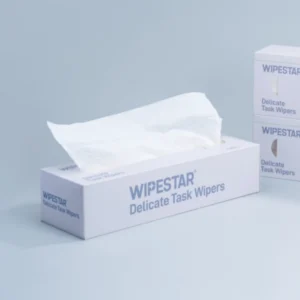
| Coving, tracks, HMI panels and touch points | P1102 Delicate Task Wipes | Soft, low-lint and small enough for detail work |
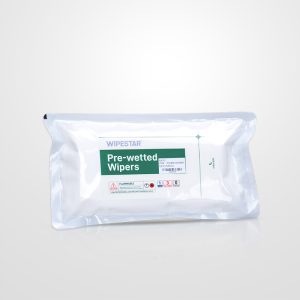
| Solvent passes on grease, sealant and adhesive residue | G2101 Pre-Wetted Wipes | Known saturation, no open solvent bottles in the room |
| Walls and floors, high-volume wet work | SW5603 Microfiber Wipers + mop system | Particle capture with color-coded zoning |
| Leaks and spills while work is underway | L1201 Universal Absorbent Pads | Contain at the source before anything tracks |
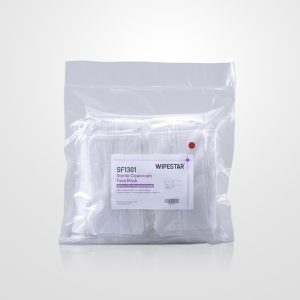
| Contractor boundary traffic and gowning | Cleanroom PPE | Masks, coveralls and covers at the transition point |
Heavy non-viable loading on subfloor or corridor work can justify wiping papers for the first gross pass, followed by the proper room-grade wiper for the finishing pass. Gross, then detail, then disinfect — never the reverse.
Stage 3: Verify the Room Before You Claim It
Cleaning without evidence is a claim, and a restart qualification is not the place for claims. The verification stack:
- Recorded visual inspection. Zone by zone, under good angled light, signed off — including the voids and the detail points from Stage 2.
- Surface monitoring. Contact plates or swabs at representative points, weighted toward the work zone and whatever sits down-airflow of it.
- Non-viable particle counts. With airflow restored, confirm the room meets its ISO 14644-1 class at rest. If the work disturbed filtration or pressure regimes, run the ISO 14644-3 recovery test — the 100-to-1 decay that proves the room actually self-cleans, not just that it looked tidy at one instant.
- A fresh viable baseline. Settle and surface counts taken in the first days after restart give the next month of trend data something to anchor to. Skip this and a slow drift has no reference point.
- The paper trail. Scope, containment, who entered, what was cleaned with which SKU, results, sign-offs. Under ISO 14644-2’s ongoing monitoring logic, the restart record becomes the first entry in the next period’s data — and in an aseptic plant it slots into the Annex 1 environmental monitoring file.
Stage 4: Stage the Consumable Kit Before Day One
The difference between a clean restart and a mop-and-go is usually decided the week before the window. Crews clean with whatever is at hand at 6 a.m. on a Monday, so put everything at hand deliberately: volume cloths for the top-down pass, delicate wipes for detail, pre-wetted wipes for solvent work, microfiber and mop heads for walls and floors, absorbent pads for the guaranteed leak, boundary PPE, tacky mats and enough sealable waste bags for zone segregation. Stage it outside the work zone, check it against the scope before day one, and restock before anything runs halfway out.
WIPESTAR assembles shutdown kits like this as a single order, mapped to your zones and documented for the qualification file. If a maintenance window is on the calendar, send us the scope and the zone plan and we’ll spec the kit against it.
Who You’ll Work With at WIPESTAR
We plan shutdown cleaning the way maintenance plans the mechanical work — scoped, staged, and delivered on the floor before the window starts.

Juan — Purification Industry Specialist
Juan has years of project experience with clean process equipment and purification environments. He coordinates customers, internal teams and suppliers so a shutdown plan covers the room, the airflow and the restart evidence — not just the work order.

Ethan — Sales Director
Ethan has over 20 years in the cleanroom consumables industry and leads our global team, including coordinated supply when a shutdown program has to run to one standard across multiple sites.

Lee — Key Account Sales Manager
Lee has handled overseas accounts including Foxconn, Samsung and Apple since 2018. He times staged deliveries to fixed maintenance windows, so the full kit is on site and checked before the first housing is opened.
Get Started with Your Next Shutdown
Filter change or full refit, the cleanup is scoped work with a consumable plan behind it. Send us the scope and zone map; we’ll quote the kit, the mop system and the delivery schedule.
- W2203 Universal Wiping Cloths — the volume workhorse for the top-down pass.
- G2101 Pre-Wetted Wipes — controlled solvent passes without bottles in the room.
- Request a Technical Consultation — send the maintenance scope; we’ll spec and schedule the staged kit.
Browse All Products → Request a Custom Quote
Frequently Asked Questions