English
 Chinese



A machine shop in western Michigan ran six CNC mills off a single 400-gallon coolant sump. Coolant life was eleven weeks, consistently, against a supplier claim of six months. The shop was buying biocide by the case to compensate, and the maintenance manager had already decided the coolant supplier was overselling.
The actual problem was the skim pass. Every three weeks a technician laid a general-purpose shop towel on the sump surface, let it soak, wrung it out over a waste drum, and repeated. The towel absorbed oil and water-based coolant with equal enthusiasm — so every pass removed a liter of coolant along with the tramp oil. Then the sump level dropped, and the shop topped it up with fresh mix.
They were not losing coolant to bacteria. They were throwing it away one wrung-out towel at a time.
Tramp oil is the single most controllable of the three inputs that degrade water-miscible coolant, and skimming is the control. This guide covers the separation physics, the method, and how to read a skim log so it tells you something about the machines.
The Three Things That Kill Coolant
Water-miscible coolant fails for three reasons, and only one of them is biological.
Tramp oil. Hydraulic oil, way lube and spindle oil migrate into the sump from the machines. The oil floats, coats the coolant surface, and seals it off from the air the aerobic coolant chemistry needs. Under that blanket, anaerobic bacteria thrive, and the byproducts are the sour smell and the skin irritation operators complain about first.
Concentration drift. Water evaporates; concentrate does not. A sump topped up with premix instead of water gradually weakens; a sump topped up with water only gradually strengthens. Either direction stresses the additive package. Concentration belongs on a refractometer, not on a guess based on how the fluid looks.
Chips and fines. Metal fines settle into the sump bottom and become a surface area for bacterial growth, and they also abrade pumps. The chip bed and the sump bottom are part of the coolant maintenance routine, not a separate cleaning task.
Skimming addresses the first. It cannot fix the other two, which is why a shop that only skims still sees short coolant life — but a shop that never skims will not get long life no matter what else it does.
Why Skimming Works — and Why Most Attempts Don’t
Oil and water-based coolant separate by density. Given a still surface, tramp oil rises and forms a layer. The separation is real but slow, and three things routinely defeat the skimming attempt:
- Skimming a circulating sump. With pumps running, the surface is turbulent and the oil is dispersed as droplets rather than a layer. Skim a moving sump and you remove an oil-water emulsion, not oil.
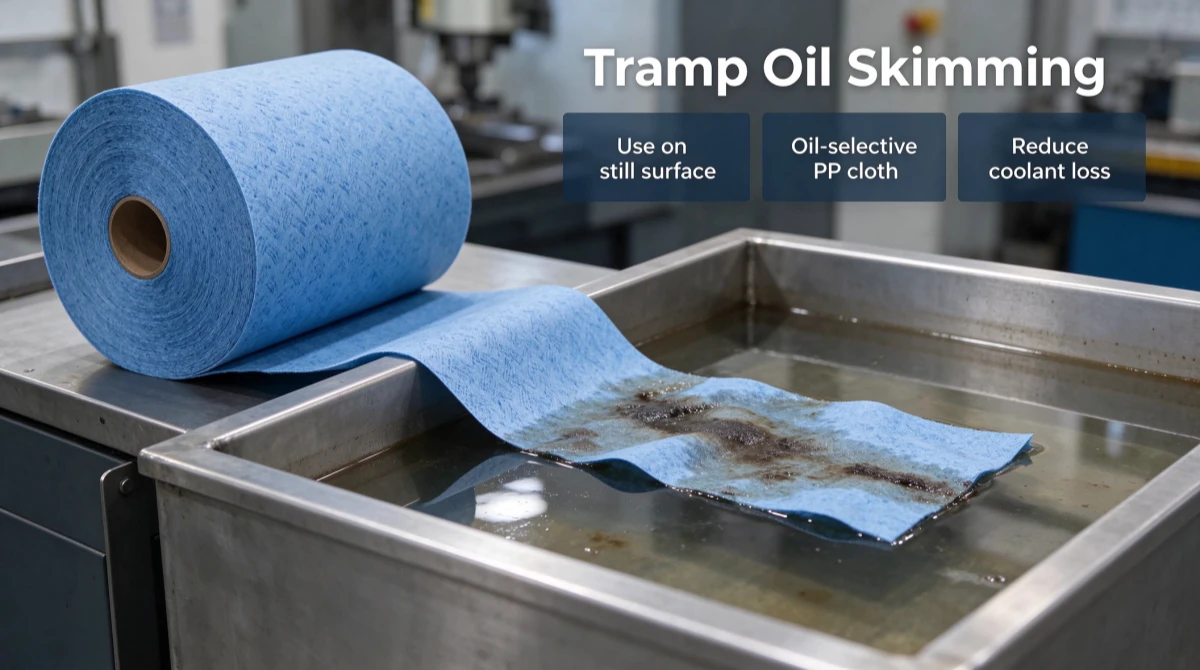
- Using a hydrophilic medium. A wood-pulp or cellulose blend absorbs water as readily as oil. On a sump it removes both, which lowers the level and forces a top-up. Polypropylene is hydrophobic and oleophilic — it picks up the oil layer and leaves the coolant.
- Dragging instead of wicking. A cloth pulled through the coolant reaches below the oil layer and loads up on coolant. A cloth laid flat on the surface and allowed to wick for a few seconds contacts only the oil.
That is the entire technical basis for oil-only media on a sump. It is not a premium feature; it is the behavior that makes skimming work at all. A universal wipe on a sump is the mechanical equivalent of draining the sump into the waste drum.
The Skim Method, Step by Step
- Stop the pumps and let the sump settle. Thirty minutes minimum; an hour is better on a large central sump. The oil layer needs time to coalesce and rise.
- Lay the cloth flat on the surface. Do not press, do not drag. Let it float and wick for five to ten seconds. The oil sheen should visibly darken the cloth.
- Lift straight up and wring into an oil waste container. Not back into the sump, not into a floor drain, not into the chip bin. The oil is the product of the exercise.
- Work the whole surface, then repeat once. The first pass takes the bulk layer; the second takes the sheen that reforms. Two passes after settling beat six passes on a moving sump.
- Record the volume removed and the date. This is the step that turns skimming from a chore into a diagnostic.
Frequency depends on how fast the machines shed oil. A shop running way lube heavily may need a skim every week; a shop with newer machines and tight seals can go three or four weeks. Start weekly for a month, watch the skim volume, and set the interval from the data rather than the calendar.
Choosing the Skim Medium
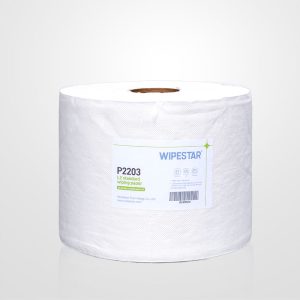
The medium has to be oil-selective, strong enough to wring, and clean enough that it does not leave fiber in the coolant circuit. The WIPESTAR wiping cloth range has three formats that fit the job at different scales:
| Format | Construction | Use on a Sump |
|---|---|---|
| W4301 Cleanroom Oil Cloth | Polypropylene, white | The default skim medium — oil-selective, low fiber release, clean enough that nothing sheds into the circuit |
| W4202 Heavy Duty Oil Cloth | Polypropylene, larger format | Large sumps and central systems where a standard sheet would need several passes per square foot |
| W4201 Heavy Duty Oil Cloth | Polypropylene, standard format | Individual machine sumps and small tanks where the reach is short |
| Spill control pads | Absorbent pad | Not a skim medium — for oil that has already reached the floor, where volume pickup matters more than selectivity |
Keep the skim cloths in a separate bin from general bay wipes. Once a wood-pulp universal wipe ends up on the sump, the coolant loss resumes and it is difficult to notice, because the pass still looks like it worked.
The Skim Log as a Leak Detector
Skim volume is a leading indicator of machine condition. A shop that normally pulls 2 liters per skim and suddenly pulls 6 has a machine shedding way lube faster than it should — usually a failing seal, an over-lubricated way, or a hydraulic leak that has not yet reached the floor.
Three things make the log useful: the volume, the sump identity (so you know which machine group is implicated), and the interval since the last skim. Without the sump identity, a rising trend tells you that something is wrong but not where to look.
Pair the log with a monthly coolant check: concentration by refractometer, pH, and a visual on the chip bed. The skim log explains oil loading; the coolant check explains chemistry. Together they explain most of what shortens sump life.
When Skimming Isn’t Enough
Manual skimming handles the oil that reaches the surface and stays there. Three situations exceed it:
- High-volume oil ingress. If a machine is losing way lube continuously, no skim schedule keeps up. Fix the machine.
- Emulsified oil. Oil whipped into the coolant by high-pressure pumps does not rise to the surface. That is a coalescer or separator job, not a cloth job.
- Tramp oil in a central system with long residence time. A large central sump may benefit from a belt or tube skimmer running continuously, with manual skimming as a supplement rather than the primary control.
Manual skimming is the right first step because it is cheap, immediate and diagnostic. It is not a permanent answer for a shop with a real oil ingress problem, and pretending otherwise just moves the cost into biocide and coolant top-up.
Who You’ll Work With at WIPESTAR
We supply the oil-selective cloths that make skimming work, and we are usually asked the same question first: how do I know which of your cloths will actually leave the coolant alone?

Carolina — Product Specialist
Carolina works with maintenance teams on how polypropylene behaves against real coolants and oils — she checks oil selectivity and fiber release on the actual fluid before a cloth is approved for sump work.

Lee — Key Account Sales Manager
Lee has served Foxconn, Samsung and Apple since 2018 and runs multi-site programs — for shop groups he sets one oil-cloth SKU across locations so a skimming method written once holds everywhere.

Zac — Customer Service
Zac handles sample boxes and reorder timing — a shop can test an oil-selective cloth on its own sump for a month before changing the consumables schedule.
Get Started with Sump Skimming
Tell us your sump volume, how often you currently skim, and what you use, and we will recommend a skim medium and an interval you can defend with data.
- W4301 Cleanroom Oil Cloth — the low-shed skim medium.
- W4202 Large Format Oil Cloth — central sumps and wide surfaces.
- Request a Technical Consultation — describe the sump; we will size the program.
Browse Wiping Cloths → Request a Custom Quote
Frequently Asked Questions