English
 Chinese



A dye house in Surat, Gujarat runs 14 jet dyeing machines producing polyester-cotton blends for the European market. Last monsoon season—they’re running July through September, peak humidity—their reject rate on navy blue orders jumped from 2.3% to 8.7%. Same recipe, same dyes, same machines, same operators.
The lab dip matched. The bulk didn’t. Off-shade, every time, just slightly—enough that the buyer’s QC rejected it at the port of entry.
Root cause took three weeks to find. The maintenance team had switched from a synthetic nonwoven wipe to a cotton-based rag for machine cleaning between color runs. Cotton holds dye. The navy blue was migrating from the rag into the next batch—a lighter blue that picked up residual navy contamination during the machine wipe-down between runs.
The contamination wasn’t enough to show up on the machine operator’s visual check. It was more than enough to fail the spectrophotometer reading at the buyer’s lab. Delta E of 0.8 against the standard. Buyer’s tolerance was 0.5.
That’s a $43,000 reject on a single order. And it was entirely preventable with the right wipe.
If you run a dye house, a finishing line, or a color kitchen, your cleaning consumables are part of your color management system whether you’ve documented them or not. This guide covers what makes textile dyeing different from other industrial cleaning, which wipe materials prevent dye transfer, and how to spec wipes for the chemistry you’re actually using.
Dye Transfer Prevention: The Silent Reject Killer
Dye transfer is the single biggest contamination risk in a dye house. And it’s insidious because it doesn’t announce itself. You don’t get a visible stain or an obvious machine malfunction.
You get a shade that’s off by a fraction—just enough to fail the buyer’s color tolerance but not enough for the machine operator to catch during the run.
The physics are simple. Dye molecules are designed to bond to fiber surfaces. They also bond to other surfaces—metal, rubber, plastic, and critically, to the cellulose and synthetic fibers in your cleaning materials.
A wipe that absorbs a reactive dye during machine cleaning retains that dye even after rinsing, because reactive dyes form covalent bonds with cellulose. They don’t wash out. Ever. So the “clean” rag you used to wipe down the dyeing machine after a red batch is now permanently tinted red.
When you use it on the machine before a yellow batch, you’re transferring red dye molecules into the yellow dyeing environment. The yellow shifts toward orange. The spectrophotometer catches it. The buyer rejects it.
This is why dye houses need wipes that don’t retain dye. The material matters enormously.
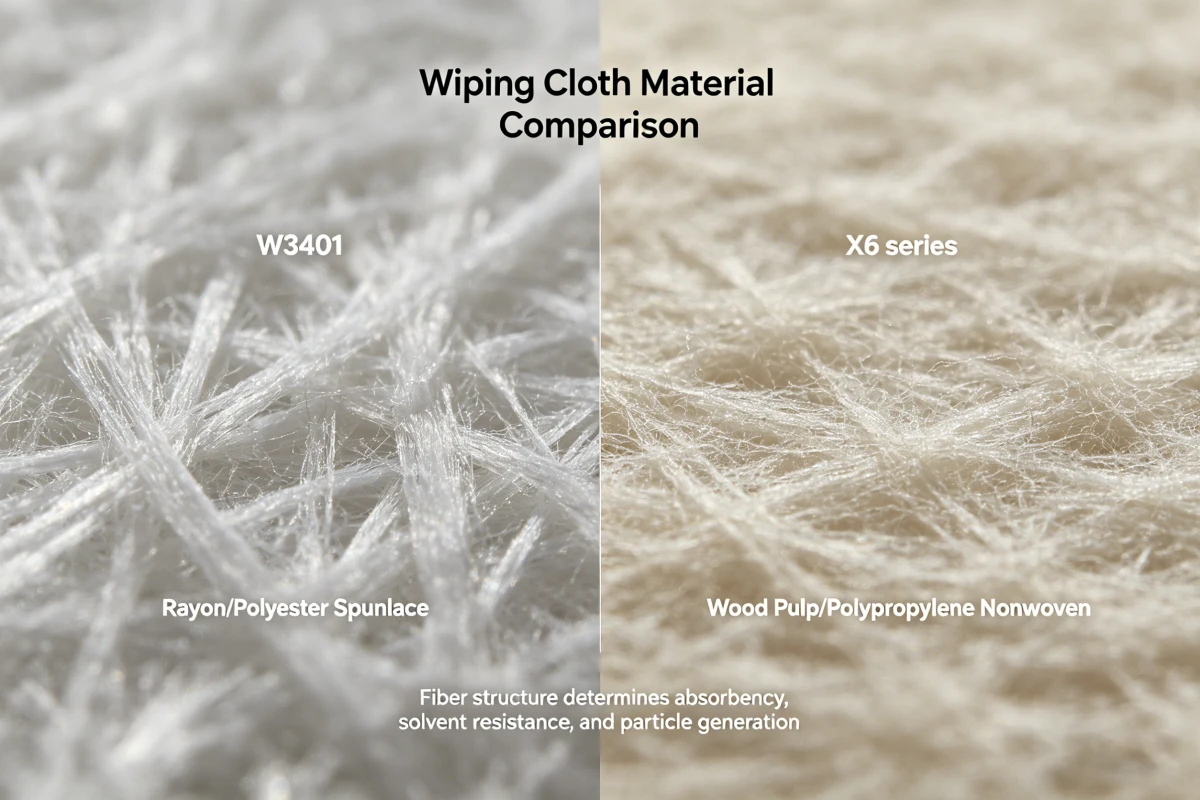
Cellulose-based wipes (cotton rags, cellulose nonwovens) are the worst choice for dye house cleaning—they’re essentially dye sponges. Synthetic wipes—polypropylene, polyester, or blends—have much lower dye affinity. The dye sits on the surface rather than bonding into the fiber structure, which means it can be removed during rinsing or simply doesn’t transfer to the next contact surface.
Single-use wipes eliminate the problem entirely. Use once, discard, grab a fresh one for the next color. No retained dye, no transfer risk, no shade variation from cleaning contamination.
For dye houses running frequent color changes—especially into lighter shades after dark ones—single-use synthetic wipes are the simplest and most reliable solution.
Chemical Resistance Across Dye Classes
Textile dyeing uses some aggressive chemistry, and the chemistry varies dramatically depending on the dye class and the fiber being dyed. Your wipe needs to survive whatever it contacts. Here’s what you’re dealing with:
Reactive dyes (used on cotton, cellulosics) are applied in alkaline conditions—sodium carbonate or sodium hydroxide at pH 10.5–11.5, with sodium sulfate as an electrolyte. The fixation step uses more alkali.
After dyeing, you have a soaping-off step with detergent at 95°C to remove unfixed dye. Your wipe contacts alkaline dye liquors at elevated temperatures. It needs to maintain structural integrity at pH 11+ and 90°C+ without degrading, shedding, or releasing extractables that could contaminate the next batch.
Disperse dyes (polyester, nylon) require an acidic dye bath—acetic acid or citric acid at pH 4–5—plus a carrier or dispersing agent, at temperatures up to 130°C in high-temperature jet machines. The chemistry is milder on pH but harsher on temperature.
A wipe that works fine at 95°C might soften, deform, or release binders at 130°C. If you’re cleaning a jet dyeing machine between high-temperature runs, the wipe needs to tolerate the residual heat in the machine.
Acid dyes (wool, silk, nylon) use a mildly acidic bath with pH 2–6 depending on the dye type and the leveling behavior required. The chemistry is gentler, but the aftertreatment can include formic acid or chrome mordants for certain shades.
Chrome mordant dyeing (declining in use due to Cr(VI) restrictions under REACH and Oeko-Tex, but still present in some wool dyeing operations) uses potassium dichromate and sulfuric acid—a combination that’s aggressive on most organic materials.
Vat dyes (cotton workwear, military fabrics) use sodium hydroxide and sodium hydrosulfite in the reduction step—strongly alkaline and strongly reducing simultaneously. The reoxidation step uses hydrogen peroxide or sodium perborate. This is a brutal chemical environment.
Cotton rags don’t survive it. Even some synthetic wipes struggle. For vat dyeing operations, specify polypropylene wipes with verified performance in high-alkaline, high-temperature reducing conditions.
Machine Cleaning Between Color Runs
This is where wipe selection has the most direct impact on quality. Machine cleaning between color runs is a routine task—every time you change from one shade to another, you need to clean the machine components that contact the dye liquor.
That means the dye vat or jet chamber, the heat exchanger, the pump impeller, the filter screens, the nozzles, and the fabric guide rollers.
The cleaning protocol depends on the color transition. Dark to light is the critical one. Going from black to white requires aggressive cleaning—multiple rinses, sometimes a boil-out with caustic or a reducing agent to strip residual dye from machine surfaces.
Going from one medium shade to a similar medium shade might need only a standard rinse and a wipe-down of accessible surfaces. But even for minor shade transitions, the wipe you use matters.
Here’s a cleaning protocol that works for most dye house color changes:
Step 1: Drain the machine and run a hot water rinse at 80–90°C for 10–15 minutes.
Step 2: For dark-to-light transitions, run a chemical boil-out—typically 2 g/L caustic soda plus 1 g/L a reducing agent at 98°C for 20 minutes.
Step 3: Drain and rinse again.
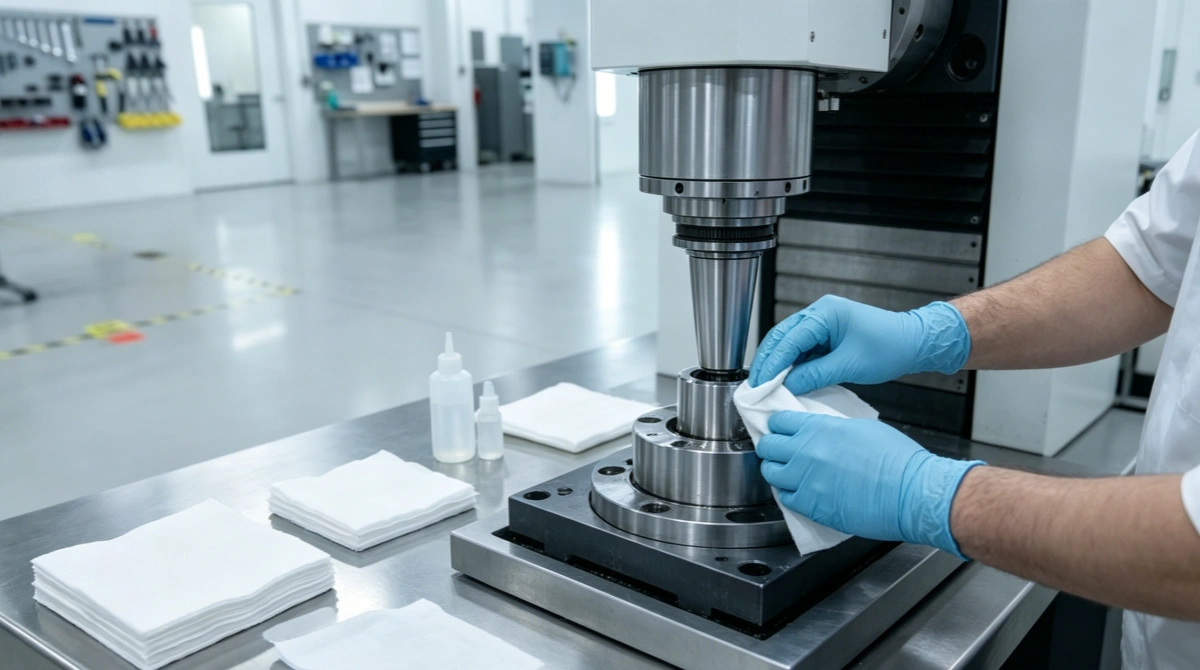
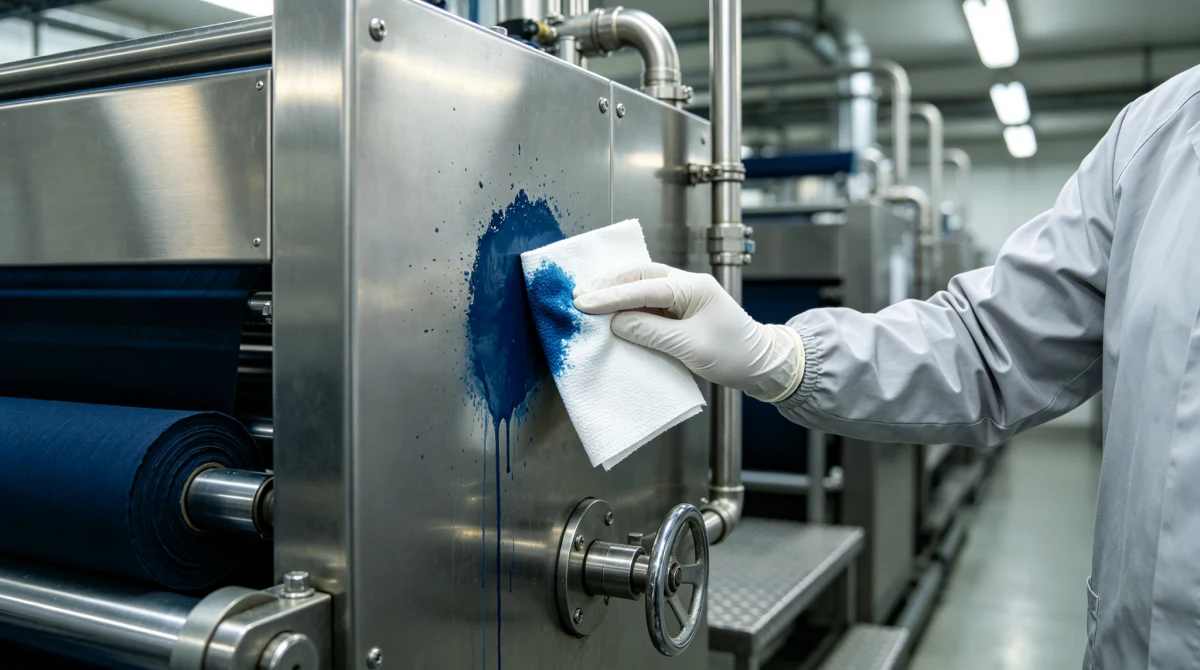
Step 4: Manually wipe all accessible machine surfaces—the lid seal, the nozzle face, the filter housing, the fabric loading area—with a clean, dry synthetic wipe.
Step 5: For the final wipe-down before loading the next batch, use a fresh wipe moistened with the new dye bath water (not the previous dye liquor). This final wipe picks up any residual dye the chemical clean didn’t remove.
That final wipe is critical, and it must be dye-free. If your wipe retained dye from a previous cleaning task, it’s reintroducing contamination at the worst possible moment—right before the new batch loads.
Single-use synthetic wipes, stored separately by color zone if you’re using colored wipes for different machine sections, solve this cleanly.
Equipment Stain Removal
Dye stains on equipment are inevitable in a dye house. The floor, the machine exterior, the pipe flanges, the valves, the dye kitchen counter—everything gets stained eventually. The question is how efficiently you can remove fresh stains versus letting them accumulate into permanent discoloration.
Fresh dye stains—within the first few minutes after the spill—come off relatively easily with a wet wipe and mild detergent. The dye molecules haven’t had time to bond to the surface.
Wait an hour, and the cleaning effort doubles. Wait overnight, and you’re looking at scrubbing with abrasive pads or chemical stain removers.
The wipe you use for fresh stain removal needs good absorbency to soak up the liquid dye before it spreads, and enough scrubbing texture to lift the dye film from the surface.
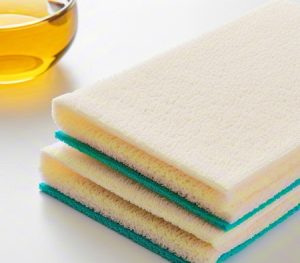
Textured nonwoven wipes work well for this—embossed or dual-layer construction that provides a scrubbing surface on one side and an absorbent layer on the other.
For tough, dried-on stains on metal surfaces (machine exterior, floor grating), a nonwoven wipe dampened with a dilute oxidizing solution (sodium hypochlorite at 1–2% for cellulosic dye stains, or hydrogen peroxide at 3% for most organic dyes) can be effective. But test the chemical on a small area first—not all machine surfaces tolerate oxidizers equally.
Humidity Management and Wet-Environment Wipes
Dye houses are wet. Inherently, unavoidably wet. Steam from the dyeing machines, spray from the washing-off range, moisture from the stenter frames, ambient humidity from the sheer volume of hot water in the process.
Relative humidity in a dye house typically runs 70–90%, and in the immediate vicinity of a jet dyeing machine during a high-temperature run, it can approach 100%.
That humidity affects your wipes. A wipe that performs perfectly in a dry lab environment absorbs moisture from the air in a dye house and becomes a different product. Its absorbency changes—you’ve already used up some of its capacity absorbing atmospheric moisture before you even touch it to a surface.
Its wet strength matters more, because the wipe is never truly dry in this environment. And its packaging matters—if the bag isn’t moisture-proof, the wipes inside are compromised before you open them.
For dye house environments, we recommend wipes packaged in moisture-barrier bags—foil-lined or heavy-gauge polyethylene with a resealable opening. Store them in a dry area (a dehumidified storage room or at minimum a sealed cabinet away from direct steam exposure).
Once a bag is opened, use the contents within the shift if possible. A bag of wipes that’s been open in a dye house for a week has absorbed enough ambient moisture to change its performance profile.
There’s also a practical wipe-material consideration for wet environments. Cellulose-based wipes lose most of their structural integrity when saturated—they tear, they fall apart, they leave fibers behind. Synthetic wipes (polypropylene, polyester) maintain their wet strength much better.
In a dye house, you’re always wiping wet surfaces. The wipe needs to hold together under those conditions. Wet strength isn’t a premium feature here—it’s a baseline requirement.
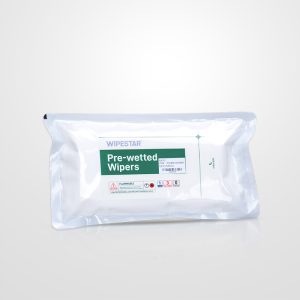
Some dye houses use pre-wetted wipes for machine cleaning, which sounds like a good idea in a wet environment but introduces a new variable: the wetting agent. If the wipe is pre-wetted with IPA or a surfactant solution, you need to verify that the wetting agent doesn’t interact with your dye chemistry.
IPA can affect certain disperse dye formulations. Surfactant residues can interfere with dye leveling. For dye house use, we generally recommend dry wipes that the operator wets with process water or the appropriate cleaning solution at the point of use. That way you control the chemistry.
Wipe Type Comparison for Dye Houses
Dye houses typically work with three main wipe categories, selected based on the cleaning task and the dye chemistry involved.
| Property | Polypropylene Nonwoven | Polyester Nonwoven | Textured Dual-Layer (Synthetic) |
|---|---|---|---|
| Dye Retention | Very Low — dye sits on surface, rinses off | Low — some dye adsorption, generally removable | Low — synthetic fibers resist dye bonding |
| Reactive Dye Compatibility (pH 11, 95°C) | Excellent | Good — verify binder at high pH | Good — check binder and adhesive layers |
| Disperse Dye Compatibility (pH 4, 130°C) | Good to 120°C; verify above | Excellent — polyester stable at 130°C | Good — check adhesive layers for heat limits |
| Acid Dye Compatibility (pH 2–6) | Excellent | Excellent | Good |
| Vat Dye Compatibility (NaOH + hydrosulfite) | Excellent — polypropylene handles reducing conditions | Moderate — check binder degradation in strong alkali | Moderate — adhesive layers may degrade |
| Wet Strength | High | High | High |
| Absorbency | Low–Moderate (2–4 mL/g) | Moderate (3–5 mL/g) | Moderate–High (4–6 mL/g) |
| Scrubbing Ability | Low | Low | High (textured surface) |
| Best Use | Machine interior cleaning, chemical handling, dye bath contact | Machine exterior, general maintenance, disperse dye areas | Stain removal, coating residue, dried-on deposits |
| Relative Cost | $ | $$ | $$ |
A note on cost: in a dye house, the wipe cost is trivially small compared to the cost of a shade reject. A single rejected batch of 500 kg of dyed fabric at $8/kg is $4,000. If one shade reject per month is caused by wipe-borne contamination—and in our experience it’s more frequent than that—the annual cost of rejects dwarfs the annual cost of the premium wipes that would have prevented them.
Cost-per-wipe is the wrong metric. Cost-per-clean-batch is what matters.
Most dye houses we work with run a two-tier system: polypropylene wipes for machine interior and dye-contact cleaning (cheapest, best chemical resistance, lowest dye retention), and textured dual-layer wipes for equipment exterior, stain removal, and general housekeeping.
Some add polyester wipes specifically for the disperse dye machines where the higher temperature tolerance matters. Segregate by color if you want extra safety—store the red-zone wipes separately from the light-zone wipes, even though the synthetic materials don’t retain dye like cotton does.
Whatever your approach, document the wipe spec in your cleaning SOP and qualify the product before switching suppliers. “Qualification” means testing in your actual environment—your dyes, your machines, your humidity conditions—not just trusting the supplier’s datasheet.
Who You’ll Work With at WIPESTAR
We work with textile dyeing and finishing operations where dye transfer prevention and chemical resistance are essential. Our team understands the specific cleaning challenges of dye houses and finishing lines.

Ethan — Sales Director
Ethan has over 20 years of experience in the industrial wiping cloth and cleanroom consumables industry. He leads the global sales team and provides high-quality cleanroom solutions for worldwide customers.

Lee — Key Account Sales Manager
Lee has 7 years of sales experience in the cleanroom consumables industry, having served international companies such as Foxconn, Samsung, and Apple. He focuses on solving problems for customers.

Vicky — Foreign Trade Sales Supervisor
Vicky plays a key role in the foreign trade sales team, responsible for client communication, sales coordination, and maintaining cooperative relationships with global clients.
Get Started with Textile Dyeing and Finishing Wipes
Whether you’re dealing with shade variation issues, evaluating wipes for a new dyeing line, or standardizing cleaning consumables across multiple dye classes, we can help. Chemical compatibility data, dye retention testing, and absorbency profiles available for all products—specific to your dye chemistry and operating conditions.
- Browse All Wiping Cloths — Full product range with specs, certifications, and material data sheets for dye house applications.
- Chemical Resistant Industrial Wipes — Technical guide covering chemical compatibility across aggressive industrial environments.
- Request Technical Consultation — Need help matching a wipe to your specific dye chemistry? Our team can provide compatibility data and retention testing for your facility.
Browse Full Wiping Cloths Range → Request a Custom Quote
Frequently Asked Questions