English
 Chinese



Most gowning programs spend their QA time on the coverall. That’s backwards. Every media fill out-of-spec I’ve sat through — every EM excursion that traced back to gowning — started with gloves and masks. The coverall covers a person. The gloves and mask stand at the two tiny, intentional breaches in the barrier: the hands and the face. Get them right, and the gowning room is doing its job. Get them wrong, and the fanciest PP+PE coverall in the world is a costume.
A sterile injectables client showed me the data. They ran two glove SKUs on two shifts for six months — identical coverall, identical SOP, same cleanroom grade. The day shift ran SS1011W nitrile, the night shift ran a cheaper PVC glove chosen by procurement to “match the previous SKU’s fit”. The day shift doubled the gloves and never had a media fill finding. The night shift doubled too — because the PVC tore at the wrist half the time — and logged three glove-related breach findings in five months. When we weighed the tear rates and the microbial recoveries, the cheaper glove ended up costing them fourteen times its savings in investigation time and production hold. The SOP never specified the glove. The gloves had drifted without anyone noticing, and the audit trail pointed at the contract, not the product.
Same room, same people, same procedure. Two different gloves, two very different stories. This guide is about choosing sterile cleanroom gloves and masks — the two consumables that define whether gowning is a qualified process or a dressed-up ritual. Garments matter, but gloves and masks are where the gowning program either succeeds or quietly fails.
The Gloves-Masks Barrier: Why It’s Different from the Coverall
The coverall is a passive containment device — it holds the wearer’s skin flakes and fibers inside the garment for the duration of the shift. Gloves and masks are active barriers: they touch, they’re touched, they breathe through, and they get replaced mid-cycle. That’s why they fail faster and why their specifications have to be tighter.
EU GMP Annex 1 §80–88 treats gowning as a validated process — procedure, frequency and consumables included — and specifically calls out gloves and face coverings as separate controlled items. The US pharmaceutical guidance (FDA’s Sterile Drug Products for Immediate Use — Current Good Manufacturing Practice) makes the same point from the procedural side: gloved hands face the product directly, breath aerosolizes through masks, and both generate contamination events if their integrity is in question.
So gloves and masks aren’t ancillary consumables. They’re the last — and most frequently tested — defense between the operator and the open product.

Sterile Gloves: Nitrile, Latex and PVC Compared
All three sterile glove families are gamma-irradiated, aseptically packed pair-by-pair, and designed for cleanroom work — extended cuffs (9″ / 23cm minimum to cover the forearm under the gowning cuff), textured fingertips for grip, reinforced beaded cuffs for tear resistance during donning, and a film structure that supports double-donning. The difference is the polymer — which decides sensitivity, chemical compatibility, and the failure mode on shift.
| Glove | Material | Package & Sizing | Where It Belongs |
|---|---|---|---|
| SS1008W / SS1011W Nitrile | Soft, highly elastic synthetic nitrile | 9″, white translucent; 50 pairs / inner bag / outer bag; S–XXL | The default for aseptic processing — no latex protein allergen concern, reliable elasticity, double-donning slides clean |
| SS2002W / SS2006W Latex | Natural rubber latex film | 9″, yellow; 50 pairs / inner bag / outer bag; S–XXL | Extended-wear comfort and tactile sensitivity where latex allergy is managed and documented |
| SS3001W / SS3002W PVC | Soft elastic PVC, no protein allergen | 9″ / 12″, transparent; 50 pairs / inner bag / outer bag; S–XXL | Cost-controlled applications and specific chemical-contact tasks where PVC’s barrier profile is appropriate |
Three notes from the floor. First, the glove that tears during donning is already a failed glove — you’re starting your aseptic task with a breach. Second, all three are gamma-irradiated: beware EO-sterilized gloves, as EO residuals can bind to glove surfaces and transfer to product-adjacent surfaces. Third, if IPA sanitizes gloved hands between interventions, run a 10-minute soak test with your actual solvent — nitrile and PVC lose elongation faster than latex under repeated IPA contact, and a glove that starts slippery doesn’t end well.
Double-Donning: The Design Feature Everyone Tests Wrong
“Test double-donning” in most qualification files means the QA manager tries it on once and writes “OK”. That’s not a test — that’s a ritual. Double-donning is a design feature, not a technique, and it needs a structured evaluation before the glove gets signed off.
A glove that double-dons correctly slides over itself with a minimum of resistance, pulls evenly over the cuff, and doesn’t bunch at the wrist. A glove that doesn’t — thin PVC, stiff unprocessed nitrile, natural latex with high protein content — causes the wearer to grip, pull harder, or tear. When the wearer is performing a critical intervention, that moment of resistance is a contamination event waiting to happen.
The fix is a simple five-person test (three sizes, both shifts, 50 pairs over a full shift): count tears, count moments where the double don required more than three pulls, and record operator feedback on fit. Any tear rate above zero on sterile gloves disqualifies the SKU. Any glove where half the team double-dons it differently is a design problem, not a training problem. The SS1011W nitrile is built specifically to pass this test — it’s the reason we rate it first.
Sterile Face Masks: Filtration, Fit and the Tie-On vs Headband Question
The mask is the only barrier between an open product and the operator’s face. The three variables that decide its performance are construction, fit, and change discipline — in that order.
Construction. Our sterile masks use 3-ply ES (elastic spunbond) construction — a filtration layer between two soft cover layers — manufactured and packaged in a controlled environment and gamma-irradiated for reliable sterility. Filtration performance follows ASTM F2100 (surgical mask) and EN 14683 (medical face mask) ratings: ask the supplier for bacterial filtration efficiency (BFE) and particle filtration efficiency (PFE) numbers, not just “meets standards”.
Fit. Two fastening families:
- Tie-on (SF1302, 21×9cm) — the tie straps let each operator set and hold mask tension through long interventions. Critical zones prefer ties because they don’t ride up or down during head movement, and they don’t absorb moisture into a stretchable band that then touches the gown. See the full sterile face mask catalog for 18×9cm and other profile options.
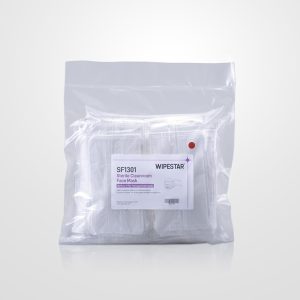
- Soft OP/PU headband (SF1301 / SF1101) — simpler and faster, adequate for outer Grade C/D zones where intervention times are shorter and head movement is less frequent. The trade-off: band compression on the face and possible moisture accumulation.
Change discipline. One mask per gowning session, immediately if damp. Masks like the SF1302 are individually bagged and triple-bagged precisely so the stack isn’t touched before each use. Pushing a mask down under the chin and re-drawing it later — a near-universal operator reflex that’s almost never written as a prohibition — is a contamination event, not a convenience. Write the single-use rule into the gowning SOP and coach it like any other aseptic technique.
Qualification: Five Documents Before You Approve a Supplier
- Certificate of irradiation per lot, with the sterility assurance level (SAL — typically 10⁻⁶) and sterilization method (gamma, validated per lot). EO-sterilized gloves carry residual concerns; demand gamma for critical zones.
- Lot traceability chain from production batch through delivery, so a recall or investigation can be scoped in hours.
- Physical test data — for gloves: pinhole (EN 455-1), tensile and elongation (EN 455-2), water vapor permeation and powder content; for masks: bacterial filtration (ASTM F2100) and breathability data.
- Packaging qualification — double or triple bagging, aseptic pair-by-pair packing, presentation at the gowning mirror, and peel behavior with gloved hands.
- Change management clause — the supplier notifies you before raw materials, sterilization parameters or film thickness change, with right to requalify on notice.
The full sterile product range — gloves, masks, garments, wipes, swabs, and environmental sampling kits — lives in the sterile products catalog. If you’re rebuilding a gowning program after a media fill finding, we’ll assemble the documentation set by SKU so your qualification file starts complete, not retroactively assembled from email.
Who You’ll Work With at WIPESTAR
We manufacture sterile gloves, masks and garments together — so we can talk about them as one system instead of three isolated catalog entries.

Juan — Purification Industry Specialist
Juan has designed and delivered cleanroom gowning programs for pharma and biotech clients — he runs the five-person double-donning evaluation before any sterile glove SKU gets quoted.

Carolina — Product Specialist
Carolina works with production technicians on how mask filtration, glove tensile properties and gamma validation actually perform on shift — she can pull BFE data and IPA soak-test results before first order.

Ethan — Sales Director
Ethan has over 20 years in the industrial wiping cloth and cleanroom consumables industry and leads our global team — the multi-site framework agreements for sterile gowning run through his desk.
Get Started with Sterile Gloves and Masks
Whether you’re qualifying a second source, fixing a gowning breach finding, or standardizing glove/mask formats across a site, we can supply samples, certificates of irradiation, and test data for evaluation.
- SS1011W Sterile Nitrile Gloves — extended cuff, double-donning friendly, the aseptic default.
- SF1302 Tie-On Sterile Face Masks — 3-ply ES, individually bagged and triple-bagged with irradiation certificates.
- Request a Technical Consultation — Tell us your grade boundaries and gowning SOP; we’ll map glove, mask and garment formats to each zone.
Browse Sterile Products → Request a Custom Quote
Frequently Asked Questions