English
 Chinese



A metal stamper in Indiana had a weld problem that looked like a welder problem. Spot welds on a structural bracket were passing peel tests in the lab and failing in the body shop — not consistently, but often enough to trigger a containment. Weld parameters were re-verified. Electrode tips were replaced on a shortened schedule. The failures continued.
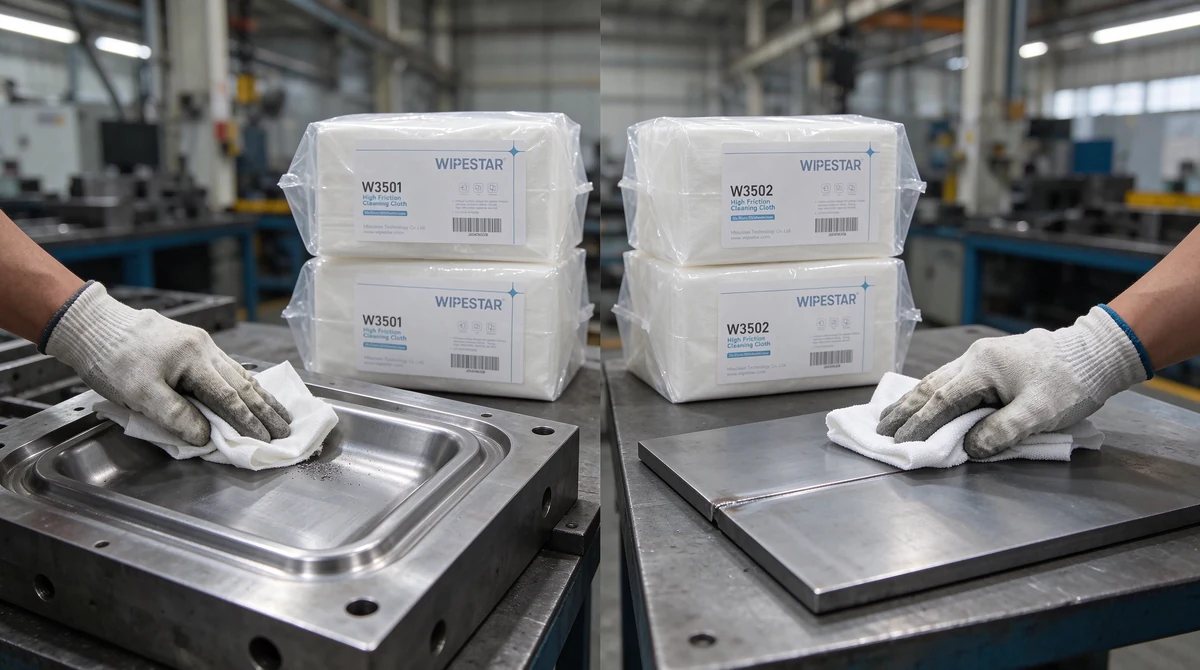
The cause was stamping lubricant. The blanks were being wiped before welding with a general-purpose shop towel, which smeared the lubricant into a thin film instead of removing it. A thin film is worse than a thick one, because it looks clean. The weld nugget formed partly through lubricant, and the peel test passed on the sample the operator had wiped hardest.
Stamping plants have two completely different cleaning jobs that both get assigned to “a rag”: cleaning the die, and cleaning the part. They have opposite requirements, and mixing them produces both the lint embossed into panels and the film that defeats welding.
Two Jobs, Opposite Requirements
A stamping die is a hardened steel surface under tonnage. A blank is a thin sheet that will be welded, painted or bonded. The wipe that serves one actively damages the other.
| Requirement | Die Cleaning | Blank / Coil Cleaning |
|---|---|---|
| Main contaminant | Stamping lubricant, metal fines, slug debris, rust preventive | Stamping lubricant film, handling oil, dust |
| Priority | Remove fines without scoring the die face | Remove the film completely without leaving fiber |
| Wrong tool | A fiber-shedding towel that packs lint into draw beads | A towel that smears lubricant into an invisible film |
| Failure it causes | Lint embossed into every panel until the die is polished | Weld porosity, paint craters, adhesive bond failure |
The two jobs are usually performed by different people — tool room and production — which is why the same wipe ends up in both places. The fix is to separate them physically by station, not just in the procedure.
Die Cleaning: Where Lint Becomes a Dent
A draw die has polished radii, draw beads and punch faces that contact the panel under hundreds of tons. Anything trapped between the die and the sheet — a metal sliver, a hardened slug, a fiber mat — is embossed into the panel on the next stroke, and then into every panel after that.
Three practices reduce the risk:
- Remove fines dry and lift them away. A high-friction wipe used dry picks up metal fines and lubricant together. A W3501 heavy duty surface prep wipe has the texture for this without the shedding of a textile rag.
- Wipe with the draw direction, not across it. Cross-die wiping drags fines over polished radii. Along the material flow, the wipe lifts rather than plows.
- Never re-use a die wipe. A wipe that has picked up metal fines is abrasive on its second pass. This is the single most common cause of polished-radius damage in a stamping plant.
For the die face itself, follow the dry pass with a solvent-damp wipe and then a dry finish. Heavy-duty oil cloths such as the W4204 handle the lubricant load on larger die surfaces and bolster plates where the surface is not a critical radius.
Blank and Coil Cleaning Before Welding
Stamping lubricant is designed to stay on the sheet. That is its job through the press, and it becomes contamination the moment the part moves to welding, painting or adhesive bonding.
The removal problem is that lubricant films are thin, tenacious and invisible. A dry towel drags a film around; a flooded wipe dissolves it and then leaves it behind as the solvent evaporates. What works is a two-step: a solvent-damp wipe to lift, followed immediately by a dry wipe to take up the solvent and the dissolved lubricant before it dries.
The dry step is the one that gets skipped, and it is the one that matters. Solvent left to evaporate on a steel surface concentrates the dissolved lubricant at the edges of the wet area — which is exactly where weld quality drops first.
For weld-critical blanks, use a wipe that will not leave fiber on the faying surface. A W3104 microfiber holds the dissolved film and releases almost nothing, and a W3401 ultrasoft handles the finish pass on visible surfaces.
Wipes by Station
| Station | Wipe | Why |
|---|---|---|
| Tool room — die faces and draw beads | W3501 Heavy Duty Surface Prep | High friction lifts fines and lubricant without shedding |
| Tool room — large die surfaces and bolsters | W4204 Heavy Duty Oil Cloth | Oil-selective, holds a heavy lubricant load |
| Weld cell — blank faying surface | W3104 Microfiber | Takes the dissolved film and leaves no fiber at the weld interface |
| Weld cell — weld-prepped blank finish pass | W3401 Ultrasoft | Final dry pass that will not mark a visible surface |
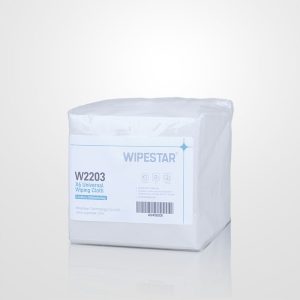
| Press area — floors, guards, general | W2203 Universal | General wipe for anything that is not a die or a weld surface |
| Coil storage and rust-preventive removal | W2401 Universal X8 | Heavier grade for bulk removal on coil edges and sheet stacks |
Verifying a Weld-Ready Surface
The reason the Indiana failures were hard to find is that a lubricant film passes every visual check. Three tests make it visible:
- Water-break. Flood the faying surface with deionized water. Uniform sheeting means the surface is clean; beading or pull-back means lubricant remains. It costs seconds and is the single most useful check at a weld cell.
- White glove or white wipe drag. Drag a clean white wipe across the surface and look at the wipe, not the part. A gray or yellow tint is lubricant.
- Peel or coupon test on the wiped condition, not the ideal condition. Lab peel tests often use a perfectly cleaned coupon, which tells you nothing about what production actually sends. Pull a sample from the line after wiping.
Run the water-break check at the start of each shift and after any lubricant change. Lubricant formulations vary in how tenaciously they cling, and a new drum can behave differently from the one it replaced.
Who You’ll Work With at WIPESTAR
We supply wipers to stamping and welding operations, and the conversation usually starts with separating the die job from the weld job — because that separation is where the quality gain is.

Lee — Key Account Sales Manager
Lee has served Foxconn, Samsung and Apple since 2018 and runs multi-site programs — for stamping groups he sets one station-by-station wipe list so every press line follows the same separation.

Ethan — Sales Director
Ethan has over 20 years in industrial wiping cloth — he works with tool rooms and weld engineering on consumable programs where the wipe is part of the process specification, not a housekeeping item.

Daisy — Sales Support
Daisy keeps the two station lists separate on reorders — die wipes and weld-cell wipes ship as distinct line items so neither gets substituted with a general shop towel.
Get Started with Stamping Plant Wipes
Tell us your lubricant, the weld process and where the die cleaning happens, and we will return a station-by-station wipe list that keeps the two jobs apart.
- W3501 Heavy Duty Surface Prep — die faces without shedding.
- W3104 Microfiber — weld-ready blank surfaces.
- Request a Technical Consultation — send the lubricant and process; we will map the stations.
Browse Wiping Cloths → Request a Custom Quote
Frequently Asked Questions