English
 Chinese



Two operators. Same room, same wiper, same disinfectant, same SOP that says “wipe the work surface.” One produces a surface that passes contact plates month after month. The other produces a surface that drifts.
I have watched this happen in three different facilities, and the difference was never the product. It was the fold. One operator quarter-folded the wiper and rotated to a fresh face with every stroke. The other bunched it in one hand and used the same face until it was visibly soiled — which meant the second half of every wipe was a smear, not a clean.
Wiping technique is the least documented part of contamination control. SOPs specify the disinfectant, the contact time and the wiper SKU, then hand the actual motion to whatever the operator learned in their first week. This guide covers the method that holds up under audit: the fold, the stroke, the sequence and the change rule.
Why the Fold Matters More Than the Wipe
A wiper has a finite capacity to hold what it lifts. Once that capacity is reached, additional strokes do not clean — they redistribute. The soil, the microorganisms and the residue come off the wiper and go back onto the surface, often in a thinner and harder-to-detect film than before.
Bunching a wiper in one hand concentrates the entire cleaning task on one small contact area and one continuous face. Quarter-folding turns the same wiper into a stack of separate clean faces. Instead of one face degrading over eight square meters, you get eight faces each doing a small amount of work at full capacity.
Three consequences follow, and all three show up in data:
- Consistent removal. Every stroke contacts the surface with a face that has not already loaded up, so removal efficiency stays roughly constant instead of decaying through the task.
- Fewer wipers per task. Counterintuitive but consistent: operators who fold use fewer wipers, because each one finishes its job before being discarded.
- Auditable technique. A folded wiper leaves a visible record — the operator can show which faces were used. A bunched wiper leaves nothing to inspect.
The Quarter-Fold: Eight Faces From One Wiper
The method is old, simple and rarely written down properly. Here is the version that works on a standard 9 × 9 inch or 23 × 23 cm wiper:
- Open the wiper flat and hold it by two adjacent corners.
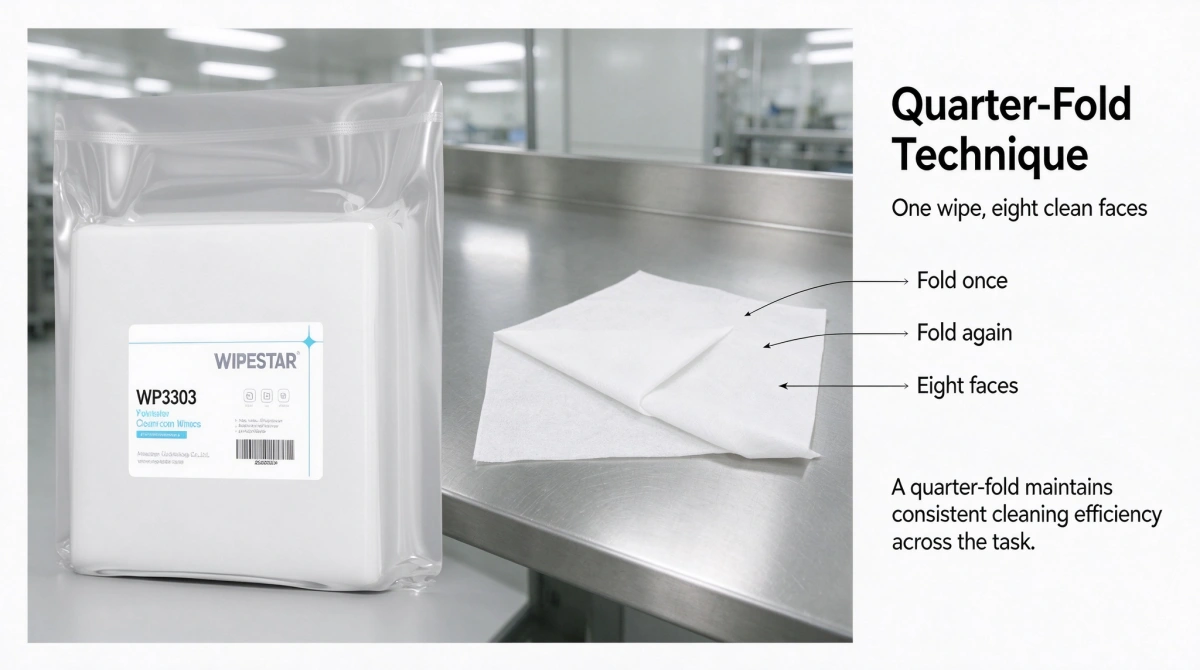
- Fold in half so the two halves meet. You now have a rectangle with two clean outer faces.
- Fold in half again, perpendicular to the first fold. You now have a quarter-size square — four layers thick, with four clean outer faces.
- Wipe with the top face using the flat of the fingers, not the fingertips. Fingertips concentrate pressure and can abrade the surface; the flat of the hand covers more area with even pressure.
- Rotate, don’t flip. After each stroke, turn the folded wiper to the next clean face. When all four outer faces are used, unfold once and refold in the opposite direction to expose the four inner faces.
That is eight faces from one wiper. Two things make it work in practice: the fold has to be tight enough that the layers do not shift under pressure, and the operator has to actually rotate. A quarter-folded wiper that is used on one face is just a thicker bunched wiper.
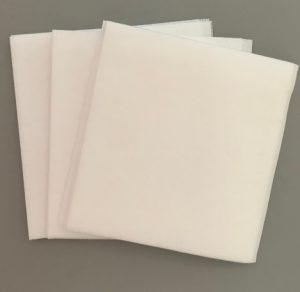
The substrate matters for how well this works. A sealed-edge polyester such as the WP3303 holds a fold crisply and does not fray at the crease, which is why it is the format most often specified for critical surface work. A softer nonwoven like the W5602 folds well but compresses more, so it holds less per face and needs rotating sooner.
Stroke Direction and Overlap
The fold decides how much capacity each stroke has. The stroke decides where the contamination goes.
One direction, always. Back-and-forth buffing is the most common technique error in cleanrooms. It lifts soil on the forward stroke and puts it back on the return. Every stroke should travel in the same direction across the surface, with the wiper lifted between strokes.
Overlap by about a quarter. Each new stroke should overlap the previous one by roughly 25 percent of the wiper width. Less overlap leaves un wiped lanes; more overlap wastes faces and slows the task without improving the result.
Start at the far edge. Begin at the point furthest from the operator and work toward yourself. This keeps the operator’s body and gloves away from the cleaned area and prevents reaching across a wet surface.
Use the flat of the hand. Fingertips create pressure points that can scratch coated surfaces and that leave uneven solvent film. The flat of the fingers, with the fold held between thumb and forefinger, gives even contact across the whole face.
Sequence: Top to Bottom, Clean to Dirty
Sequence is where technique becomes a procedure. The rule that survives audit is simple: contamination moves in one direction, and that direction is away from the product.
| Order | Surface | Reason |
|---|---|---|
| 1 | Highest, cleanest surface in the room (upper walls, ceiling fixtures, equipment tops) | Anything that falls from above lands on surfaces cleaned later, not earlier |
| 2 | Work surfaces and equipment faces | The surfaces that contact product come after the overhead work that could contaminate them |
| 3 | Lower equipment, legs, frames | Descending order keeps soil from being carried upward |
| 4 | Floors and floor-level coving | Last, with a separate wiper or mop — never the same wiper used above |
Within a single surface, the same logic applies at a smaller scale: far edge to near edge, top to bottom. And between rooms, highest grade first, working outward — a room cleaned after a dirtier one needs a fresh wiper, fresh solution and, in most procedures, a fresh set of gloves.
When to Change the Face, and When to Change the Wiper
Operators need two rules, not one, because the two decisions are different.
Change the face after every stroke on a critical surface, or whenever the face shows visible soil. On large flat panels, one face per stroke is realistic. On small fixtures, one face may cover two or three short strokes.
Change the wiper when all eight faces are used, when the wiper becomes saturated enough to leave a film, or immediately when it touches anything that is not the intended surface — a floor, a glove, a fixture, the operator’s gown. A wiper that touched the wrong surface is retired, not returned to the fold.
The change rule needs a number in it to be enforceable. “Change when dirty” is a judgment call that varies by operator and by shift. “One face per stroke on Grade A surfaces, discard after eight faces” is a rule an auditor can watch you follow.
Writing It Into the SOP
Most cleaning SOPs describe the chemistry and skip the motion. The version that closes the gap has five lines per surface type:
- Wiper SKU and size — the part number, not “cleanroom wiper.”
- Fold — “quarter-fold, eight faces.”
- Stroke — “one direction, far edge to near edge, 25% overlap, lift between strokes.”
- Change rule — “one face per stroke; discard after eight faces or on contact with a non-target surface.”
- Sequence — the surface order for that room, top to bottom.
Then train it by observation, not by slide deck. A five-minute watch at the bench tells you more about whether the technique is in place than any sign-off sheet. And when a new operator joins, pair them with someone whose fold you have actually watched.
Who You’ll Work With at WIPESTAR
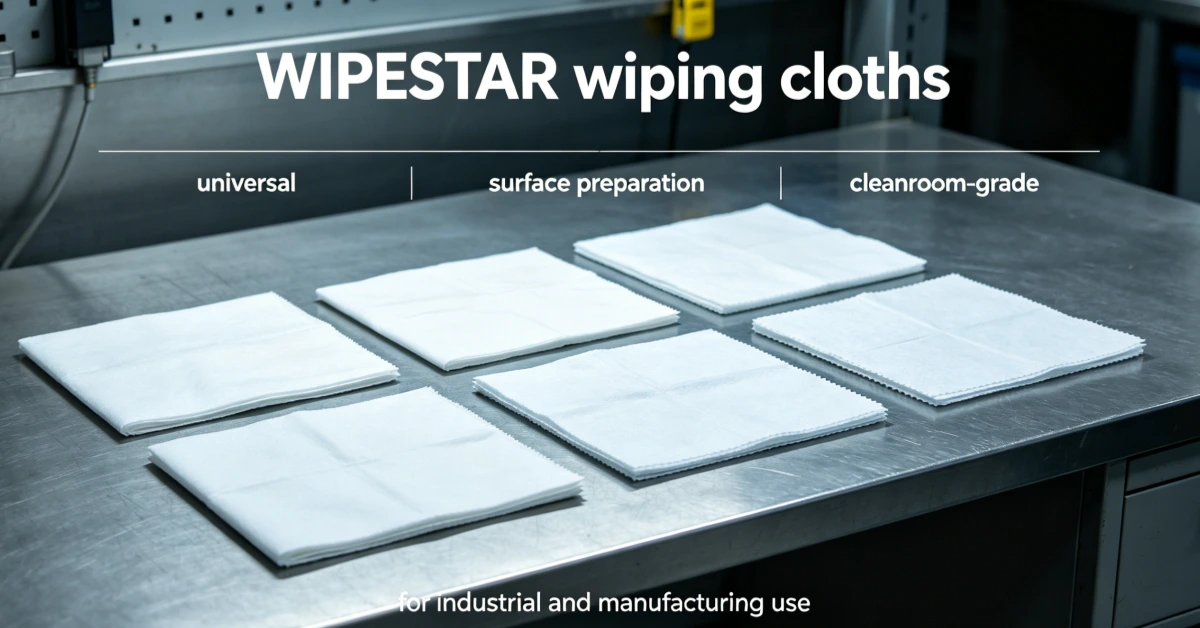
We make wipers for controlled environments, and the most common question we get after a sample request is not about material — it is about how the wipe should be folded and used.

Carolina — Product Specialist
Carolina works with production teams on how different substrates behave when folded and used — crease retention, compression and how many usable faces a wiper really gives at the bench.

Ethan — Sales Director
Ethan has over 20 years in industrial wiping cloth and cleanroom consumables — he has seen enough cleaning programs to know that the wiper spec and the wiping motion have to be written together.

Daisy — Sales Support
Daisy keeps station stock aligned with consumption — a fold-and-rotate technique uses fewer wipers, and the reorder schedule should reflect that rather than the old usage rate.
Get Started with Wipers That Hold a Fold
Tell us which surfaces you clean and at what grade, and we will recommend a wiper format that folds cleanly and holds its faces through a full task.
- WP3303 Polyester Wipers — holds a crisp quarter-fold, sealed edge.
- WP4302 Wide Border Wipers — more durable crease for heavier scrubbing.
- Request a Technical Consultation — send the surface list; we will match the wiper.
Browse Wiping Cloths → Request a Custom Quote
Frequently Asked Questions