English
 Chinese



The finding was a faint white film behind the glove-port flange. It came up during an isolator interior inspection at a fill-finish plant, and nobody could explain it: the interior had been cleaned on schedule, the records were complete, and the panels looked spotless from the outside.
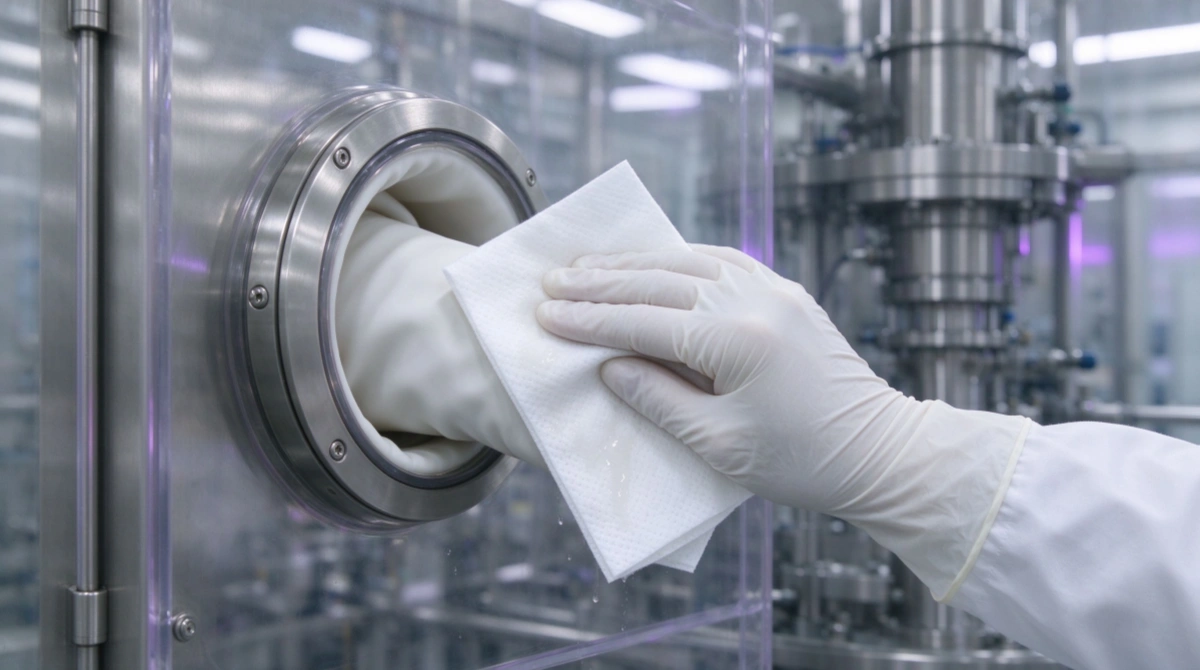
What the investigation found was a cleaning method that had never been designed for the geometry it was applied to. Operators were taking dry wipers in through the transfer hatch, spraying sporicide onto the acrylic, then buffing the seams with the same wipe they had used on the port. The solvent ran behind the flange, the wipe could not reach it, and the residue dried in place. The film was not contamination from the product. It was the cleaning chemistry, left where no wipe had ever been.
Isolators and RABS break most of the habits cleanroom teams learn in open suites. You cannot step in. You cannot see the surface at a natural angle. You cannot apply even pressure with a half-suit glove. And you only get one shot at a panel, because re-entering to fix a miss means another intervention, another glove change, and another entry in the record. This guide is about the wipes and the sequence that work inside that constraint.
Why an Isolator Is Not Just a Smaller Cleanroom
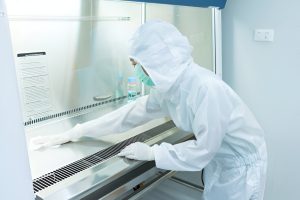
An open Grade A suite and an isolator interior both aim at the same particle and microbial limits, but the physics of cleaning them are nothing alike. Inside an isolator you are working through fixed glove ports at roughly arm’s length, on surfaces that are often reflective, often curved, and sometimes vertical to the airflow. Three consequences follow:
- Reach is fixed, not adjustable. You cannot lean in to change the angle. A wipe that is comfortable on a bench becomes unmanageable on the rear panel of a four-glove isolator.
- Pressure is inconsistent. Half-suit gloves transmit force poorly. A dry wipe dragged across acrylic at an angle skips rather than wipes, and skipping means the chemistry is applied unevenly.
- Re-entry is expensive. Every correction is a new intervention with a new glove change, a new entry in the record, and another chance to disturb the airflow. Cleaning has to be right the first time, which means the tools have to be chosen for the panel, not for the storeroom.
There is also a subtler issue: reflections. On a glossy acrylic panel, a thin film is nearly invisible from the port angle, and operators learn to trust the look of the surface instead of the wipe. That is exactly how the white film survived months of “completed” cleaning records.
Wipe Formats That Fit the Interior
The right wipe inside an isolator is the one that fits the panel and delivers a defined amount of chemistry, not the largest wipe in the catalog. WIPESTAR’s sterile range covers the formats that actually work in confined interiors:
| Format | Size | Best Use Inside the Isolator | Why It Fits |
|---|---|---|---|
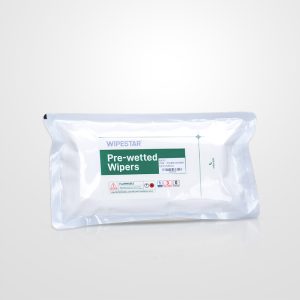
| SG2201 sterile pre-wetted wipers | 23 × 23 cm | Glove-port flanges, transfer-port surrounds, small panels, capping station faces | The compact format turns inside a glove port; factory saturation removes the spray-and-buff step that created the residue film |
| SG2101 sterile pre-wetted wipers | 23 × 28 cm | Wider flat panels and viewing windows where a single pass should cover the height of the panel | Extra length covers a panel in one stroke instead of three, which matters when the stroke has to be straight |
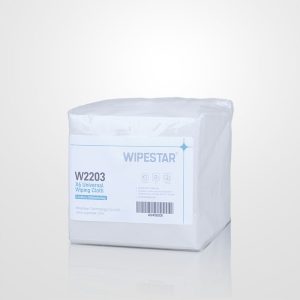
| SW4301 sterile nonwoven wipers | 30.5 × 30.5 cm | Isolator floor, large interior walls, first pass after a campaign | Area coverage at a lower cost per square meter where the surface is forgiving and the soil load is higher |
| SWP2402 sterile polyester wipers | 30.5 × 30.5 cm | Critical acrylic, sensor windows, surfaces inspected for residue | Low-lint polyester is the format to use when the panel is judged visually and a fiber would read as a defect |
| Sterile mop covers | Walk-in RABS and isolator floors | Floor of walk-in units where a single wipe would be inadequate | Only where the geometry allows a mop head; otherwise floor work stays on the 30.5 cm wiper |
Two rules of thumb from the plants that get this right. First, the wipe should be small enough that the operator can control the stroke with one hand through a glove port. Second, the wipe should be big enough to cover the panel in one pass. When those two rules conflict, the panel gets two wipes, not one oversized one.
Solution Loading and the Residue Nobody Removes
Most isolator residue problems are not contamination problems. They are dosing problems. A trigger-spray bottle plus a dry wipe hands the operator complete control over how much chemistry lands on the surface, and different operators will make different decisions every shift:
- Over-spray. Solvent runs behind flanges, into seam gaps and under the glove-port ring, where no wipe will ever follow. It dries there and shows up months later as a film.
- Under-wetting. A barely damp wipe delivers less than the contact time assumes. The surface looks wiped, the log says wiped, and the microbiology says otherwise.
- No removal pass. Many sporicidal chemistries require the residue to be removed after contact time, with a separate wipe and a separate step. If the SOP only says “apply and allow to dry,” the residue is part of the process by design.
Pre-wetted sterile wipers remove the dosing variable. The SG2201 and SG2101 arrive at a defined saturation level, so every operator starts from the same dose and the only remaining variable is technique — which you can train and observe. Where a validated process genuinely requires a specific sporicide, keep the spray but add the residue-removal pass with a separate sterile wipe, and write both steps into the record.
A Sequence That Works Port by Port
The sequence below is the one that survived audits at three different facilities. It is deliberately boring, which is the point.
- Work top to bottom, and far to near. Start at the point furthest from the glove ports and finish at the ports themselves. Every stroke moves contamination toward the exit, never back across a cleaned panel.
- One panel, one wipe, one direction. Overlap each stroke by roughly a quarter of the wipe width. No back-and-forth buffing — that redistributes what the wipe just lifted and is how the flange film gets spread.
- Glove ports: ring first, then the visible sleeve. Wipe the flange ring with the compact 23 × 23 cm format, then the visible sleeve interior. Do not solvent-wipe the glove itself unless the SOP explicitly requires it — most glove manufacturers warn against repeated solvent contact on the elastomer.
- Transfer port and its surround last among the fixtures. This is the surface that receives every bag, so it carries the highest soil load and should never be cleaned with a wipe that has already been used elsewhere.
- Floor after fixtures, with a larger format. Floor work is a different task with a different wipe; do not drag a floor wipe back up onto a panel.
- Residue-removal pass per the disinfectant instructions. Separate wipe, separate lot, separate line in the record. If the chemistry requires it and the record does not show it, the cleaning is not documented even when it happened.
Two practical additions. Use a fresh wipe for the residue pass rather than “finishing” with the cleaning wipe — the cleaning wipe is now carrying the residue you are trying to remove. And put the used wipes into the exit bag inside the isolator as you go, so nothing accumulates on a shelf where the next operator will reach for it.
What the Cleaning Record Should Carry
An isolator cleaning record that only says “cleaned” is not evidence of anything. The version that survives inspection carries the following, and it takes about forty seconds longer to complete:
- Panel map reference — the numbered panel list, with initials against each panel wiped.
- Wipe SKU and lot number — the specific sterile product, not “sterile wipes.”
- Disinfectant and concentration, with contact time start and end.
- Residue-removal pass — yes/no, wipe lot, and who performed it.
- Glove lot — because the gloves are also a sterile consumable entering the critical zone, and their lot belongs in the same traceability chain.
Under EU GMP Annex 1, isolator interiors sit inside the contamination control strategy, and cleaning has to be both validated and repeatable. The record is what proves the repeatable part. If a wipe SKU ever changes — a new supplier, a substitution during a shortage — treat it as a change that requires a residue and compatibility check before the next campaign, not after.
Who You’ll Work With at WIPESTAR
We supply sterile wipers, garments and mops to isolator and RABS lines — so the recommendation starts with your panel geometry and chemistry list, not a catalog page.

Carolina — Product Specialist
Carolina works with production teams on how substrates and saturation behave against real chemistries — for isolator work she checks which sterile wipe leaves residue on acrylic and which removes it cleanly.

Lee — Key Account Sales Manager
Lee has served Foxconn, Samsung and Apple since 2018 and runs multi-site programs — he keeps the same sterile wipe SKUs available across every line in a network so cleaning validation does not have to be repeated site by site.

Zac — Customer Service
Zac turns isolator trial kits around quickly — the formats you want to test on an actual panel can be on their way the same week you ask.
Get Started with Isolator Cleaning Consumables
Send us a photo of your interior panels and your disinfectant list, and we will return a wipe selection by panel type with the lot documentation your cleaning validation needs.
- SG2201 Sterile Pre-Wetted Wipers — 23 × 23 cm, the glove-port format.
- SWP2402 Sterile Polyester Wipers — low-lint pass for acrylic you inspect.
- Request a Technical Consultation — send the panel map; we will spec by surface.
Browse Sterile Products → Request a Custom Quote
Frequently Asked Questions