English
 Chinese



One skincare producer based in Guangzhou reached out to us last year after being forced to conduct a full recall of its vitamin C serum batch. The root cause was neither defective raw materials nor flawed formulas. Instead, microbial contamination stemmed directly from the low-grade wipes used to clean filling nozzles. Though these wipes were labeled cleanroom-certified, they lacked formal microbial bioburden verification, and their supplier failed to supply COAs with complete microbial colony count records. This single oversight led to 120,000 finished goods being removed from global markets, alongside lengthy regulatory complications that lingered for four months.
As global specialists in contamination control, we’ve found cosmetic and personal care factories rarely invest the same strict standards in cleanroom consumables as pharmaceutical and semiconductor facilities do. Even so, contamination threats remain severe, while worldwide cosmetic compliance rules grow stricter each year. We repeatedly spot the same avoidable wipe selection errors across beauty manufacturers. We developed this practical guide exclusively for production supervisors, QA specialists and procurement teams, to help you select reliable cleaning consumables proactively—long before regulatory audits or costly product recalls disrupt your business.
Why Cosmetics Manufacturing Has Its Own Wipe Requirements
People assume cosmetics are made in the same kind of cleanroom as pharmaceuticals. They’re not. Most cosmetics production happens in controlled environments that range from ISO Class 8 to unclassified rooms with basic HVAC filtration. The products aren’t sterile, and they don’t need to be—cosmetic formulations contain preservative systems specifically designed to handle low-level microbial exposure.
But here’s where it gets tricky. Cosmetics are applied to skin, eyes, and lips—some of the most sensitive tissue on the human body. A face cream contaminated with Pseudomonas aeruginosa or a mascara wand exposed to Staphylococcus aureus isn’t just a quality issue. It’s a consumer safety incident that triggers recalls, regulatory action, and brand damage that takes years to recover from.
The wipe requirements in cosmetics manufacturing sit in a gap between industrial cleaning and pharmaceutical-grade sterile consumables. You don’t need gamma-sterilized, SAL 10⁻⁶ validated wipes for a cream filling line. But you do need wipes with controlled microbial bioburden, verified chemical compatibility with your formulations, and documentation that satisfies ISO 22716 auditors. Most “cleanroom wipes” on the market are designed for particle-sensitive industries like semiconductors—they’re excellent at particle control but have never been tested for microbial contamination or cosmetic-ingredient compatibility.
For a broader look at how cleanroom wipe materials work across different industries, our cleanroom wiper selection guide covers the material science. Here, we focus specifically on what cosmetics and personal care manufacturers need to know.
ISO 22716 GMP: What the Standard Says About Cleaning Consumables
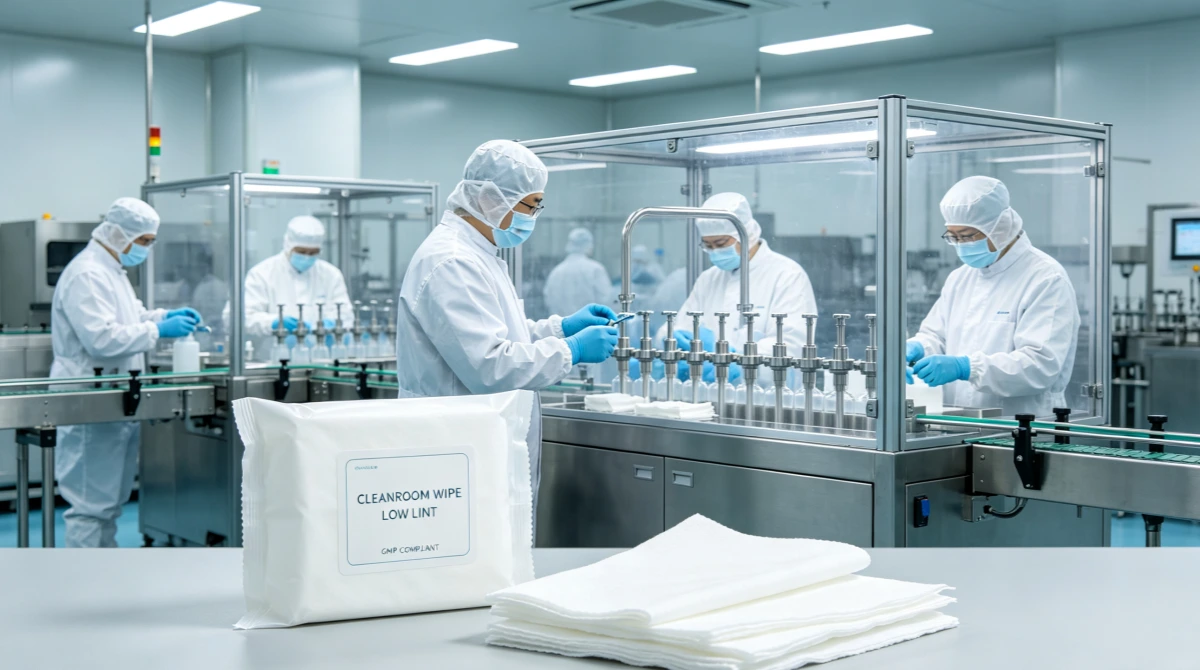
ISO 22716 is the international GMP standard for cosmetics manufacturing. It’s the framework that most regulatory bodies—including the EU (EC Regulation 1223/2009), China’s NMPA, and the FDA’s Voluntary Cosmetic Registration Program—reference when evaluating manufacturing practices. Chapter 9 covers equipment, and Chapter 10 covers materials and packaging. Together, they set the expectations for cleaning consumables.
The standard doesn’t name specific wipe products. But it requires that:
- Equipment and surfaces in contact with product must be cleaned with materials that don’t introduce contamination — This means your wipes must be validated to not shed fibers, release chemicals, or harbor microorganisms that could transfer to the product.
- Cleaning procedures must be documented and validated — Your SOPs need to specify which wipe is used on which surface, how it’s used, and what acceptance criteria it must meet. “Use a clean cloth” isn’t a validated procedure.
- Raw materials and consumables must be traceable — You need to know which wipe lot was used during each production batch, and you need the supplier’s documentation on file to prove the wipe met your specifications.
- Storage conditions must prevent deterioration — Wipes stored in humid, uncontrolled environments can develop microbial growth even before you open the package. ISO 22716 expects you to control storage and rotate stock.
The gap we see most often: cosmetics manufacturers have validated their cleaning procedures for surfaces and equipment, but they haven’t validated the consumable itself. They assume “cleanroom grade” means “safe for cosmetics.” It doesn’t—not without supporting data specific to your application.
The Three Contamination Risks in Cosmetics Production
When we work with cosmetics manufacturers on wipe selection, we start by identifying which contamination type matters most for their specific production step. The answer changes the wipe specification entirely.
Particulate Contamination
Visible particles in a cosmetic product—fibers, dust, specks—are the fastest way to generate consumer complaints. A single fiber in a clear lip gloss or a translucent serum gel is visible to the naked eye and screams “quality problem” to the buyer. Particulate control matters most during filling, packaging, and any open-product handling step.
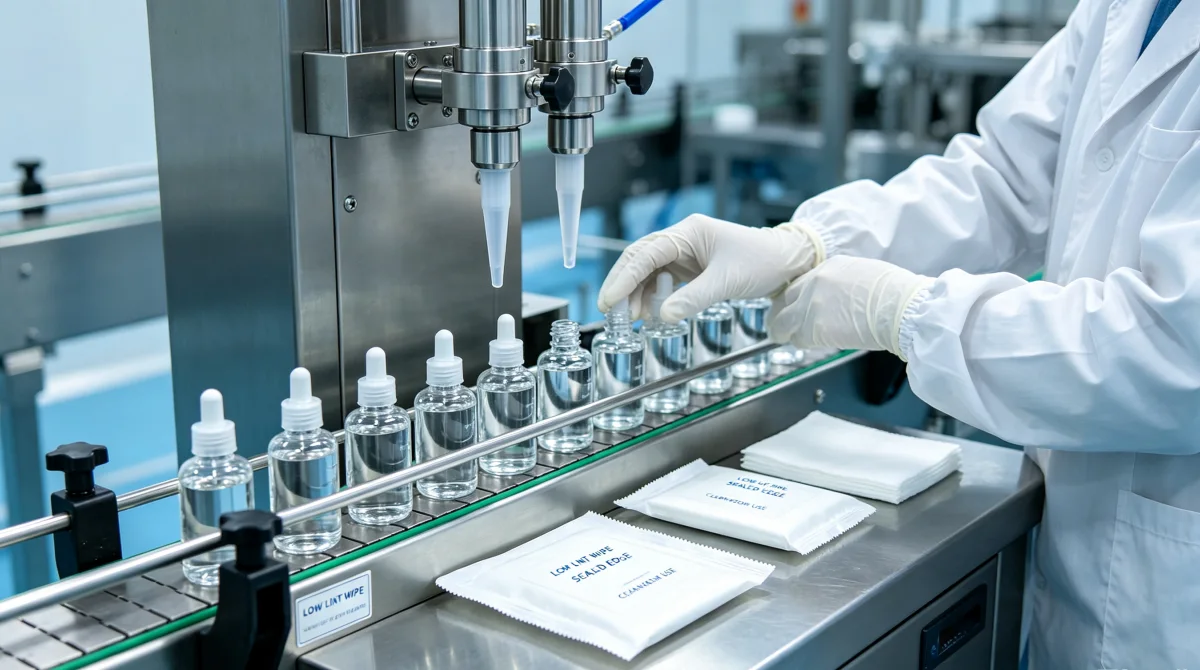
For these applications, you need low-lint wipes with sealed edges. The particle count spec doesn’t need to be semiconductor-grade (sub-100 particles per cm²), but it should be below 500 particles ≥0.5μm per cm² tested per IEST-RP-CC004. Cut-edge wipes are the most common source of fiber contamination on cosmetics filling lines.
Microbial Contamination
This is the risk that cosmetics manufacturers most often underestimate. Your product has a preservative system, but that preservative is calibrated for expected microbial load during normal shelf life—not for a spike introduction from a contaminated wipe wiping a filling needle or a mixing vessel opening.
Wipe bioburden should be controlled and documented. Request total aerobic microbial count (TAMC) and total yeast/mold count (TYMC) data from your supplier. For most cosmetics applications, a wipe bioburden below 100 CFU per wipe is acceptable. For products used around the eyes (mascara, eyeshadow, eye cream), tighten this to below 10 CFU per wipe.
Chemical Contamination
Cosmetics formulations are chemically complex. Surfactants, emulsifiers, active ingredients, fragrances, and preservatives all interact with wipe materials in different ways. A wipe that leaves behind silicone residue on a water-based serum production line can cause emulsion instability. A wipe containing isopropyl myristate residue on a natural-claim product line can trigger label compliance issues.
Your wipe supplier should provide extractable residue data—what compounds migrate from the wipe under conditions that simulate your cleaning process. For cosmetics applications, test for compatibility with your specific formulation chemistry, not just generic “chemical resistance.”
Wipe Selection by Product Type: Creams, Serums, Aerosols, and Powders
Different cosmetics product categories have different contamination sensitivities. Here’s how to think about wipe selection for each.
Skincare Creams and Lotions
Emulsion-based products (moisturizers, sunscreens, body lotions) are the most forgiving in terms of particulate visibility—opaque formulas hide small particles. But they’re the most sensitive to microbial contamination because their water activity supports bacterial growth. Wipe focus: low bioburden, chemical compatibility with your cleaning agents (typically quaternary ammonium compounds or peracetic acid), and absorbency for spill cleanup around mixing vessels.
Serums and Essences
Water-based serums are typically filled into transparent or translucent containers. Every fiber, every particle, every air bubble is visible. These lines need the tightest particle control in cosmetics manufacturing. Use sealed-edge, low-lint wipes for all product-contact surface cleaning. Non-woven polyester/cellulose blends with heat-sealed edges are the standard here.
Aerosol Products
Hair sprays, deodorants, and setting sprays introduce propellant chemistry into the mix. The filling environment is typically not a cleanroom—it’s a production floor with explosion-proof requirements. Wipes for aerosol lines need to be chemically resistant to propellants (typically propane, butane, or DME) and compatible with your valve crimping equipment. Lint control is less critical here; chemical resistance and absorbency matter more.
Powder Products
Pressed powders, loose powders, and eyeshadow palettes are manufactured in environments where airborne powder particles dominate. Wipe selection focuses on surface prep before pressing (removing residual powder from molds) and cleanup between color changeovers. The wipe needs to pick up fine powder without leaving fibers behind. Microfiber wipes work well here because their split fiber structure traps powder particles effectively.
Matching Wipes to Your Production Zone Classification
Most cosmetics manufacturing facilities don’t operate as full cleanrooms. But they do have zone classifications based on product exposure risk. Here’s how to map wipe specifications to each zone.
| Production Zone | Typical Classification | Wipe Requirements |
|---|---|---|
| Open product filling (serums, eye products) | ISO Class 7–8 / Grade C equivalent | Sealed-edge, low-lint, controlled bioburden (<100 CFU/wipe), chemical compatibility verified |
| Open product filling (creams, lotions) | ISO Class 8 / Grade D equivalent | Low-lint, controlled bioburden, absorbent, compatible with cleaning disinfectants |
| Closed mixing and compounding | Controlled but unclassified | General-purpose cleanroom wipes, bioburden data recommended, chemical resistance to cleaning agents |
| Packaging and labeling | Controlled but unclassified | Standard industrial wiping cloths, lint control for adhesive label application |
| Raw material storage and weighing | Controlled but unclassified | General-purpose wipes for spill cleanup, absorbency is the priority |
A common mistake: using the same wipe across all zones. The cheap general-purpose cloth that’s fine for wiping down a packaging machine is completely wrong for cleaning a serum filling needle. Zone-matched wipe specifications, documented in your SOPs, are what ISO 22716 auditors expect to see.
Chemical Compatibility: Why Your Wipe Must Survive Your Cleaning Agents
Cosmetics manufacturing facilities typically use a rotation of cleaning agents: quaternary ammonium compounds (QACs), peracetic acid, sodium hypochlorite, and sometimes alcohol-based sanitizers. Your wipe must be chemically compatible with every agent in your rotation—not just the one you use most often.
We’ve seen wipes that perform perfectly with QACs but disintegrate when exposed to peracetic acid. The wipe falls apart during use, leaving fibers and fragments on the surface it was supposed to clean. Your cleaning validation just became a contamination event.
Request chemical compatibility data from your wipe supplier for your complete cleaning agent rotation. Test in your actual conditions—concentration, contact time, temperature. A wipe that survives a 30-second wipe-down with 0.1% peracetic acid at room temperature might fail at 0.5% concentration at 40°C. Know your actual process parameters and validate against them.
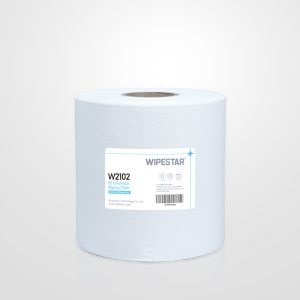
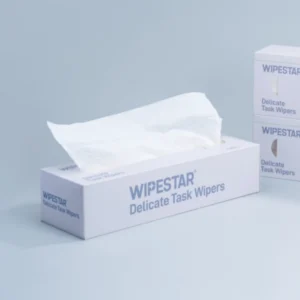
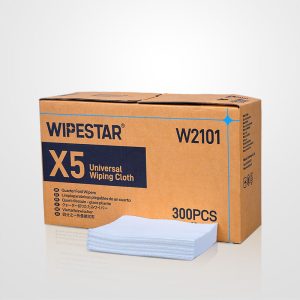
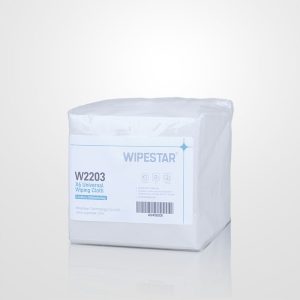
Our wiping cloths range includes products specifically tested for compatibility with common cosmetics manufacturing disinfectants. Our technical team can match the right wipe to your cleaning agent rotation and provide compatibility test data for your QA documentation.
Documentation Your QA Team Needs from Your Wipe Supplier
ISO 22716 auditors don’t just check your cleaning procedures—they check the evidence that your cleaning consumables meet your specifications. Here’s the documentation package your wipe supplier should provide:
- Certificate of Analysis (COA) — Particle counts, extractable residue levels, and dimensional verification per lot. The COA should reference your acceptance criteria, not just the supplier’s internal specs.
- Microbial Bioburden Report — TAMC and TYMC counts per lot. This is the document most cosmetics manufacturers don’t request—and the one auditors ask for first when evaluating consumable control.
- Chemical Compatibility Data — Verified compatibility with your specific cleaning agents at your use concentrations and contact times. Generic “compatible with common disinfectants” statements aren’t sufficient.
- Raw Material Traceability — Base fiber composition, processing aids, and any additives used during manufacturing. You need this to complete your own risk assessment per ISO 22716 Chapter 4.
- Change Notification Agreement — Written commitment from the supplier to notify you before any change to raw materials, manufacturing process, or packaging. This is the gap that causes the most post-audit corrective actions.
If your current wipe supplier can’t produce all five documents per lot, that’s a risk your QA team needs to assess before your next ISO 22716 audit.
The Mistakes That Cost Cosmetics Manufacturers the Most
After working with cosmetics and personal care manufacturers across skincare, color cosmetics, haircare, and oral care, certain wipe-related problems come up repeatedly:
- Buying “cleanroom wipes” without cosmetics-specific validation — Semiconductor-grade wipes are excellent for particle control but have never been tested for microbial bioburden or cosmetics-ingredient compatibility. The spec sheet looks impressive. The data your auditor needs is missing.
- Ignoring wipe bioburden entirely — Many cosmetics manufacturers have never asked their wipe supplier for microbial count data. The wipes arrive in clean packaging, look pristine, and go straight to the production floor. If the wipe itself carries 500 CFU, you just introduced a contamination source to every surface it touched.
- Using the same wipe for product-contact and non-product surfaces — Your filling nozzle wipe and your floor mop should not come from the same supplier specification. Zone-specific wipe requirements, documented in your SOPs, are a basic ISO 22716 expectation.
- No incoming inspection for wipe lots — The first lot was tested and approved. Every subsequent lot was accepted based on the packing slip. If your supplier changes their fiber source or manufacturing process, the lot-to-lot consistency changes too. Incoming inspection doesn’t need to be exhaustive—but it needs to exist.
- Storing wipes in the production area — Humidity and temperature fluctuations in production zones can compromise wipe packaging and promote microbial growth on the wipe surface. Store wipes in a controlled, dry environment and enforce FIFO rotation.
Who You’ll Work With at WIPESTAR
Our team understands cosmetics manufacturing—it is not a market we are learning on your dime. We have supported personal care producers across Asia and Europe with wipe selection, documentation packages, and ongoing quality monitoring.

Vicky — Foreign Trade Sales Supervisor
Vicky manages our international cosmetics and personal care accounts. She has worked with manufacturers navigating ISO 22716 audits across Southeast Asia and Europe, ensuring every order ships with the biocompatibility and traceability documentation your quality system demands.

Lee — Key Account Sales Manager
Lee handles key account relationships for cosmetics and personal care manufacturers. With 7+ years in cleanroom consumables and experience serving clients like Foxconn and Samsung, he brings a disciplined approach to supplier qualification and ongoing account management.

Carolina — Product Specialist
Carolina works directly with raw material suppliers and production teams to ensure the cosmetics wipes we deliver meet both spec sheet requirements and the reality of daily production line use.
Get Started with Cosmetics-Grade Cleanroom Wipes
Whether you’re qualifying wipes for a new cosmetics production line, upgrading your consumable documentation for an ISO 22716 audit, or reviewing your current supplier’s compliance data, we can help. Full documentation packages included with every order—COA, microbial bioburden reports, chemical compatibility data, and change notification agreements.
Browse our wiping cloths range to see specifications, or contact our technical team to discuss your specific cosmetics production requirements.
Frequently Asked Questions About Cleanroom Wipes for Cosmetics Manufacturing
Request a Quote for Cosmetics Manufacturing Cleanroom Wipes
We supply cleanroom wipes from our ISO 9001:2015 certified factory with full GMP documentation, custom sizing, private labeling, and fast global shipping. Every lot ships with the documentation package your ISO 22716 quality system requires.