English
 Chinese



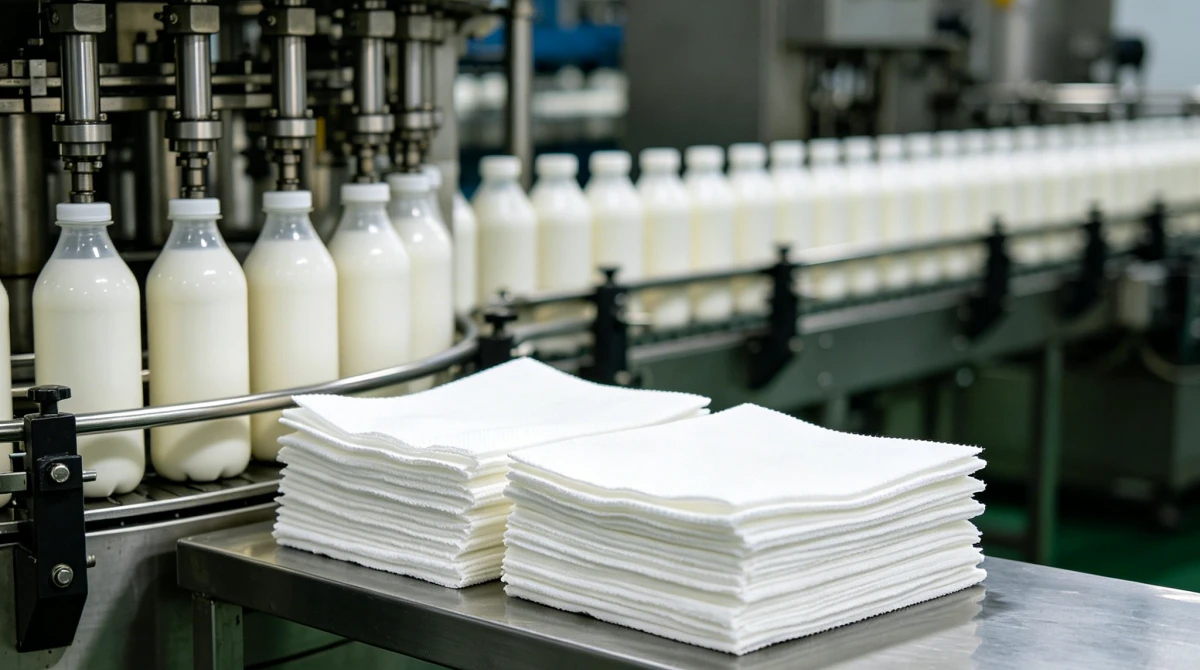
A dairy processing plant in Shandong got hit with an FDA Form 483 during a routine inspection last year. The finding had nothing to do with their product, their process, or their hygiene protocols. It was the wiping cloths on their filling line. The auditor asked for documentation proving the wipes were safe for food contact surfaces. The plant manager showed a spec sheet that said “food safe.” The auditor said: “That’s a claim. Show me the evidence.”
They couldn’t. The wipes had no FDA compliance documentation, no extractable testing, no material traceability. The plant spent four months qualifying a new supplier and revalidating their cleaning procedures. The wipes cost ¥0.15 each. The remediation cost ¥200,000.
We supply industrial wiping cloths to food and beverage manufacturers, pharmaceutical packaging facilities, and consumer goods production lines across Asia. This guide covers what we’ve learned about specifying wipes for food-contact and near-food-contact applications—where “food safe” on a label means nothing without the paperwork to back it up.
FDA Food Contact Compliance: What It Actually Means
FDA doesn’t have a specific regulation for “food grade wipes.” What they have is a framework that covers any material that contacts or may contact food surfaces. Your wipe falls under one of these categories:
- Food Contact Substance (FCS) — If the wipe directly contacts food (wiping a conveyor belt that carries unpackaged food), it’s an FCS and requires FDA clearance under 21 CFR. The wipe material, any coatings, binders, or additives must be listed in the regulation or have a Food Contact Notification (FCN) approval.
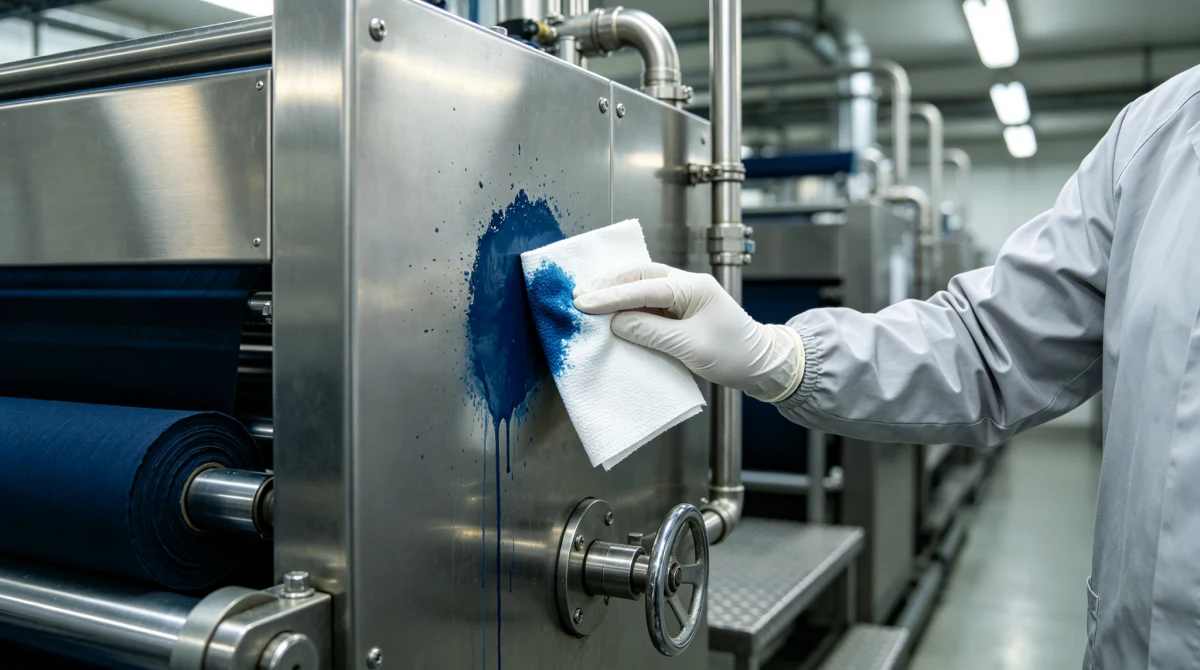
- Indirect food additive — If the wipe contacts a food-contact surface but not the food itself (wiping a filling nozzle exterior, cleaning a stainless steel prep table), it’s an indirect food additive. The wipe must not transfer harmful substances to the food-contact surface at levels that could migrate to food.
- Non-food-contact surface — If the wipe only contacts surfaces that never touch food (equipment exteriors, floors, non-contact machine parts), food contact compliance isn’t legally required—but your HACCP plan may still require documented material safety.
The critical distinction: “food safe” is a marketing claim. FDA compliance is a documented regulatory status backed by testing data. If your wipe supplier says their product is “food safe” but can’t provide 21 CFR compliance documentation, extractable testing results, or a Food Contact Notification number, the claim is unsubstantiated. Your auditor will treat it as such.
EU Food Contact Regulation: The Other Standard You May Need
If your products are exported to the European Union, or if you’re a European manufacturer, you need to comply with Regulation (EC) No 1935/2004 and the specific measures for materials and articles intended to come into contact with food. For wipes, the key requirements are:
- Declaration of Compliance (DoC) — The wipe supplier must provide a DoC stating that the product complies with Regulation (EC) No 1935/2004, including identification of the product, the supplier, and the specific migration limits that apply.
- Overall migration limit — 10 mg/dm² of food-contact surface area. This is the total amount of substances that can migrate from the wipe to the food-contact surface.
- Specific migration limits — For certain substances (e.g., primary aromatic amines, formaldehyde, heavy metals), specific migration limits apply. Your wipe’s extractable profile must be below these limits.
If you supply both the US and EU markets, your wipe must comply with both FDA 21 CFR and EU 1935/2004. The testing frameworks are different, and compliance with one doesn’t guarantee compliance with the other. Ask your supplier for documentation covering both regulatory frameworks.
Material Selection: Which Wipe Materials Are Safe for Food Surfaces
Not all cleanroom wipe materials are suitable for food-contact applications. Here’s the breakdown:
| Material | FDA Status | EU Status | Best Application |
|---|---|---|---|
| 100% Polyester (PET) | Cleared under 21 CFR 177.1630 | Compliant with EU 10/2011 | General food-contact surface cleaning, filling line wipe-down |
| 100% Polypropylene (PP) | Cleared under 21 CFR 177.1520 | Compliant with EU 10/2011 | Chemical-resistant applications, high-moisture environments |
| Wood Pulp / PP Blend | Cleared (pulp component under 21 CFR 176.170) | Compliant with proper documentation | General-purpose wiping, high-absorption applications |
| Rayon / Polyester Blend | Requires specific FCN or prior sanction | Requires specific compliance documentation | Soft-surface applications, glass and polished metal |
| Cotton | Generally recognized as safe (natural fiber) | Compliant but requires pesticide residue testing | Heavy-duty wiping, abrasive applications |
The material alone doesn’t guarantee compliance. Additives, binders, coatings, and finishing agents used in wipe manufacturing must also be food-contact cleared. A polyester wipe with a silicone-based release agent from the manufacturing process is not food-safe even though the polyester itself is. Request a full material declaration from your supplier showing all components, not just the base fiber.
Chemical Safety: Extractables, Leachables, and Migration Testing
FDA and EU auditors don’t just check what your wipe is made of—they check what it might release onto food-contact surfaces. This requires migration testing that simulates actual use conditions.
What Migration Testing Covers
- Overall migration — Total amount of substances that migrate from the wipe to a food-contact surface under simulated conditions (temperature, contact time, food simulant). Must be below 10 mg/dm² for EU compliance.
- Specific migration — Targeted testing for substances of concern: primary aromatic amines (from azo dyes), formaldehyde (from certain binders), heavy metals (from pigments or processing aids), and volatile organic compounds.
- Extractable profiling — GC-MS (Gas Chromatography-Mass Spectrometry) analysis identifying all organic compounds that can be extracted from the wipe under aggressive conditions. This catches contaminants that targeted migration testing might miss.
Request migration testing data from your supplier that uses food simulants relevant to your production environment. A wipe tested with 10% ethanol (aqueous food simulant) may have different migration results when exposed to fatty food simulants or acidic cleaning solutions. Your testing should match your actual use conditions.
HACCP Integration: Where Wipes Fit in Your Food Safety Plan
Your HACCP (Hazard Analysis and Critical Control Points) plan must address all materials that contact food-contact surfaces—including wiping cloths. Here’s how wipes integrate into your HACCP framework:
Hazard Analysis
Identify the hazards associated with your wiping cloths: chemical contamination (extractable compounds, residual solvents), physical contamination (fibers, particles), and biological contamination (microbial growth on wet wipes or improperly stored dry wipes). Document the controls for each hazard.
Critical Control Points
If your filling line wipe-down is a CCP in your HACCP plan, the wipe itself becomes a controlled input. Specify the approved wipe product, require lot-level incoming inspection, and document wipe usage at each CCP. If you switch suppliers, the change must go through your HACCP team for review.
Prerequisite Programs
Even if wipes aren’t a CCP, they’re part of your prerequisite program for sanitation. Document your wipe specifications, approved supplier list, incoming inspection procedures, and storage requirements. Your auditor will check these during GMP inspections.
A food manufacturer we work with in Jiangsu integrated their wipe management into their HACCP plan after an auditor finding. They now track every wipe lot used at their filling line CCPs—lot number, supplier, incoming inspection results, and usage date. The traceability took two hours to set up. The audit findings took four months to close.
Allergen Cross-Contact: Wipe Management in Multi-Product Facilities
If your facility processes multiple products—especially products with allergen declarations—your wipe management becomes a critical allergen control point. Wipes used on a dairy line cannot be used on a soy-free production line without validated cleaning. And “validated cleaning” for a wipe means using a new wipe, not rinsing the old one.
Allergen Wipe Segregation
- Color-coded wipe systems — Use different colored wipes or wipe packaging for allergen-zoned areas. Red for dairy, blue for soy, green for nut-free zones. This is a visual control that prevents cross-contact at the point of use.
- Single-use policy — In allergen-controlled zones, wipes are single-use. One wipe, one surface, then discard. Reusing a wipe that contacted an allergen-containing surface transfers the allergen to the next surface.
- Supplier allergen declaration — Your wipe supplier must declare whether their manufacturing process uses or processes any of the major allergens (milk, eggs, fish, shellfish, tree nuts, peanuts, wheat, soy, sesame). This is a standard allergen control requirement for any input to your food safety plan.
Sanitizing Wet Wipes vs. Dry Wipes: What’s the Difference and When to Use Each
Food manufacturers use both dry and pre-wetted (sanitizing) wipes. The distinction matters for compliance:
Dry Wipes
Used for surface preparation, spill absorption, and general wipe-down where no sanitizing action is required. The wipe itself must be food-contact compliant if it contacts food surfaces, but it doesn’t carry a sanitizer claim. Dry wipes are typically more cost-effective and have longer shelf life.
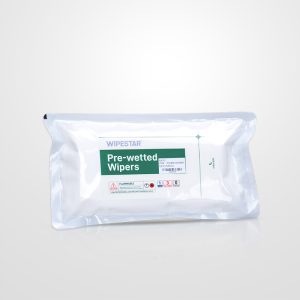
Pre-Wetted Sanitizing Wipes
These carry an EPA-registered sanitizer claim and must comply with both food-contact material regulations and EPA pesticide regulations (sanitizers are classified as pesticides under FIFRA). The sanitizer concentration, contact time, and surface compatibility must match your HACCP plan requirements. Key considerations:
- The sanitizer in the wipe must be approved for food-contact surface sanitization at the concentration in the wipe (typically quaternary ammonium compounds, hydrogen peroxide, or peracetic acid).
- Contact time matters—a sanitizer wipe that requires 30 seconds of wet contact time doesn’t work if the surface dries in 10 seconds. Match the wipe’s wet contact time to the sanitizer’s required dwell time.
- The wipe material must not neutralize the sanitizer. Some wipe fibers absorb or react with sanitizing agents, reducing efficacy below the registered concentration.
Documentation Requirements for Food-Grade Wipe Procurement
For food manufacturing applications, your supplier must provide:
- FDA Compliance Statement — Specific 21 CFR citations for each component of the wipe (fiber, binder, coating, finishing agent). “Food safe” without 21 CFR citations is not a compliance statement.
- EU Declaration of Compliance — Per Regulation (EC) No 1935/2004 and Commission Regulation (EU) No 10/2011, with overall and specific migration test results.
- Material Safety Data Sheet (SDS) — Current, complete, covering all components of the wipe. Your facility’s chemical safety program requires this.
- Migration Testing Report — Overall migration and specific migration test results using food simulants relevant to your application. Test laboratory must be accredited.
- Allergen Declaration — Statement confirming whether the wipe manufacturing process involves any of the major food allergens.
- Material Traceability — Raw material source, lot numbers, manufacturing date, and production facility. Required for HACCP documentation and audit traceability.
- ISO 9001:2015 / FSSC 22000 Certificate — Quality management certificate covering the manufacturing site. FSSC 22000 certification of your wipe supplier is a significant advantage for food industry audits.
If your supplier can’t provide items 1–4, the wipe isn’t food-grade regardless of what the packaging says. We maintain complete compliance documentation for every food-industry customer and update it when regulations change.
Your Food Industry Consumables Team at WIPESTAR
Food manufacturing accounts get a team that understands FDA, EU, and HACCP requirements—not just product specifications.

Vicky — Foreign Trade Sales Supervisor
Vicky manages overseas food industry accounts with the documentation rigor that FDA and EU compliance demands. She coordinates lot-level compliance packages—FDA statements, EU DoC, migration test reports, allergen declarations—and ensures they arrive with every shipment. If you export to the US or EU, she handles the regulatory documentation trail from our factory to your QA team.

Juan — Purification Industry Specialist
Juan’s background in contamination control extends to food manufacturing environments. He understands how your facility’s air handling, surface materials, and cleaning protocols interact with your consumable choices. For food production lines with specific hygiene zone requirements, he helps match wipe specifications to your HACCP plan and prerequisite program needs.

Zac — Customer Service
Zac handles day-to-day order management and customer support. For food manufacturers with seasonal demand peaks—canning season, dairy processing cycles, holiday production ramps—he coordinates production scheduling and safety stock to make sure your line never runs out of wipes during peak demand. He’s also your first contact for quality issue escalation and replacement shipment coordination.

Carolina — Product Specialist
Carolina works with our production team to ensure food-grade wipe lots meet the tighter specification requirements that food manufacturing demands. She manages the compliance documentation for each lot—migration testing data, allergen declarations, material traceability—and coordinates with accredited test laboratories when new test data is needed for regulatory updates or customer requirements.
Meet the full team: WIPESTAR Team Page →
Frequently Asked Questions About Food Grade Industrial Wiping Cloths
Request Food-Grade Wiping Cloth Samples and Compliance Documentation
We supply food-grade industrial wiping cloths direct from our factory—full FDA 21 CFR compliance documentation, EU Declaration of Compliance, migration testing reports, allergen declarations, and lot-level traceability. ISO 9001:2015 certified production. Free samples with complete compliance documentation for qualified food manufacturers.
Browse our wiping cloth range →
Request Compliance Documentation →