English
 Chinese



Why ESD Destroys Electronics — And Why Your Wipe Choice Matters
Last October I got a call from a process engineer at a chip packaging line in Penang. Their yield had dropped 3% over two months — not catastrophic, but enough to trigger a root-cause investigation. They’d checked everything: reflow profiles, solder paste viscosity, placement accuracy. Nothing stood out.
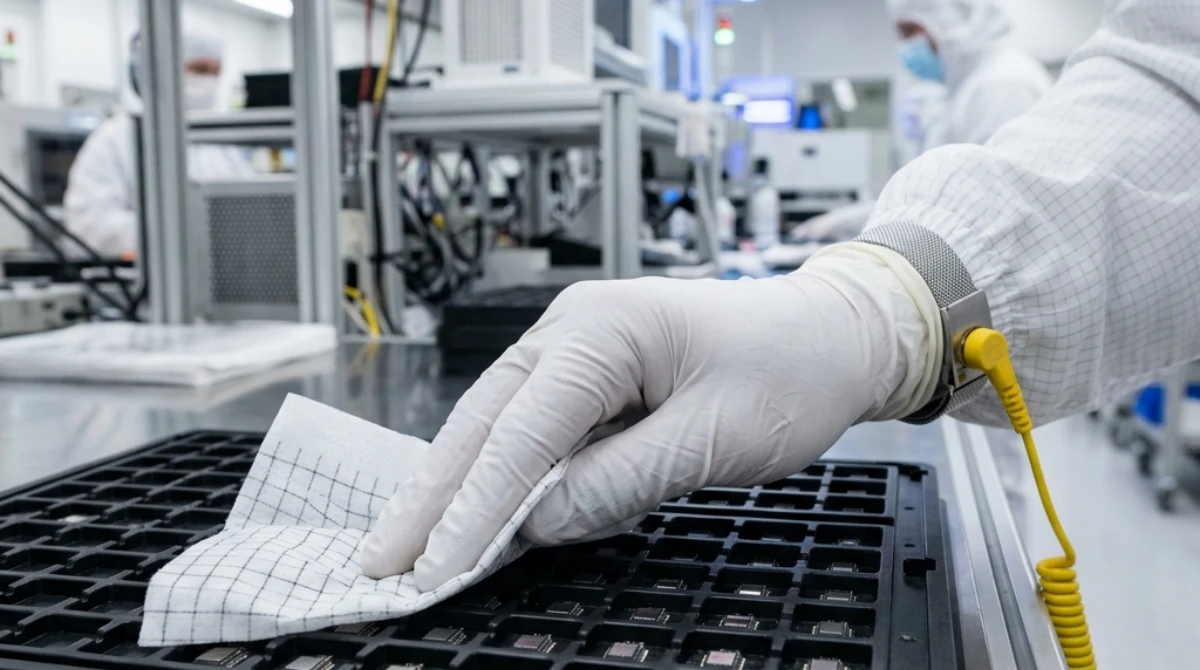
Then someone noticed the operators were using general-purpose polyester wipes to clean carrier trays and fixture surfaces between runs. The wipes worked fine for particle removal. But every pass generated a static charge on the tray surface — enough to zap bare dies during the next loading cycle. Three months of cumulative ESD events had degraded enough components to move the yield needle.
The fix cost almost nothing. They switched to ESD-safe wipes with embedded static-dissipative fibers, added a wipe-down step to the standard work instruction, and the yield recovered within two weeks.
This story plays out across electronics manufacturing more often than most facilities admit. ESD damage is insidious — it doesn’t always cause immediate failure. A component weakened by an electrostatic discharge might pass testing, ship to the customer, and fail six months into service. By then, tracing the root cause back to a cleaning wipe is nearly impossible.
How ESD-Safe Wipes Actually Work (It’s Not Magic)
A standard cleanroom wipe — even a high-quality continuous-filament polyester — is an insulator. Rub it across a surface, and it generates triboelectric charge through friction. That charge has nowhere to go. It sits on the surface until it discharges into the next conductive object it contacts — like a bare die, a wire bond, or a PCB trace.
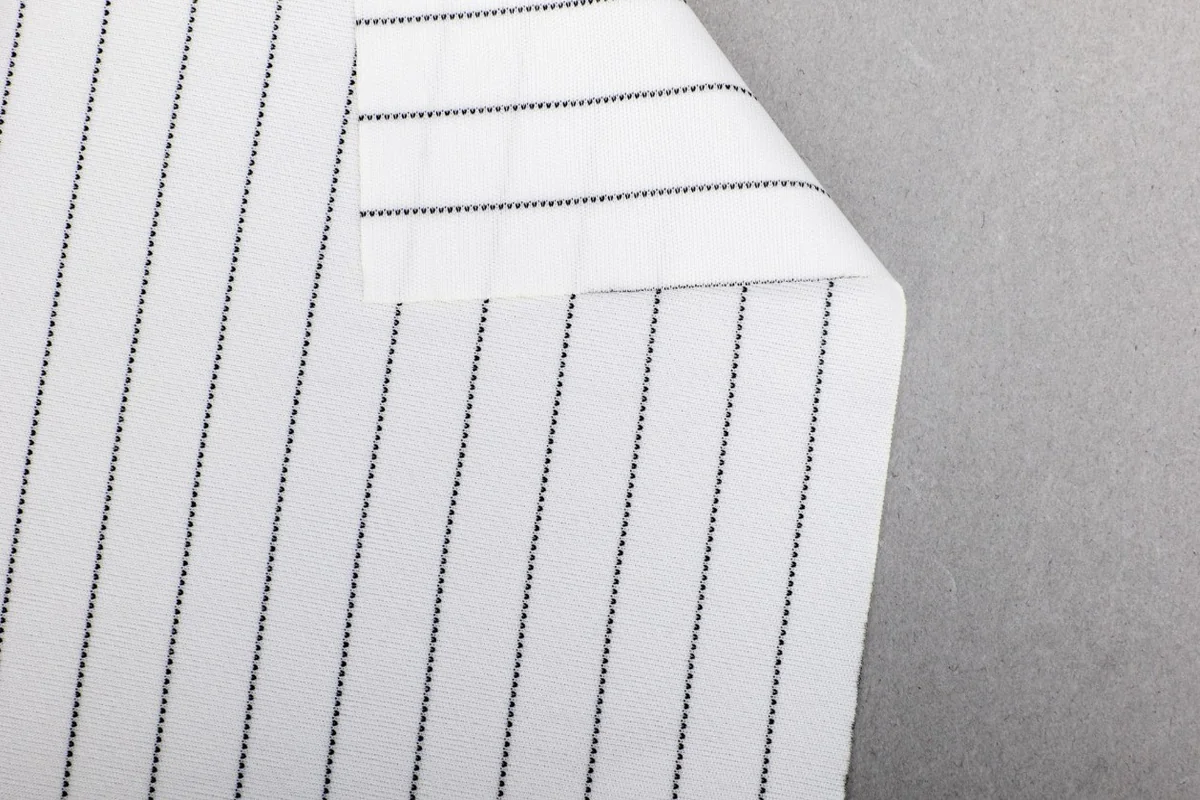
ESD-safe wipes solve this by incorporating conductive or static-dissipative fibers into the fabric structure. These fibers create a controlled path for charge to bleed off the surface during wiping. The key specifications:
- Surface resistance: 10⁵–10¹¹ ohms. Below 10⁵ is conductive (too aggressive — can cause rapid discharge). Above 10¹¹ is effectively insulative (useless for ESD control). The sweet spot for electronics manufacturing is 10⁶–10⁹ ohms.
- Static dissipation time: Less than 2 seconds from 1,000V to 100V. For high-sensitivity applications (bare dies, wafer-level packaging), look for under 0.5 seconds.
- Charge generation: The voltage generated by friction during wiping should stay below 100V. Standard polyester wipes can generate 5,000V or more from a single pass.
The static-dissipative fibers are typically spaced 5–10mm apart in the fabric weave. This spacing matters — too far apart and you get charge pockets between the fibers; too close and you compromise the wipe’s absorbency and particle-capture performance. At WIPESTAR, we engineer the spacing based on the target application — tighter for wafer handling, wider for general electronics assembly.
5 Spec Sheet Mistakes That Lead to ESD Failures
1. Confusing “Anti-Static” with “Static-Dissipative”
These are different properties. Anti-static means the material resists generating charge. Static-dissipative means it actively bleeds charge away. A wipe can be anti-static (low triboelectric generation) but still accumulate charge over time if it lacks dissipation capability. For electronics manufacturing, you need both properties — low charge generation AND active dissipation.
2. Ignoring the Test Method
Surface resistance values are meaningless without knowing the test method. ANSI/ESD STM11.11 and IEC 61340-2-3 measure different things under different conditions. A spec sheet that says “10⁸ ohms” without specifying the test standard is giving you a number without context. Always ask: tested how, at what humidity, and at what voltage?
3. Not Checking the Dissipation Rate
Surface resistance tells you the wipe can eventually dissipate charge. Dissipation rate tells you how fast. In a high-throughput packaging line where operators wipe fixtures every 30 seconds, a wipe that takes 5 seconds to dissipate charge is too slow — the next component is already on the fixture before the charge clears. For fast-cycle processes, demand dissipation data at your actual operating voltage.
4. Overlooking Extractables in ESD Wipes
The conductive fibers in ESD-safe wipes sometimes use carbon or metallic coatings. Under certain solvent conditions (IPA, acetone, NMP), these coatings can leach extractable compounds onto the wiped surface. For semiconductor and display applications, extractable contamination is as dangerous as ESD damage. Always request extractable profiles for the specific solvents you use in your process.
5. Assuming All Sizes Perform Identically
ESD performance can vary with wipe size. A 4″×4″ wipe has a different fiber density per unit area than a 9″×9″ wipe of the same material. The static-dissipative fiber spacing changes with the fold pattern and how the wipe is dispensed. Test the exact size and fold you plan to use in production — don’t extrapolate from a different SKU.
Matching the Right Wipe to Your Electronics Process
Different electronics manufacturing stages have different ESD sensitivity levels. A wipe that’s perfect for PCB assembly might be completely wrong for bare die handling. Here’s how to match:
| Process Stage | ESD Sensitivity | Recommended Wipe Type | Key Requirement |
|---|---|---|---|
| Wafer fabrication / bare die handling | Class 0 (<250V HBM) | Ultra-clean ESD polyester, laser-sealed edge | Dissipation <0.5s, particle count <50/cm² at ≥0.5µm |
| Chip packaging & wire bonding | Class 0A (0–125V CDM) | ESD continuous-filament polyester, 100–120 GSM | Surface resistance 10⁶–10⁸Ω, low extractables |
| SMT / PCB assembly | Class 1A (250–500V HBM) | ESD polyester or ESD microfiber blend | Good solvent compatibility, moderate dissipation |
| Final assembly & test | Class 1B (500–1000V HBM) | Standard ESD wipes, 90–120 GSM | Cost-effective, good absorbency |
| Fixture & equipment cleaning | Class 2 (1000–2000V HBM) | Heavy-duty ESD wipes, higher GSM | Abrasion resistance, chemical compatibility |
The critical insight most procurement teams miss: you don’t need the same ESD wipe for every stage. Using a Class 0-rated wipe for fixture cleaning wastes money. Using a Class 2-rated wipe for bare die handling risks yield loss. Zone-based procurement — where the wipe matches the ESD sensitivity of the process — cuts cost while improving protection.
For semiconductor and microelectronics applications, see our guide on choosing cleanroom wipes for semiconductor wafer fabrication. For PCB assembly specifics, our PCB assembly wiping cloth guide covers defect reduction in detail.
How to Test ESD-Safe Wipes in Your Facility Before You Commit
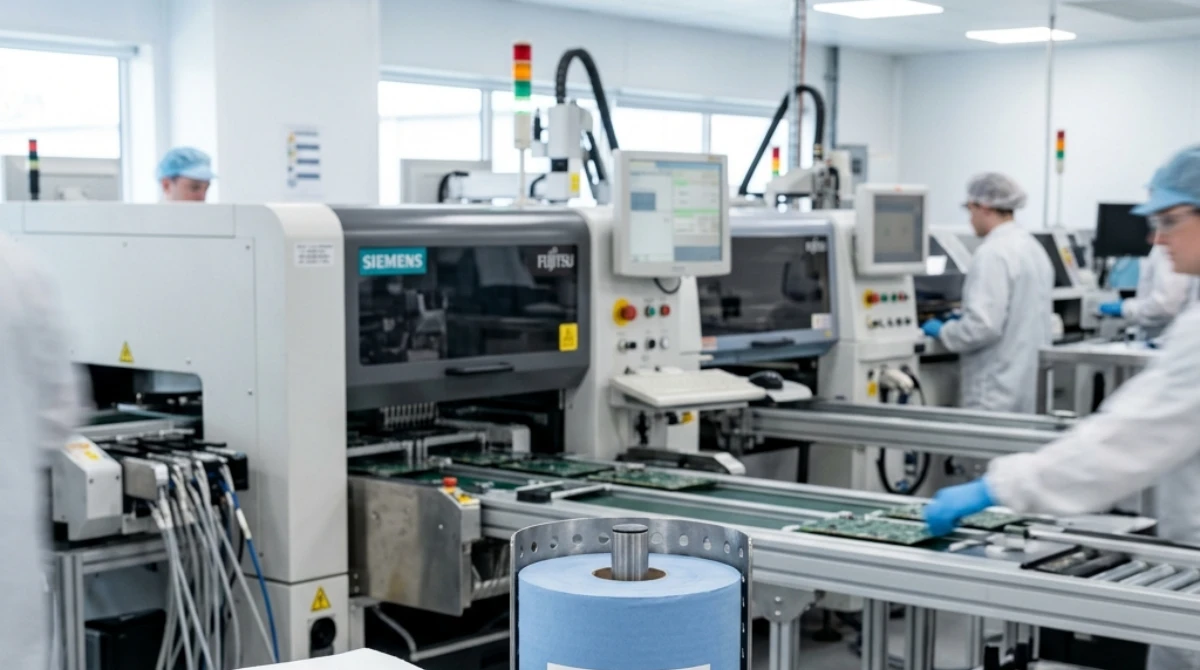
Spec sheets are a starting point. The real test is your environment, your chemicals, your operators. Here’s a practical protocol for evaluating ESD-safe wipes on-site:
Equipment You Need
- Surface resistance meter (megohmmeter with concentric ring electrode)
- Electrostatic field meter or charge plate monitor
- Particle counter (if cleanroom-rated)
- Your standard cleaning solvents
- 5–10 operators from different shifts
Test Protocol
- Baseline measurement. Measure the static voltage on your target surface before wiping. This is your control.
- Single-pass test. Wipe once with the candidate product. Measure the voltage immediately after the pass, then at 0.5s, 1s, 2s, and 5s intervals. Plot the decay curve.
- Repeated-pass test. Wipe the same surface 20 times with the same wipe section. Measure particle generation and surface resistance after the 20th pass. ESD performance should remain stable — if resistance drifts by more than one order of magnitude, the conductive fibers are degrading.
- Solvent compatibility. Wet the wipe with your standard solvent (IPA, acetone, deionized water, whatever you use). Repeat the single-pass test. Some ESD coatings lose performance when saturated — the solvent bridges the dissipative fibers and changes the resistance profile.
- Operator feedback. Give each test operator 20 wipes and a structured feedback form. Ask about feel, tear resistance, wet strength, and whether they’d use it daily. Your operators use these all day — their comfort matters more than spec sheet numbers.
We ship ESD-safe wipe samples from our product range at no charge. Send us your process specs, ESD sensitivity class, and cleaning chemicals — we’ll recommend the 2–3 products most likely to work and ship samples within 48 hours.
What ESD-Safe Wipes Actually Cost (And What They Save)
ESD-safe wipes cost 30–80% more per sheet than their non-ESD equivalents. That premium looks steep until you run the cost-per-task analysis — the same framework we use in our industrial wipe procurement guide.
| Cost Component | Standard Polyester Wipe | ESD-Safe Polyester Wipe |
|---|---|---|
| Unit price | $0.08 | $0.14 |
| Sheets per task | 1.5 | 1.5 |
| Cost per task (wipe only) | $0.12 | $0.21 |
| Monthly ESD-related yield loss | $8,000–$25,000 | $0–$500 |
| Monthly field failure returns (ESD-caused) | $3,000–$12,000 | $0–$1,000 |
| Monthly wipe cost (200 tasks/day × 22 days) | $528 | $924 |
| Monthly total | $11,528–$37,528 | $924–$2,424 |
The wipe that costs 75% more per sheet delivers 90–95% lower total cost. The math is even more favorable for high-value products — a single ESD-damaged wafer can cost hundreds of dollars in scrap. At 200 wipe tasks per day, the payback period for switching to ESD-safe wipes is measured in days, not months.
For a deeper breakdown of cost modeling across industrial wiping applications, see our guide on reducing industrial wiping cloth costs and our analysis of total cost of ownership for industrial cleaning wipes.
Frequently Asked Questions
Request ESD-Safe Wipe Samples
Static-dissipative cleanroom wipes for semiconductor, PCB assembly, and electronics manufacturing — factory direct from our Shenzhen production facility. ISO-certified quality, lot traceability, and technical support included.