English
 Chinese



Who This Guide Is For
You’re a procurement manager, purchasing specialist, or facility operations lead. You buy industrial wiping cloths, cleanroom wipes, or specialty cleaning consumables — maybe a few thousand dollars a year, maybe six figures. Your current supplier works “fine.” Your current product passes audits. But you suspect there’s a better deal out there, or your quality team keeps flagging wipe-related incidents, or your boss just asked you to cut consumable spend by 15%.
This isn’t a technical paper about fiber structures or ISO classifications. It’s a procurement decision framework — the kind of analysis I walk through with purchasing teams who come to us asking whether they’re buying the right product at the right price from the right supplier.
The short version: most industrial buyers overpay for wipes because they optimize on unit price instead of total task cost. Some underpay and bleed money on rework. The sweet spot requires understanding three things — what you’re actually cleaning, how much you actually use per task, and what your supplier actually controls in their production process.
7 Procurement Mistakes That Cost More Than They Save
1. Buying on Unit Price Alone
The cheapest wipe on the shelf is almost never the cheapest wipe per task. A cotton rag at $0.03 per piece that takes five sheets to do what one engineered wipe does at $0.10 isn’t saving you $0.07 — it’s costing you an extra $0.05 per task, plus the risk of fiber contamination. Procurement teams that benchmark on cost-per-sheet instead of cost-per-task consistently overspend by 30–60%.
2. Using One SKU Across Every Zone
Standardizing on a single wipe simplifies purchasing and reduces SKU management overhead. It also wastes money. A cleanroom-rated continuous-filament polyester wipe used in a gowning room corridor is overkill. A general-purpose cloth used in an ISO Class 5 zone is a contamination risk. Zone-based procurement — where the wipe matches the criticality of the area — typically cuts total spend by 20–35% while improving cleanliness outcomes.
3. Ignoring Dispensing Format
A wipe in a bag costs less per sheet than the same wipe in a pop-up box. But workers wearing gloves can’t open bags cleanly — they grab handfuls instead of individual sheets, and consumption spikes 40–80% above what the spec sheet predicts. The packaging format is part of the product decision, not an afterthought.
4. Skipping the On-Site Trial
Spec sheets look promising. Lab data is clean. But the only test that matters is your team using the wipe on your surfaces with your chemicals in your environment. A proper trial — 50–100 units, across 2–3 use cases, with operator feedback collected — takes two weeks and costs almost nothing. Skipping it costs everything when the wrong product lands in bulk.
5. Not Tracking Actual Consumption
Most facilities don’t know how many wipes they actually use per shift, per line, per task. They know how many they order per month. The gap between those two numbers — the gap between what arrives and what gets used — is where waste, hoarding, and misuse live. A simple consumption log for 30 days reveals patterns that change procurement decisions permanently.
6. Locking Into Annual Contracts Without Benchmarks
Annual contracts with volume commitments make sense for predictable demand. But they only work if you’ve benchmarked the product first and if the contract includes quality guarantees — not just price and delivery terms. A contract that guarantees $0.08 per sheet but doesn’t specify particle counts, fiber shedding limits, or extractable profiles is a contract that lets quality drift while you’re locked in.
7. Treating Wipes as a Commodity
Indirect materials — gloves, tape, wipes, lubricants — get lumped into “MRO spend” and bought from whoever offers the lowest price on a distributor portal. For some MRO categories, that’s fine. For wiping cloths that touch your product surface, your cleanroom environment, or your paint line, the wipe is a process input. Treating it like a commodity means you’re optimizing the wrong variable.
Building a True Cost-Per-Task Model
The cost-per-task model is the single most useful tool in wipe procurement. Here’s how to build one for your facility:
Step 1: Define the Task
Be specific. “Cleaning the production line” is too vague. “Wiping the interior of a CNC fixture between aluminum casting runs to remove cutting fluid and metal fines” is a task. Each task has a defined surface, a defined contaminant, and a defined outcome. List every distinct wipe task in your facility — most plants have 8–15.
Step 2: Measure Current Consumption
For each task, count how many sheets your operators actually use per occurrence. Not how many the spec sheet says — how many they grab. Do this across multiple operators and multiple shifts. The variance is usually wider than you expect.
Step 3: Add the Hidden Costs
The per-sheet price is visible. These costs are not:
- Rework rate. How many quality incidents per month trace back to wipe-related contamination? What does each incident cost in labor, scrap, and customer impact?
- Operator time. A wipe that takes two passes instead of six saves 30–45 seconds per task. Across 200 tasks per shift, that’s 2.5–3 hours of recovered production time daily.
- Disposal volume. More sheets used means more waste handling — bags, bins, hazmat classification if the wipe absorbed solvents or oils.
- Inventory carrying cost. A facility stocking 50 SKUs of wipes across different zones ties up warehouse space and management attention. Consolidating to 8–12 well-chosen SKUs frees resources.
Step 4: Calculate and Compare
| Component | Cotton Rags | Engineered Wiping Cloths |
|---|---|---|
| Unit price | $0.03 | $0.10 |
| Sheets per task (measured) | 5.2 | 1.4 |
| Cost per task | $0.16 | $0.14 |
| Tasks per shift | 200 | 200 |
| Daily wipe cost | $96 | $84 |
| Monthly rework incidents (wipe-related) | 6–10 | 0–1 |
| Monthly rework cost | $4,500–$12,000 | $0–$750 |
| Monthly total | $6,300–$14,400 | $2,500–$3,250 |
The wipe that costs 3× more per sheet delivers a monthly cost that’s 50–75% lower. This pattern holds across automotive paint shops, semiconductor fabs, pharmaceutical cleanrooms, and general manufacturing. The details change; the math doesn’t.
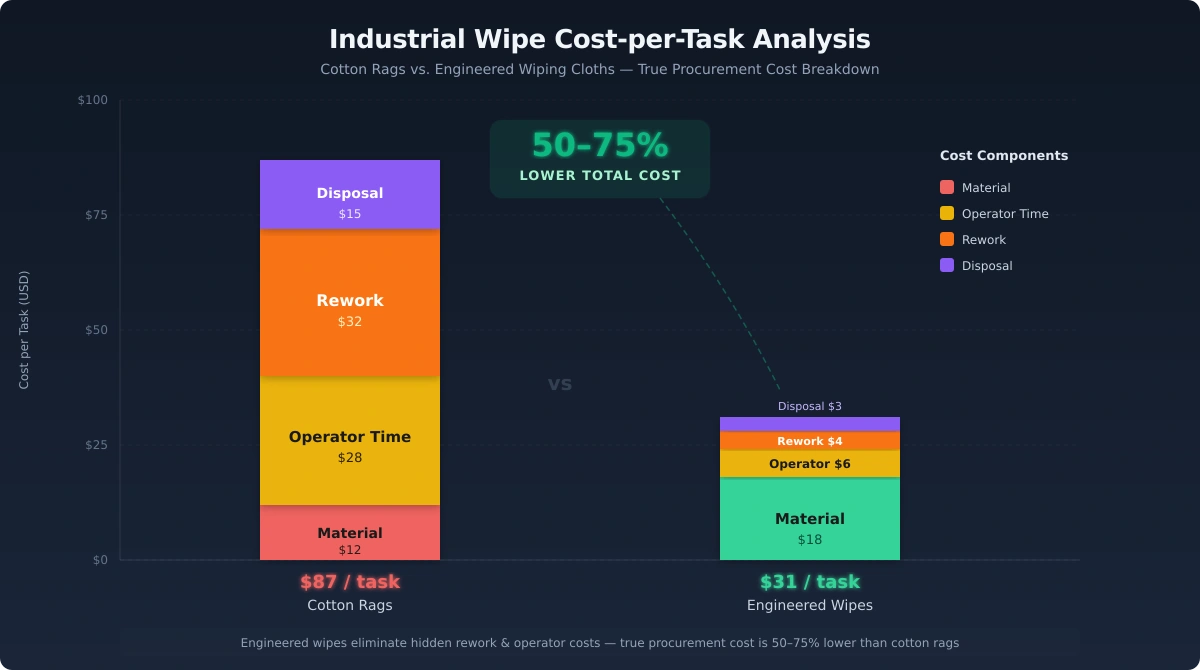
For a deeper look at how this plays out in specific industries, see our guides on reducing industrial wiping cloth costs and industrial cleaning wipes and total cost of ownership.
Supplier Qualification Checklist: 12 Points That Matter
Not all wipe suppliers are equal. Here’s what to evaluate before committing to a vendor — whether that’s us or someone else:
Production Control
- Own manufacturing vs. reselling. A supplier that manufactures controls quality from raw material to finished product. A reseller controls packaging and logistics. The difference matters when you have a quality issue that needs root-cause analysis.
- Raw material sourcing. Ask where the polyester, polypropylene, cellulose, or microfiber comes from. Consistent raw materials mean consistent wipe performance lot-to-lot.
- Production capacity. Can they handle your volume without stretching lead times? What’s their backup plan during demand spikes?
Quality Systems
- ISO certification. ISO 9001 is the baseline. For cleanroom wipes, look for ISO 14644 awareness and documented cleanroom production environments.
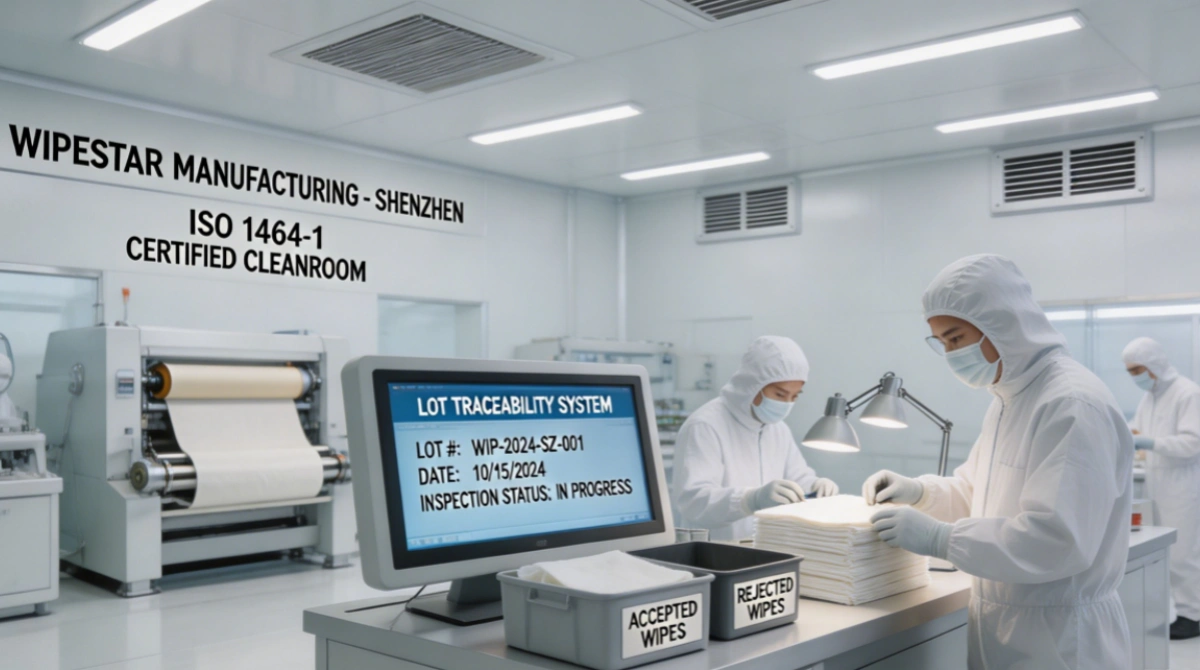
- Lot traceability. Can they trace a finished wipe back to the raw material batch, production date, and quality check records? If a defect shows up in your facility, traceability is how you find the root cause.
- Testing documentation. What data do they provide? Particle counts, fiber shedding rates, extractable profiles, chemical compatibility — the spec sheet should have numbers, not adjectives.
Service and Support
- Sample availability. A good supplier ships samples within 48 hours and doesn’t pressure you into a bulk order before you’ve tested.
- Technical support. When you call with a contamination problem, do you get a salesperson or someone who understands your production environment? The gap between those two experiences defines the relationship.
- Lead time consistency. Quoted lead times are marketing. Actual lead times — tracked over 6–12 months of orders — are data. Ask for them.
Commercial Terms
- Pricing transparency. Is the price structure clear — unit cost, volume breaks, shipping terms? Or are there hidden fees, minimum order surcharges, and price adjustment clauses?
- OEM capability. If you need custom sizes, specific fold patterns, private labeling, or modified packaging — can they do it? What’s the minimum order for customization?
- Return and quality claim process. When something goes wrong, how fast do they respond? A 30-day investigation process for a quality claim on a production-critical consumable is unacceptable.
At WIPESTAR, we publish our capabilities openly because we’d rather you choose us for the right reasons than discover the wrong ones after a bulk order.
Reading a Wipe Spec Sheet Without Getting Misled
Every wipe supplier publishes a spec sheet. Not every spec sheet tells you what you actually need to know. Here’s how to read one critically:
What Matters on the Spec Sheet
- Material composition. “Lint-free” is a marketing claim. “100% continuous-filament polyester, knitted, 75 gsm” is a specification. Know what the wipe is made of — the material determines absorption, particle generation, chemical compatibility, and cost.
- Particle count data. For cleanroom wipes, look for particle counts at specific size thresholds (≥0.5µm, ≥1.0µm, ≥5.0µm) per unit area. This data should come from IEST-RP-CC004 or equivalent test methods.
- Extractable profiles. What chemicals leach out of the wipe when exposed to solvents? For semiconductor, pharma, and electronics applications, this data is critical. If the spec sheet doesn’t list extractables, the supplier either hasn’t tested or doesn’t want you to see the results.
- Chemical compatibility. Which solvents is the wipe rated for? At what concentrations? “Compatible with IPA” is vague. “No degradation after 24-hour immersion in 99% IPA, acetone, and NMP” is actionable.
What to Ignore (or Challenge)
- “Premium quality.” Every supplier says this. It means nothing without data.
- “Ultra-low linting.” How low? Measured how? By whose standard? Ask for the test method and the actual number.
- “Suitable for cleanroom use.” Which cleanroom class? ISO 5 and ISO 8 are vastly different environments. A wipe “suitable for cleanroom use” might be rated for ISO 8 only.
Our Industrial Wipes Materials & Types Guide breaks down the technical properties of each material class. Our Wiping Cloth Selection Guide matches materials to applications. And our product catalog includes spec sheets with actual numbers — not adjectives.
How to Run a Proper Wipe Trial in Your Facility
A wipe trial isn’t complicated, but most facilities do it wrong. They test on one surface, ask one operator, and make a decision based on a single afternoon’s impression. Here’s a better approach:
Trial Design
- Select 2–3 candidate products. Include your current wipe as the control. The candidates should represent different materials or specifications — not three variants of the same thing.
- Define 3–5 test tasks. Pick tasks that represent the range of your facility’s cleaning needs — a high-criticality task (paint prep, cleanroom wipe-down), a medium task (equipment cleaning), and a high-volume task (general surface cleanup).
- Run 50–100 units per candidate per task. Enough to see patterns, not enough to break the budget.
- Measure four outcomes:
- Sheets used per task (count, don’t estimate)
- Time per task (stopwatch, not memory)
- Visual quality result (photograph under consistent lighting)
- Operator feedback (structured form, not hallway conversation)
Evaluation Criteria
After the trial, score each product on a 1–5 scale across these dimensions:
- Cleaning effectiveness. Does it remove the target contaminant completely in the expected number of passes?
- Fiber shedding. Inspect the cleaned surface under appropriate lighting. Any visible fibers?
- Wet strength. Does the wipe hold together when saturated with solvent or oil?
- Operator preference. Your production team uses these all day. Their comfort and efficiency matter.
- Cost per task. Not cost per sheet — cost per completed task, measured during the trial.
We ship trial samples from our product range at no charge. Send us your specs, your surface types, and your cleaning chemicals — we’ll recommend the 2–3 products most likely to work and ship samples within 48 hours. No pressure, no minimum order commitment.
Contract Negotiation: What to Push On and What to Accept
Once you’ve selected a product, the negotiation phase determines whether you get good value or great value. Here’s what experienced procurement teams focus on:
Push On These
- Quality guarantees in writing. Your contract should specify acceptable ranges for particle counts, fiber shedding, and extractable profiles — not just “ISO certified.” If quality drifts outside those ranges, you need a defined remediation process, not a customer service ticket.
- Lot-to-lot consistency requirements. Ask for a variance limit on key specifications. A wipe that performs great on one order and poorly on the next creates unpredictable quality outcomes on your floor.
- Lead time penalties. If your production depends on a steady supply of cleaning consumables, late deliveries cost you real money. Build lead time guarantees into the contract with meaningful remedies.
Accept (or Don’t Fight)
- Volume pricing tiers. These are standard. A 10–20% discount at annual volumes is normal and reasonable. Fighting for 30%+ on a consumable that’s already cost-effective per task burns relationship capital you might need later.
- Minimum order quantities. MOQs exist because production runs have setup costs. A supplier asking for 500 units minimum on a specialty wipe isn’t being unreasonable — they’re covering their changeover costs.
- Price adjustment clauses tied to raw materials. If your contract runs longer than six months, a raw material index clause protects both parties. Polypropylene and polyester prices fluctuate — a fixed price for 18 months means one side is absorbing all the risk.
Our commercial team — Ethan and Lee — works directly with procurement teams on contract terms. They’ll tell you what’s standard, what’s flexible, and what we can’t compromise on. No games, no drawn-out back-and-forth.
Your WIPESTAR Procurement Support Team
When you work with WIPESTAR, you’re not dealing with a distributor or a trading company. We manufacture from our Shenzhen facility — 100,000+ m² of production space, 1,200+ specialized machines, ISO-certified quality systems. That means direct communication with the people who make your product.
Ethan leads sales and handles enterprise accounts. Twenty years in the consumables business — automotive, semiconductor, pharma, general manufacturing. If your requirement is complex or non-standard, Ethan works out the approach.
Lee manages key accounts. His background includes seven years in cleanroom consumables before joining WIPESTAR, with clients like Foxconn, Samsung, and Apple on his track record. He handles the commercial side — pricing, contracts, volume commitments.
Vicky runs foreign trade operations. International shipping, customs documentation, sample logistics — the operational details that keep your supply chain moving. She makes sure orders arrive on spec and on time.
Carolina is our product specialist. She works on the factory floor and on client sites, gathering feedback from the people who actually use wipes every day. That input shapes our product development — and it’s why our wiping cloths perform in production conditions, not just in lab environments.
Juan handles purification and cleanroom applications. When your procurement decision intersects with contamination control strategy — airflow, surface materials, chemical protocols — Juan brings the technical depth.
Guan covers semiconductor and high-tech clients with 4.5 years in semiconductors and 5+ years in cleanroom consumables. He understands the spec requirements that electronics and EV battery manufacturers face.
Contact: info@wipestar.com / +86-755-8961-6775. Full team at wipestar.com/team.
What We Offer
- OEM and ODM services — custom sizes, fold patterns, packaging, private labeling
- Free trial samples — ship within 48 hours of request
- Lot traceability documentation on every order
- Technical consultation on wipe selection — no charge, no obligation
- Factory-direct pricing with transparent volume tiers
WIPESTAR — Making the World Cleaner.
Frequently Asked Questions
Request a Procurement Consultation
Wiping cloths, surface preparation wipes, cleanroom consumables — factory direct with transparent pricing, OEM options, and technical support from our Shenzhen manufacturing team.