English
 Chinese



Every quarter, the same conversation plays out in procurement departments. The budget review lands on the desk. Cleaning consumables — specifically wiping cloths — are up 15% year-over-year. Someone asks, “Can we find a cheaper supplier?”
And the cycle starts over.
I’ve been in this industry for over 20 years, and I can tell you: switching to a cheaper product almost never saves money. The real savings come from fixing how you buy, how you use, and how you track your wiping cloths. We’ve seen facilities cut their annual spend by 25–30% without downgrading a single product — just by correcting procurement habits that nobody questioned.
Let me walk you through the seven cost leaks we run into most often, and the fixes that actually work.
The Hidden Costs Inflating Your Wiping Cloth Budget
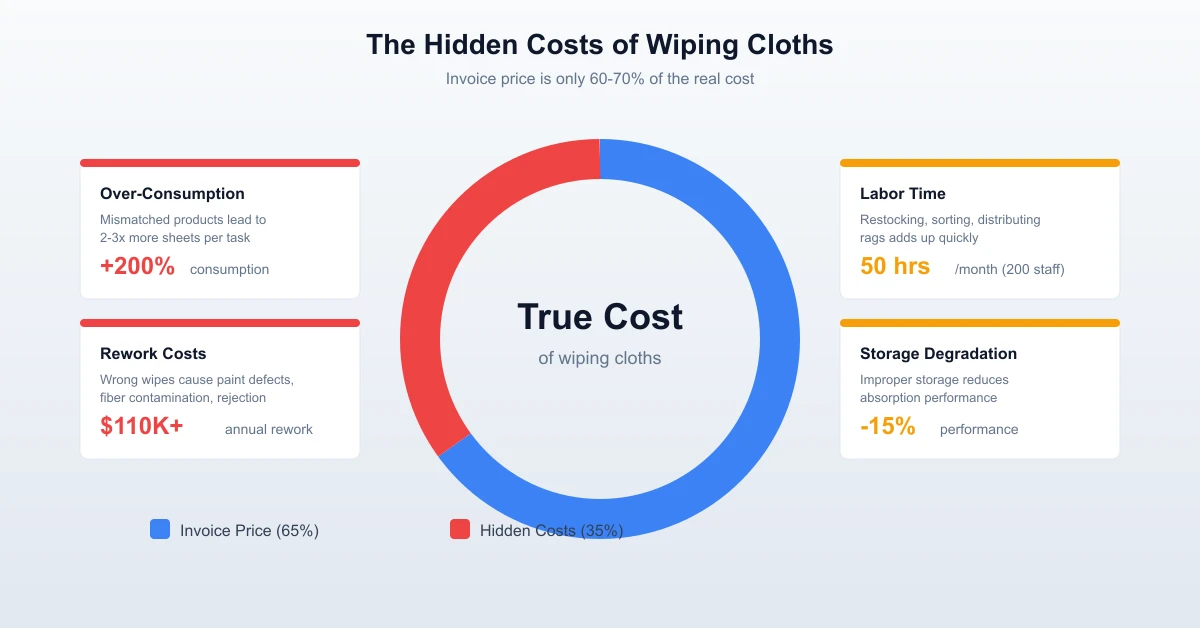
When a procurement manager tells me their facility spends $40,000 a year on wiping cloths, I know that number is wrong. Not because they’re lying — it’s just the invoice total. The real cost is higher, sometimes much higher, because of expenses that never show up on the purchase order.
Over-consumption from mismatched products
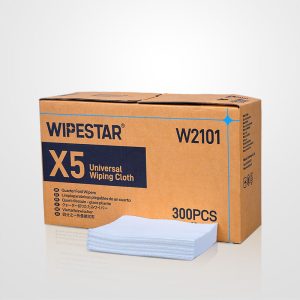
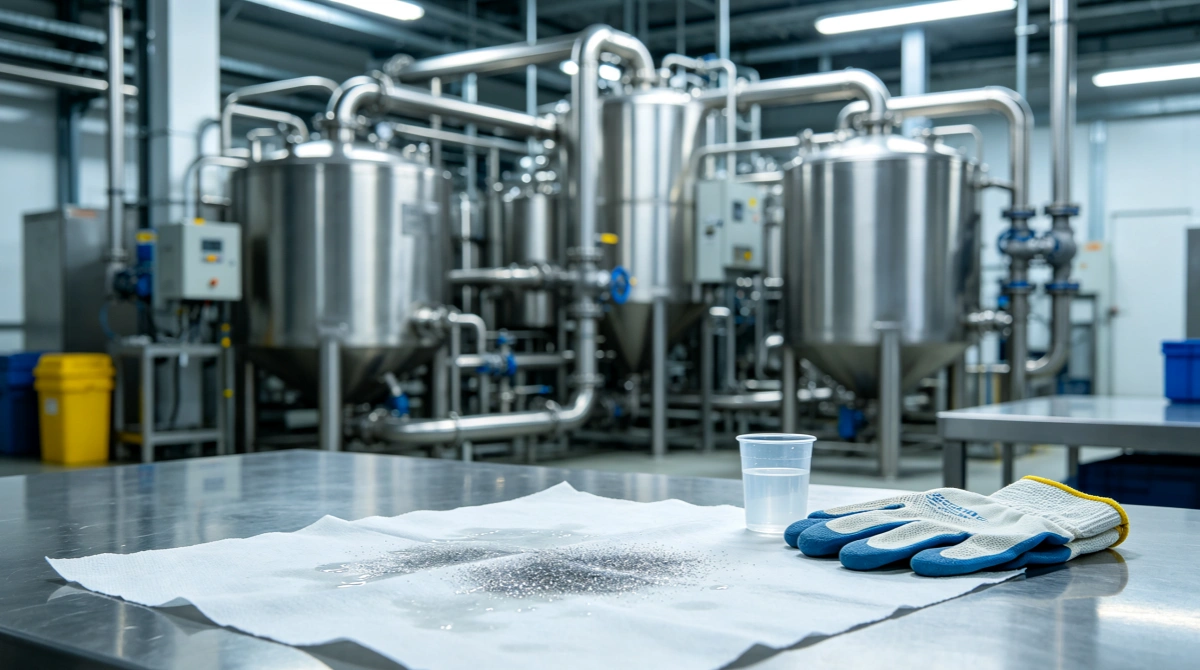
This is the biggest money drain I see. A facility orders a general-purpose cloth like the W2101 Universal Wiping Cloth (X5) for every task on the floor. It works fine for dust and light moisture. But when a machine operator needs to clean coolant off a CNC surface, the X5 doesn’t absorb fast enough. So they grab two or three sheets instead of one.
Multiply that by every operator, every shift, every day — and you’ve tripled your consumption on a single task without anyone noticing.
Rework and quality failures
This one hurts. We worked with an automotive parts supplier in 2024 — their wiping cloth spend was around $28,000 a year. Sounds reasonable. But their paint rejection rate was running at 19%. When we traced it back, the surface preparation wipes they were using left microfibers on panels before coating. Those fibers caused fisheyes and nibs that required wet-sanding and repainting.
The rework cost them over $110,000 that year. Switching to the right surface preparation wipes — specifically the W3501 Heavy Duty Surface Preparation Wipes — dropped their rejection rate to under 4%. The wiping cloth spend went up slightly. The total cost of ownership went way down.
Labor time you’re not counting
If your team uses flat-stack cloths from boxes that run out unpredictably, someone is walking to the supply closet multiple times per shift. If you’re still using cut-up rags, someone is sorting, folding, and distributing them. Five minutes per operator per shift doesn’t sound like much. Across a 200-person facility running three shifts, that’s 50 hours of labor per month — just on cloth logistics.
Why Cost Per Box Is the Wrong Metric (and What to Use Instead)
This is the most common procurement mistake I run into, and honestly it’s the easiest to fix.
Two boxes of wiping cloths might look comparable on a spec sheet. But Box A contains 900 sheets at 31 × 34.5 cm each, and Box B contains 300 sheets at 25 × 35 cm. Box A costs 40% more per box. Is it more expensive?
Not even close.
Here’s the actual math:
- Box A: 900 sheets × 0.107 m² = 96.3 m² of material. If one sheet handles the task, your cost per wipe is the box price divided by 900.
- Box B: 300 sheets × 0.0875 m² = 26.25 m² of material. If the operator needs two sheets per wipe because the smaller format doesn’t cover the surface, your effective cost per task is the box price divided by 150.
Box A, despite the higher sticker price, costs roughly 60% less per task. This is why the W2201 Universal Wiping Cloth (X6) in roll format — 900 sheets per roll — is one of the most cost-effective options for high-volume production lines. Fewer box changes, fewer supply runs, lower cost per wipe.
The cost-per-task formula
Have your procurement team use this calculation for every product comparison:
Cost per task = (Box price) ÷ (Sheets per box) ÷ (Average sheets used per task)
That last variable — sheets used per task — is where the real data lives. Have your floor team track it for one week. The results will surprise you.
The Single-SKU Trap: One Wipe Can’t Do Everything
Standardizing on a single wiping cloth SKU feels efficient. One product to order, one inventory to manage, one supplier relationship. I get the appeal. But in practice, single-SKU standardization almost always costs more than a targeted two- or three-product setup.
Here’s why: industrial cleaning tasks fall into distinct categories that need different material properties.
General dust and light debris
Bench surfaces, tool exteriors, equipment housings. You need a cloth that picks up particles without shedding fibers and doesn’t cost much per sheet. The W2101 (X5) handles this well — wood pulp/polypropylene blend, quarter-folded for one-at-a-time dispensing, economical enough for high-frequency use.
Oil, coolant, and solvent absorption
CNC machines, hydraulic equipment, bearing housings. Here you need rapid absorption and chemical resistance. The W2202 (X6) or W2201 (X6) in roll format works well. For heavier oil loads, W4201 meltblown polypropylene wipes are purpose-built. Using a general-purpose cloth for heavy oil cleanup means using three to four times more sheets.
Surface preparation before coating or bonding
This is where cutting corners gets expensive. Residual oil, fingerprints, or particles on a surface before painting or adhesive bonding cause defects that cost 10–50× the price of the right wipe to fix. The W3401 Ultrasoft Surface Preparation Wipes are designed for precision applications — optical components, display surfaces, instruments. The W3501 Heavy Duty variant handles more aggressive surface prep with its high-friction cellulose/polyester blend.
For a deeper dive on paint prep specifically, our automotive paint surface preparation guide covers the full workflow.
The setup that works
Most facilities we work with settle on two or three SKUs. A universal cloth for general tasks, an absorbent roll for liquid cleanup, and a surface preparation wipe for quality-critical stations. The total spend on three targeted products is typically 20–35% less than over-using a single “universal” cloth across every task.
For a detailed breakdown of material properties and which blend fits which application, see our Industrial Wipes Materials & Types Guide.
Dispensing and Storage Mistakes Wasting Your Money
How you store and dispense wiping cloths has a bigger impact on consumption than most people realize.
Flat stack vs. roll — match it to your workflow
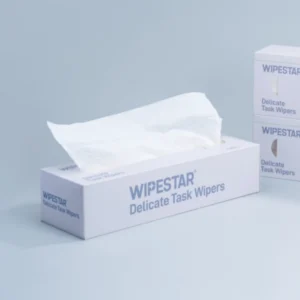
Flat-stack cloths — like the W2301 (X7) in 9-inch format — work well at quality control stations, inspection benches, and anywhere an operator needs one cloth at a time. The quarter-fold design means each pull dispenses a single sheet. No waste, no over-pull.
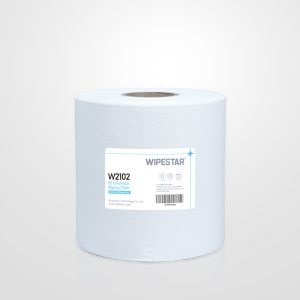
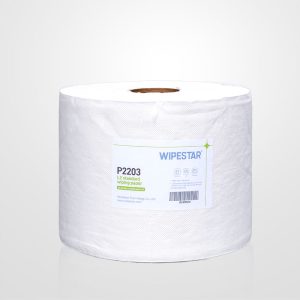
Roll-format cloths are better for production lines where demand is continuous. The W2201 (X6) roll with 900 sheets per roll means the dispenser needs refilling less often. Fewer refill trips = less downtime.
The mistake I see all the time: facilities using roll-format cloths at low-traffic stations. The roll sits open, collecting dust and moisture. By the time someone uses it, the outer sheets are contaminated. That’s waste you’re paying for.
Storage conditions matter more than you think
Wiping cloths stored in humid environments absorb moisture from the air. That moisture changes the cloth’s absorption behavior — it’s already partially saturated before it reaches the surface. We’ve measured up to 15% performance degradation in cloths stored improperly for more than two weeks. Keep boxes sealed until use, stored in a dry area away from direct heat sources.
Color-coding prevents expensive mix-ups
In facilities where different cloths serve different purposes, mixing them up is common. An operator grabs a surface preparation wipe for a general cleanup because it was closer. That’s a $0.15 cloth doing a $0.04 job.
Simple color-coding — using products like the W1302 (blue), W1502 (green), or W1103 (white) multi-purpose wipes for different zones — eliminates this confusion. It also supports contamination control protocols in regulated environments.
Bulk Ordering Strategies That Actually Work
Once you’ve optimized your product selection and reduced waste, the next layer of savings comes from how you order.
Consolidate orders across departments
In larger facilities, we often find that maintenance, production, and quality control each place their own orders for wiping cloths — sometimes from different suppliers. Consolidating those orders into a single monthly or quarterly PO does two things: it gives you leverage on volume pricing, and it reduces the administrative overhead of managing multiple vendor relationships.
Our team — led by Sales Director Ethan, who has over 20 years of experience in industrial wiping cloth procurement — regularly works with clients to restructure ordering schedules for maximum cost efficiency.
Negotiate based on annual volume, not per-order quantity
Suppliers price based on what they expect you to spend annually, not what you order in a single shipment. If you’re placing six orders a year at $3,000 each, you’re a different customer than someone placing one order at $18,000 — even though the annual spend is identical. Commit to an annual volume and negotiate accordingly.
At WIPESTAR, our account management team — including specialists like Lee, who has served global clients including Foxconn and Samsung, and Zhen, who manages accounts across microelectronics, optics, and aerospace — structures pricing tiers around annual commitments to give clients the best possible rates.
Don’t over-order to hit a price break
This sounds contradictory after what I just said, but it’s a trap I see regularly. A facility orders 18 months of inventory to hit a 10% price break. The cloths sit in storage, absorbing moisture and taking up space. The capital tied up in that inventory has a cost. The storage space has a cost. And if your usage patterns change — new equipment, different cleaning chemistry, a process change — you’re stuck with product you may not need.
Order what you’ll use in 60–90 days. If the price break requires more volume than that, negotiate a scheduled delivery arrangement instead.
WIPESTAR Products Designed for Cost Optimization
We built our product line around a simple reality: different tasks need different wipes, and most facilities need a small, targeted set rather than a sprawling catalog.
Universal wiping cloths (X5, X6, X7 series)
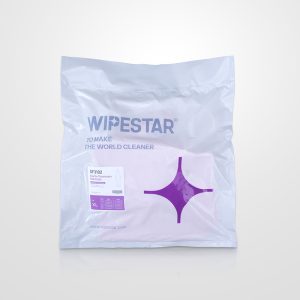
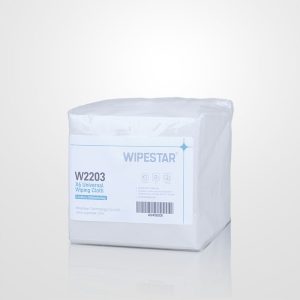
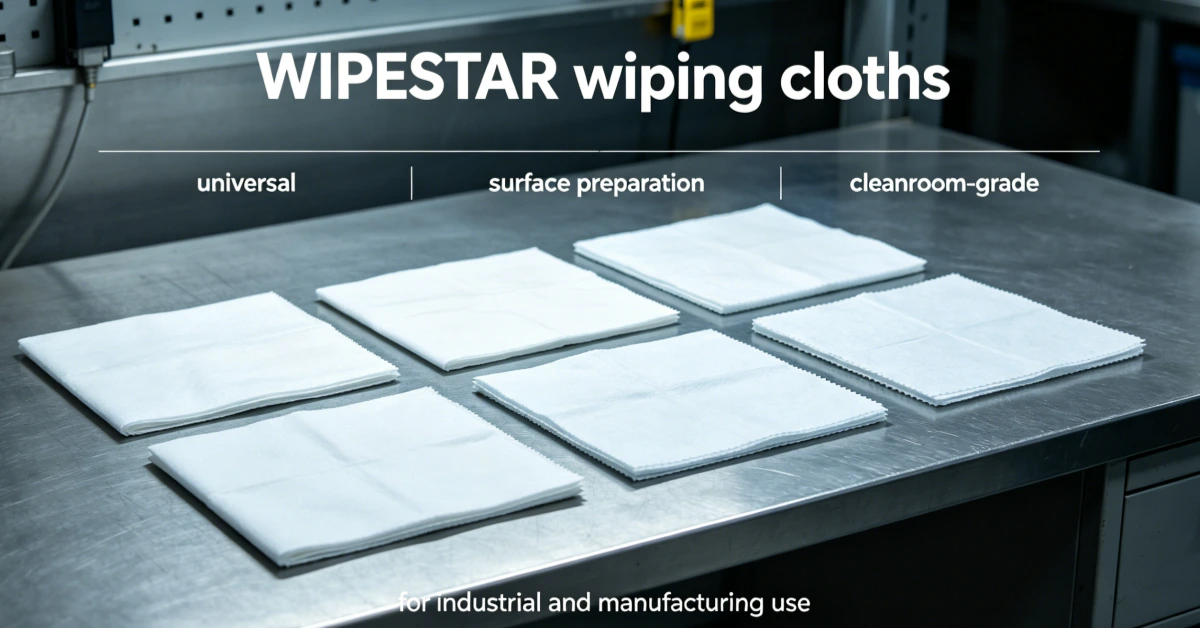
The backbone of most facilities’ cleaning operations. The X5 (W2101, W2102) handles general-purpose tasks. The X6 (W2201, W2203) steps up absorption for liquid-heavy environments. The X7 (W2301, W2302) in 9-inch format is compact for precision stations.
All use wood pulp/polypropylene construction with cut edges, optimized for industrial absorption at a competitive price point. Browse the full wiping cloths product range for all available sizes and configurations.
Surface preparation wipes
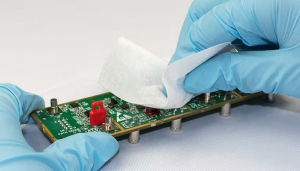
When quality is on the line — pre-paint, pre-bond, pre-assembly — the cost of a defect dwarfs the cost of the wipe. The W3401 Ultrasoft (rayon/polyester, 12-inch) is our go-to for sensitive surfaces. The W3501 Heavy Duty (cellulose/polyester, 12-inch) with high-friction treatment handles more demanding prep work. For adhesive residue, the W3301 Mesh Wipes use an open geometry that lifts adhesive rather than smearing it.
All of these are detailed in our Wiping Cloth Selection Guide.
Multi-purpose wipes
For facilities that need color-coding for zone separation or contamination control, the W1103 (white), W1302 (blue), and W1502 (green) provide cellulose/polyester construction in distinct colors. Cut edge, standardized sizing, and consistent quality across the range make them easy to integrate into existing workflows.
OEM & ODM capabilities
For distributors and large-volume users, we offer custom design and packaging services. If your facility needs a specific sheet size, fold format, or branded packaging, our production team can develop it. This eliminates the cost premium of adapting your processes to off-the-shelf formats.
The People Behind the Products
Product quality starts with the people behind it. At WIPESTAR, our team brings together decades of combined experience across cleanroom consumables, contamination control, and industrial cleaning solutions.
This depth of expertise means when you talk to us, you’re not talking to someone reading from a product spec sheet. You’re talking to someone who’s been on factory floors, who understands the difference between a wiping cloth that works on paper and one that works at 3 AM on a production line.
A 90-Day Plan to Cut Your Wiping Cloth Costs
If you’ve gotten this far and want to act on it, here’s the framework we use with clients:
Days 1–30: Audit and baseline
- Map every wiping cloth SKU currently in use across all departments
- Track consumption per task category for two weeks (general cleanup, liquid absorption, surface prep)
- Calculate current cost per task for each product
- Identify the top three sources of waste or over-consumption
Days 31–60: Optimize and consolidate
- Replace mismatched products with task-appropriate alternatives (target 2–3 SKUs)
- Adjust dispensing formats to match workflow (flat stack for QC, rolls for production lines)
- Implement color-coding if multiple product types are in use
- Consolidate ordering across departments into a single supplier relationship
Days 61–90: Measure and negotiate
- Compare new consumption data against the baseline
- Calculate new cost per task and total annual spend projection
- Negotiate annual volume pricing based on consolidated, optimized order quantities
- Set up a quarterly review cycle to catch drift early
Most facilities we work with see measurable savings by Day 60. The full 25–30% reduction typically materializes within two quarters as the optimized product mix and ordering rhythm settle in.
If you’d like help running this analysis for your facility, reach out to our team. We’re happy to walk through your current setup and identify where the savings are hiding.
Frequently Asked Questions
Recommended Resources: