English
 Chinese



A battery cell manufacturer in Hefei had a problem they couldn’t explain. Their electrolyte filling line was hitting 94% yield—respectable by most standards, but their target was 98%. They’d optimized their coating parameters, tightened their separator tolerances, and upgraded their electrolyte filtration. Yield budged 0.3%. Then their process engineer asked a question that rarely comes up in battery production meetings: “What about the wipes?”
They were using standard cleanroom wipes rated for ISO Class 5 in a dry room operating at -40°C dew point. The wipes were absorbing ambient moisture during transfer, introducing trace water into the cell assembly zone, and triggering electrolyte decomposition at the anode interface. One wipe specification change later, yield jumped to 97.2%.
We supply cleanroom consumables to lithium-ion battery manufacturers, gigafactory projects, and battery pack assembly operations across Asia and Europe. This is what we’ve learned about matching wipes to the specific—and often counterintuitive—requirements of battery cell production.
Why Battery Manufacturing Isn’t Like Other Cleanroom Applications
Most cleanroom wipe specifications are built around particle counts and fiber generation. Those matter in battery production too—but they’re not the primary concern. Battery cell manufacturing introduces three variables that most cleanroom consumable specs don’t address:
- Moisture sensitivity — Lithium and lithium compounds react violently with water. Even trace moisture (above 10 ppm) in the cell assembly environment causes electrolyte decomposition, gas generation, and capacity loss. Your wipe must not introduce or absorb moisture.
- Transition metal contamination — Iron, copper, zinc, and chromium particles at ppb levels cause internal short circuits and thermal runaway risks. Your wipe’s metal extractable profile is a safety parameter, not just a quality parameter.
- Chemical compatibility with electrolytes — LiPF₆-based electrolytes are reactive with many common materials. Your wipe must not shed organic compounds or fibers that react with the electrolyte and form resistive films on electrode surfaces.
These requirements mean that a “cleanroom wipe” specification alone is insufficient. You need a wipe qualified specifically for battery cell manufacturing conditions—which is a different spec sheet from pharmaceutical, semiconductor, or electronics applications.
Dry Room Wipe Requirements: Moisture Is the Enemy
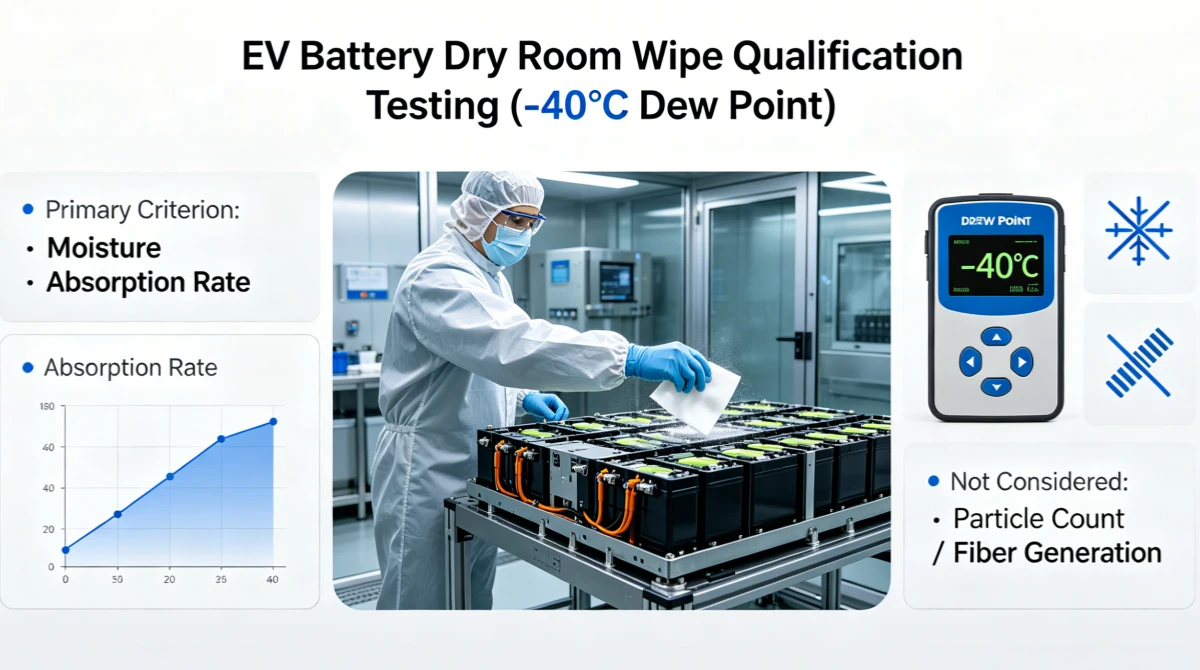
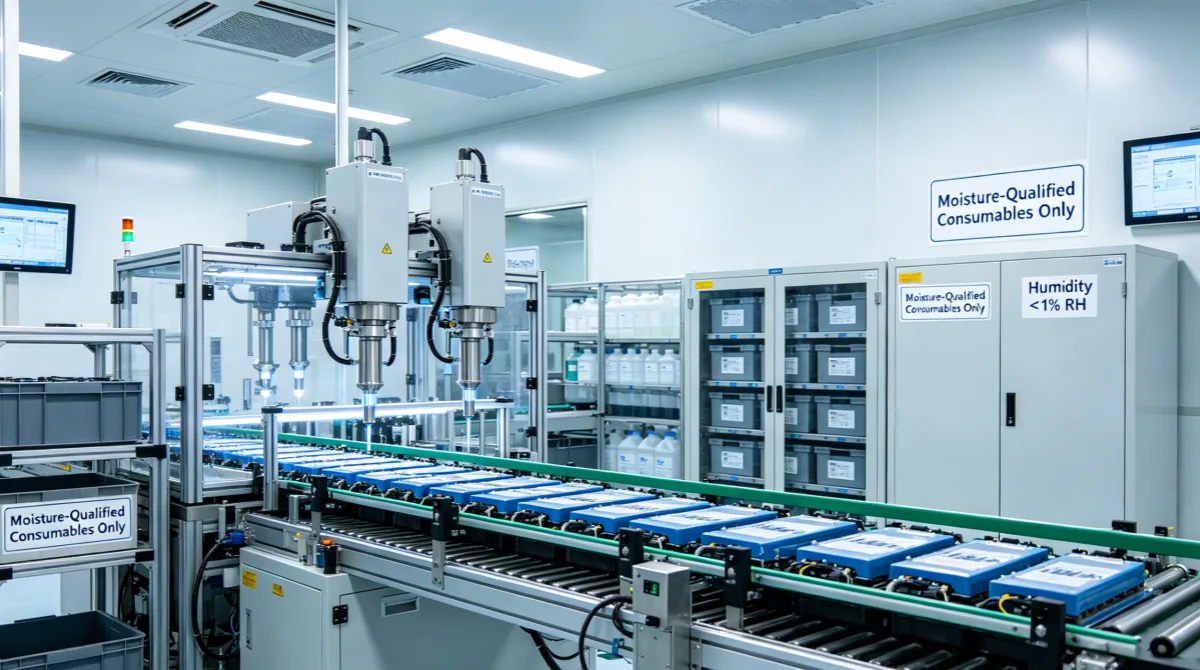
Battery cell assembly happens in dry rooms with dew points between -40°C and -60°C (below 1% RH). In these conditions, any material that enters the room becomes a moisture source. Standard cleanroom wipes—especially cellulose-based products—absorb atmospheric moisture during the seconds they’re exposed to ambient conditions during transfer from packaging to use point.
What to Look For
- Low moisture absorption rate — The wipe should absorb less than 0.5% moisture by weight during a 30-second exposure at your dry room dew point. Test this in your actual dry room, not in a lab at ambient humidity.
- Fast moisture release — If the wipe does absorb trace moisture during transfer, it should release it quickly in the dry room environment. Wipes that hold moisture slowly release it over minutes, contaminating the surrounding zone.
- Material selection — 100% polypropylene wipes have the lowest moisture absorption of any common wipe material. Polyester is acceptable but absorbs 2–3× more moisture than polypropylene. Cellulose and wood pulp blends are prohibited in dry room applications—their moisture absorption is 10–20× higher than synthetic materials.
We worked with a gigafactory project in Changzhou that was specifying cellulose/polypropylene blend wipes for their dry room. We ran moisture absorption testing in their dry room at -50°C dew point: the blend absorbed 3.2% moisture in 30 seconds. Our 100% polypropylene wipe absorbed 0.3%. They switched before their first production line qualified, and their electrolyte decomposition rate dropped by 60% in the first month.
Metal Contamination: How Wipes Can Short-Circuit Your Cells
Metal particle contamination in lithium-ion cells is a safety issue, not just a yield issue. Transition metal particles (iron, copper, chromium, zinc) deposited on electrode surfaces during manufacturing can penetrate the separator during cycling and cause internal short circuits. At best, this causes cell failure. At worst, thermal runaway.
Your cleanroom wipe is a potential metal contamination source in two ways:
- Metal particles from the wipe manufacturing process — Cutting, sealing, and packaging equipment can introduce metal fines into the wipe material. Your supplier should provide metal scan data showing absence of ferrous and non-ferrous metallic particles above your acceptance threshold.
- Extractable metal ions — The wipe material itself may contain trace metals from raw material processing or dyeing. These metals leach out when the wipe contacts solvents or electrode surfaces. Request ICP-MS extractable metal data with acceptance limits below 100 ppb for iron, copper, zinc, and chromium combined.
One battery manufacturer we work with requires every wipe lot to pass a metal scan using a handheld XRF (X-ray fluorescence) analyzer at incoming inspection. Lots that show any detectable metal signal above background are quarantined and returned. This takes five minutes per lot and catches contamination that standard CoA testing misses.
Electrode Slurry Mixing and Coating: Wipe Selection for Wet Processes
Electrode manufacturing—the slurry mixing, coating, calendering, and slitting stages—has different wipe requirements from dry cell assembly. The primary concerns are:
Slurry Mixing Area
Electrode slurry is a suspension of active material (NMC, LFP, or graphite), binder (PVDF or CMC/SBR), and conductive additive (carbon black or CNT) in NMP or water. Wipe-down of mixing equipment, tanks, and transfer lines between batches requires wipes that:
- Absorb NMP solvent without degrading—NMP dissolves some wipe materials over extended contact.
- Don’t shed fibers that contaminate the slurry—fiber inclusions in the electrode coating cause local defects that manifest as capacity loss or lithium plating.
- Handle the viscosity and abrasiveness of slurry residue—standard low-lint wipes tear when wiping thick slurry residue from tank walls.
Coating and Calendering
The coating line is a high-speed process where electrode foil passes through slurry application at 20–50 meters per minute. Surface contamination on the foil before coating causes coating defects—bare spots, thickness variations, and adhesion failures. Use low-lint, sealed-edge wipes for foil edge cleaning and coating head wipe-down. The wipe must be compatible with your foil material (aluminum for cathode, copper for anode) and must not introduce lubricants or release agents from its own manufacturing.
Slitting and Stacking
After calendering, electrodes are slit to final width and stacked or wound into cell assemblies. Metal burrs from slitting and particle debris from handling are the primary contamination concerns. Wipe-down of slitting blades and stacking equipment requires wipes with enough mechanical strength to pick up metal fines without generating their own fibers.
Cell Assembly and Electrolyte Filling: The Critical Zone
This is where wipe selection has the most direct impact on cell performance and safety. The cell assembly environment is typically ISO Class 7 or better, operating in a dry room at -40°C to -60°C dew point.
Before Electrolyte Filling
Cell internals—the stacked or wound electrode/separator assembly—must be free of particles, fibers, and moisture before the electrolyte is introduced. Wipe-down of filling equipment, cell housings, and transfer fixtures requires the driest, cleanest wipe you can source. 100% polypropylene, sealed-edge, metal-scanned, with documented moisture content below 0.1% by weight.
Electrolyte Filling Equipment
Electrolyte filling nozzles, reservoirs, and transfer lines must be wiped with electrolyte-compatible materials. LiPF₆ electrolyte reacts with moisture and many organic compounds. The wipe must not introduce water, alcohols, or reactive organic species. Verify chemical compatibility with your specific electrolyte formulation—standard “cleanroom grade” doesn’t guarantee electrolyte compatibility.
We’ve seen filling line contamination events traced to wipes that were clean by particle standards but introduced trace moisture from improper storage. The electrolyte reacted with the moisture, forming HF gas that corroded the filling nozzle and contaminated subsequent cells. Packaging integrity and storage discipline matter as much as the wipe specification itself.
Formation and Aging: Post-Fill Surface Cleaning
After electrolyte filling and sealing, cells enter the formation cycling stage where the solid electrolyte interphase (SEI) layer forms on the anode. During formation, cells may vent trace gases and develop surface residue from electrolyte seepage around the seal area.
Post-formation surface cleaning requires wipes that remove electrolyte residue without introducing new contaminants. The wipe must be compatible with the residual electrolyte chemistry—typically a mix of LiPF₆ decomposition products, organic carbonates, and trace HF. Standard IPA-dampened wipes work for external surface cleaning, but the wipe itself must be free of moisture and reactive species.
For formation area equipment—cell holders, bus bar contacts, and temperature monitoring surfaces—use dry wipes with verified moisture content. Wiping down formation chamber interiors between batches requires the same dry room wipe you use in cell assembly, not a standard cleanroom wipe pulled from a shelf outside the dry room.
Packaging and Transfer Protocols for Dry Room Environments
Even the best wipe becomes a contamination source if the packaging and transfer protocol introduces moisture. For battery dry room applications:
- Vacuum-sealed or nitrogen-flushed packaging — Standard cleanroom double-bag packaging is insufficient for dry room wipes. The inner bag should be vacuum-sealed or nitrogen-flushed to prevent moisture ingress during storage. Verify package integrity by checking for vacuum indicators or seal integrity before opening.
- Controlled transfer through airlocks — Wipes must pass through a staged dry room airlock—not directly from ambient conditions into the dry room. The airlock cycle should include a dwell time at intermediate humidity to allow the wipe package to equilibrate without absorbing moisture.
- Immediate use after opening — Once the inner package is opened in the dry room, the wipe absorbs moisture at a rate determined by the dry room dew point. At -50°C dew point, a polypropylene wipe has a usable window of 15–30 minutes before moisture absorption becomes significant. Don’t leave opened packages on the bench “for later.”
- FIFO with moisture monitoring — Store wipe inventory in a controlled environment even outside the dry room. Track storage humidity and rotate stock FIFO. Wipes stored at high humidity before entering the dry room will have elevated baseline moisture content.
Qualifying a Wipe Supplier for Battery Manufacturing
Battery wipe qualification requires testing that no other industry demands. Here’s the process:
Moisture Absorption Testing
Test the wipe in your actual dry room at your operating dew point. Weigh a sample before and after 30-second and 60-second exposures. Accept only wipes below 0.5% moisture gain at 30 seconds. This test must be performed in your facility—lab testing at ambient humidity is meaningless.
Metal Contamination Scan
Use XRF or ICP-MS to verify absence of transition metals above your acceptance threshold. Test at the lot level, not just during qualification. Metal contamination from manufacturing equipment can vary lot-to-lot.
Electrolyte Compatibility
Soak the wipe in your electrolyte formulation for 24 hours and analyze the electrolyte for degradation products, extracted organics, and moisture content change. Any significant change means the wipe is reactive with your chemistry.
Particle and Fiber Testing
Standard IEST-RP-CC004 testing, but specifically in dry room conditions—particle generation behavior changes at low humidity. Some wipes that perform well at standard cleanroom humidity generate more particles when the moisture content of the wipe material drops.
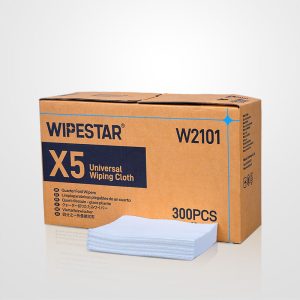
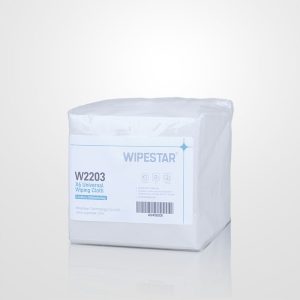
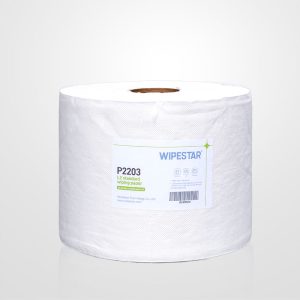
If you need a supplier who understands battery-specific wipe requirements, browse our cleanroom wipe range or contact our battery industry team.
Your Battery Consumables Team at WIPESTAR
Battery manufacturing accounts get a team that understands dry room chemistry and cell assembly contamination—not generalists applying standard cleanroom specs to a non-standard environment.

Lee — Key Account Sales Manager
Lee manages major accounts including gigafactory supply agreements. He’s handled multi-million-unit supply contracts with companies that demand zero-defect delivery schedules. For battery manufacturers running 24/7 production, he coordinates safety stock programs, manages your quality agreement, and ensures every shipment arrives with the documentation your cell assembly line needs.

Yunyun — ESD Project Manager
Static charge in battery dry rooms behaves differently than in standard cleanrooms—extremely low humidity dramatically changes ESD dynamics. Yunyun tests wipe ESD properties under actual dry room conditions, not just standard lab environments. She ensures the wipes you use in cell assembly won’t generate static that damages cell components or attracts particles to electrode surfaces.

Zhen — Account Manager
Zhen manages ongoing customer relationships and handles the day-to-day coordination that battery manufacturers need—order scheduling aligned to your production plan, lot-level documentation tracking, and rapid response when your line needs emergency stock. He’s the first call when something needs to happen fast.

Daisy — Sales Support
Daisy handles sample coordination, documentation packages, and the administrative follow-through that keeps battery accounts moving. When you request engineering samples or qualification documentation, she’s the one who assembles everything—CoA, moisture test data, metal scan reports, packaging specifications—and gets it to you on schedule.
Meet the full team: WIPESTAR Team Page →
Frequently Asked Questions About Cleanroom Wipes for EV Battery Manufacturing
Request EV Battery-Grade Cleanroom Wipe Samples
We supply cleanroom wipes for EV battery cell manufacturing—moisture-qualified for dry room operation, metal-scanned at the lot level, and electrolyte-compatible. ISO 9001:2015 certified production. Free engineering samples with full moisture and metal contamination data for qualified battery manufacturers.
Browse our cleanroom wipe range →