English
 Chinese



Last August a maintenance manager at a stamping plant outside Detroit called me. His paint rejection rate had climbed from 2% to 8% in six weeks. He’d already checked the paint formula, booth airflow, curing oven temps — all normal. I asked what surface prep wipe they were using. Silence. “We switched to something cheaper in June.”
That cheaper wipe was leaving microscopic fibers on panels before they hit the paint booth. Invisible to the eye, but under the inspection lamp after coating — defects across the board. Eight percent rejection, from a wipe that saved four cents a sheet.
I’ve spent twenty-plus years in this industry. Factory floors on four continents, thousands of conversations with procurement managers and production engineers. The pattern is always the same: the cheapest consumable on the purchase order is rarely the cheapest on the production floor.
I’m Ethan, Sales Director at WIPESTAR. I wrote this for procurement teams who are evaluating suppliers right now — what to look for, what to avoid, and what questions separate a real manufacturer from a middleman with a good website.
Why Splitting Orders Across Multiple Suppliers Backfires
Most factories I walk into are juggling four to twelve consumable suppliers. One for wipes, one for swabs, another for gloves, someone else for surface prep chemicals. Each vendor has its own lead time, its own quality benchmark, its own account rep who gets back to you… eventually.
The plants with the lowest defect rates and smoothest audits almost always consolidate. Not because someone told them to — because they learned the hard way that mixing suppliers creates invisible inconsistencies.
A semiconductor fab in Suzhou was buying cleanroom wipes from three different vendors. Each one claimed “ISO compliant.” But nobody had tested how those three products behaved in the same cleaning sequence. When we replaced all three with a single product line under one quality standard, their particle excursion rate dropped roughly 40% in the first quarter. The wipes themselves weren’t magic. The inconsistency was the problem, and removing it fixed the rest.
If you want the full breakdown of what we manufacture, our cleanroom consumables overview covers every product category. This article focuses on the sourcing side — how to pick the right supplier in the first place.
Five Questions That Expose a Reseller Disguised as a Manufacturer
About half the new prospects I talk to have been burned by a “manufacturer” that turned out to be a trading office with a polished website. Here’s how to spot the difference before you sign anything:
1. Ask for a custom size. If the answer is “let me check with our factory,” you’re talking to a middleman. A real manufacturer asks what dimensions you need and starts asking about your application.
2. Ask about raw materials. Can they explain why wood pulp/polypropylene absorbs differently from rayon/polyester spunlace? Can they describe their surface treatment process? If they’re reading off a spec sheet, they didn’t produce it.
3. Verify certifications — actually verify them. ISO 9001 is the floor. For cleanroom products, look for ISO 14644 compliance testing. ROHS for European markets. These aren’t footer logos — they represent auditable, documented processes. Ask for the certificate number and check it.
4. Ask who you’ll call when something goes wrong. Is there a named person with domain expertise? Someone who can look at a photo of a contamination issue and tell you whether it’s a wipe problem or a process problem? Anonymous order desks won’t do that.
5. Check their client track record. A supplier who has survived quality audits from Foxconn, Samsung, or major automotive OEMs has already proven their processes under the toughest standards. That history doesn’t show up on a datasheet, but it shows up in fewer problems for you.
What We Make and What That Means for Custom Orders
WIPESTAR manufactures in-house from our Shenzhen facility. Raw materials in, finished product out. I mention this because it directly affects what happens when you need something non-standard — a different fold, a custom size, your own branding and packaging. We change the machine setup and cut the tooling ourselves. A reseller can only sell what’s already on their supplier’s shelf.
The range covers three main categories:
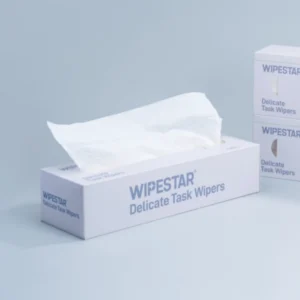
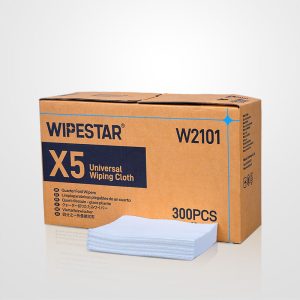
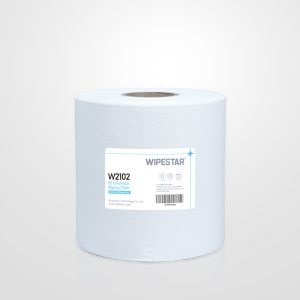
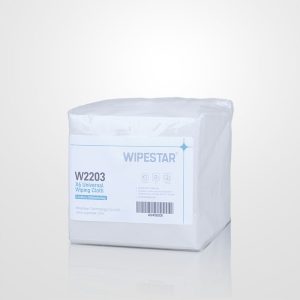
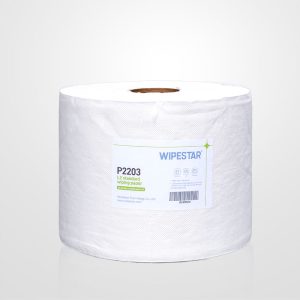
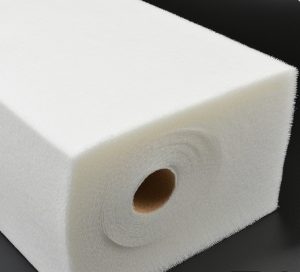
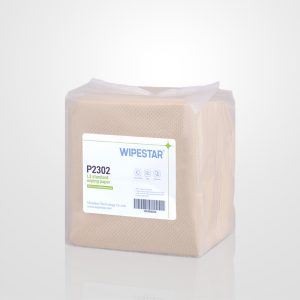
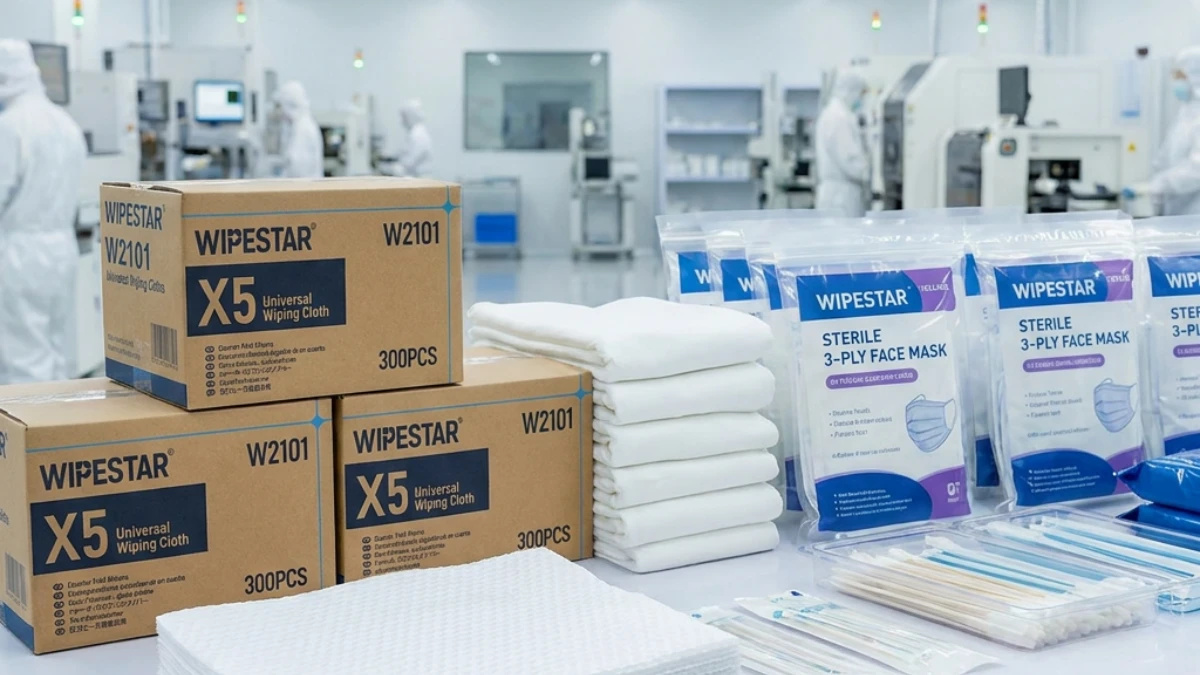
Universal wiping cloths — the everyday workhorse your team grabs fifty times a shift. The W2101 (X5) handles general wipe-downs: wood pulp/polypropylene blend, quarter-folded, pop-up box. For CNC oil and coolant work, the W2201 (X6) has a stone-pattern spunlace surface that grabs liquid rather than pushing it around. For tight spaces, the W2301 (X7) is a 9-inch format that doesn’t waste material on small tasks.
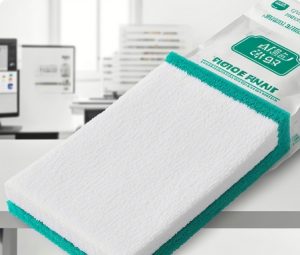
Surface preparation wipes — where generic cloths fall apart, sometimes literally. Before painting, coating, or bonding, any residual oil or fingerprints become defects. The W3501 uses a high-friction treatment that mechanically lifts contaminants. For optics and displays, the W3401 cleans without scratching. Label glue and tape residue? The W3301 mesh gets under the adhesive and lifts it off instead of smearing.
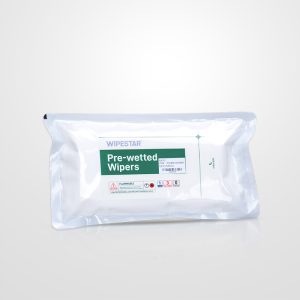
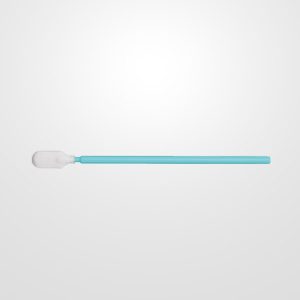
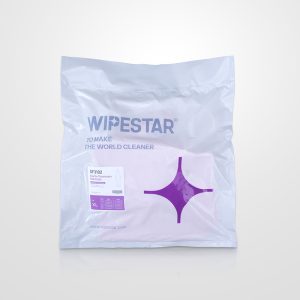
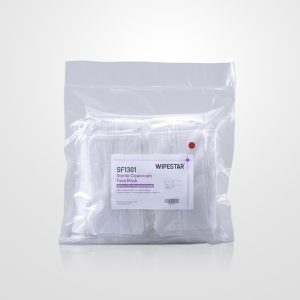
Cleanroom wipes and swabs — for semiconductor, pharma, and precision electronics. Ultra-low-lint materials, certified particle counts, extractable chemical controls. Everything rated for ISO Class 4–7, all available for OEM and ODM customization.
Full specs on the wiping cloths page and the selection guide.
Which Wipe Works Where — Industry by Industry
Every industry has different contamination problems. After twenty years of watching what fails and what holds up, here’s the practical breakdown:
Automotive manufacturing — surface defects before painting or coating are the biggest risk. A generic cloth leaves fibers and residue that show up under the inspection lamp. Use a dedicated surface prep wipe like the W3501 for high-friction work, and a lint-free universal cloth for general maintenance between shifts. Our automotive paint prep guide has the technical details.
Semiconductor and electronics — sub-micron particles and ESD. A general-purpose wipe in a wafer fab is a yield problem waiting to happen. You need certified cleanroom wipes with controlled particle counts and, in ESD-sensitive zones, static-dissipative fibers. More on this in our semiconductor wipe selection guide.
Pharmaceutical and medical — bioburden control and chemical compatibility with your sanitizers. Cleanroom-rated wipes with validated extractable levels, compatible with whatever pharma-grade disinfectant your SOP specifies.
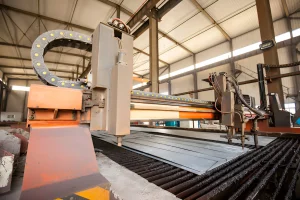
CNC machining and metalworking — oil, coolant, metal chips. You need a wipe that absorbs instead of smearing, holds up in solvents, and doesn’t shed fibers into bearing races. The W2201 (X6) was designed for this. Our CNC maintenance guidelines cover the wipe-down routines that protect machine accuracy over time.
Food and beverage processing — hygiene compliance, zero chemical residue on food-contact surfaces. We covered this in our food and beverage wipes article.
Optics and precision instruments — cleaning without scratching. The W3401 ultrasoft handles this without leaving residue or marks.
Most facilities need two or three product types. A universal cloth handles about 80% of daily tasks. The remaining 20% — surface prep, adhesive removal, cleanroom work — needs specialized products. That 20% is where the real costs hide if you get it wrong.
The Per-Sheet Pricing Trap
Procurement teams fixate on per-sheet pricing. It’s a clean, comparable number — and the most misleading metric for evaluating cleaning consumables.
What the purchase order doesn’t show:
Sheets per task. A cheap wipe that takes six sheets to do what one good wipe does isn’t cheap. It’s six times the unit cost, dressed up as savings.
Rework. Fiber contamination on a painted surface or a wafer means a second cleaning pass or a scrapped unit. We’ve seen facilities cut surface-defect rework by 90% just by switching to a properly lint-free wipe.
Technician time. In a three-shift operation, five minutes of faster cleanup per task adds up to hundreds of hours a year.
Disposal volume. More sheets means more waste, more handling, more cost.
When facilities switch from commodity rags to engineered wipes, the typical result is 50–70% fewer sheets per task and lower total spend despite a higher per-sheet price. The math is in our TCO breakdown.
Don’t compare products on the invoice. Compare them on the production floor.
Who Picks Up the Phone When Something Goes Wrong
I’ve seen facilities buy the right product from the wrong supplier and still end up unhappy. The wipe performed fine on paper, but three weeks in when something went wrong, nobody answered. Specs tell you what a product should do. The team tells you what happens when it doesn’t.
The people you’ll work with at WIPESTAR:
Lee, Key Account Manager — seven years in cleanroom consumables, worked with Foxconn, Samsung, and Apple on their supply needs. Carolina, Product Specialist — spends her time on factory floors talking to the people who actually use our products, then feeds that back to our raw material suppliers. Guan, cleanroom consumables sales — four and a half years in semiconductors, five-plus years in cleanroom products, understands fab and pharma pain points firsthand.
Then Vicky running foreign trade operations, Daisy keeping orders on track, Zac handling customer service, and Juan bringing his purification industry background to every client interaction. Full team on our team page.
Twelve people across sales, product, and support. Not a call center — a team that understands contamination control at the process level.

INDEX™ 2026 — Booth 2150
Right now (May 19–22, 2026) we’re at INDEX™ 2026 in Geneva — Booth 2150 at Palexpo, alongside our partner brand YESHE. INDEX™ is the world’s largest nonwovens exhibition, held once every three years.
We’ve got the full product range on display — universal cloths, surface prep wipes, cleanroom consumables, swabs, PPE — and you can test everything side by side with what you’re currently using. There’s no substitute for holding a wipe in your hand and feeling the difference.
Can’t make Geneva? Our recent exhibition stops and upcoming schedule are on the 2026 shows page — next up, Turkey in early June.
Questions We Hear Every Week
Get a Quote — Factory-Direct, Global Shipping
We ship worldwide from our ISO-certified factory in Shenzhen. Bulk pricing, OEM customization, ROHS compliant. Whether you need one case for evaluation or a standing monthly order for a multi-line facility, we’ll work out something that makes sense.