English
 Chinese



A diagnostic consumables plant I know ran three weeks of intermittent leak-test failures before anyone traced the problem. The reagent cartridge had a narrow cleaning port, and the valve seat sat roughly 90 millimeters inside the channel — buried deep enough that the standard 120mm swab the line had always used could touch the port mouth but never the seat. Molding release residue stayed where it was. Leak tests failed in clusters, passed on retest, and the investigation went exactly nowhere for a month.
The fix cost nothing dramatic: a carton of WFS703 long-reach swabs — the format built for anything over 180mm — reached the seat on the first try, and the leak failures vanished inside a week. Nothing else changed. Same solvent, same operator, same line.
That story is the whole argument of this guide: swab length isn’t a spec-sheet detail, it’s the difference between cleaning the surface and thinking you did. Access geometry decides the swab. Everything else — tip material, head shape, price — only matters once the tip can actually reach where the soil is.
The Size Ladder: From 60mm Detail to 180mm Reach
Cleanroom swabs come in rough size bands, and each band exists because a category of task demands it. The WIPESTAR swab range covers the full ladder:
- 60–80mm — detail work. The WFS758 and WFS757 live here: small heads, short stiff handles, built for ports, valve seats and corners where a longer swab can’t pivot.
- 80–100mm — the middle band. The WFS761 and WFS706 balance reach with control — the default when a task sits between “too small for the big swab” and “too deep for the short one.”
- 120–140mm — general cleanroom work. The WFS707 is the workhorse most facilities standardize on: good contact area, comfortable grip, fast coverage on flats.
- 140–160mm — long standard. The WFS712C reaches guide-rail undersides and channel mouths that the 120mm class misses.
- Over 180mm — true reach. The WFS703 is the deep-access tool: narrow channels, deep seats, anywhere the soil is further in than your hand can safely go.

Head Geometry Matters as Much as Length
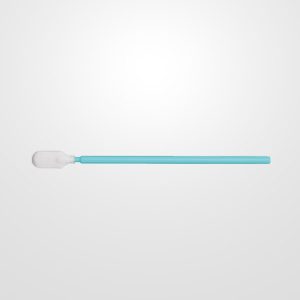
Two swabs of identical length can behave completely differently because of the head. A paddle-style foam head covers flat surfaces fast and holds a lot of solvent — right for wiping a guide rail. A pointed or tapered head concentrates pressure into a corner or a port — right for the valve seat in the cartridge story, where a paddle would fold and skip.
Foam adds a third variable: compliance. Polyurethane foam compresses against the surface, which lets a slightly-too-large head squeeze into a slightly-too-small gap. That’s forgiving in the field, but it isn’t magic — a head that’s grossly oversized for the channel will buckle sideways and clean the wrong wall.
The practical rule: pick the head shape for the geometry, then pick the length for the reach, and only then compare materials and price. Most “our swabs don’t work” complaints trace back to a head that was the wrong shape for the feature, not a bad swab.
Handle Rigidity, Bend and the No-Cutting Rule
Long swabs need enough backbone to transmit pressure without whipping. The WFS703’s handle stays controllable at full extension, which is what makes deep-channel work precise instead of vague. Short swabs benefit from the opposite: a slightly stiffer handle turns fingertip pressure into consistent contact on hard corners.
One habit to kill during training: cutting a long swab down to size. Cutting exposes the internal bond line and core, and the freshly cut end sheds whatever it’s made of — directly onto the surface you were trying to clean. If the reach is wrong, change the swab SKU. That’s what the ladder is for.
Swab Size Table by Task
| Task | Access Constraint | Swab | Why It Works |
|---|---|---|---|
| Deep ports and channels (90mm+) | Depth beyond standard reach | WFS703 (180mm+) | True long-reach format; slim enough to keep the tip usable at full extension |
| Guide-rail undersides, channel mouths | Medium depth, awkward angle | WFS712C (140–160mm) | Long standard band with enough head contact for rails |
| Valve seats, small ports, corners | Very tight geometry | WFS758 (60–80mm) | Compact head pivots where long swabs fold |
| Detail finishing around fixtures | Tight but shallow | WFS757 (60–80mm) | Short handle turns fingertip pressure into controlled contact |
| Mixed daily work | Neither deep nor tiny | WFS761 / WFS706 (80–100mm) | The in-between band most stations actually need |
| General surface wiping | Open flats | WFS707 (120–140mm) | Fast coverage, comfortable grip, lowest cost per task |
A realistic stockroom carries three or four rungs of this ladder, not all six. The way to decide which: walk the line with the table open, note the access constraint at every cleaning point, and buy the band that comes up most. The cartridge plant’s maintenance cage now holds WFS703, WFS758 and WFS707 — reach, detail and general — and nothing sits unused.
Who You’ll Work With at WIPESTAR
We build swabs across the whole size ladder, so the recommendation starts with your access constraints instead of a single catalog favorite.

Lee — Key Account Sales Manager
Lee has served Foxconn, Samsung and Apple since 2018 — he standardizes the same three-band swab list across multi-site programs so every stockroom carries what the line actually uses.

Carolina — Product Specialist
Carolina works with production teams on how tip materials and head geometries behave on real surfaces — she matches head shape to feature before quoting a SKU.

Zac — Customer Service
Zac turns size-ladder sample kits around quickly, so teams can trial the right band on the actual feature before committing to a stockroom list.
Get Started with the Right Swab Sizes
Send us the hard-to-reach points on your line — photos help — and we’ll return a sample kit across the size bands that matter, with a stockroom recommendation that fits your actual constraints.
- WFS703 Long-Reach Swabs — the deep-channel fix most stockrooms are missing.
- WFS758 Detail Swabs — compact head for ports, seats and corners.
- Request a Technical Consultation — send the station list; we’ll map sizes to tasks.
Browse Cleanroom Swabs → Request a Custom Quote
Frequently Asked Questions