English
 Chinese



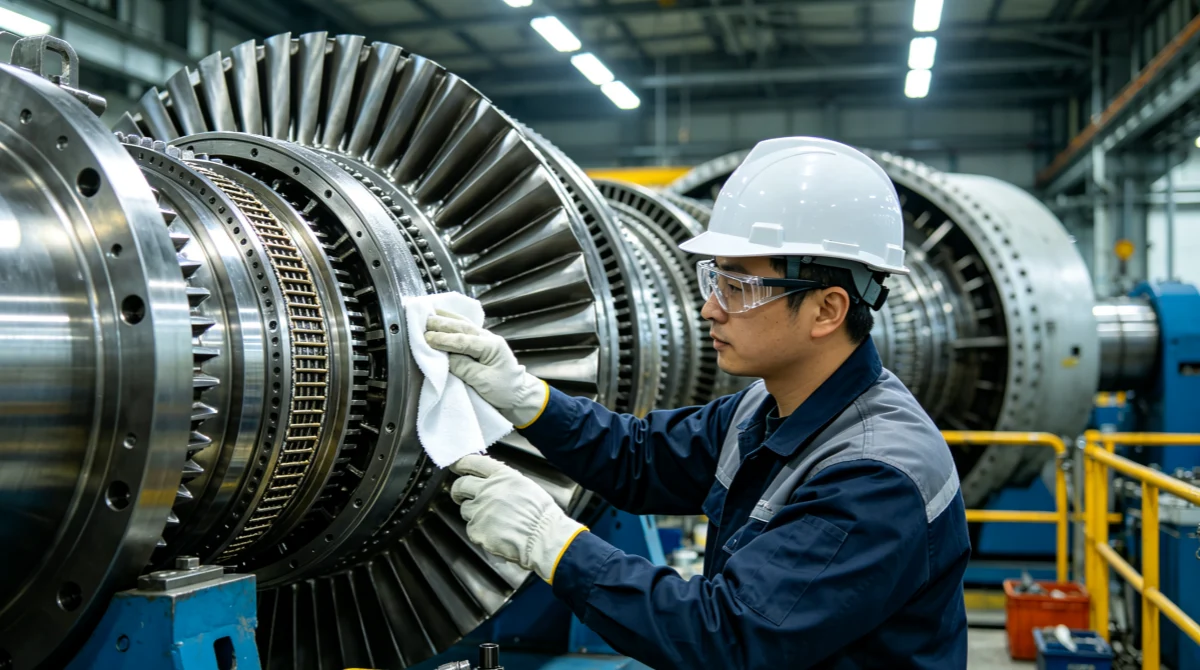
A heavy equipment dealer in Nevada services haul trucks and loaders that come in off a gold operation caked in two kinds of contamination: fine silica dust on every horizontal surface, and hydraulic oil weeping from fittings that have been heat-cycled for 20,000 hours.
The shop had a wipe problem it had never named. Technicians used one general-purpose towel for both jobs — dust first, then oil — which meant the oil-soaked towel then dragged silica grit across machined surfaces, and the dust-loaded towel went into the hydraulic fittings. Seal failures were being blamed on the rebuild process. The rebuild process was fine; the wipe was carrying abrasive dust into the assembly.
Mining is one of the few environments where the two contamination sources actively fight each other, and where getting the wipe wrong produces mechanical failure rather than a cosmetic defect. This guide covers the split, the formats and the field practice.
Two Contaminants, Two Jobs
Anyone who has walked a mining maintenance bay knows the pattern. The machine arrives with a layer of silica and rock dust over everything, and underneath it the usual oil weeps, grease points and coolant residue. The dust is abrasive and hygroscopic. The oil is slick and persistent. A wipe that handles one badly handles the other worse.
The operating rule is straightforward: remove the dust dry, then deal with the oil. Wiping oil through a layer of silica is the mechanical equivalent of sanding the surface, and it is how grit ends up inside a fitting that was just opened for service.
- Dry dust removal first. A dry, high-capacity wipe takes the bulk of the silica off before any solvent is introduced. Solvent plus grit makes a slurry that works its way into every seam.
- Then oil, with an oil-specific cloth. Once the surface is free of grit, an oil-selective polypropylene cloth lifts the hydraulic film instead of pushing it around.
- Never reuse the dust wipe on the oil pass. A loaded dry wipe becomes a sanding pad; the second use is worse than the first.
Silica Dust: The Abrasive Nobody Tracks
Silica dust is a known respiratory hazard and a less-discussed mechanical one. On a maintenance floor it does three things that matter to a wipe program:
It abrades. Quartz is harder than most seal materials and many machined surfaces. A dust-loaded wipe dragged across a cylinder liner or a seal journal leaves a scratch pattern that becomes a leak path. This is why the dust pass has to be dry and one-directional, and why the wipe gets discarded rather than folded and reused.
It holds moisture. Fine dust absorbs water from humid air and from wash-down, and the resulting paste clings to surfaces in a way dry dust does not. On equipment that works wet, the dust layer behaves more like a film than a powder.
It migrates. Dust on a bench becomes dust on gloves, becomes dust inside an open hydraulic circuit. Once inside, it circulates. This is the pathway that turns a wipe choice into a component failure six weeks later.
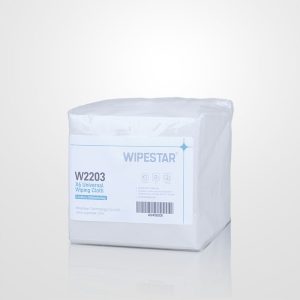
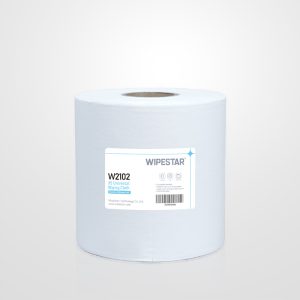
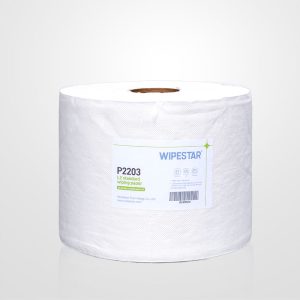
The practical response is a high-capacity dry wipe with enough structure to trap and hold fines rather than push them. A heavier universal grade such as the W2401 X8 has the basis weight for bulk dust removal on large surfaces, while the W2203 covers smaller areas and detail work around fittings.
Hydraulic and Gear Oil: Volume, Not Smear
The oil side of a mining maintenance bay is a volume problem. A weeping fitting, a drained line or a filter change produces more fluid than a general wipe can hold, and once a wipe is saturated it stops absorbing and starts spreading.
Two behaviors separate a cloth that works here from one that makes a mess:
- Oil selectivity. Polypropylene absorbs hydrocarbons and repels water, which matters when the equipment is wet from wash-down or working in rain. A wood-pulp blend takes water and oil together and gives back a slurry.
- Wet strength. A saturated oil cloth has to be wrung and reused for the next fitting without tearing. Light grades fall apart exactly when the load is heaviest.
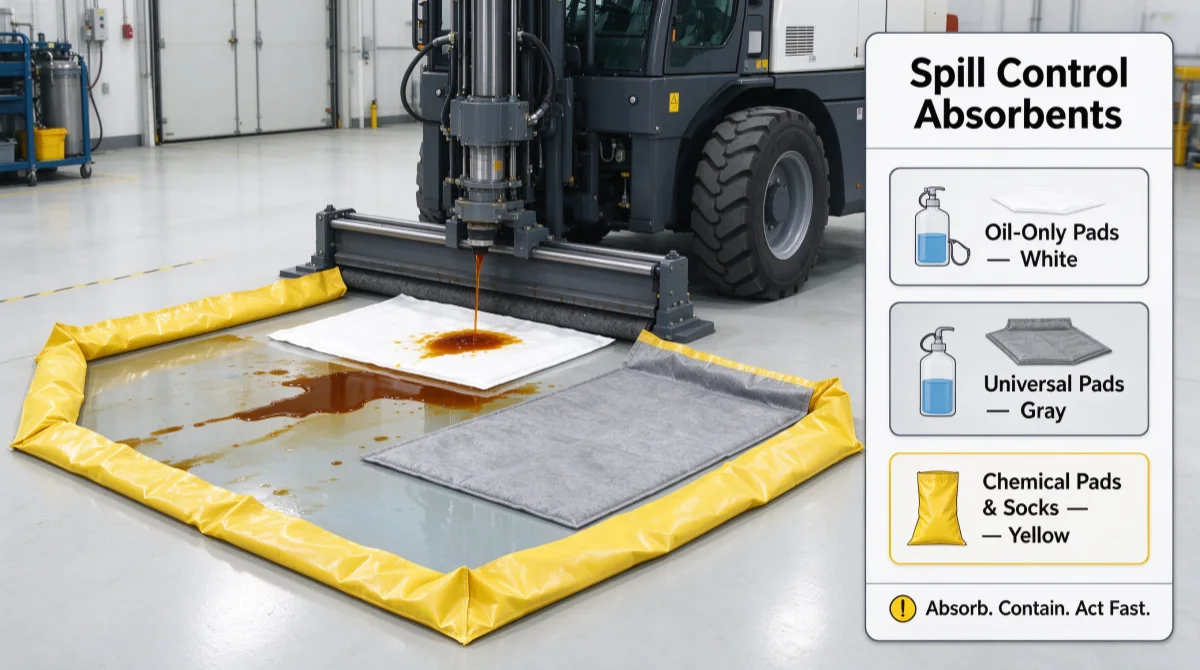
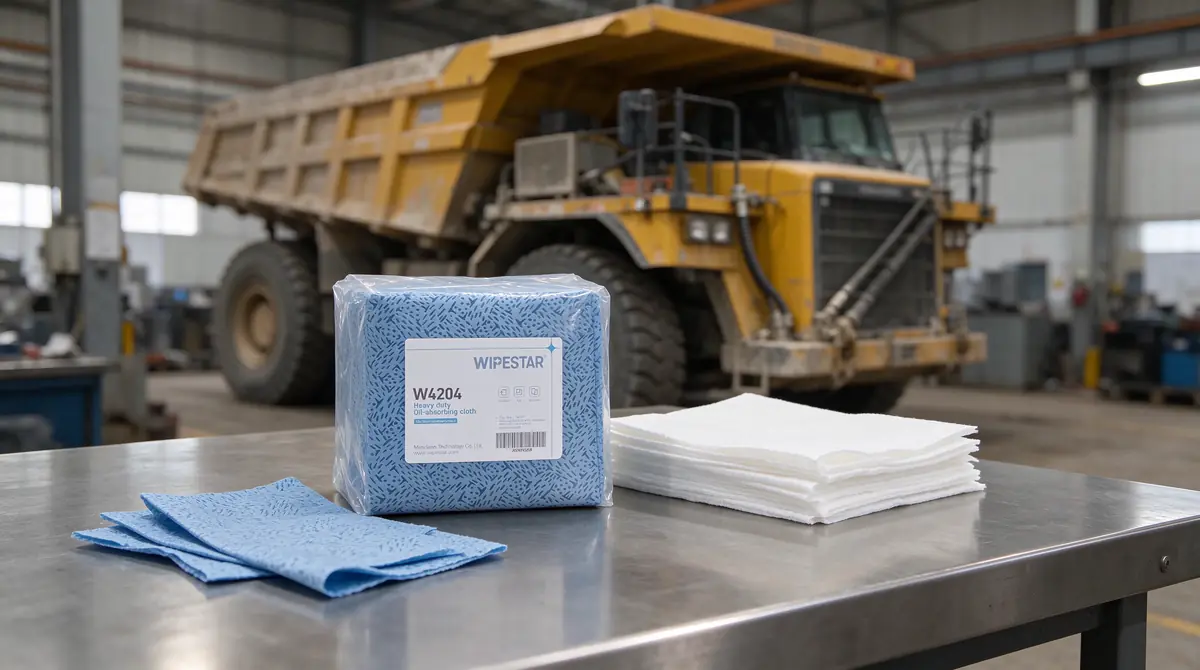
The W4204 heavy duty oil cloth is the 12-inch format most shops settle on for fittings, hoses and filter housings, with the W4202 covering larger areas such as frame rails and underbody panels. For the fluid that has already reached the floor — and on mining equipment, some always has — pads from the spill control range do the volume work that a cloth cannot.
One caution that matters in cold climates: hydraulic oil viscosity rises sharply below freezing, and a cloth that wicks quickly at 20°C wicks slowly at −10°C. In winter, allow contact time instead of pressing harder — pressure drives oil into the weave rather than through it.
Wipes by Task on a Mining Floor
| Task | Wipe | Why |
|---|---|---|
| Bulk silica and rock dust removal | W2401 Universal X8 | Heavier grade holds fines instead of pushing them; large format covers body panels fast |
| Detail dust around fittings and seals | W2203 Universal | Manageable size for reaching into tight areas without dragging a large sheet |
| Hydraulic fittings, hoses, filter housings | W4204 Heavy Duty Oil Cloth | Oil-selective, strong enough to wring and reuse on the next fitting |
| Frame rails, underbody, large oiled areas | W4202 Large Format Oil Cloth | Coverage without saturating mid-panel |
| Seal journals and machined surfaces before reassembly | W3401 Ultrasoft | Final pass that will not scratch a machined surface |
| Pooled oil or coolant on the floor | Spill control pads and socks | Volume absorption — a cloth is the wrong tool once there is standing fluid |
That is five formats, which is more than most shops want to stock. The minimum viable set is three: a heavy dry universal for dust, a heavy oil cloth for fluid, and spill control for the floor. The ultrasoft finish pass earns its place only if the shop does seal or bearing work where scratch patterns matter.
Field Service Kits and Disposal
Field service is where the discipline usually collapses. A technician working on a haul truck at a remote site has whatever is in the truck box, and if that is a roll of paper towels, both passes happen with the same material.
A workable field kit is small: one pack of heavy universal wipes for dust, one pack of oil cloths, a small closed container for used wipes, and a pair of gloves. The kits get restocked when the truck returns to the shop, not when someone remembers.
Disposal follows the same logic as any oil-contaminated material. Used oil wipes go into a closed, labeled container — not the truck bed, not the general trash, and not an open bucket in the shop. Oil-soaked cloths piled in an open container are a self-heating risk as well as a waste-classification problem, and the same daily-removal discipline that applies to solvent wipes applies here.
Dust wipes are a different waste stream: dry, non-hazardous in most jurisdictions, but still worth keeping separate so the oil stream is not contaminated by volume. Two bins, two streams, one rule.
Who You’ll Work With at WIPESTAR
We supply heavy-duty wipes to mining, heavy equipment and field service operations, so the conversation usually starts with the machine and the site rather than a case price.

Lee — Key Account Sales Manager
Lee has served Foxconn, Samsung and Apple since 2018 and runs multi-site programs — for equipment dealers he sets one wipe list across every branch so a field kit packed in Nevada matches the one packed in Chile.

Ethan — Sales Director
Ethan has over 20 years in industrial wiping cloth — he works through the dust-versus-oil split with maintenance managers who need two clean waste streams, not one general towel.

Zac — Customer Service
Zac handles heavy-order logistics and reorder timing — bulk wipe programs for remote sites get scheduled so a truck is never waiting on consumables.
Get Started with Mining Maintenance Wipes
Tell us what your machines come in coated with and how your field kits are packed, and we will recommend a two-stream wipe program that keeps grit out of the hydraulic circuit.
- W2401 Universal X8 — the dry dust pass.
- W4204 Heavy Duty Oil Cloth — the oil pass.
- Request a Technical Consultation — describe the site; we will build the field kit.
Browse Wiping Cloths → Request a Custom Quote
Frequently Asked Questions