English
 Chinese



A combined-cycle plant outside Houston finished a routine hot gas path inspection on their GE 7FA turbine. The borescope tech flagged something between the first-stage nozzle and blade row—a fiber, about 5mm long, partially carbonized, wedged in a cooling passage barely 1.5mm wide.
It had been sitting there for 18 months. Eight thousand hours of operation at 600°C inlet temperature, slowly starving three blade passages of cooling air.
The blades were cooked. Thermally distressed to the point of replacement. $120,000 in parts. Three days of unplanned outage at peak summer demand, when replacement power was trading at $85/MWh. The fiber came from a cotton rag. A maintenance tech used it during the previous outage to wipe down a nozzle segment before reassembly. Nobody caught it.
I’ve seen gas turbine FOD events where the total cost—parts, lost generation, replacement power—topped $2 million. And in every single case, the root cause was something preventable: wrong wipe, wrong procedure, or no procedure at all.
This guide is for outage managers, turbine maintenance supervisors, and plant engineers. We’ll cover wipe selection by equipment type, FOD prevention that actually works, oil system cleaning, and how to build an outage consumable program that won’t leave a fiber behind to ruin your summer.
Why Power Generation FOD Is a Catastrophe, Not a Nuisance
In most manufacturing environments, FOD means rework. A bolt left in an assembly, a chip in a gearbox—you take it apart, clean it up, move on. Annoying, expensive, but survivable.
Power generation is different. The operating environment is so extreme, and the consequences so severe, that FOD isn’t a quality issue. It’s an existential one.
A foreign object in a gas turbine compressor can destroy an entire blade row. In the hot gas path—where inlet temperatures push past 600°C and first-stage blades see nearly 1,000°C even with cooling—a fiber that blocks a cooling passage causes localized overheating that cascades into blade failure.
A foreign object in a generator can short-circuit windings and start a fire inside a hydrogen-filled casing. In a transformer, particulate contamination reduces dielectric strength until you get arc flash. These aren’t hypotheticals. They’re the reason power plant maintenance managers lose sleep.
Let me put real numbers on the risk:
Gas turbine hot gas path repair means 3–7 days of outage. At $50,000–$200,000 per day in lost revenue and replacement power costs, depending on market conditions and season.
Generator rewinding means weeks of downtime. You’re ordering custom-wound coils and waiting.
Transformer replacement means months. Lead times on large power transformers are measured in years right now.
Your cleaning consumables are part of the reliability chain. The wipe that cleans a turbine component must not leave anything behind that becomes FOD during the next operating cycle. That’s not a suggestion—it’s a requirement that every major OEM spells out in their maintenance manuals.
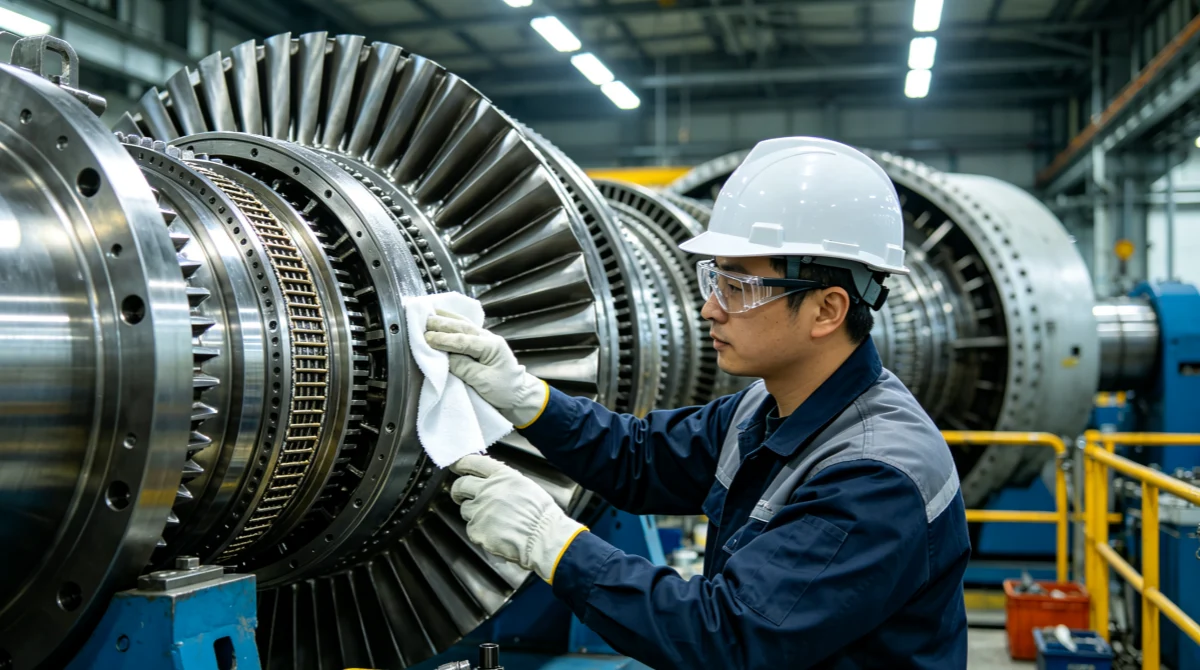
Equipment Areas and Their Wipe Requirements
Not all power generation assets have the same wipe requirements. Temperature, fluid compatibility, and contamination sensitivity vary wildly. The wipe that works fine on a lube oil system will destroy a turbine blade. Here’s the breakdown:
Gas Turbine — Combustion and Hot Gas Path
This is the most demanding cleaning application in the entire power generation sector. Inlet temperatures exceed 600°C. First-stage blade temperatures approach 1,000°C even with film cooling.
Any organic material—a fiber, a wipe residue, a trace of oil—that survives in the hot gas path causes localized overheating, blocks cooling passages, or accelerates oxidation on blade surfaces.
What you need is non-negotiable: zero detectable fiber release, which means sealed-edge construction only. Verified particle cleanliness per IEST-RP-CC004 or equivalent—target below 200 particles ≥0.5μm per cm², though some operators push below 100 for first-stage components.
And OEM compliance: if GE, Siemens, or Mitsubishi specifies a particular wipe product or cleanliness level in their maintenance manual, you follow it. Period.
Steam Turbine
Lower temperatures than gas turbines, but the contamination picture is different. Steam-side deposits—silica, iron oxide, copper—build up on blade surfaces and cause erosion that kills efficiency over time.
Your wipes need to remove those deposits without leaving fibers behind that become nucleation sites for future buildup. Oil-side cleaning (bearing housings, the governor system, the turning gear) demands high oil absorption and absolutely lint-free performance. One fiber in a governor valve and you’ve got a control problem.
Generator
Generator internals are sensitive in a way that’s easy to underestimate. Stator and rotor windings, hydrogen cooling passages, the seal oil system—particulate and moisture are the enemies here.
Hydrogen-cooled generators run with pure hydrogen inside the casing; any particulate contaminant causes insulation degradation or hydrogen purity alarms that force you offline. Wipes must be lint-free, moisture-free, and compatible with electrical insulation materials: epoxy, mica, glass fiber composites. Cotton is out. Moisture-releasing materials are out.
Transformer
Transformer oil is highly refined mineral oil that must stay ultra-clean. Moisture and particulate contamination reduce dielectric strength—it’s that simple.
Cotton wipes are a double problem here: they release moisture and cellulose fibers into the oil. Synthetic wipes exclusively. If you’re doing any work on a transformer that involves opening it to atmosphere, every consumable that goes near it needs to be clean and dry.
| Equipment Area | Primary Risk | Recommended Wipe Type | Key Requirement | Storage Rule |
|---|---|---|---|---|
| Gas turbine hot gas path | Fiber blocking cooling passages | Sealed-edge synthetic (polyester/polypropylene) | Zero fiber release, particle count <200/cm² | Sealed packaging, opened only at work station |
| Steam turbine (steam side) | Fiber nucleation sites for deposits | Lint-free synthetic | Deposit removal without fiber shedding | Clean enclosed storage |
| Generator internals | Insulation degradation, H₂ purity alarms | Lint-free, moisture-free synthetic | Compatible with epoxy, mica, glass fiber | Dry enclosed cabinet |
| Transformer oil handling | Dielectric strength reduction | Ultra-low particulate synthetic | No moisture, no cellulose | Sealed until use, dry storage only |
| Turbine lube oil systems | Bearing damage, control valve sticking | High-absorbency synthetic | Lint-free, no moisture content | Enclosed cabinet, separate from EHC wipes |
| EHC hydraulic systems | Phosphate ester fluid contamination | Polyester or polypropylene (no adhesive) | Phosphate ester resistant | Separate storage from all other fluid wipes |
Zero-Fiber Standards: What the OEMs Actually Require
GE, Siemens, Mitsubishi, Ansaldo—they’ve all converged on essentially the same standard for internal component maintenance: zero detectable fiber release from cleaning consumables. Here’s what that means in practice, and where I see people cut corners:
Sealed-edge construction is mandatory. Cut-edge wipes shed fibers from every cut edge. In a turbine where cooling passages are 1–2mm in diameter, a single fiber blocks a passage completely. Laser-sealed or ultrasonic-sealed edges eliminate this risk. Don’t let anyone tell you a “clean cut” is good enough—it isn’t.
Particle cleanliness must be verified, not assumed. Request particle count data per IEST-RP-CC004. For gas turbine applications, target below 200 particles ≥0.5μm per cm². Some operators voluntarily tighten this to below 100 for the most critical surfaces—first-stage blades and nozzles. If your supplier can’t provide per-lot particle count data, find a different supplier.
No cotton. No cellulose. Period. Natural fibers are longer, more variable in size, and far more likely to survive in the hot gas path than synthetic fibers. They’re also harder to detect during borescope inspection. Synthetic polyester or polypropylene with sealed edges is the baseline standard across every major OEM.
FOD check after every wipe-down. Visual inspection under bright lighting—LED work lights, not the overhead fluorescents in the turbine hall. Any fiber, particle, or wipe fragment is a reject. This step is in every OEM manual. It’s also the step most commonly skipped when the outage schedule is running behind. Don’t skip it.
Lube Oil, Hydraulic Fluid, and Fuel System Cleaning
Power generation equipment runs on fluids—lots of them. Turbine lube oil, EHC hydraulic fluid, fuel gas, fuel oil, transformer oil, seal oil. Each system has specific wipe requirements, and mixing them up causes real, expensive problems.
Turbine lube oil (typically ISO VG 32 or VG 46 mineral oil) needs wipes with high oil absorption, zero lint, and no moisture content. Fiber contamination in lube oil causes bearing damage and sticks control valves.
Hydraulic fluid in EHC (electro-hydraulic control) systems is a different beast entirely—it’s usually a phosphate ester fire-resistant fluid that’s essentially a solvent. It dissolves many wipe materials and adhesives. If you use a wipe with adhesive bonding in an EHC system, the adhesive dissolves and contaminates the fluid. Use only polyester or polypropylene with no adhesive construction.
Fuel gas and fuel oil systems need chemical resistance to fuel components and zero fiber release into fuel lines. Transformer oil—covered above—needs ultra-low particulate and zero moisture or cellulose.
The critical rule: never use the same wipe for lube oil and EHC systems. Cross-contamination degrades the EHC fluid, and EHC fluid contamination in lube oil causes its own set of problems. Maintain separate inventories, stored in separate locations.
Making Every Outage Minute Count
Power plant outages are time-critical in a way that’s hard to appreciate until you’ve lived through one. Every hour of extended outage costs money—sometimes enormous amounts of money, especially during summer peak demand or winter heating season. Your cleaning consumable program either supports the outage schedule or it delays it.
Pre-stage consumables before the outage begins. Stage the right wipes at each work station—turbine deck, generator platform, oil system area, transformer pad. Don’t make crews walk 200 feet to a central supply closet to grab a wipe. Every minute of walking is a minute of outage. I’ve seen outages where the consumable staging alone saved four hours across the full duration.
Zone-specific inventory, clearly labeled. Gas turbine internals, lube oil systems, and electrical equipment each need different wipes. Color-code the dispensers or use large printed labels. The goal is zero-thought selection: a crew member grabs the right product without having to read fine print or ask a supervisor.
Build FOD checks into the SOP itself. Don’t make inspection a separate step that happens “after cleaning.” The crew wipes, inspects, and signs off in one integrated operation. When inspection is a separate step, it gets skipped when the schedule is tight. When it’s part of the wipe step, it happens every time.
Count wipes in, count wipes out. If 20 wipes went into the turbine compartment for cleaning, 20 wipes should come out before closure. A missing wipe is a FOD event that requires investigation. Document the count in the maintenance record. This is basic FOD prevention, and it’s astonishing how many plants don’t do it.
Quality System Documentation
I’ve worked with enough power plants to know that documentation gaps cause more outage delays than actual product failures. An outage supervisor asks for the wipe spec sheet, nobody can find it, work stops while someone tracks it down.
Or worse: the wipe arrives on site and doesn’t meet the OEM spec because nobody checked before ordering.
Here’s what you need on file, organized and accessible:
A product specification with particle cleanliness data. Per-lot particle count data per IEST-RP-CC004. For gas turbine applications, this is non-negotiable. If your supplier provides generic spec sheets without per-lot data, push back.
Chemical compatibility data. Verified resistance to your specific fluids—lube oil, EHC fluid, fuel, transformer oil—and to the cleaning chemicals used on-site.
A current, GHS-compliant SDS—required by OSHA for workplace chemical exposure. Auditors check dates.
Supplier qualification. Your plant’s quality system should have an approved supplier list. Include particle cleanliness verification in your qualification criteria, not just price and delivery.
An OEM compliance statement. If your gas turbine OEM specifies a wipe material or cleanliness level, your supplier should confirm compliance in writing. Keep this with the product documentation, not in someone’s email inbox.
Cleaning Mistakes That Cost You Money
I visit power plants regularly. These are the consumable mistakes I see that create real operational problems. All of them are preventable.
Cotton rags in gas turbine maintenance. This is the big one. Cotton fibers are long, variable in diameter, and survive in the hot gas path for thousands of hours. They block cooling passages (1–2mm diameter), cause blade thermal distress, and are nearly impossible to detect during borescope inspection until the damage is already done. I’ve seen plants that used cotton rags for years without a problem—until they had one. Then it was a six-figure problem.
Cut-edge wipes on turbine components. Cut-edge wipes shed fibers from every edge. With cooling passages in the 1–2mm range, a single fiber blocks a passage. Sealed-edge construction costs marginally more per wipe. The cost of not using sealed-edge is measured in blade replacements.
Same wipe for lube oil and EHC systems. Phosphate ester EHC fluid is an aggressive solvent. Wipes used on lube oil carry residual oil and additives that contaminate the EHC fluid. Separate inventories, separate storage, separate color coding. No exceptions.
No wipe count-out procedure. If you can’t account for every wipe that went into the turbine, you can’t confirm FOD-free closure. It’s a 30-second procedure that prevents multi-day investigations. Document it.
Storing wipes in the turbine compartment. Wind, crew movement, and ventilation blow loose fibers onto exposed turbine components. Store consumables outside the turbine compartment and bring them in only when the work area is prepared and the crew is ready to use them immediately.
Skipping the FOD check when the schedule is tight. This is the one that costs a million dollars. The outage is running behind, the crew is tired, someone decides to skip the visual inspection after the wipe-down. Six months later, a fiber blocks a cooling passage and you’re replacing blades. The FOD check is in the OEM manual for a reason. It takes two minutes. Don’t skip it.
Who You’ll Work With at WIPESTAR
We supply cleaning consumables to power generation facilities where FOD prevention and oil management are critical. Our team understands the demands of gas turbine, steam turbine, and transformer maintenance.

Vicky — Foreign Trade Sales Supervisor
Vicky plays a key role in the foreign trade sales team, responsible for client communication, sales coordination, and maintaining cooperative relationships with global clients.

Carolina — Product Specialist
Carolina has many years of experience in the cleanroom consumables industry, focusing on product quality and performance. She communicates closely with production teams to continuously optimize products.

Juan — Purification Industry Specialist
Juan has rich experience in the purification industry, with professional command of clean products and purification process equipment, committed to providing optimized clean solutions.

Guan — Cleanroom Consumables Sales Specialist
Guan has 4.5 years in the semiconductor industry and over 5 years in cleanroom consumables sales, with deep understanding of semiconductor production cleanroom requirements.
Get Started with Power Generation Wiping Cloths
Whether you’re qualifying wipes for gas turbine outage maintenance, upgrading consumables for FOD prevention, or building an outage consumable program for your plant, we can help. Our industrial-grade wipes come with full documentation—per-lot particle count data, chemical compatibility verification, SDS, and OEM compliance statements.
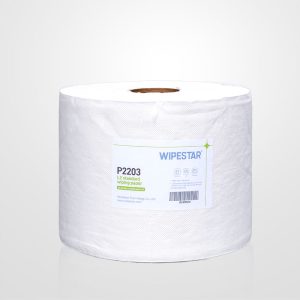
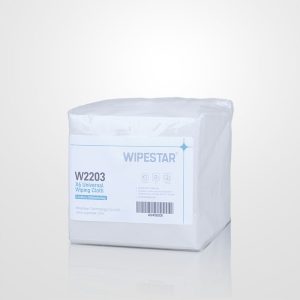
- Sealed-Edge Gas Turbine Wipes — Zero-fiber-release synthetic wipes with per-lot particle count data per IEST-RP-CC004. Designed for hot gas path component cleaning where a single fiber can cause $120,000 in blade damage.
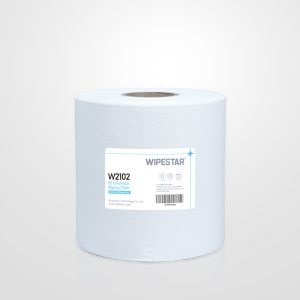
- EHC-Compatible Hydraulic Wipes — Polyester or polypropylene with no adhesive construction. Verified resistance to phosphate ester fluids. Separate from lube oil wipe inventory.
- Ultra-Clean Transformer Wipes — Ultra-low particulate, zero moisture, zero cellulose. For transformer oil handling where dielectric strength is non-negotiable.
Browse Wiping Cloths Range → Request a Custom Quote
Frequently Asked Questions