English
 Chinese



Here’s something that happened in a Belgian praline factory about two years ago. A routine allergen swab came back positive for peanut protein on a tempering line that had never processed anything nut-related. The whole line shut down. Full investigation. Three days of lost production.
The source? A maintenance tech grabbed a wipe from the shared rag bin—twenty meters away in the general workshop—and used it to clean chocolate residue off a depositor nozzle. That wipe had previously been used on a peanut brittle enrobing belt.
One wipe. Three days of downtime. An allergen incident report filed with the FAVV (Belgian food safety authority). Completely avoidable.
Chocolate and confectionery manufacturing has a cleaning problem that most facilities don’t fully appreciate until something goes wrong. The wipe you choose—and how you use it—matters more in a chocolate factory than almost any other food production environment.
Cocoa butter residue, allergen proteins, sugar crystallization, temperature swings between zones. Every one of these factors turns your cleaning consumable decision into a food safety decision, not just a purchasing one.
This guide is written for factory managers, quality assurance teams, and production supervisors in chocolate and confectionery plants. If you’re responsible for cleaning validation, allergen control, or consumable procurement, this is for you.
Why Allergen Cross-Contamination Is Your Biggest Wipe Risk
Let’s get the uncomfortable truth out of the way first. Chocolate factories are allergen nightmares. Most confectionery facilities run multiple product lines—dark chocolate, milk chocolate, white chocolate, pralines with hazelnuts, bars with peanut pieces, truffles containing soy lecithin. Some plants run twenty or more SKUs on shared equipment in a single shift.
The big four allergens in confectionery are milk, tree nuts, peanuts, and soy. All four are either ingredients or common cross-contact contaminants in chocolate production. Milk proteins linger on enrobing belts. Peanut dust settles on conveyors. Soy lecithin residue coats tempering vessels. Hazelnut oil migrates into every porous surface it touches.
And here’s the part most cleaning protocols miss: a wipe that’s been used to clean a nut-containing product line carries those proteins to whatever surface it touches next. The protein doesn’t disappear because you folded the wipe over. It transfers.
If that next surface is a “nut-free” production line, you’ve just created an allergen cross-contact event. BRC Global Standard for Food Safety (Issue 9, Clause 5.3) specifically requires documented controls for allergen cross-contamination—and that includes your cleaning consumables.
What does this mean in practice?
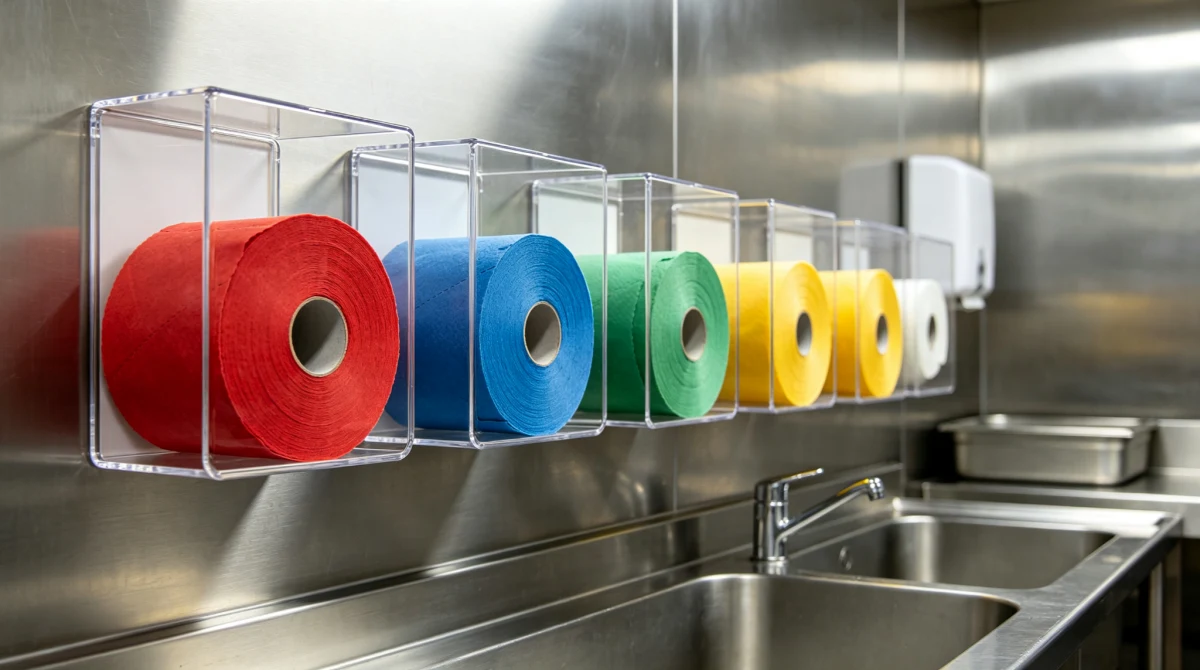
Color-coded wipe segregation. Dedicate different wipe colors or types to different allergen zones. Red for nut-containing lines. Blue for dairy. Green for allergen-free. Sounds simple. Almost nobody does it consistently.
Single-use, no exceptions. A wipe used on a hazelnut praline enrober goes in the bin after one use. It does not get “one more wipe” on the dark chocolate tempering machine. Non-negotiable in any facility with allergen zoning.
Supplier allergen documentation. Your wipe supplier should confirm the wipe itself doesn’t contain allergen-derived materials. Some natural fiber wipes use casein-based binders. Others use starch-based sizing from wheat. If your allergen control plan doesn’t account for the wipe itself, you’ve got a gap.
Cocoa Butter, Fat, and Oil: The Residue Problem
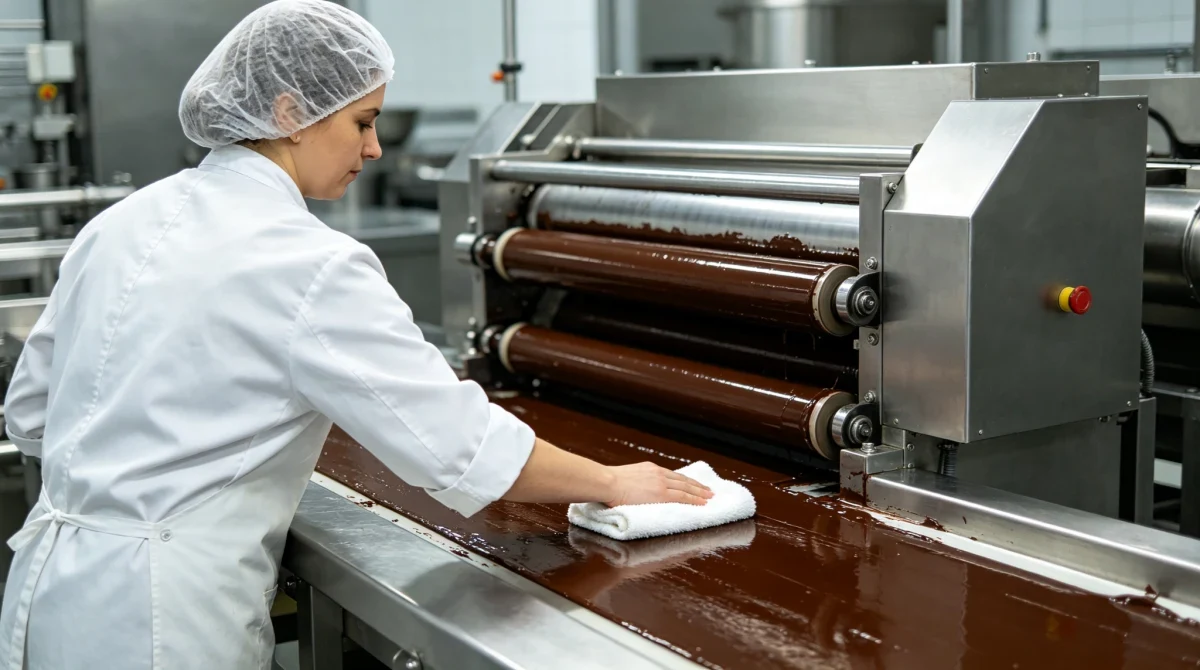
Chocolate is, at its core, a fat-based system. Cocoa butter is the dominant fat, and it’s everywhere in a chocolate factory—on tempering machines, enrobing belts, depositor nozzles, mold surfaces, cooling tunnels, and packaging conveyors. Cocoa butter melts at around 34–38°C, which means it’s liquid in most production areas and solid in cold storage.
That phase change makes cleaning complicated.
When cocoa butter is warm and liquid, a standard wipe smears it around without actually removing it. You end up with a thin, invisible fat film that attracts dust, harbors bacteria, and contaminates the next batch. When it’s cold and solid, it flakes off—but those flakes get into everything.
Your wipe needs to either absorb the fat effectively (when warm) or lift and trap the solid particles (when cold). Standard cellulose wipes are terrible at fat absorption. They just push grease across the surface.
You need wipes with specific oil-absorption capacity—synthetic or blended materials that wick fats into the fiber structure rather than smearing them. This is one of those specs that doesn’t show up on a generic wipe data sheet but makes an enormous difference on the factory floor. Ask your supplier for oil absorption test data. If they can’t provide it, that tells you something.
And it’s not just cocoa butter. Confectionery facilities deal with coconut oil, palm kernel oil, shea butter, milk fat, and nut oils—all with different viscosities, melting points, and cleaning challenges. A wipe that handles cocoa butter well might struggle with sticky caramel residue or crystallized sugar deposits.
The best approach is zone-specific wipe selection based on the dominant residue type in each area.
Temperature Challenges Across the Factory Floor
Walk through a chocolate factory and you’ll experience temperature swings that would confuse a thermostat. The tempering area sits at 28–32°C. The enrobing line runs at 30–35°C. Cooling tunnels drop to 10–14°C. Cold storage for finished products sits at 12–16°C with 50% relative humidity. Packaging areas are typically ambient, around 20–24°C.
That range matters for your wipes. A wipe that performs well at 30°C in the tempering room might stiffen and lose absorbency at 12°C in the cooling tunnel. A wipe optimized for cold environments might disintegrate faster in the warm, humid conditions near the enrobing belt.
You need materials that maintain consistent performance across 10–35°C—and that’s not a given with every cleaning cloth on the market.
Humidity is the other variable people forget. Chocolate production areas typically maintain 40–50% RH to prevent sugar bloom and fat bloom on finished products. But that humidity also affects wipe performance. Cellulose wipes absorb atmospheric moisture and become less effective at absorbing production residues.
Synthetic wipes handle humidity better, but you still need to store them properly—sealed dispensers, not open bins sitting on the production floor.
BRC and IFS Compliance for Cleaning Consumables
If your facility holds BRC Global Food Safety certification or IFS Food certification—and most major chocolate manufacturers do—your cleaning consumables fall under the same scrutiny as your ingredients. That’s not an exaggeration. Both standards treat cleaning materials as potential contamination sources that require documented control.
BRC Issue 9 covers this under Clause 4.9 (Cleaning) and Clause 5.3 (Allergen Management). The standard requires that cleaning materials are suitable for food contact, that they’re stored and controlled to prevent contamination, and that allergen-containing and allergen-free zones use segregated cleaning equipment. Your wipes are part of that equipment.
IFS Food Version 8 takes a similar approach under Chapter 4 (Food Safety and Quality Management) and Chapter 5 (Personnel). The standard expects documented cleaning procedures, validated cleaning methods, and verification that cleaning consumables don’t introduce hazards.
For allergen zones, IFS specifically requires that cleaning equipment—including wipes—be dedicated to specific areas and not shared across allergen boundaries.
What auditors actually look for during a BRC or IFS audit:
They want your cleaning consumable specification sheet. They want allergen declarations for the wipe itself. They want evidence of color-coding or segregation in your allergen zoning plan. They want to see that your wipes are food-contact compliant (typically to FDA 21 CFR or EU Regulation 1935/2004).
And they want to verify that your cleaning validation swabs confirm allergen removal to your validated limits—usually below 10 ppm for peanut protein, below 2.5 ppm for milk protein, depending on your internal thresholds.
If you can’t produce any of that documentation, you’ll get a non-conformance. Minor at best. Major if it’s a repeat finding. We’ve seen facilities lose their BRC AA rating over consumable documentation gaps. It happens more often than you’d think.
HACCP Cleaning Validation: What Auditors Actually Check
HACCP-based cleaning validation in chocolate manufacturing focuses on two critical control points: allergen removal and microbiological cleanliness. Your wipes play a direct role in both.
For allergen validation, most facilities use lateral flow devices (LFDs) or ELISA tests to swab production surfaces after cleaning. The typical acceptance limit for peanut is 10 ppm protein, for milk it’s 2.5 ppm protein, and for hazelnut it’s 10 ppm protein. These are surface swab results—meaning the surface must be visually clean AND pass the allergen test.
If your wipe leaves residue (fat films, fiber deposits, chemical traces), it can interfere with both the visual inspection and the swab result.
For microbiological validation, chocolate production surfaces typically target total viable count (TVC) below 100 CFU/cm² and absence of Salmonella, Listeria, and coliforms per swab. Your wipe can either help or hurt here.
A contaminated wipe—one that’s been sitting in an open bin, absorbing moisture and bacteria from the environment—can actually increase the microbial load on a surface during cleaning. This sounds counterintuitive, but it’s well-documented. A 2021 study in the Journal of Food Protection found that reusable cleaning cloths in food production environments harbored microbial loads 10–100× higher than the surfaces they were used to clean.
The fix is straightforward: use fresh, single-use wipes from sealed dispensers for all CCP-related cleaning. Don’t reuse. Don’t leave wipes in open containers. And make sure your cleaning validation swab protocol accounts for the wipe’s potential contribution to surface contamination.
Chocolate Production Wipe Specs by Zone
Chocolate factories aren’t one-size-fits-all. Each production zone has its own residue profile, temperature range, and risk factors. Here’s how wipe specs break down across the typical chocolate factory floor.
| Production Zone | Primary Residue | Temp Range | Key Wipe Specs | Critical Risk |
|---|---|---|---|---|
| Tempering | Cocoa butter, chocolate mass | 28–32°C | High oil absorption, lint-free, food-contact compliant | Fat film residue causing bloom defects |
| Enrobing | Cocoa butter, nut oils, dairy | 30–35°C | Allergen-segregated, oil-absorbent, sealed-edge | Allergen cross-contact between product lines |
| Molding / Depositing | Chocolate mass, caramel, fondant | 25–35°C | Lint-free, non-shedding, food-safe | Fiber contamination in finished product |
| Cooling Tunnel | Cocoa butter condensation, sugar bloom | 10–14°C | Performance at low temp, moisture-resistant | Sugar/fat bloom from inadequate cleaning |
| Packaging | Wrapper dust, adhesive residue | 20–24°C | Low-lint, antistatic, food-contact safe | Package seal contamination, label adhesion issues |
| Allergen-Free Line | General chocolate residue | 20–30°C | Dedicated color, allergen-free declared, sealed | Allergen introduction from cross-zone wipe use |
Quick note on cost: dedicated allergen-zone wipes and oil-absorbent synthetics cost more per unit than generic cellulose rags. But compare that to a single allergen incident—a product recall, a lost BRC rating, three days of line shutdown. Cost-per-wipe is the wrong metric. Cost-per-clean-production-run is what matters.
Most chocolate factories run a two-tier strategy: premium oil-absorbent, sealed-edge wipes for critical zones (tempering, enrobing, molding), and standard food-safe wipes for general areas (packaging, corridors, change rooms). Some add a third tier—dedicated allergen-zone wipes in distinct colors for lines that handle nuts, dairy, or soy.
Whatever your approach, document the wipe spec in your cleaning SOP and qualify the product in your actual factory conditions—not just the supplier’s datasheet.
6 Wipe Mistakes That Cause Chocolate Factory Shutdowns
1. Using shared wipe stocks across allergen zones. This is the Belgian praline factory story from the beginning. One wipe, one trip across an allergen boundary, and you’re filing an incident report. Color-code your wipe inventory. Store allergen-zone-specific wipes in sealed dispensers at the point of use. Train every operator—maintenance included—on the segregation rules.
2. Wiping cocoa butter with cellulose cloths. Cellulose doesn’t absorb fats—it smears them. You end up with an invisible cocoa butter film on tempering machines and enrobing belts that looks clean but isn’t. That film oxidizes, turns rancid, and contaminates the next batch. Use oil-absorbent synthetic wipes for all fat-contact surfaces.
3. Reusing wipes in allergen validation zones. “I’ll just give it one more wipe” is how allergen events start. A wipe that’s been used on a hazelnut enrober carries measurable tree nut protein. Reusing it on a dark chocolate line transfers those proteins. Single-use. Sealed dispenser. Bin after one wipe. No exceptions.
4. Storing wipes in open bins on the production floor. Open bins in a humid chocolate factory (40–50% RH) are moisture traps. Your wipes absorb that moisture, grow bacteria, and become contamination sources instead of cleaning tools. Sealed dispensers with controlled dispensing mechanisms. Every time.
5. Ignoring wipe fiber shedding on molding lines. Chocolate molds are precision-machined surfaces. A fiber from a cut-edge wipe left on a mold surface ends up embedded in the finished chocolate. Consumers find it. They photograph it. They post it on social media with your brand name visible. Sealed-edge wipes for all mold-contact cleaning. Not negotiable.
6. Missing allergen declarations for the wipe itself. BRC and IFS auditors will ask: “Is your cleaning cloth allergen-free?” If your wipe supplier can’t provide a written allergen declaration confirming the wipe material doesn’t contain milk proteins, nut derivatives, soy, wheat gluten, or other declared allergens, you have a documentation gap that will show up in your next audit. Get the declaration before you get the non-conformance.
Who You’ll Work With at WIPESTAR
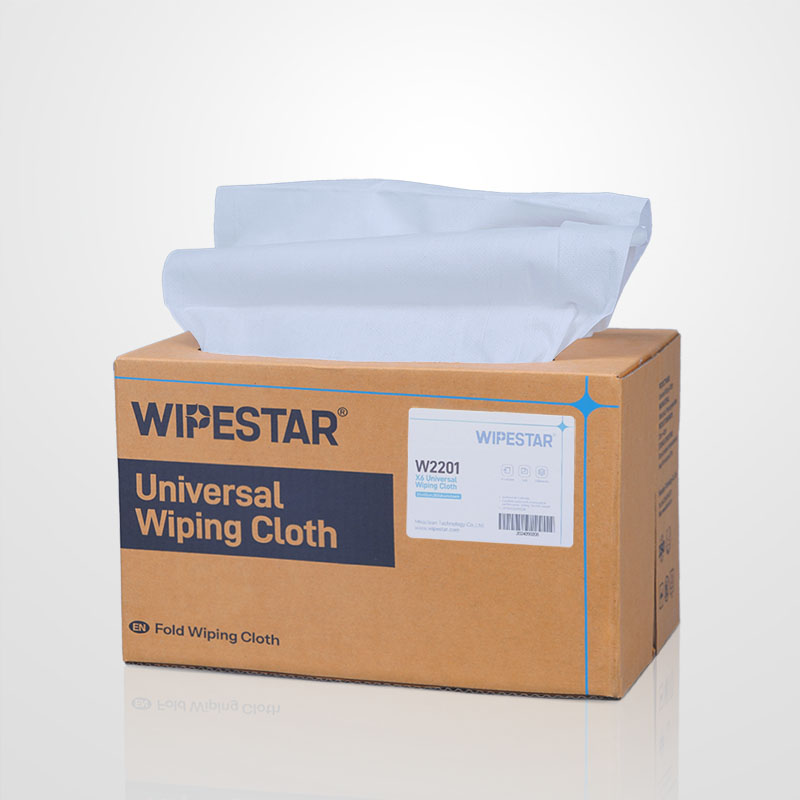
We supply cleaning consumables to chocolate factories and confectionery production facilities where allergen cross-contamination is a serious concern. Our team understands food safety compliance and the specific cleaning challenges of confectionery operations.

Zhen — Account Manager
Zhen has extensive experience in cleanroom consumables and contamination control, covering industries from microelectronics to food production. He helps chocolate factories match the right wipe to each production zone.

Daisy — Sales Support
Daisy handles order tracking, customer communication, and day-to-day business operations. She makes sure your wipe supply stays consistent so you never run short during a production push.

Zac — Customer Service
Zac handles incoming inquiries, order processing, and after-sales support. Fast turnaround on quotes and sample requests so you can qualify products without slowing down your timeline.

Yunyun — ESD Project Manager
Yunyun specializes in static control technology for cleanroom environments. While ESD is more critical in semiconductor fabs, her contamination control expertise applies to any precision manufacturing environment.
Get Started with Chocolate Factory Cleaning Consumables
Whether you’re setting up allergen zone wipe segregation for the first time, upgrading from cellulose to oil-absorbent synthetics, or preparing documentation for your next BRC or IFS audit, we can help. Full allergen declarations, food-contact compliance letters, oil absorption data, and lot traceability—everything your quality system needs.
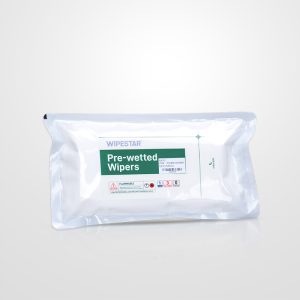
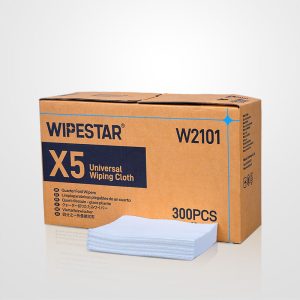
- Food Grade Industrial Wiping Cloths — FDA-compliant wipes for food-contact surfaces. Full allergen declarations and oil absorption data included.
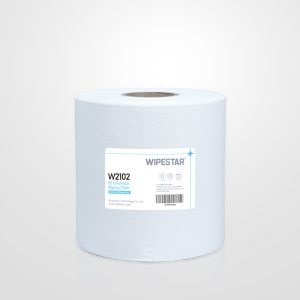
- Browse All Wiping Cloths — Full product range with specs, certifications, and material data sheets for food-grade applications.
- Request Technical Consultation — Need help matching a wipe to your specific production zone? Our team can provide compatibility data and allergen declarations for your facility.
Browse Full Wiping Cloths Range → Request a Custom Quote
Frequently Asked Questions