English
 Chinese



A surgical site infection in a US hospital runs between $20,785 and $100,000 per case—sometimes more, depending on the organism and the procedure. That figure comes from the CDC’s 2024 HAI Progress Report, not from a sales pitch. SSIs make up roughly 20% of all healthcare-associated infections, and surface contamination in the operating room is a documented contributing factor in at least 15–20% of those events.
The OR floor. The instrument table. The anesthesia machine. The Mayo stand. Surfaces that get cleaned between cases with… something.
That “something” is where things fall apart. I’ve watched sterile processing techs in hospitals across three continents clean OR surfaces between surgical cases, and the inconsistency is striking. Same hospital, same protocol, same disinfectant—completely different results depending on who’s wiping, what they’re wiping with, and whether anyone has ever validated that the process actually works.
The wipe itself gets almost zero attention. The disinfectant gets all the scrutiny—EPA registration, contact time, organism claims, dilution ratios. But the wipe is the delivery system. Pick the wrong one and you can neutralize a perfectly good disinfectant, leave organic residue that shields microorganisms, or fail to physically remove bioburden from the surface.
This guide is for infection control teams, sterile processing managers, and perioperative nurses who spec consumables for OR surface cleaning. It covers what the guidelines don’t tell you—and what we’ve learned from working with hospital OR teams on four continents.
The Wipe Is the Delivery System—And It Matters More Than You Think
Picture what happens when a surgical tech wipes down the OR table between cases. They grab a pre-saturated disinfectant wipe (or sometimes a dry wipe plus a squirt bottle), swipe the surface a few times, and move on. Total time: maybe 30 seconds. The disinfectant label says it needs 2–10 minutes of wet contact time to kill the target organisms.
The tech probably doesn’t know that. Or they know it but don’t have time—because the next case is rolling in 8 minutes and the room has to be turned over.
Here’s what nobody talks about: even if the contact time were perfect, the wipe itself can sabotage the whole effort. A wipe made from incompatible material binds the active ingredient in the disinfectant, dropping its concentration on the surface below the effective threshold. A wipe that sheds fibers leaves organic debris that physically shields microorganisms from the disinfectant.
A wipe with residual surfactants from its manufacturing process can react with quaternary ammonium compounds (quats) and cut their efficacy by 50% or more.
This isn’t alarmism. These are documented, measurable effects. A 2020 study in the American Journal of Infection Control tested quat concentration on surfaces after wiping with different cloth materials. Cotton wipes reduced free quat levels by up to 85% compared to the labeled concentration. Polyester microfiber dropped quats by 30–40%. Only synthetic nonwoven wipes maintained near-labeled quat concentrations.
Same disinfectant. Same surface. Three completely different outcomes—based on the wipe material alone.
If your infection control committee hasn’t evaluated wipe compatibility with your facility’s disinfectant system, you have a gap. A significant one.
Sporicidal Compatibility: Why Your Wipe Can Kill Your Disinfectant
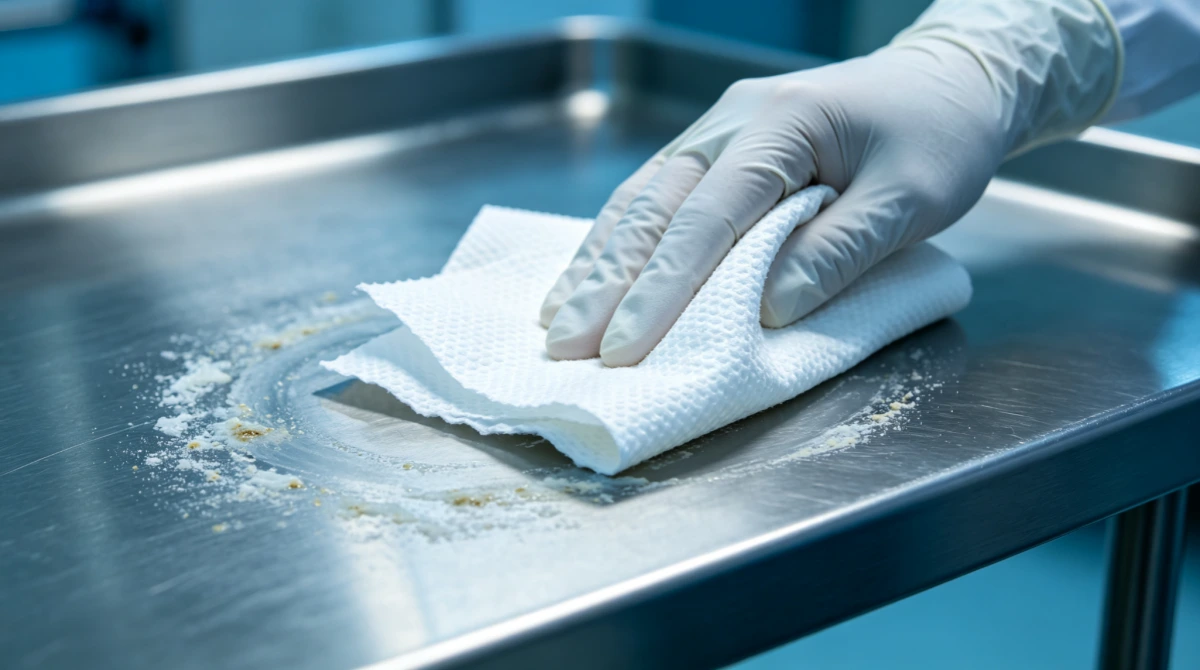
Let’s talk about sporicidal agents—because this is where wipe selection gets genuinely critical. Clostridioides difficile (C. diff) spores survive on OR surfaces for months. They shrug off most hospital-grade disinfectants—quats, alcohols, phenolics don’t touch spores. You need a sporicidal agent: sodium hypochlorite at ≥5,000 ppm, accelerated hydrogen peroxide (AHP) at 0.5%, or a peracetic acid-based product.
The catch is that sporicidal agents are reactive chemicals. Sodium hypochlorite (bleach) reacts with cellulose fibers, cotton, and many natural materials—degrading the active chlorine concentration. Accelerated hydrogen peroxide can decompose on contact with catalase-positive materials or metal-contaminated wipes. Peracetic acid corrodes certain synthetic polymers.
Your wipe needs to be chemically inert relative to your sporicidal disinfectant. That means:
For bleach-based sporicidal agents (sodium hypochlorite ≥5,000 ppm): Use synthetic nonwoven wipes—polyester, polyester/cellulose blends with verified bleach compatibility, or polypropylene. Avoid 100% cotton or cellulose wipes, which consume free chlorine and reduce effective concentration. Verify compatibility by measuring free chlorine levels before and after contact with the wipe material. If the drop exceeds 10%, the wipe is eating your active ingredient.
For accelerated hydrogen peroxide (AHP): Polyester and polypropylene wipes are generally compatible. Avoid wipes with metal contaminants (iron, copper, manganese) that catalyze peroxide decomposition. Some recycled-content wipes contain metal fragments from processing equipment—exactly the kind of contaminant that breaks down AHP on contact.
For peracetic acid: Check the wipe manufacturer’s compatibility data specifically for peracetic acid. Some synthetic polymers degrade in peracetic acid solutions over extended contact. The wipe needs to hold its structural integrity for at least the full contact time of your disinfectant protocol—typically 5–10 minutes.
This isn’t theoretical. A 400-bed academic medical center in the Midwest switched from quat-based to bleach-based sporicidal disinfection for their OR terminal cleaning protocol. They kept the same cotton cleaning cloths.
Six months later, environmental cultures showed persistently elevated C. diff spore counts on OR surfaces. The investigation found that the cotton cloths were consuming so much free chlorine that the effective concentration on the surface had dropped below the sporicidal threshold. Same protocol. Same frequency. Wrong wipe. The problem cleared up after they switched to verified-compatible synthetic nonwovens.
Wipe-and-Dry vs. Wet Contact Time: The Protocol Gap
Every EPA-registered disinfectant has a required contact time—the amount of time the surface must stay visibly wet with the disinfectant solution for the claimed organisms to be killed. For most hospital-grade disinfectants, that’s 1–10 minutes. For sporicidal claims, it’s typically 5–10 minutes. Some newer products claim 1-minute contact times for bacteria and viruses but still require 5–10 minutes for spores.
Now here’s what actually happens during OR turnover cleaning. The surgical team needs the room ready for the next case—fast. Between the patient leaving, the room being cleaned, the next patient being prepped, and the surgical team re-entering, the turnaround time in a busy OR is typically 15–25 minutes. Surface cleaning gets maybe 5–8 of those minutes.
Nobody is standing there watching a surface stay wet for 10 minutes. The disinfectant gets wiped on and wiped off in seconds.
This is the protocol gap. And it’s not strictly a wipe problem—it’s a system problem. But the wipe choice directly affects whether you have any shot at achieving adequate contact time, even imperfectly.
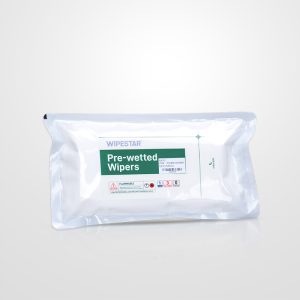
A pre-saturated wipe that delivers a controlled, consistent volume of disinfectant solution gives you a better chance of maintaining wet contact than a dry wipe dipped in a bucket of dilute disinfectant. The pre-saturated wipe has a defined saturation level—the manufacturer specifies grams of solution per square meter of wipe material.
A dry wipe dipped in a bucket could be oversaturated (dripping, wasting solution) or undersaturated (dry spots, no disinfectant delivery). The inconsistency is the problem.
Some facilities address this with a two-step process: wipe on the disinfectant with a saturated wipe, then leave it—don’t wipe it off—for the full contact time. This “wipe and wait” approach works for terminal cleaning between cases when you have time. For rapid between-case turnover, a shorter-contact-time disinfectant (1–2 minutes) delivered by a pre-saturated wipe is more practical than a 10-minute sporicidal agent that nobody actually leaves on the surface long enough.
Bioburden Reduction: Physical Removal Before Chemical Kill
There’s a fundamental concept in surface disinfection that gets overlooked in a lot of hospital training materials: physical removal of bioburden is at least as important as chemical killing. A disinfectant can’t kill what it can’t reach. If organic soil—blood, tissue, protein, body fluids—sits on the surface, it creates a physical barrier between the disinfectant and the microorganisms underneath.
The disinfectant reacts with the organic soil first (this is called organic load interference), and its effective concentration drops before it ever contacts the organisms.
This is why the CDC’s Guidelines for Environmental Infection Control in Healthcare Facilities (2003, updated 2019) recommends a two-step process for visibly soiled surfaces: clean first to remove organic matter, then disinfect. The cleaning step—physical removal of soil with a wipe and detergent or enzymatic cleaner—reduces bioburden by 80–90% before the disinfectant even touches the surface.
Your wipe choice directly affects how well that cleaning step works. A wipe with good absorbency and scrubbing texture physically lifts and traps organic soil in its fiber structure. A flat, smooth wipe tends to push soil around. A wipe that’s too soft won’t dislodge dried blood or protein residue. A wipe that’s too abrasive scratches the surface—creating microscopic crevices where microorganisms hide from subsequent disinfection.
For OR surface cleaning, the ideal wipe has moderate texture (enough to physically dislodge soil), high absorbency (to trap the soil in the wipe rather than redistribute it), and low lint (to avoid leaving fibers that become food for microorganisms). This is a different specification than a cleanroom wipe for a semiconductor fab—you need cleaning performance, not just particle counts.
Laminar Flow Hood and Air Handling Maintenance
Operating rooms with laminar airflow systems—typically orthopedic implant surgery, joint replacement, and neurosurgery suites—maintain positive pressure air environments with HEPA-filtered air flowing in a unidirectional pattern over the surgical field. The air change rate in a modern OR runs 15–25 air changes per hour, with the laminar canopy delivering ISO Class 7 or better air directly over the surgical site.
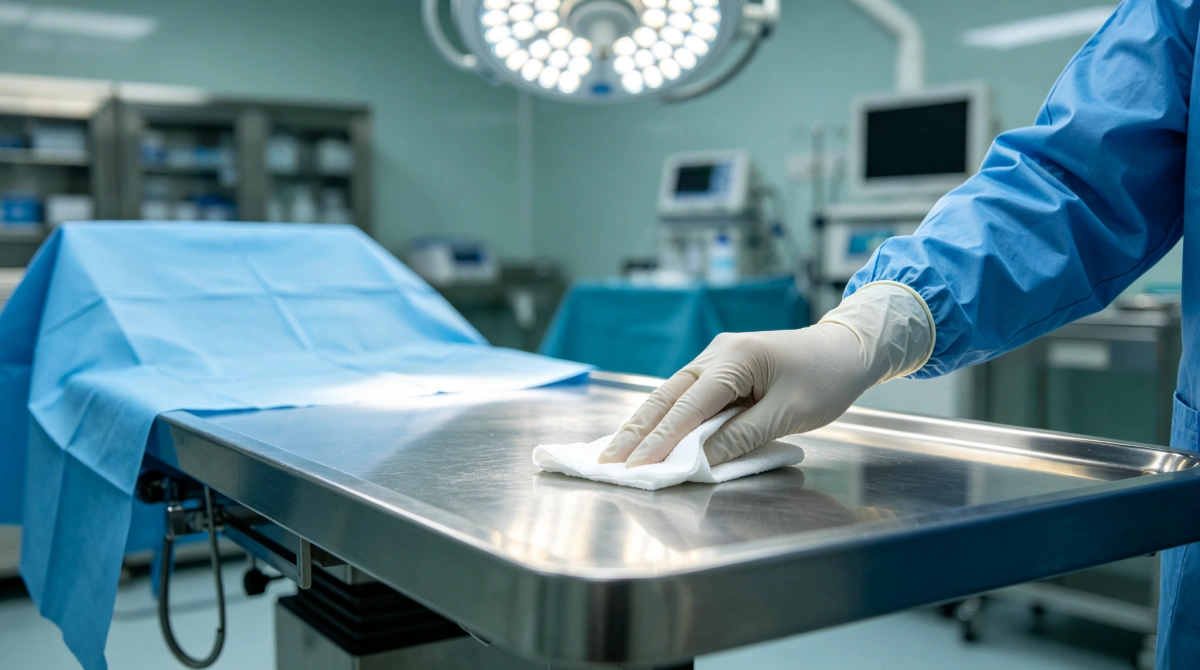
Those laminar flow diffusers, HEPA filter housings, and air return grilles need periodic cleaning and maintenance. And the wipe you use matters, because any fibers or particles shed during maintenance become airborne contaminants in the most critical zone of the OR. A standard cleaning cloth used on a laminar flow diffuser panel can release thousands of fibers into the airstream—fibers that settle directly into the open surgical wound.
For laminar flow equipment maintenance, you need low-particle, sealed-edge wipes—essentially cleanroom-grade materials. The same logic applies to cleaning the interior surfaces of instrument pass-throughs, warming cabinets with HEPA filtration, and any equipment with filtered air delivery. The wipe must not introduce particles into a controlled airflow environment.
Most hospitals don’t have a separate wipe specification for laminar flow equipment. They use the same general-purpose cleaning cloths used on OR floors and walls. That’s a gap. If your facility performs joint replacements or other implant surgeries in laminar flow ORs, the wipe used on the diffuser panels and air return grilles should meet a different—and higher—specification than the wipe used on the OR floor.
AORN and CDC Guidelines: What They Actually Say About Wipes
AORN’s Guidelines for Perioperative Practice (2024 edition) address environmental cleaning in the “Prevention of Transmission of Infections” chapter. The guideline recommends EPA-registered low- to intermediate-level disinfectants for noncritical environmental surfaces (OR floors, walls, furniture, equipment exteriors) and specifies that cleaning should proceed from clean areas to dirty areas, from high surfaces to low surfaces.
The guideline acknowledges that pre-saturated disinfectant wipes are acceptable for surface disinfection when used according to the manufacturer’s instructions for use (IFU).
What AORN doesn’t specify—and what causes confusion—is the wipe material itself. The guidelines focus on the disinfectant’s EPA registration and the cleaning technique, leaving wipe selection to facility policy. That’s a gap that infection control committees need to fill internally. Your facility’s surface disinfection protocol should specify the wipe material, not just the disinfectant.
The CDC’s 2003 Guidelines for Environmental Infection Control (still the primary reference, with 2019 updates) takes a similar approach—focus on the disinfectant’s registration and the cleaning process, with minimal guidance on wipe selection. The CDC does recommend that “cleaning cloths should be changed frequently during the cleaning process” and that “single-use disposable cloths are preferred” for high-risk areas. That’s as specific as it gets at the federal guideline level.
For practical OR infection control, your wipe selection should be driven by:
- Compatibility testing with your specific disinfectant—not just the general product class, but the exact product and concentration you use.
- Bioburden removal effectiveness validated on your OR surfaces.
- Lint and particle generation appropriate for your surgical environment (laminar flow ORs need cleanroom-grade wipes).
- Single-use or validated reprocessing if reusable—AORN prefers single-use for perioperative environments.
OR Surface Wipe Specs by Application
| OR Application | Surface Type | Disinfectant Class | Key Wipe Specs | Critical Requirement |
|---|---|---|---|---|
| OR Table (Between Cases) | Stainless steel, padded surfaces | Quat, AHP, or alcohol-based | Lint-free, quat-compatible, moderate absorbency | Wipe must not consume active quat concentration |
| Instrument Table / Mayo Stand | Stainless steel | Quat or AHP | Sealed-edge, low-particle, chemical-resistant | No fiber shedding into sterile field |
| Anesthesia Equipment | Mixed (plastic, rubber, metal) | Intermediate-level (quat or AHP) | Lint-free, compatible with rubber/plastic | No material degradation on contact surfaces |
| OR Floor | Vinyl, epoxy, terrazzo | Quat or bleach (sporicidal for C. diff) | High absorbency, scrub texture, bleach-compatible | Physical soil removal + chemical disinfection |
| Laminar Flow Diffuser | Perforated metal, plastic panels | AHP or quat (low-residue) | Cleanroom-grade, sealed-edge, ultra-low particle | Zero fiber release into HEPA-filtered airflow |
| Terminal Clean (C. diff Room) | All surfaces | Sporicidal (bleach ≥5,000 ppm or AHP) | Synthetic nonwoven, bleach-inert, high soil capacity | Sporicidal contact time: 5–10 minutes wet |
5 Wipe Mistakes That Increase SSI Risk
1. Using cotton rags with quat-based disinfectants. This is the single most common wipe-disinfectant incompatibility in hospitals. Cotton fibers bind quaternary ammonium compounds—consuming the active ingredient and reducing the effective concentration on the surface by up to 85%. The surface looks wet, it smells like disinfectant, but the actual quat level may be below the bactericidal threshold.
Switch to synthetic nonwoven wipes verified for quat compatibility. Test free quat levels before and after wiping if you want to confirm the effect in your facility.
2. Skipping the cleaning step before disinfection. Blood, tissue, and protein residue on OR surfaces protect microorganisms from chemical disinfection. Your disinfectant reacts with the organic soil first—by the time it reaches the organisms underneath, it’s weakened or depleted.
Always clean first (physical removal with an appropriate wipe) then disinfect. Two separate steps. Two separate wipe passes. The AORN guideline is clear on this, and yet single-step “wipe and disinfect” protocols persist in facilities that should know better.
3. Using general-purpose cleaning wipes on laminar flow equipment. The HEPA-filtered air over your surgical field is only as clean as the surfaces it passes over. A general-purpose cleaning cloth used on a laminar flow diffuser releases fibers into the airstream—fibers that settle directly into the open wound.
Use cleanroom-grade, low-particle wipes for any maintenance on laminar flow equipment, HEPA filter housings, and air return grilles. This is a different specification than your OR floor wipe.
4. Reusing disinfectant wipes across multiple surfaces. A wipe used on the OR floor picks up bioburden, blood, and organisms from the floor. Use that same wipe on the instrument table or anesthesia machine, and you’re transferring floor contamination to a critical patient-care surface.
Single-use wipe, one surface, dispose after use. This is explicitly recommended by the CDC and AORN. And yet the temptation to “get one more wipe” out of a saturated cloth is strong when turnover time is tight.
5. Ignoring contact time in between-case cleaning. Your disinfectant’s EPA-registered contact time is a label claim requirement—not a suggestion. If the label says 5 minutes wet contact for C. diff sporicidal activity, wiping the surface and immediately drying it doesn’t achieve sporicidal disinfection.
For between-case turnover with short-contact-time disinfectants (1–2 minutes), pre-saturated wipes with controlled saturation give you the best chance. For terminal cleaning, apply the disinfectant and leave it for the full contact time before wiping dry. Know your label. Follow your label. The organisms don’t care what your protocol says if the chemistry doesn’t have time to work.
Who You’ll Work With at WIPESTAR
We work with hospital operating rooms and sterile processing departments where surface cleaning directly impacts patient safety. Our team understands infection control protocols and the regulatory requirements of clinical environments.

Zac — Customer Service
Zac focuses on professional and efficient customer service, dedicated to responding to inquiries quickly, handling orders smoothly, and providing reliable after-sales support.

Yunyun — ESD Project Manager
Yunyun is a dedicated ESD prevention professional with rich experience in static control technology research, application, and solution implementation for cleanroom environments.

Ethan — Sales Director
Ethan has over 20 years of experience in the industrial wiping cloth and cleanroom consumables industry. He leads the global sales team and provides high-quality cleanroom solutions for worldwide customers.
Get Started with Hospital OR Cleaning Consumables
Whether you’re evaluating wipe-disinfectant compatibility for your OR surface cleaning protocol, designing a laminar flow equipment maintenance program, or preparing for your next Joint Commission survey, we can help. Disinfectant compatibility verification, material safety data, particle cleanliness specifications, and traceability documentation—everything your infection control program needs.
- Cleanroom Wiper Selection Guide — Our full technical guide covering wipe materials, chemical compatibility, and cleanroom class matching. Start here if you’re evaluating options for your OR.
- Browse All Wiping Cloths — Full product range with specs, certifications, and material data sheets for hospital-grade and cleanroom-grade wipes.
- Request Technical Consultation — Need help matching a wipe to your specific disinfectant chemistry? Our team can provide compatibility testing data for your facility.
Browse Full Wiping Cloths Range → Request a Custom Quote
Frequently Asked Questions