English
 Chinese



What’s the cheapest thing on a solar cell production line that can still wreck your yield? It’s not the silver paste, not the PECVD gas, not even the DI water. It’s the wipe sitting next to the wet bench that nobody thinks twice about.
A quality engineer at a 2 GW cell factory in Hefei figured this out the hard way. One production lane was running 1.8% lower average efficiency than the other three. Same equipment, same chemistry, same operators. They spent two weeks pulling SEM images, checking diffusion profiles, re-calibrating the PECVD chamber. Turned out Lane 2 was using generic polyester wipes from a local supplier—no sealed edges, no particle certification, no ionic testing. The other three lanes had proper low-particle, sealed-edge wipes. That ¥0.03 per wipe difference was costing them roughly ¥2.1 million a year in lost wattage.
That kind of thing happens everywhere—Jiaxing, Suzhou, Penang, the new mega-factories in Rajasthan. The wipe is the smallest line item in your consumables budget. It’s also the one most likely to quietly bleed your cell efficiency if you spec it wrong.
This guide is written for production engineers, QC managers, and procurement teams who buy consumables for photovoltaic cell and module manufacturing. Not generic industrial cleaning—PV production, where a 15-micron particle trapped under an AR coating becomes a permanent recombination site that costs you output for the next 25 years.
Why Solar Cells Are Unforgiving About Surface Contamination
Most manufacturing environments can tolerate a bit of particulate residue here and there. Solar cell production can’t. The physics are straightforward: a crystalline silicon cell converts photons to electrons across its entire surface, and any foreign material—lint fiber, silica dust, fingerprint oil—blocks that conversion locally.
Worse, contamination trapped under an anti-reflective (AR) coating creates permanent defects that no downstream process can fix. The coating goes on at 70–80nm thickness via PECVD. Anything sitting on the wafer surface before that step becomes a nucleation defect baked into the film.
Solar panels also operate outdoors for 25–30 years. A contamination defect that seems minor at the cell level can accelerate into delamination, hot spots, or PID (potential-induced degradation) once the module is under real UV exposure and thermal cycling. So the quality bar at the cell stage has to account for decades of field performance.
The wipe you use at the rinse station before AR coating is the last thing that touches that wafer surface. Pick the wrong one, and you’re introducing the exact particles you’re trying to remove.
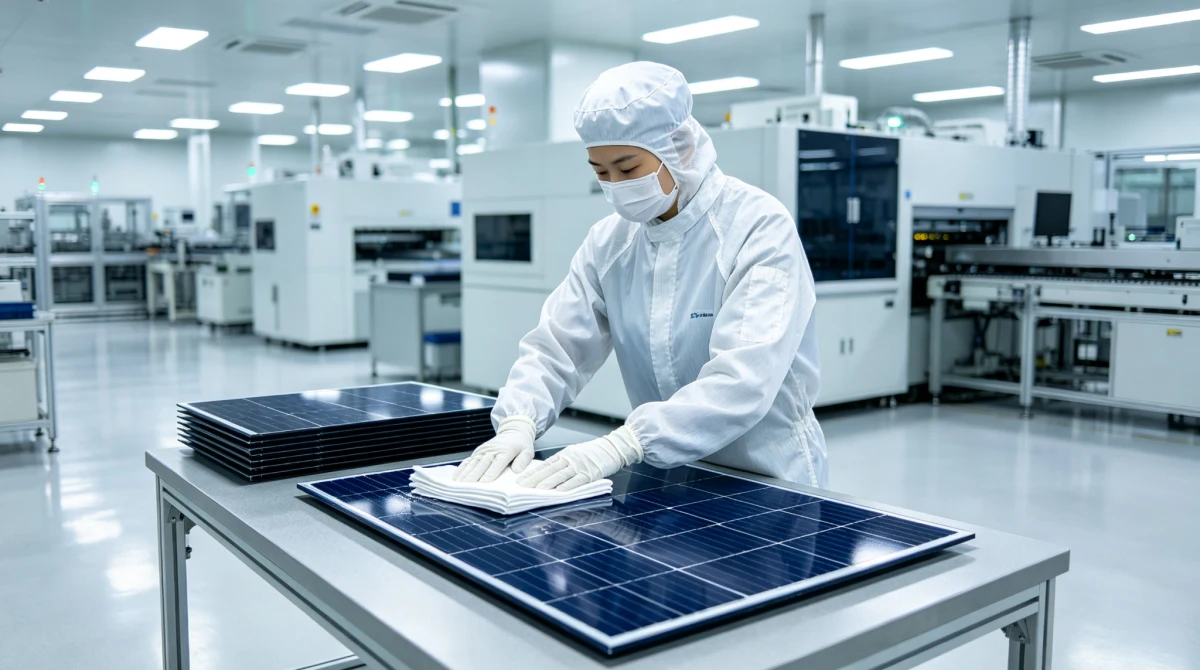
Cleanroom Classes Across the PV Production Line
A lot of factories set one ISO class for the entire facility and call it done. That either wastes money—over-filtering the module assembly area—or risks yield by under-filtering the cell processing zone. Different stages need different cleanliness levels.
Cell fabrication (texturing, diffusion, AR coating, metallization) — This is where contamination hurts the most. You want ISO 5 (Class 100) to ISO 6 (Class 1000) in the critical zones, particularly around the PECVD chamber for AR coating and the screen printing station for metallization. Wafer texturing with alkaline or acidic solutions is somewhat more forgiving, but the rinse and dry steps before coating absolutely demand cleanroom discipline.
Cell sorting and stringing — ISO 7 (Class 10,000) is generally acceptable. Cells are already coated and metallized, so you’re protecting finished surfaces rather than preparing them for deposition. Still, scratches on the AR coating during sorting reduce light absorption, so wipe choice matters even here.
Module lamination and assembly — ISO 7 to ISO 8 (Class 10,000 to 100,000). The glass cleaning step before lamination is critical. A particle trapped between the glass and the EVA encapsulant creates an air pocket that expands under thermal stress. That’s a warranty claim waiting to happen three years into field deployment.
Your cleanroom team already knows these standards. The problem isn’t knowledge—it’s that wipe procurement often happens at the facility level rather than the process-step level. One SKU ordered in bulk for the whole factory. That’s where yield leaks.
Wipe Types and Specs for Each Production Stage
Not all cleanroom wipes are interchangeable. Using a heavy-duty polyester knit where you need a delicate microfiber is like using sandpaper to clean eyeglasses—technically it removes the smudge, but you’ve introduced a bigger problem.
Here’s what we recommend at each stage, based on real production data from our PV manufacturing clients:
| Production Stage | Recommended Wipe Type | Basis Weight | Particle Generation | Key Properties | Typical Cleanroom Class |
|---|---|---|---|---|---|
| Wafer texturing & rinse | 100% polyester, sealed-edge knit | 90–120 g/m² | < 2.5 × 10⁵ particles/m² (≥0.5µm) | Acid/alkali resistant, low NVR, absorbent | ISO 6 (Class 1000) |
| AR coating prep (PECVD) | Microfiber polyester/nylon blend | 70–90 g/m² | < 1.0 × 10⁵ particles/m² (≥0.5µm) | Ultra-low particle, IPA-compatible, non-abrasive | ISO 5–6 (Class 100–1000) |
| Metallization (screen printing) | Polyester knit, heat-sealed edge | 100–130 g/m² | < 3.0 × 10⁵ particles/m² (≥0.5µm) | Solvent resistant, good ink/paste pickup | ISO 6 (Class 1000) |
| Cell sorting & stringing | Non-woven polyester/cellulose blend | 60–80 g/m² | < 5.0 × 10⁵ particles/m² (≥0.5µm) | Soft surface, ESD-safe option available | ISO 7 (Class 10,000) |
| Glass cleaning (pre-lamination) | Non-woven, high-absorbency | 80–110 g/m² | < 8.0 × 10⁵ particles/m² (≥0.5µm) | No streak residue, compatible with glass cleaners | ISO 7–8 (Class 10,000–100,000) |
| Module edge sealing & final QC | Anti-static polyester | 90–110 g/m² | < 4.0 × 10⁵ particles/m² (≥0.5µm) | ESD dissipative (10⁹–10¹¹ Ω), cleanroom packaged | ISO 7 (Class 10,000) |
Two things worth calling out from that table. First, the AR coating prep step has the tightest particle spec—and for good reason. You’re wiping a surface that’s about to receive a 75nm silicon nitride film via PECVD. Any particle larger than about 50nm becomes a nucleation defect.
Second, the ESD requirement at the final module stage is often overlooked. Solar cells generate static charge during handling, and an uncontrolled discharge can micro-crack the silicon, creating invisible defects that show up as hot spots two years into service. Anti-static wipes aren’t optional there—they’re insurance.
AR Coating Protection: Where Most Lines Leak Yield
If I had to pick one stage where the wrong wipe causes the most damage, it’s the cleaning step right before anti-reflective coating deposition. The AR coating—usually SiNx applied via PECVD—is what gives solar cells their characteristic dark blue color and, more importantly, what reduces surface reflectivity from roughly 35% down to under 3%.
That reflectivity reduction directly translates to current generation. Less reflection equals more photons absorbed equals more electrons collected.
The coating is thin. Really thin. Typically 70–80nm. At that scale, even a fingerprint smudge creates a thickness variation that changes the optical properties locally. You get what the industry calls a “color cell”—a cell with visible discoloration that fails EL (electroluminescence) inspection. Those cells either get scrapped or downgraded to B-class, which sells at a 15–20% discount.
The fix is straightforward but requires discipline:
- Use a microfiber polyester/nylon blend wipe with IPA or deionized water as the cleaning agent.
- Wipe in one direction, not circular.
- Replace the wipe after every 8–12 wafers—or sooner if you notice any resistance.
- And this is the part that gets skipped—validate your wipe’s extractable ion content quarterly. Sodium and potassium ions above 5 ppm in the wipe fiber will migrate into the PECVD chamber atmosphere and contaminate the coating.
Glass Cleaning Before Lamination
This one seems simple. It’s glass. You wipe it. Done, right?
Not quite. Tempered solar glass has a textured surface—to reduce reflectivity and improve EVA adhesion—and that texture traps particles in its micro-valleys. A standard wipe glides over the surface without actually dislodging the debris.
You need a wipe with enough loft and absorbency to conform to the surface topography and lift particles out of those valleys. Non-woven wipes with high cellulose content work well here—they have a fuzzy surface texture that grabs particles rather than pushing them around.
The trade-off is higher fiber shedding compared to polyester knits, so you need to do a final lint-free wipe pass before the glass enters the laminator. Two-step cleaning. It adds 3–4 seconds per panel, but the scrap reduction pays for itself within a week on any line running above 500 panels per day.
A production manager at a factory in Jiaxing told me that switching from single-step to two-step glass cleaning reduced their lamination defect rate from 0.6% to under 0.1%. At their volume—about 8,000 panels per day—that translated to roughly 40 fewer rejects daily. The cost of the second wipe pass? About ¥0.05 per panel.
ESD Control: The Silent Killer in Module Assembly
Electrostatic discharge in solar module assembly is one of those problems that doesn’t announce itself. There’s no spark, no visible damage. What happens is microscopic: a static charge builds up on the cell surface during automated handling, and when it discharges—usually to the gripper arm or conveyor—it creates a tiny melt zone in the silicon.
That melt zone becomes a shunt path—a microscopic short circuit that bleeds current under operation.
Shunted cells pass standard flash testing at the factory. They look fine on the I-V curve. But under field conditions with reverse bias during shading events, those shunts accelerate. The cell heats up. Neighboring cells heat up. Hot spot. Module warranty claim.
Anti-static wipes with surface resistivity in the 10⁹ to 10¹¹ ohm range dissipate charge gradually without creating a sudden discharge event. They’re not glamorous. Nobody gets excited about ESD wipes.
But a production manager at a 1.5 GW module factory in Jiaxing told me that switching to proper ESD-rated wipes reduced their field return rate by 0.4%—which, at their scale, translated to about 6 MW of modules that didn’t come back for warranty service. At current module pricing, that’s several million yuan saved. Over the 25-year warranty period, the number gets much bigger.
Wipe Type Comparison: Side-by-Side
PV manufacturers typically use four main categories of wipes. The choice depends on your cleanroom class, the process step, and the chemical environment.
| Property | Polyester Knit (Sealed Edge) | Microfiber Polyester/Nylon | Non-Woven Polyester/Cellulose | Anti-Static Polyester |
|---|---|---|---|---|
| Cleanroom Class Suitability | ISO 5 – ISO 7 | ISO 5 – ISO 6 | ISO 7 – ISO 8 | ISO 6 – ISO 7 |
| Particle Generation (≥0.5µm) | < 2.5 × 10⁵ /m² | < 1.0 × 10⁵ /m² | < 5.0 × 10⁵ /m² | < 4.0 × 10⁵ /m² |
| Ionic Extractables | Low (< 5 ppm total) | Very Low (< 3 ppm) | Moderate (5–15 ppm) | Low (< 5 ppm) |
| ESD-Safe | No (standard version) | No | Limited options | Yes (10⁹–10¹¹ Ω) |
| Chemical Compatibility | Excellent—IPA, acetone, alkaline solutions | Good—IPA, DI water; limited with strong solvents | Good—IPA, DI water; degrades in strong alkali | Excellent—broad solvent resistance |
| Absorbency | Moderate (~3.5 mL/g) | Moderate (~4 mL/g) | High (~6–8 mL/g) | Moderate (~3 mL/g) |
| Best For | Wafer texturing, metallization, general tool cleaning | AR coating prep, critical wafer contact | Glass cleaning, spill cleanup, gowning area | Module assembly, final QC, cell sorting |
| Relative Cost | $$ | $$$ | $ | $$ |
Quick note on cost: the cheapest wipe in that table runs about ¥0.05–¥0.10 per wipe. The most expensive microfiber is ¥0.20–¥0.40. That looks like a big gap until you compare it to one rejected cell at the AR coating station.
One color-cell reject at a 2 GW factory, running 20,000 cells per hour, with a 15% B-class downgrade discount—do the math. A year’s supply of the best microfiber wipes costs less than a single day of color-cell rejects on one production lane. Cost-per-wipe is the wrong metric. Cost-per-clean-cell is what matters.
Most PV manufacturers run a two-tier strategy: premium microfiber for critical process areas (AR coating prep, PECVD chamber cleaning), and standard polyester knit for general cell line maintenance (equipment surfaces, bench tops, texturing tank edges). Some add a third tier—non-woven wipes for glass cleaning and module assembly corridors—to control cost without compromising critical zones.
Whatever your approach, document the wipe spec in your production SOP and qualify the product before switching suppliers. “Qualification” means testing in your actual environment—your solvents, your wiping technique, your cleanroom conditions—not just trusting the supplier’s datasheet.
Who You’ll Work With at WIPESTAR
We supply cleaning consumables to solar panel manufacturing facilities where particle contamination directly impacts cell efficiency. Our team understands the cleanroom requirements and surface sensitivity of photovoltaic production.

Ethan — Sales Director
Ethan has over 20 years of experience in the industrial wiping cloth and cleanroom consumables industry. He leads the global sales team and provides high-quality cleanroom solutions for worldwide customers.

Lee — Key Account Sales Manager
Lee has 7 years of sales experience in the cleanroom consumables industry, having served international companies such as Foxconn, Samsung, and Apple. He focuses on solving problems for customers.

Vicky — Foreign Trade Sales Supervisor
Vicky plays a key role in the foreign trade sales team, responsible for client communication, sales coordination, and maintaining cooperative relationships with global clients.
Get Started with Solar Panel Manufacturing Cleanroom Wipes
Whether you’re qualifying wipes for a new cell line, upgrading consumables to fix a yield problem, or trying to track down the source of color-cell rejects, we can help. Full documentation including COA, ionic analysis, and IEST-RP-CC004 compliance data.
- Cleanroom Wiper Selection Guide — Our full technical guide covering wipe materials, particle specs, and cleanroom class matching. Start here if you’re evaluating options.
- Browse All Wiping Cloths — Full product range with specs, certifications, and material data sheets for PV-grade wipes.
- Request Technical Consultation — Need help matching a wipe to your specific process? Our team can provide ionic analysis and compatibility data for your production line.
Browse Full Wiping Cloths Range → Request a Custom Quote
Frequently Asked Questions