English
 Chinese



What’s the most overlooked consumable in wind turbine maintenance? It’s not the hydraulic fluid or the gear oil. It’s the wipe that nobody thinks twice about.
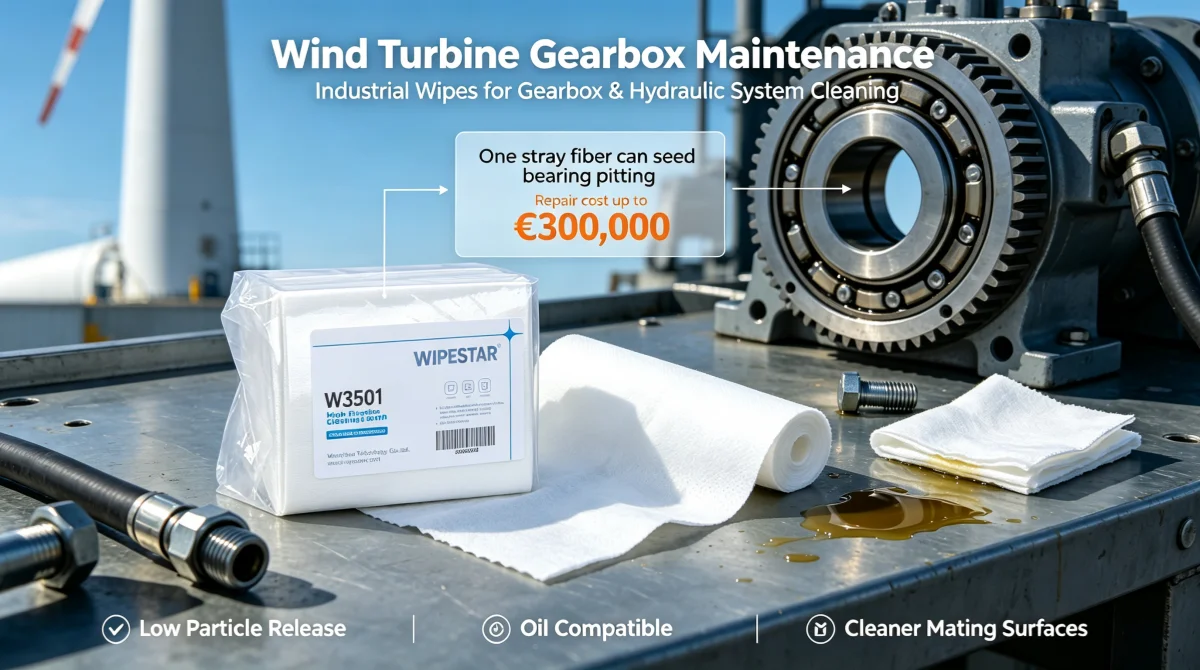
Last October, a maintenance crew on a 4.8 MW offshore turbine 40 km off the coast of Yantai pulled the gearbox for a routine oil change. Standard procedure — they’d done it a hundred times. But this time, a technician wiped the housing mating surface with a general-purpose shop rag before reassembly. The rag left behind micro-fibers and a thin film of hydraulic fluid residue. Three months later, that turbine was back in port with bearing pitting and a repair bill that would make your CFO cry.
That’s not a one-off story. It happens at wind farms everywhere — the North Sea, Inner Mongolia, the Texas Panhandle, offshore Guangdong. The wipe is the cheapest item in your maintenance toolkit. It’s also the one most likely to cause a premature gearbox failure if you grab the wrong one.
This guide is written for wind farm maintenance managers, turbine technicians, and procurement teams who spec consumables for turbine servicing. Not generic industrial cleaning — the kind of work where you’re 100 meters up, opening a gearbox that costs €180,000 to replace, and every surface you touch with a wipe either protects that component or contaminates it.
The Gearbox Oil Cleanup Nobody Talks About
Wind turbine gearboxes are the second most expensive component in the drivetrain (after the blades, which are in a cost category of their own). A typical 3 MW gearbox runs about €180,000 to replace — and that’s before you factor in crane mobilization, lost production, and the logistics of getting a 12-ton component up a tower or onto a jack-up vessel.
So when you’re servicing one — changing oil, replacing filters, inspecting bearings — surface cleanliness isn’t optional. It’s the difference between a gearbox that runs another 8 years and one that develops micropitting within 6 months.
The ISO 4406 cleanliness code governs hydraulic and gear oil contamination levels. Most gearbox OEMs (Winergy, ZF, Moventas) specify ISO 16/14/11 or cleaner for the oil in service. That means fewer than 640 particles larger than 4 µm, fewer than 160 particles larger than 6 µm, and fewer than 20 particles larger than 14 µm — per milliliter.
When you open the gearbox housing, every surface you touch with a wipe either contributes particles to that count or doesn’t. A shop rag — the kind most maintenance teams grab from a bin — typically sheds 10 to 100 times more particles than a proper industrial wipe. And it’s not just particle count. Shop rags carry residual oils, metal fines from previous use, and sometimes even water. All of that goes straight into your gearbox oil circuit.
Offshore vs. Onshore: Same Turbine, Different Wipe Requirements
You’d think a wipe is a wipe. Same nacelle, same gearbox, same maintenance procedure. But the operating environment changes everything about material selection.
Salt spray is the main offshore culprit. Sodium chloride crystals deposited on nacelle surfaces are hygroscopic — they pull moisture from the air and create a persistent conductive film. When that film contacts carbon steel components (gearbox housing, yaw bearings, pitch mechanisms), it accelerates corrosion. Standard polyester wipes handle salt residue fine, but the wipes themselves need to be stored in sealed packaging that prevents salt contamination before use. A bag of wipes left open on a nacelle shelf for two weeks in the North Sea is essentially useless for any precision cleaning task.
Onshore turbines in arid regions face a different problem: fine dust and sand. Gobi desert sand particles average 100–300 µm — large enough to be abrasive but small enough to infiltrate every seal gap in the nacelle. Wipes used in these environments need higher absorbency and mechanical strength to capture and hold sand particles rather than just pushing them around.
Temperature is another factor that spec sheets ignore. Offshore, ambient nacelle temperatures in winter hover around -10°C to 0°C. Onshore in northern climates, you might see -30°C at the tower top. Wipes stored at these temperatures become stiff and lose their conformability. A wipe at 10°C cleans 2–3x more effectively than the same wipe at -20°C because the fiber structure stays supple and conforms to surface irregularities.
Wipe Selection by Maintenance Task
Different turbine maintenance operations have radically different cleanliness requirements. Using the same wipe for everything is like using the same socket for every bolt — it sort of works, until it doesn’t.
| Maintenance Task | Recommended Wipe Type | Key Contaminants Removed | Cleanliness Standard | Wipe Change Frequency |
|---|---|---|---|---|
| Gearbox housing reassembly | Lint-free polyester knit, sealed-edge | Oil residue, metal fines, old gasket material | ISO 4406: 16/14/11 or cleaner | New wipe per mating surface |
| Hydraulic system fluid change | Low-particle polyester, IPA-compatible | Hydraulic fluid varnish, seal degradation particles | ISO 4406: 15/13/10 (OEM-dependent) | New wipe per connection point |
| Blade leading edge inspection prep | Non-woven, high-absorbency, non-abrasive | Insect residue, salt deposits, dirt film | Visual cleanliness (no standard code) | Every 2–3 m of blade length |
| Generator room cleaning | Anti-static polyester/cellulose blend | Carbon dust, bearing grease, cooling air residue | General industrial cleanliness | As needed; multiple wipes per unit |
| Pitch system and yaw bearing service | Heavy-duty non-woven, solvent-resistant | Grease, corrosion products, old lubricant | Visual + functional (smooth motion) | Wipe until surface is clean |
| Electrical panel and slip ring cleaning | Anti-static, lint-free microfiber | Carbon brush dust, oxidation, moisture | ESD-safe per IEC 61340-5-1 | New wipe per panel / slip ring |
A few notes from the field. For gearbox work, we strongly recommend sealed-edge polyester knit wipes — not because we sell them (we do), but because unsealed polyester edges shed fibers at a rate 5–10x higher than sealed edges under mechanical pressure. When you’re pressing a wipe against a machined housing surface to remove oil film, those loose fibers go straight into the oil circuit. It’s the difference between passing and failing an oil sample analysis three months later.
For blade inspection prep, the wipe doesn’t need to meet a particle count spec — it just needs to remove visible contamination without scratching the gelcoat or laminate surface. Non-woven wipes with high cellulose content work well here because they’re soft enough to conform to the blade’s curved surface and absorbent enough to lift insect residue and salt deposits with minimal pressure.
One thing people overlook: aggressive scrubbing on a composite blade surface can create micro-scratches that become stress concentration points under cyclic loading. Not ideal for a component designed to rotate 20 million times a year.
Hydraulic System Cleanliness: Where Wipes Make or Break ISO Codes
Every hydraulic system on a wind turbine — pitch control, yaw drive, main brake — runs on fluid cleanliness specs. And every connection point you open during maintenance is a contamination ingress opportunity.
The pitch system hydraulic unit is particularly sensitive. Pitch cylinders operate at 200+ bar and use servo-proportional valves with clearances measured in single-digit microns. A particle larger than 6 µm wedged in a valve spool can cause the pitch system to stick or respond sluggishly. On an offshore turbine in 25 m/s gusts, a delayed pitch response is a safety issue, not just an efficiency problem.
When you disconnect a hydraulic line for maintenance, the exposed fitting and hose end need to be wiped with a lint-free, low-particle wipe before reconnection. Most hydraulic OEMs (Bosch Rexroth, Eaton, Parker) recommend wiping the fitting three times with a fresh section of wipe each time, then visually inspecting under good lighting. The wipe should come away clean — no discoloration, no particles visible to the naked eye.
We’ve tested generic industrial rags against sealed-edge polyester knit wipes in simulated hydraulic fitting cleanup. The generic rags left behind an average of 340 visible fibers per fitting. Our wipes left 12. That’s 28x fewer potential valve contaminants per connection. Over a full hydraulic system service (40–60 connection points on a typical pitch circuit), the difference adds up fast.
The Height Problem: Wipe Packaging and Portability
This is a practical concern that spec sheets don’t address. You’re carrying everything you need up a ladder or in a service elevator to a nacelle 100+ meters off the ground. Every kilogram matters. Every item that doesn’t fit in your tool bag is one more trip.
Wipe packaging matters more in wind turbine maintenance than in almost any other industrial application. Individual wipe packs (singles or 10-count sleeves) are far more practical than bulk bags for nacelle work. You don’t want to open a 100-count bag of wipes at the top of a tower, use 8 of them, and then have 92 wipes slowly degrading in a nacelle that swings 2 meters in moderate wind.
We package our wind energy wipes in moisture-sealed 10-count and 25-count sleeves, sized to fit standard tool bags. Each sleeve has a resealable strip so unused wipes stay clean between tasks.
It sounds trivial. But a maintenance lead at a 150 MW wind farm in Gansu told us that switching from bulk bags to sealed sleeves reduced their wipe waste by about 40% — wipes that used to get contaminated or dried out in open bags were now staying usable for the full maintenance window.
Blade Leading Edge Protection: A Growing Maintenance Focus
Leading edge erosion (LEE) has become one of the top three maintenance concerns for modern wind turbines, especially offshore. Rain, hail, salt spray, and airborne particulates gradually erode the blade’s leading edge protective coating, exposing the underlying glass fiber composite. Once the composite is exposed, erosion accelerates dramatically.
During blade inspection — whether visual, drone-based, or rope-access — you need to clean the inspection area to get accurate readings. Contamination on the blade surface can mask erosion damage, leading to under-reporting of blade condition. That means a blade that should be scheduled for leading edge protection (LEP) coating repair gets deferred, and by the next inspection cycle, the damage has doubled.
The right wipe for blade prep is soft, absorbent, and leaves zero residue. You’re not trying to strip coatings — you’re removing surface grime so the inspector (human or camera) can see the actual blade condition. IPA-dampened non-woven wipes work well for this application. Avoid anything with silicone or wax additives, as these leave a film that interferes with LEP adhesion if the blade is scheduled for coating repair after inspection.
Wipe Type Comparison: Side-by-Side
Wind turbine maintenance typically uses three main categories of wipes. The choice depends on the task, the environment, and how much contamination you can afford to introduce.
| Property | Sealed-Edge Polyester Knit | Polyester/Cellulose Non-Woven | Heavy-Duty Solvent-Resistant |
|---|---|---|---|
| Particle Generation | Very Low — sealed edges eliminate fiber shedding | Moderate — higher linting than knit | Low–Moderate — depends on weave density |
| Absorbency | Moderate (~3.5 mL/g) | High (~6–8 mL/g) | Low–Moderate (~2.5 mL/g) |
| Chemical Compatibility | Excellent — IPA, mineral spirits, gear oils, hydraulic fluids | Good — IPA, DI water; limited with strong solvents | Excellent — petroleum greases, synthetic lubricants, aggressive cleaners |
| Mechanical Strength | High — holds up under pressure on machined surfaces | Moderate — soft, conformable, tears more easily | Very High — designed for heavy scrubbing |
| Anti-Static Versions | Yes (carbon-loaded) | Limited | Available |
| Best For | Gearbox reassembly, hydraulic fittings, precision cleaning | Blade inspection prep, nacelle surfaces, spill cleanup | Pitch system greasing, yaw bearing service, heavy contamination |
| Relative Cost | $$ | $ | $$$ |
Quick note on cost: the cheapest wipe in that table runs about $0.08–$0.15 per wipe. The most expensive heavy-duty option is $0.30–$0.60. That looks like a big gap until you compare it to one gearbox failure at an offshore wind farm.
One premature gearbox replacement pays for a decade of the right wipes. Cost-per-wipe is the wrong metric. Cost-per-clean-turbine is what matters.
Most wind farm operators run a two-tier strategy: premium sealed-edge polyester for critical drivetrain and hydraulic work, and standard non-woven wipes for general nacelle cleaning and blade prep. Some add a third tier — heavy-duty wipes for pitch and yaw servicing — to control cost without compromising the components that keep the turbine spinning.
Whatever your approach, document the wipe spec in your maintenance SOP and qualify the product before rolling it out across the farm. “Qualification” means testing in your actual environment — your solvents, your wiping technique, your nacelle conditions — not just trusting the supplier’s datasheet.
Who You’ll Work With at WIPESTAR
We supply cleaning consumables to wind farm operators and maintenance contractors who can’t afford to have a turbine down because of a contaminated gearbox. Our team understands the unique challenges of turbine maintenance — from offshore salt spray to onshore dust storms.

Vicky — Foreign Trade Sales Supervisor
Vicky plays a key role in the foreign trade sales team, responsible for client communication, sales coordination, and maintaining cooperative relationships with global clients.

Carolina — Product Specialist
Carolina has many years of experience in the cleanroom consumables industry, focusing on product quality and performance. She communicates closely with production teams to continuously optimize products.
Get Started with Wind Turbine Maintenance Wipes
Whether you’re qualifying wipes for a new wind farm, upgrading consumables for offshore maintenance, or investigating a gearbox failure linked to contamination, we can help. Full documentation including COA, particle generation data, and ISO 4406 compliance information.
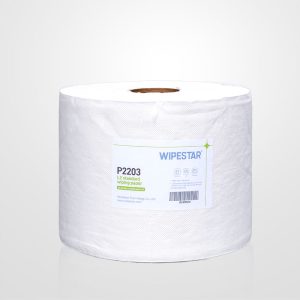
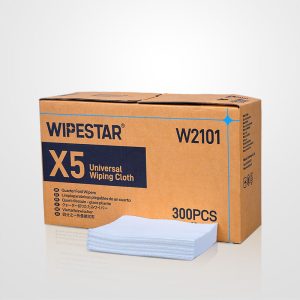
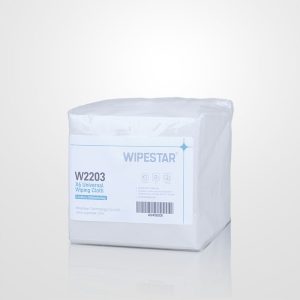
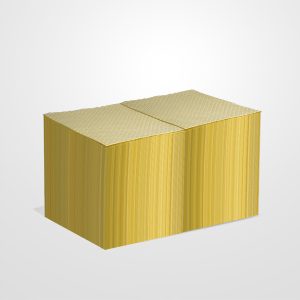
- Wiping Cloths — Our full range of polyester knit, non-woven, and heavy-duty wiping cloths. Sealed-edge options for gearbox and hydraulic work, high-absorbency options for blade prep. Browse specs, certifications, and material data sheets.
- W3501 Heavy Duty Surface Preparation Wipes — High-friction wipes built for pitch system greasing, yaw bearing service, and heavy-contamination tasks. High mechanical strength, compatible with petroleum-based greases and synthetic lubricants.
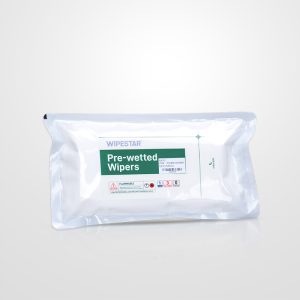
- Pre-Wetted Wipes — Factory-sealed with known solvent purity and saturation level. Eliminates operator variability at the wet bench or during critical hydraulic fitting cleanup.
- Request Technical Consultation — Need help matching a wipe to your specific maintenance tasks? Our team can provide compatibility data and free sample packs for field evaluation.
Browse Wiping Cloths → Request Samples & Quote
Frequently Asked Questions