English
 Chinese



Last year a mill in Port Hawkesbury, Nova Scotia had a problem they couldn’t figure out. Sheet breaks on their 350-inch newsprint machine were running 40% above normal. The press section felt was loading up faster than it should.
Maintenance had changed nothing—same felt supplier, same shower pressures, same vacuum box settings. What they had changed, about six weeks prior, was their cleaning wipe. A procurement manager in a distant office had switched to a cheaper “industrial grade” wipe to trim consumable costs by about $0.03 per unit.
Saved maybe $400 a month. Cost them roughly $180,000 in lost production over that quarter.
The replacement wipe was shedding lint at a rate the old one never did. That lint was embedding in the press felt, blocking drainage, increasing felt differential pressure, and eventually causing the felt to blind prematurely. The sheet breaks were a downstream symptom of a consumable decision made by someone who’d never set foot on the machine floor.
Paper mills are harsh environments. The chemicals are aggressive, the humidity is relentless, and the quality tolerances are tighter than most people realize. A wipe that works fine in a warehouse or a general manufacturing plant can be completely wrong for a paper machine.
This guide is for mill maintenance supervisors, process engineers, and the procurement teams who spec consumables for pulp and paper operations. We’ll cover what makes paper mill cleaning different, which wipe materials survive the chemistry, and where the hidden quality risks are.
Paper Machine Felt and Roll Cleaning
The press felt is one of the most expensive consumables on a paper machine. A single felt for a wide-format newsprint or packaging machine can run $15,000–$40,000 depending on the grade and construction. Its lifespan—typically 30 to 90 days of continuous operation—depends heavily on how well you maintain it.
“Maintain” includes what you wipe it with during shutdowns and grade changes. That part gets overlooked way too often.
Felt cleaning during scheduled downtime involves removing residual fiber, fillers (calcium carbonate, kaolin clay), wet strength resins, and pitch deposits from the felt surface and internal structure. The standard approach uses high-pressure showers and vacuum extraction. But manual wipe-down of felt rolls, Uhle boxes, and suction roll surfaces is part of every maintenance protocol.
That’s where your wipe choice matters.
A felt-safe wipe needs to do two things: remove the contamination without depositing its own. Sounds obvious, right? But a surprising number of “heavy-duty” industrial wipes use binders—adhesives that hold the fiber matrix together—that dissolve under wet conditions. In a paper mill, everything is wet.
Humidity in the press section runs 85–95% RH. The felt itself is saturated. A wipe with a water-soluble binder is literally falling apart while you’re using it, depositing binder residue onto the roll surface. That residue transfers to the felt, accelerates loading, and shortens felt life.
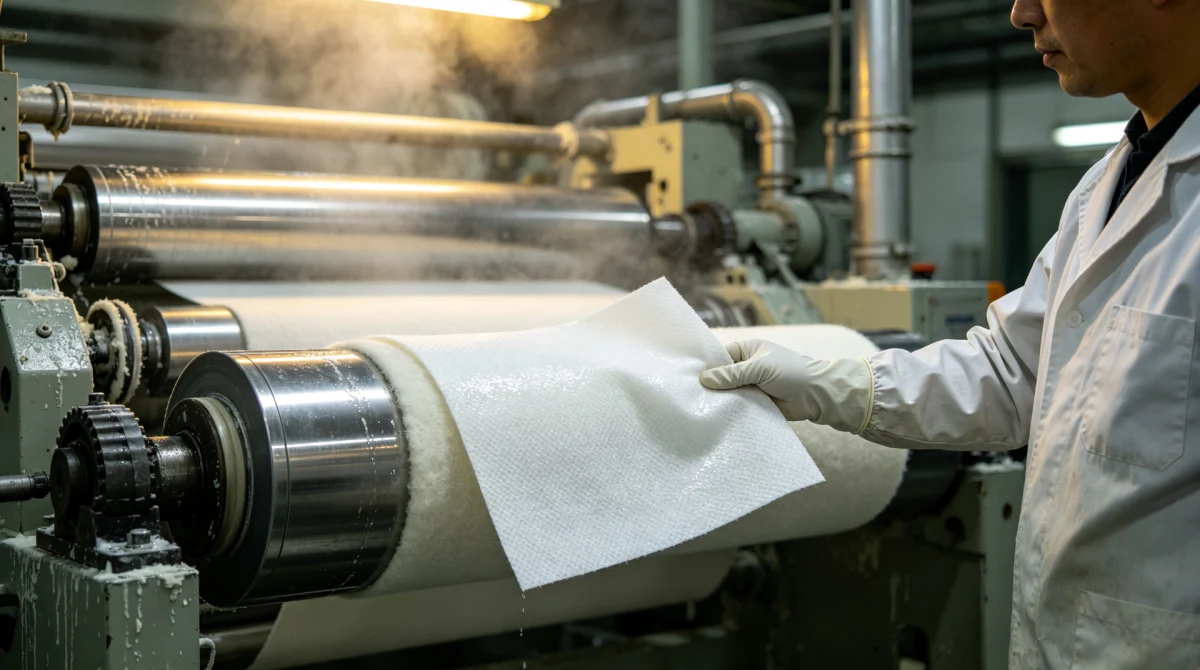
For felt and roll cleaning, we recommend a thermally bonded nonwoven wipe with no soluble binders. It needs decent wet strength—you’re pressing it against wet metal surfaces, sometimes with moderate force—plus low lint.
The lint requirement is non-negotiable. Loose fibers from the wipe embed in the felt and act as nucleation points for further deposit buildup. You’re trying to clean the felt, not seed it with new contamination.
White Water System Maintenance
White water is the fiber-loaded water that drains through the forming fabric on the paper machine. It gets recirculated—filtered, treated, sent back to the headbox. The system includes savealls, white water chests, piping, screens, and pumps.
All of it accumulates deposits over time: pitch, stickies, bacterial slime, fiber bundles, filler agglomerates. During maintenance windows, operators wipe down screen housings, saveall surfaces, valve bodies, and pipe flanges.
The white water itself is mildly acidic to neutral (pH 5–7 typically) and loaded with fine fibers and dissolved organics. It’s not as chemically aggressive as the bleach plant, but the contamination profile is different—sticky, resinous deposits that don’t wipe away easily.
What you need here is a wipe with good absorbency and some scrubbing texture. A flat, smooth-surface wipe just smears pitch around. A textured nonwoven—with a slight emboss or a dual-layer construction (scrub side / absorbent side)—actually lifts the deposit off the surface instead of redistributing it.
We’ve seen mills switch from flat rags to textured nonwovens and cut their screen housing cleaning time by roughly a third. Less time scrubbing, less residual deposit left behind, fewer rework cycles during shutdown.
Chemical Handling: Caustic, Chlorine Dioxide, and Everything Else
Paper mills use some of the harshest chemicals in industrial manufacturing. The list is long and unforgiving.
Caustic soda (NaOH) at 15–25% concentration for kraft pulp digestion and screen room cleaning. At that concentration, caustic will degrade cotton fibers within minutes. It will also attack cellulose-based wipes and many common binder systems.
You need a synthetic wipe—polypropylene or a polypropylene-polyester blend—that maintains structural integrity in high-pH environments. Tested to pH 14, not just “alkaline resistant” on a generic spec sheet.
Chlorine dioxide (ClO₂) is the primary bleaching agent in ECF (element-chlorine-free) bleaching sequences. It’s a powerful oxidizer at the concentrations used in bleach plants (8–12 g/L active ClO₂). It degrades most organic materials—cotton, cellulose, standard polyester binders.
For ClO₂ environments, you want a wipe made from solution-dyed polypropylene or high-density polyethylene fibers. These materials have the oxidative resistance to survive repeated contact without degrading, shedding, or losing absorbency.
Sodium hypochlorite, hydrogen peroxide, and sodium hydrosulfite round out the bleach plant chemical inventory. Each has its own compatibility profile. Hypochlorite attacks cotton and cellulose aggressively. Hydrogen peroxide is more forgiving with synthetic materials but can degrade certain binder systems.
Sodium hydrosulfite (used in reductive bleaching) is mildly reducing and generally compatible with synthetic wipes, but the alkaline conditions it’s used under matter—the combined pH environment is what you need to test against, not just the chemical in isolation.
Here’s what we tell every mill: don’t buy a generic “chemical-resistant” wipe and assume it covers everything. Get the compatibility data for your specific chemicals at your specific concentrations and temperatures.
A wipe that survives 5% NaOH at 25°C might fail at 20% NaOH at 60°C. And in a kraft mill digester area, 60°C caustic is a Tuesday.
Coating Kitchen Cleanup
The coating kitchen is where coated paper and board grades get their surface finish. Starch-based coatings, PVA (polyvinyl alcohol), calcium carbonate slurries, clay dispersions, styrene-butadiene latex—the coating formulations are complex, and they’re messy.
Drips, spills, dried residue on mixing tanks, transfer pumps, coating heads, and the surrounding floor area are constant maintenance headaches.
Coating materials have a particularly annoying property: they dry into tough films that are much harder to remove than the wet state suggests. A fresh starch coating spill wipes up easily. The same spill that’s been drying on a pump housing for three hours needs scraping, soaking, and aggressive wiping.
Your wipe needs to handle both states—wet absorption and dried-film removal.
For coating kitchen cleanup, absorbency is the primary spec. You’re dealing with viscous, high-solids formulations (45–65% solids for most coating colors), and you need a wipe that can soak up significant volume without falling apart.
Cellulose-polyester blend nonwovens work well here—high absorbency from the cellulose component, wet strength from the polyester. They’re also cheap enough that you don’t feel bad using them liberally. In a coating kitchen, volume matters. You go through a lot of wipes per shift.
Lint matters here too, though not as critically as on the machine itself. Coating kitchen contamination doesn’t directly contact the paper web. But if you’re doing any maintenance on the coating head or the applicator roll, lint from your wipe can end up in the coating formulation, clog the applicator slots, and cause streaks on the finished sheet.
Keep a low-lint wipe on hand for any work near the coating application point, and use the cheaper absorbent nonwovens for general floor and equipment cleanup further away.
Moisture Sensitivity and Lint Requirements for Paper Quality
Paper quality is measured in microns and counts per square meter. Sheet formation uniformity, printability, surface strength, brightness—every quality parameter can be affected by contamination on the machine. And in a paper mill, contamination sources are everywhere.
Broke fiber, filler dust, pitch deposits, bacterial slime, and—yes—lint from your cleaning consumables. The lint requirement depends on where the wipe is used.
On the paper machine itself—forming section, press section, dryer section—lint is absolutely critical. A fiber from a wipe that ends up on the forming fabric becomes a defect in the sheet. On a fine printing grade, that defect is visible. On a tissue grade, it’s a customer complaint. On a filter paper grade, it’s a functional failure.
The tolerance for wipe-borne lint on-machine is essentially zero.
Off-machine—stock prep, chemical storage, the woodyard, the power house—lint requirements are more relaxed. You’re not directly contaminating the paper web. But even in these areas, excessive lint generation creates housekeeping problems and can end up in the stock system if you’re not careful.
A wipe that sheds heavily in the stock prep area will contribute fibers to the furnish. Those fibers are often the wrong type—synthetic, heat-bonded, not beaten—and they show up as defects downstream.
Moisture is the other factor. Paper mills are wet environments. Humidity in the forming and press sections is extreme. Wipes stored in the mill absorb moisture from the air. A wipe that performs well dry might perform very differently once it’s absorbed ambient moisture.
We recommend storing wipes in sealed packaging until use and specifying wipes with moisture-resistant packaging for mill environments. A wipe that’s been sitting open in a humid mill for two weeks is not the same product you tested in the lab.
For the highest-quality grades—coated freesheet, specialty papers, filter media—we recommend cleanroom-grade wipes even though the mill itself isn’t a cleanroom. The particle and lint performance of cleanroom wipes gives you a safety margin that standard industrial wipes can’t match. Yes, they cost more. But on a grade where a visible defect means a customer reject, the premium is justified.
Wipe Type Comparison for Paper Mills
Paper mills typically use three to four categories of wipes, each matched to a specific area and contamination profile.
| Property | Cellulose-Polyester Nonwoven | Polypropylene Nonwoven | Textured Dual-Layer Nonwoven | Low-Lint Knit (for On-Machine) |
|---|---|---|---|---|
| Best Application Area | Coating kitchen, general cleanup, spill absorption | Chemical handling (caustic, ClO₂), bleach plant | Felt/roll cleaning, white water system, deposit removal | Press section, dryer section, forming area |
| Wet Strength | Moderate | High | High | High |
| Absorbency | High (6–8 mL/g) | Low–Moderate (2–4 mL/g) | Moderate–High (4–6 mL/g) | Low–Moderate (2–3 mL/g) |
| Caustic Resistance (NaOH 20%) | Poor — cellulose degrades | Excellent | Good (depends on binder) | Good (polyester knit) |
| ClO₂ Resistance | Poor — oxidizer degrades cellulose | Excellent | Moderate | Moderate–Good |
| Lint Generation | Moderate | Low | Low–Moderate | Very Low |
| Scrubbing Ability | Low | Low | High (textured surface) | Low |
| Relative Cost | $ | $ | $$ | $$$ |
Most mills run a two- or three-tier wipe strategy. The coating kitchen and general cleanup get the cheap absorbent nonwovens—nobody needs premium wipes to mop up a starch spill. The bleach plant and chemical storage get chemical-resistant polypropylene wipes that won’t dissolve in caustic.
And the machine itself—any area where the wipe could contact felt, fabric, or roll surfaces—gets the low-lint option. Some mills add a fourth tier for stock prep and the woodyard, using basic industrial rags or recycled textiles where contamination risk is minimal.
The mistake we see most often is a mill running one generic wipe everywhere. It works fine in the woodyard and the coating kitchen. It fails on the machine. By the time someone connects the wipe to the felt loading problem or the sheet defect, you’ve already lost felt life, production time, and quality rejects.
Segment your wipe inventory by area. It’s not complicated, and it saves real money.
Who You’ll Work With at WIPESTAR
We supply cleaning consumables to paper mills and pulp processing facilities where chemical resistance and lint control are critical. Our team understands the unique cleaning challenges of paper manufacturing operations.

Zac — Customer Service
Zac focuses on professional and efficient customer service, dedicated to responding to inquiries quickly, handling orders smoothly, and providing reliable after-sales support.

Ethan — Sales Director
Ethan has over 20 years of experience in the industrial wiping cloth and cleanroom consumables industry. He leads the global sales team and provides high-quality cleanroom solutions for worldwide customers.

Lee — Key Account Sales Manager
Lee has 7 years of sales experience in the cleanroom consumables industry, having served international companies such as Foxconn, Samsung, and Apple. He focuses on solving problems for customers.
Get Started with Paper Mill Industrial Wipes
Whether you’re evaluating wipes for a new paper machine startup, investigating felt loading issues linked to consumables, or standardizing wipe inventory across multiple mill areas, we can help. Chemical compatibility data, lint and fiber testing, and absorbency profiles available for all products.
- Browse All Wiping Cloths — Full product range with specs, chemical compatibility data, and material data sheets for paper mill applications.
- Cleanroom Wiper Selection Guide — Our technical guide covering wipe materials, lint specs, and cleanroom class matching. Useful for high-grade paper production.
- Request Technical Consultation — Need help matching a wipe to your specific mill chemistry? Our team can provide compatibility data and absorbency profiles.
Browse Full Wiping Cloths Range → Request a Custom Quote
Frequently Asked Questions