English
 Chinese



Aseptic filling gets the white-glove treatment. Packaging gets the product shipped. Then QA opens a sealed blister and finds a dark speck on the foil, and suddenly the Class 8 room everybody treated as a packing shed is the most investigated square meters in the plant.
I watched this play out at a solid-dose site running a thermoforming blister line. The complaint was tiny black flecks, one or two per thousand packs, visible only against white tablets — and of course only after the lidding was sealed on. The first suspicion was the PVC film. New supplier, easiest villain. Film testing came back clean. The metallurgist looked at the flecks under magnification: a mix of carbon-black specks off worn guide adjustment and fine brown film residue — old dried lubricant and adhesive, polished thin across the forming-station guide by repeated wipe-downs. Here’s the part that stuck with me: the crew wasn’t skipping cleaning. They were doing it faithfully, every changeover, with one cotton terry towel. Product path, conveyor rail, reject bin, operator wiped the towel down his pant leg and hung it up. The towel wasn’t removing the residue. It was distributing it, atomizing it, and building a thin film that flaked off onto the foil. They replaced the towel with a domain-assigned consumable set, added vacuum-before-wipe, and the fleck rate fell below detection inside two weeks. Zero capex. New SKUs and a laminated card at the line.
Packaging cleaning isn’t aseptic technique. It’s a changeover discipline: right material, right domain, right order, written down. Here’s how to build it.
The Four Contaminants a Packaging Room Actually Makes
Packaging contamination is nothing like process-side contamination. It’s coarse, visible eventually, and mostly self-generated:
- Board and paper dust. Carton blanks and leaflets shed cellulose fibers at every feed, fold and turning rail. It’s lightweight, it carries static, and it stays airborne long enough to land on open blisters.
- Adhesive and ink. Glue strings on cartoner pickers, dried label adhesive, coding ink overspray. All of it turns tacky, grabs passing dust, and ages into a film on the guides.
- Forming fines. PVC/PVDC thermoforming and Alu/Alu cold-forming shave microscopic polymer and metal particles that collect in the forming-pocket area and ride the web.
- Machine grime. Lubricant creep, wear particles, and the general gray film on frames that hands touch a hundred times a shift.
The common multiplier is static — film, foil and cardboard are dielectrics moving over stainless steel at speed, so every particle in the room gets an invitation to land on the pack. None of this needs a sterile response. All of it needs absorbency, texture and single-use discipline, because a contaminated wipe is a distribution system.
Where GMP Still Applies Past the Fill Line
Packaging is the last defense between your batch and the patient, and the regulators know it. EudraLex Volume 4, Chapter 3 expects premises to be clean, maintained and operated to prevent mix-ups and contamination; Chapter 5 requires packaging operations to be cleaned, checked and documented between products, with particular attention to preventing cross-contamination, mix-up and substitution. FDA 21 CFR 211.67 says much the same in American terms: equipment must be cleaned, maintained and scheduled on a written basis, with records. 211.105 adds the line-clearance expectation before packaging starts.
Translate that to the floor and three things become non-negotiable: documented line clearance between campaigns, defined cleaning materials by area, and records specific enough to reconstruct what actually happened. “Line cleaned” in a logbook satisfies nobody once a complaint shows up with a lot number attached.
The Changeover Sequence That Holds Up in a Batch Record
- Line clearance first. Prior product, labels, leaflets and printed foil physically removed and reconciled. Cleaning and clearance are separate sign-offs — one proves nothing’s left, the other proves what’s left is clean.
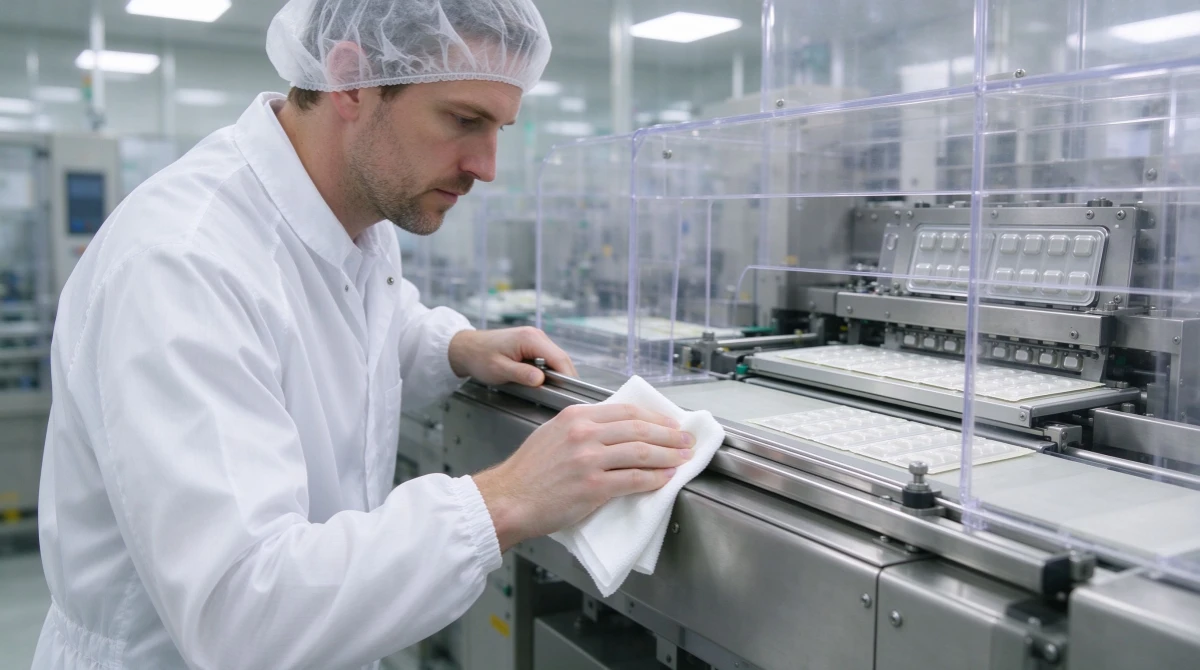
- Vacuum, then wipe. Pull loose dust and forming fines with a HEPA-filtered vacuum before any cloth touches the line. Wiping dry dust just buffs it into the stainless steel — the blister plant’s original sin.
- Top down, product path first. Infeed and forming area, product-contact surfaces, sealing and coding stations, discharge — then guard panels, frame rails and machine base.
- One domain, one wipe. Product-path cloths never touch the floor-level frame. Fresh fold, fresh face, fresh cloth per domain. This is the rule that retires the shared towel.
- Adhesive gets texture and metered chemistry. Tackified residue needs a scrub-structure cloth or a pre-saturated wipe, not more elbow grease on a thin sheet, which just polishes the film thinner.
- First-pack verification. Bright light at discharge, inspect the first ten packs before releasing the run.
Consumable Mapping: Cloth, Paper, Pre-Wetted
Packaging rooms live on cost-per-pack, which is exactly why indiscriminate “buy the cheapest rag” is expensive — one rejected campaign dwarfs a year of wiper savings. Assign the material to the risk:
| Task | Consumable | Why This One |
|---|---|---|
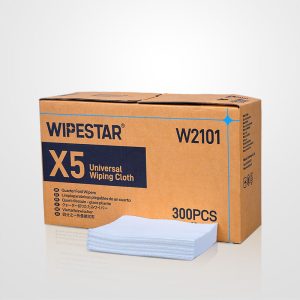
| Product-contact surfaces, format parts, guides | W2101 Universal Wiping Cloth (X5) | Low-lint and durable; holds a fold for precision passes |
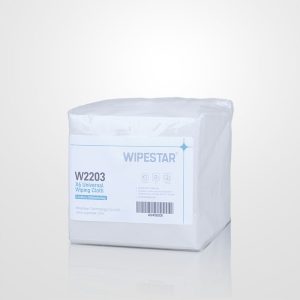
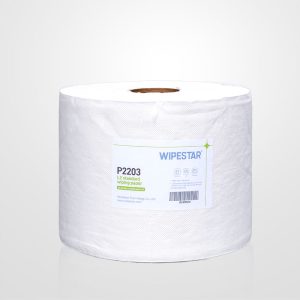
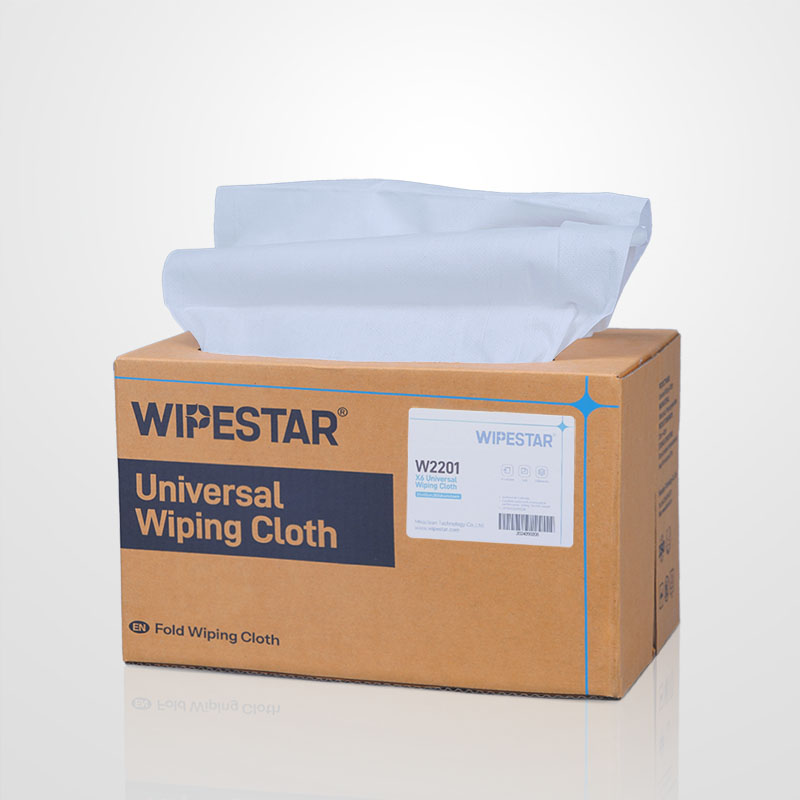
| Panels, rails and frame exteriors | W2203 Universal Wiping Cloth (X6) | Coverage and absorbency where volume matters |
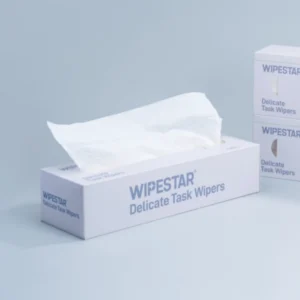
| Light dust, sensors, HMI screens | P1102 Delicate Task Wipes | Soft, disposable, single-task certainty |
| High-volume wiping, spills, peripheral zones | P3101 Efficient Wiping Paper | Sheet economics for the daily non-contact work |
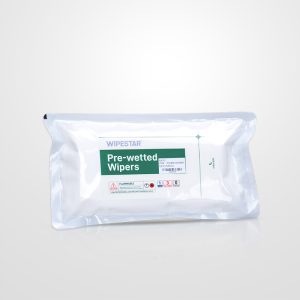
| Cured adhesive, ink, film residue | G2101 Pre-Wetted Wipes | Metered IPA/DIW saturation — no open bottles near the line |
| Leaks that reach the floor | L1201 Universal Absorbent Pads | Containment at the drip point before wheels spread it |
Two principles underneath the table. First, disposable beats laundered here: rewashed shop towels carry yesterday’s adhesive into today’s campaign, and their lint profile is whatever the laundry’s last load was. Second, put the premium cloth where quality lives and the paper where volume lives — the per-sheet difference is cents; a rejected batch is not.
The Room Around the Line: Dust, Static, Wheels
The machine gets all the attention; the room seeds most of the dust:
- Feeders and staging. A pallet of cartons being opened in the room is a continuous fiber source. Open packaging stock in a separate area, and wipe feeder stations per shift.
- Static control. Ionized bars at film and foil unwinds cut particle attraction at the source; anti-static wiping on panels stops dust jumping straight back after cleaning.
- Wheels and floors. Every trolley crossing the room redistributes packaging dust. Mat transitions plus scheduled floor wiping keep the migration honest — volume papers like the P3101 handle that workload economically.
- Waste discipline. Open reject bins re-seed the air continuously. Lidded, lined, emptied on a schedule.
Frequency writes itself from the defect data: product-path wipe every shift and every changeover, full line wipe-down per changeover, frames and feeders weekly or per campaign, dust-source audit monthly. Standardizing changeover consumables across lines or plants? Send us your line list and we’ll build the SKU assignment table with you; the full range sits in the product catalog.
Who You’ll Work With at WIPESTAR
We supply multi-line packaging operations where every site needs the same consumable spec and the same delivery discipline around campaign calendars.

Lee — Key Account Sales Manager
Lee has served accounts including Foxconn, Samsung and Apple since 2018 and runs multi-site supply programs, so every packaging line in every plant orders against the same SKU and spec sheet.

Zac — Customer Service
Zac turns sample and line-trial requests around quickly — trial kits of cloths, papers and pre-wetted wipes sized to one packaging line’s changeover, not a generic sample box.

Daisy — Sales Support
Daisy handles order follow-up and campaign-aligned replenishment, so changeover stock doesn’t quietly run out halfway through a product run.
Get Started with Packaging Line Consumables
Fixing a speck trend, standardizing changeover kits, or kitting a new line — we can ship trial quantities mapped to your changeover schedule, with specs identical across sites.
- W2101 Universal Wiping Cloths — low-lint product-path wiping at changeover.
- G2101 Pre-Wetted Wipes — metered chemistry for adhesive and ink without line-side bottles.
- Request a Technical Consultation — send the line list; we’ll build the changeover assignment table.
Browse All Products → Request a Custom Quote
Frequently Asked Questions