English
 Chinese



An OSAT line in Penang was stuck at 97.3% die attach yield against a 99.5% target. At roughly 40 million units a month on that line alone, the gap meant close to a million units getting reworked or scrapped every month.
The failure mode never moved: die shear strength below spec on packages that had passed wafer test clean. The die was good. The epoxy was within spec. The dispense system checked out. Three weeks later, someone noticed what the operators were using to wipe down die attach tooling between lot changes — cotton rags. Fibres from those rags drifted onto lead frames in the seconds between cleaning and adhesive dispense. Not enough to see. Enough to weaken a bond.
They switched to sealed-edge low-particle synthetics and hit 99.4% within two weeks. The rags had been costing about $180,000 a month in rework and scrap. The wipes cost $2,400.
That story keeps repeating, because packaging lines tend to inherit their wipe spec from the wafer fab — or run on whatever the maintenance crib stocks. Back-end packaging is a different contamination problem: fibres on lead frames, films on bond pads, mold flash, trim debris. The wipe that’s perfect on a litho track is wrong at a mold chase, and not because one is better.
This guide is for OSAT process engineers, packaging line supervisors, and facility managers who want to spec consumables against the contamination that actually shows up at the back end.
Why Fab Wipe Specs Miss the Point
Front-end fabs run bare silicon with nanometre features in ISO Class 3 to Class 5 rooms. Their wipe specs follow from that: ultra-low particle counts, sub-ppb extractables, high-purity pre-wetted formats, double bagging. All of it necessary there.
Packaging runs in a different world. The die is already passivated under nitride and polyimide. Package features are measured in microns. Most lines sit at ISO Class 7 or Class 8 under ISO 14644-1. Nobody loses a QFN line to a 0.1-micron particle — they lose it to a cotton fibre sitting in die attach adhesive, a silicone film on a bond pad, flash on a thermal pad, or a copper sliver bridging two leads. Those are fibre control, surface chemistry, and debris capture problems, and fab wipes aren’t designed for any of them.
So copying the fab’s approved wipe list overspends on chemical purity while missing sealed edges, abrasion resistance against tool steel, absorbency for resin cleanup, and compatibility with epoxy and mold compound chemistries.
The opposite mistake is just as common: writing packaging off as rough work and stocking shop rags. Die attach and wire bonding have tight contamination budgets even in a Class 8 room. A disciplined line with the right consumables beats a cleaner room with the wrong ones.
Die Attach: Fibres Beat Particles
Die attach bonds the die to the lead frame or substrate with a silver-filled epoxy — sintered silver or a solder preform when the reliability spec demands it. The joint has to hold its shear strength through thermal cycling and mechanical shock, typically verified against MIL-STD-883 Method 2019. When that requirement fails, the adhesive is rarely the culprit. It’s what the adhesive had to bond around.
Three offenders show up over and over: particulate that physically blocks the wetting, oils and silicone compounds that prevent it, and fibres. Fibres do the most damage and get blamed the least.
The mechanism is simple. A fibre trapped in the bond line forces the epoxy to bond around it instead of to the metal, which leaves a void. Thermal cycling turns that void into a stress riser, and the crack follows it. At shear testing the joint fails low — and the fibre gets destroyed in the process, so failure analysis reports “insufficient bond strength” and moves on. That’s exactly what the Penang team kept seeing for three weeks.
Lead frames don’t arrive clean, either. Stamping oil, metal fines from forming, handling contamination. Most facilities plasma-treat or solvent-wash on arrival, then the frame sits in a queue and picks up whatever the room is shedding.
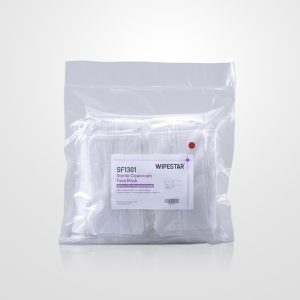
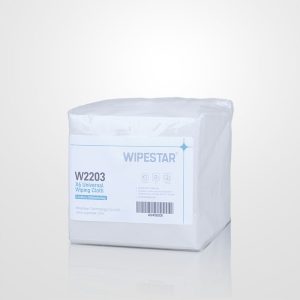
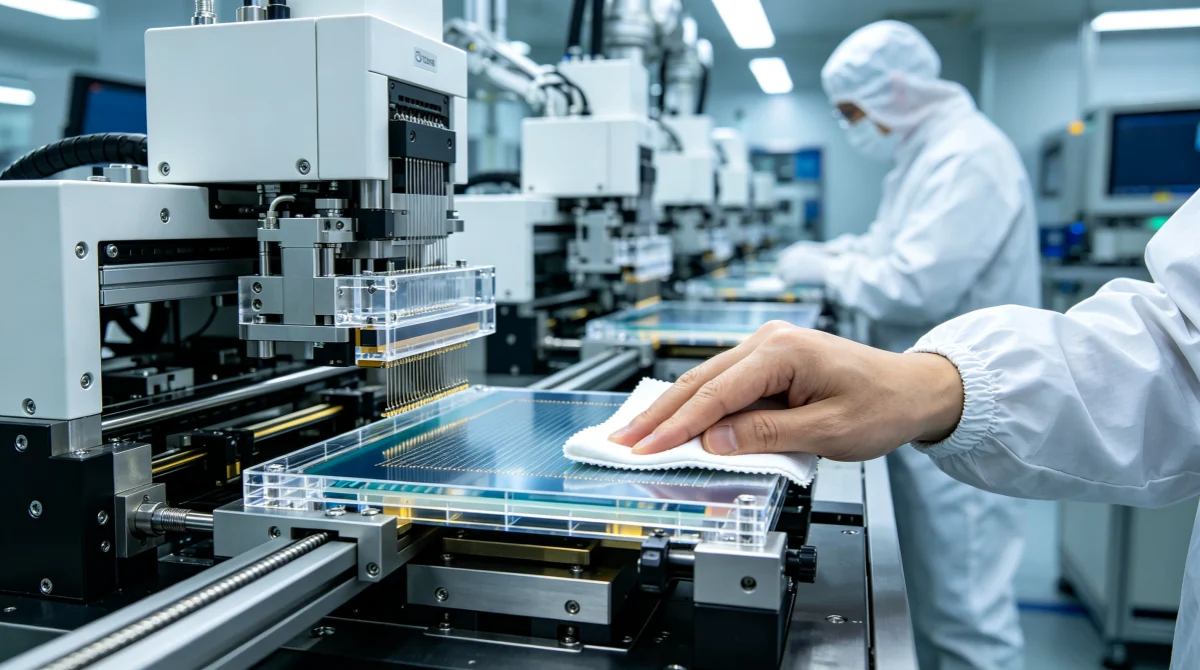
Tooling deserves the same attention. Dispense needles, pick-and-place collets, vacuum chucks — wipe them with a sealed-edge synthetic from our wiping cloths range, dampened with the solvent your adhesive supplier recommends. The wrong solvent can precipitate silver filler out of the epoxy into a sludge that clogs needles and seeds the next lot with contamination.
Wire Bonding and the 100-Micron Problem
A wire bond pad is 50 to 100 microns across. Thermosonic gold ball bonding and ultrasonic aluminium wedge bonding both need intimate metal-to-metal contact, and anything sitting on that pad — particle, fibre, chemical film — gets trapped under the bond. One fibre, one bad joint.
By the time a package reaches the wire bonder it’s been through die attach and cure, and both leave contamination behind: epoxy bleed at the die edge, outgassing residue, particulate from lead frame handling. Most bonders run an in-line argon or argon-hydrogen plasma right before bonding, which handles organic films. It does nothing about particulate. Plasma cleans around a fibre; the fibre stays.
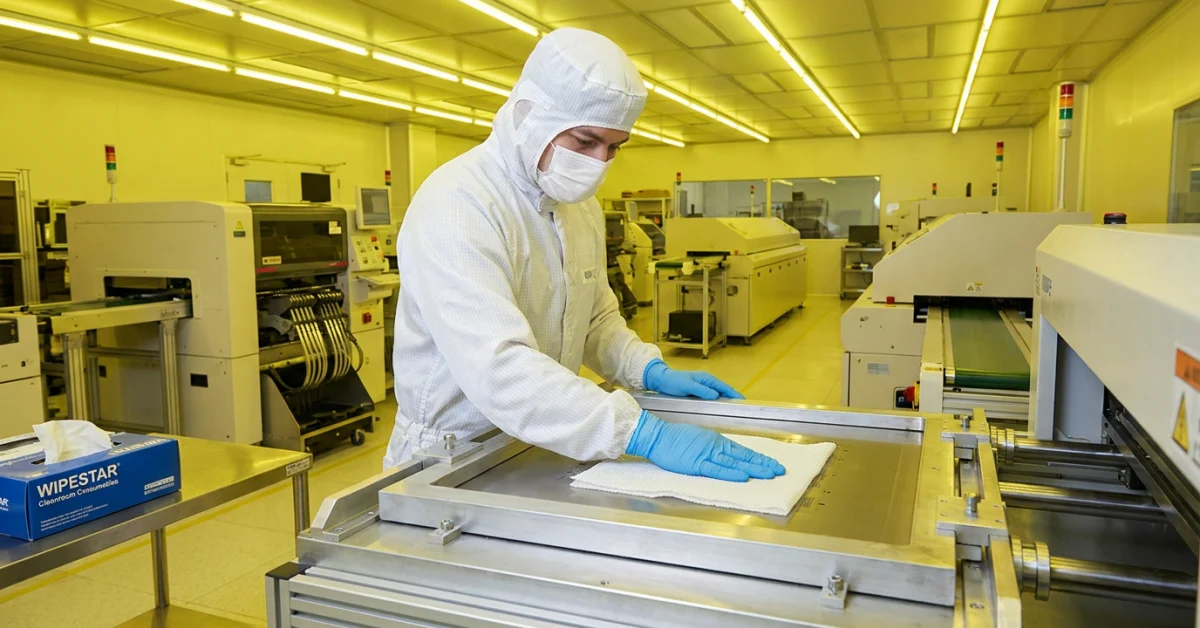
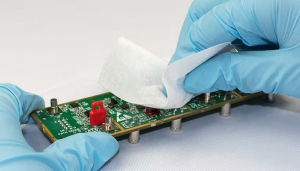
Prevention is the only reliable play. Sealed-edge low-particle wipes for every cleaning task in the bond zone. No cotton or cellulose anywhere near the bond head. Dispensers positioned so that grabbing a wipe doesn’t happen over exposed product.
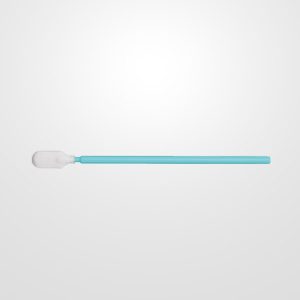
The bond tool itself needs routine attention too. Every bond deposits a thin film of gold or aluminium on the capillary or wedge, and over thousands of cycles that film changes the tool geometry and the bond geometry with it. A lint-free synthetic dampened with a compatible solvent removes the film without leaving residue. Some operators use an eraser-type tool for bulk removal — fine, except eraser crumb is rubber particulate on a bond tool. Follow it with a wipe pass, and use cleanroom swabs for the capillary tip and other small features a folded wipe can’t reach cleanly.
Mold Flash, Trim Debris, and Marking
Transfer molding is messy by design. Silica-filled epoxy flows through the mold chase under heat and pressure, and some always squeezes out between the mold plates. That thin film is flash, and it has to come off — it throws off trim and form dimensions, kills marking adhesion, and on exposed-pad packages it blocks solder wetting on the thermal pad.
For uncured flash, a synthetic cloth dampened with your compound supplier’s recommended solvent does the job. Acetone dissolves many compounds effectively, but it also attacks marking inks and some substrate materials, so test before using it on production parts. Isopropyl alcohol is the safer default on package surfaces.
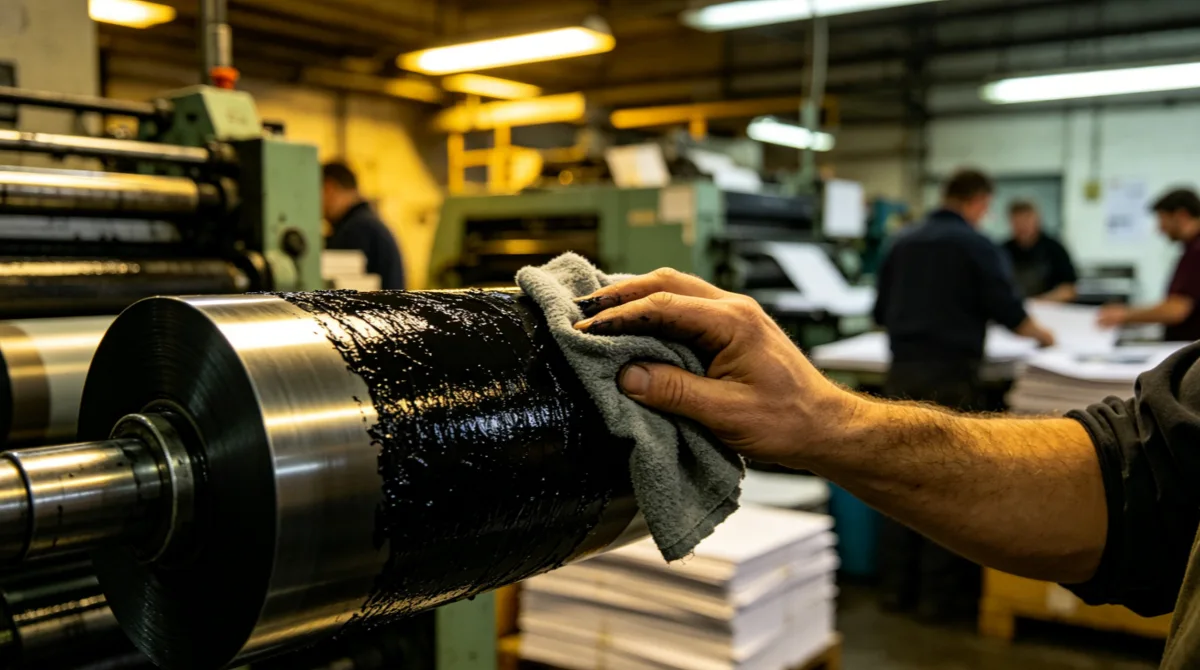
Tooling cleanup is its own thing. Cured compound has to come off the mold chase mechanically first — brass tools, non-abrasive pads — then the surface gets wiped to lift the residual film. Cotton rags here are how fibres end up frozen inside the package body on the next shot. An inclusion in the mold compound is a reliability problem: it cracks under thermal cycling and opens a moisture path.
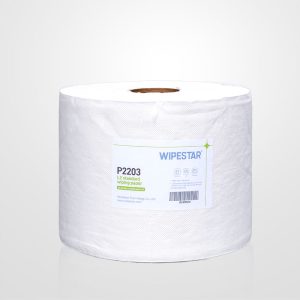
Trim and form generates the debris nobody budgets for. Punches and dies shear the leads and the frame webbing — copper alloy or Alloy 42 depending on the package — and every stroke throws fine metal particles. Loose on a package, they bridge leads or embed in the lead finish and show up later as shorts or solder defects at board assembly. Clean trim tooling between lots with a heavy-weight industrial synthetic that captures metal fines instead of scattering them, and one that won’t tear on tool edges. For the leads themselves, a tightly woven sealed-edge wipe, run along the lead rather than across it so the cut edge can’t snag the cloth.
Marking is the last step people think about and the first place flash residue shows up. Silicone release agent from the mold, oil from trim tooling, handling films — any of them give you faded ink or a dull laser mark. A lint-free synthetic dampened with IPA before marking fixes most of it, though some compounds swell slightly in IPA, so check on a sample lot. Printheads and laser optics get the same treatment as any precision assembly: low-particle lint-free wipes, compatible solvent, never a paper towel.
Notice what all these steps have in common: the critical zones need controlled wipes, and everything outside them doesn’t. General benches and floors are where standard synthetics and wiping papers belong. Solvent and resin spills during cleanup get real spill control absorbents, not premium wipes sacrificed to a puddle. Spend where the product is exposed.
Wipe Selection by Process Step
Here’s the mapping we use when we spec a packaging line. It follows the contamination risk at each step, not a generic cleanroom class.
| Process Step | Recommended Wipe | Why | Avoid |
|---|---|---|---|
| Die attach — tooling | Sealed-edge low-particle synthetic | No fibre shedding near open lead frames | Cotton rags, cellulose |
| Die attach — lead frame area | Low-particle synthetic, cleanroom-packaged | Keeps fibres out of the window before adhesive dispense | Any unsealed wipe in the product zone |
| Wire bond — capillary and wedge | Lint-free synthetic, solvent-dampened | Lifts wire film without leaving residue | Eraser-only cleaning (rubber crumb) |
| Wire bond — bond area surfaces | Sealed-edge low-particle synthetic | One fibre on a 50–100 µm pad is a bond defect | Cotton, cellulose, anything shedding |
| Mold — chase and plunger | Textured synthetic, solvent-compatible | Scrubbing action for cured compound residue | Cotton (fibre inclusions in the package body) |
| Mold — package surface and exposed pad | Soft low-particle synthetic | No scratch, no fibres in thermal pad solder | Abrasive wipes on package surfaces |
| Trim and form — tooling | Heavy-weight industrial synthetic | Captures metal fines, won’t tear on tool steel | Thin cleanroom wipes |
| Trim and form — lead wiping | Tightly woven sealed-edge synthetic | Won’t snag on cut lead edges | Loose weaves, cotton |
| Marking — pre-clean and printhead care | Lint-free synthetic, IPA-dampened | Removes silicone and oil for ink or laser marking | Silicone-treated wipes, paper towels |
| General benches and floors | Standard synthetic or wiping paper | Cost control outside product zones | Premium wipes on general surfaces |
Most OSATs run two or three tiers off this table: premium sealed-edge wipes for die attach and wire bond, standard synthetics for mold and trim, and economy wipes for everything outside the product zones. It keeps cost aligned with risk. If you want the reasoning behind the material choices, our wiper selection guide goes deeper.
Who You’ll Work With at WIPESTAR
We supply cleanroom consumables to semiconductor packaging and OSAT facilities worldwide, and we spec by process step — not by whatever datasheet the fab sent over. Three of the people you’ll work with:

Carolina — Product Specialist
Carolina gets into the detail of your process — which wipe at which step, which solvents it has to survive, where fibre control actually matters. If you need a spec matched to a packaging line instead of a fab’s datasheet, start with her.

Lee — Key Account Sales Manager
Lee looks after key accounts across the semiconductor supply chain, building consumable programmes around real production schedules. Volume pricing, buffer stock, quarterly reviews — he keeps the commercial side predictable.

Daisy — Sales Support
Daisy coordinates orders and shipping for packaging customers. Her job is making sure cleanroom-packaged consumables land on site when the line needs them, in the packaging they were qualified in.
Get Started with Semiconductor Packaging Cleanroom Wipes
Whether it’s a high-volume QFN line, a BGA operation, or a mixed-technology OSAT, we’ll match the wipe to each step — die attach, wire bond, mold, trim and form, marking — against your actual contamination challenges. Full documentation available with every lot, including COA and IEST-RP-CC004 test data.
- Browse All Wiping Cloths — Sealed-edge and standard synthetics with specs and certifications for every packaging step.
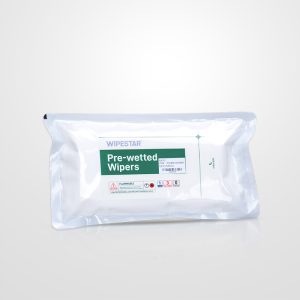
- Pre-Wetted Wipes — Factory-sealed with verified solvent purity for mold cleanup and critical surface prep.
- Browse Cleanroom Swabs — Capillaries, bond pads, and the tooling features a folded wipe can’t reach.
- Wiper Selection Guide — The material and specification reasoning behind the table above.
- Request Technical Consultation — Compatibility data for your specific adhesive and mold compound systems.
Browse Full Wiping Cloths Range → Request a Custom Quote
Frequently Asked Questions