English
 Chinese



A mid-size packaging printer in Birmingham lost a £50,000 pharmaceutical blister pack run last spring. Same artwork, same substrate, same inks they’d run dozens of times. But this time the client’s QC team found faint magenta ghosting in the white ink areas—visible under their UV inspection lamp, invisible to the naked eye. The entire 180,000-sheet run was rejected.
The root cause? Generic cotton rags used for blanket cleaning. They shed fibres, absorbed solvent unevenly, and left a thin film of previous ink residue on the blanket surface even after what looked like a clean wash-up.
In commercial printing, the wiping cloth is the last line of defence between a clean job and a contaminated one. Most print shop managers spend hours evaluating inks, substrates, and press settings, then grab whatever rag is cheapest for the cleaning that determines whether all that setup work actually produces a saleable product.
This guide is for press supervisors, print production managers, and pre-press technicians who need to understand how wiping cloth selection affects print quality across offset, flexo, and digital presses—and how to build a contamination-control cleaning programme that prevents cross-job contamination.
Why Commercial Printing Has Unique Contamination Challenges
Most industrial cleaning is about removing visible dirt. Printing is different. The contamination that matters is often invisible—a microscopic film of previous ink pigment on a blanket, a few stray fibres on a printing plate, a thin layer of paper dust on a substrate surface. You don’t see it. Your client’s spectrophotometer or UV lamp does.
Printing ink is designed to bond to surfaces. That’s the whole point. But that same chemistry means ink residue bonds to blankets, plates, rollers, and impression cylinders during wash-up, and a standard wiping cloth can’t always break that bond completely. The residue builds up over successive jobs, and eventually it transfers to the next substrate in quantities that fail QC.
Modern print quality standards are tighter than ever. Brand owners use spectrophotometers with ΔE tolerances of 2 or less. Pharmaceutical and food packaging clients add UV inspection, adhesion testing, and migration testing. A few fibres from a cotton rag embedded in an ink film can fail a fibre contamination check. A microscopic ghost image from a previous job’s pigment can fail UV inspection.
Offset Press Blanket and Plate Cleaning
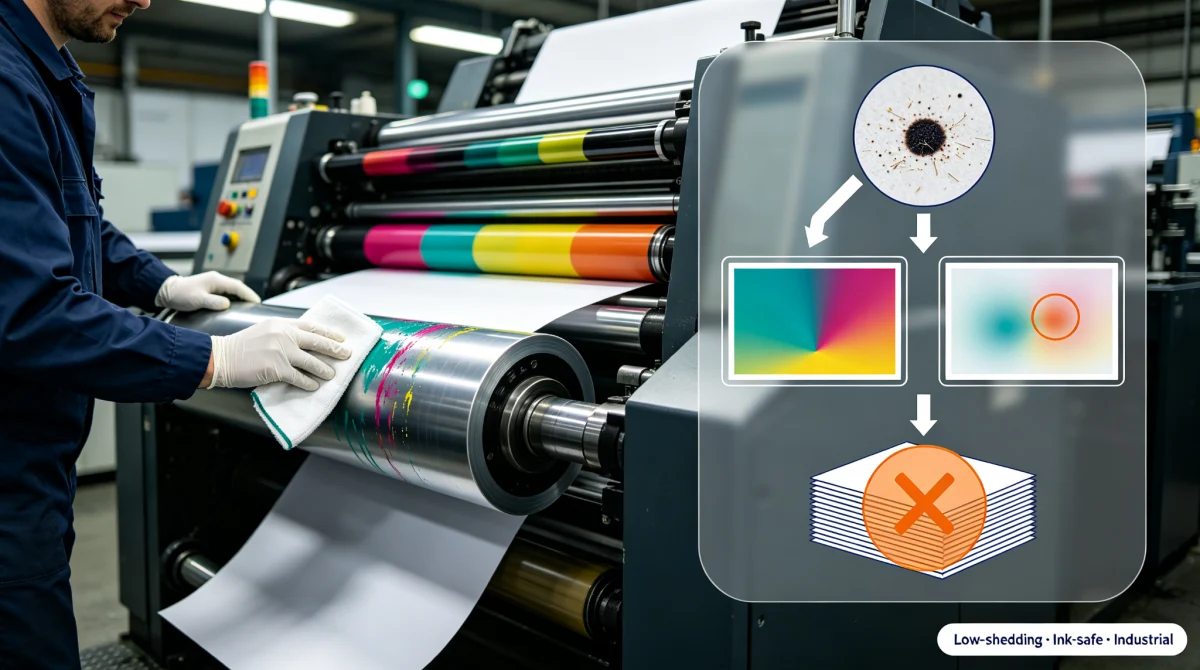
The offset blanket is where contamination originates for most print shops. During a run, the blanket picks up ink, paper dust, coating particles, spray powder, and paper fragments. Wash-up removes the bulk of this, but the blanket’s micro-porous surface traps pigment particles and paper fibres that a solvent wash alone doesn’t fully release.
After the solvent wash dissolves the surface ink film, a wipe physically removes the released residue. If the wipe leaves fibres behind, those fibres become contamination on the next job. If it doesn’t have enough absorbency, the residue stays and transfers to the next plate.
Cotton rags are the default in most print shops, and they’re the wrong choice. Cotton sheds fibres—especially when saturated with solvent—and those fibres embed in the blanket surface. Cotton also has inconsistent absorbency depending on the weave, thickness, and how many times it’s been laundered. A shop in Leeds was getting intermittent ghost images on carton work. Turns out their “clean” cotton rags still contained residual dye from the original fabric, transferring to the blanket during wash-up.
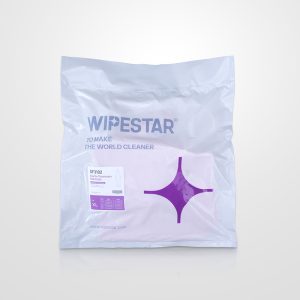
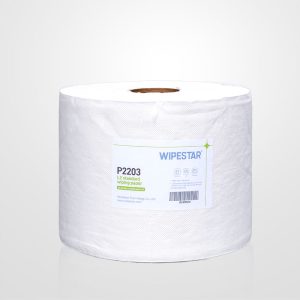
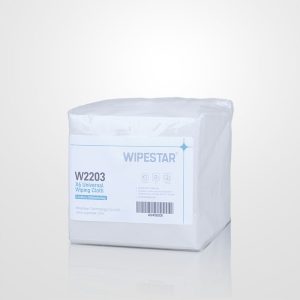
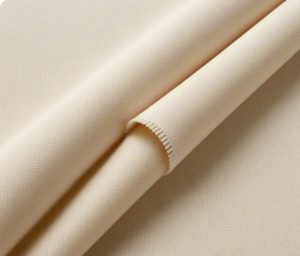
A low-lint synthetic wipe designed for press cleaning absorbs solvent evenly, releases dissolved residue effectively, and doesn’t shed fibres. For colour-critical work—pharmaceutical, cosmetic, food packaging—sealed-edge synthetic wipes eliminate the fibre problem entirely. The edges are thermally sealed so the wipe can’t shed from its cut edges, which is where most linting originates.
For plates—the actual printing surface—the stakes are even higher. Aluminium litho plates have a delicate image area susceptible to scratching from abrasive fibres and chemical damage from residual solvents. Paper towels and cotton rags both scratch plates over repeated use. A soft, low-lint synthetic wipe is the safe choice for plate cleaning during make-ready and between jobs.
Impression cylinders accumulate paper dust, spray powder, and ink mist during a run. If not cleaned between jobs, this residue causes uneven ink transfer—typically showing as mottled or speckled areas in solid colour fills. Wipe impression cylinders with a clean synthetic cloth dampened with the appropriate cylinder wash at each job change. Don’t wait until you see a problem—by the time mottling is visible, you’ve already started the run with contaminated cylinders.
Flexo Press: Anilox Roll Maintenance and Plate Care
Flexo printing has its own contamination profile, fundamentally different from offset. The anilox roll—a ceramic-coated steel cylinder engraved with thousands of microscopic cells that meter ink to the plate—is the most critical component to keep clean. And the hardest to clean properly.
A typical 600-line-per-inch anilox has cells roughly 30 microns deep. Dried ink pigment, coating residue, and paper fibres plug these cells. When cells are plugged, they can’t carry the correct volume of ink, and print density drops. Press operators compensate by increasing ink flow, which leads to dot gain, bleed, and longer drying times. Eventually someone notices print quality has drifted and blames the ink. The real culprit is a dirty anilox.
A standard cotton rag can’t reach into anilox cells—the fibres are too large and too irregular. What you need is a tightly woven, low-lint synthetic wipe that applies even pressure across the anilox surface while absorbing dissolved residue out of the cells.
For the plate itself, flexo plates are softer than litho plates—typically photopolymer—and more susceptible to damage from abrasive wiping. Use only soft, non-abrasive synthetic wipes on flexo plates. Never shop rags or paper towels. A scratched flexo plate shows up as visible lines in every print until the plate is replaced.
Doctor blades and ink chambers also need regular wiping. Ink builds up on the blade edge and chamber walls, drying into flakes that break loose and contaminate the ink supply. Wipe doctor blades with a solvent-dampened synthetic at each colour change.
Digital Press Printhead and Platen Wiping
Digital presses—inkjet in particular—have the tightest cleaning tolerances of any press type. The nozzles in an inkjet printhead are measured in microns. A single fibre, a dried ink droplet, or a particle of paper dust blocking one nozzle creates a visible streak in the print. In production inkjet, a nozzle blockage that goes undetected can waste a significant run before someone catches it.
Most digital presses have automated cleaning systems—wiper assemblies, spit stations, vacuum purges—but these systems themselves need cleaning. The wiper blades on an inkjet printhead assembly accumulate ink residue that redistributes across the nozzles instead of cleaning them. Cleaning the wiper assembly requires a lint-free synthetic wipe compatible with the ink chemistry—aqueous, UV-curable, or solvent-based.
For manual printhead cleaning on industrial inkjet systems, use only wipes specified by the press manufacturer. The wrong wipe can scratch the nozzle plate, leave fibres that block nozzles, or introduce chemicals that precipitate ink components and clog nozzles permanently.
For HP Indigo shops specifically, the photo imaging plate (PIP) and blanket are the critical surfaces. The PIP is delicate and easily scratched. Use only the wipes and cleaning solutions HP recommends, and handle the PIP with lint-free gloves.
Substrate Preparation: The Overlooked Contamination Source
Most print shops focus cleaning efforts on the press—blankets, plates, rollers, printheads. Few pay enough attention to the substrate itself. But paper, board, film, and foil all arrive at the press with contamination that affects print quality.
Paper generates dust. Every sheet that runs through the cutter or the delivery stack releases paper particles. These particles land on the press, the ink system, and—critically—the surface of the next sheet in the stack. Paper dust on a substrate surface creates spots in solid ink coverage, interferes with coating adhesion, and migrates into the ink system where it plugs anilox cells.
For high-quality work, wipe or vacuum the substrate feed area before starting a run. For film and foil substrates—an antistatic wipe on the feed path removes particulate that static would otherwise hold on the surface.
For packaging printers running food-contact materials, substrate cleanliness has regulatory implications. Particulate contamination on food packaging substrates can migrate into the food product. Wiping substrates with clean, lint-free wipes before printing is part of a GMP-compliant food packaging workflow.
Ghost Image Prevention: Why Your Wash-Up Isn’t Working
Ghost images—the faint impression of a previous job’s image appearing on the current print—are the most common contamination complaint in commercial printing. They show up intermittently, they’re often subtle enough to miss during casual inspection, and by the time a client catches them, you’ve already printed thousands of sheets.
Ghosts have three main causes, and your wiping cloth choice affects all three.
Residual ink on the blanket. Even after a full wash-up, microscopic ink pigment remains in the blanket’s porous surface. The solvent dissolves the ink vehicle but doesn’t always release the pigment particles from the rubber matrix. A physical wipe after the solvent wash pulls these particles out. If your wipe doesn’t have sufficient absorbency, it redistributes the pigment instead of removing it.
Ink residue on the plate cylinder. Plate cylinders accumulate ink mist during a run. If the cylinder isn’t wiped between jobs, that mist transfers to the new plate and shows as a ghost of the previous image. This is particularly common with dark-to-light job sequences.
Impression cylinder contamination. The impression cylinder picks up ink mist, paper dust, and spray powder during a run. On the next job, this contamination transfers to the back of the sheet. Wipe impression cylinders between every job. Not every other job. Not when you remember. Every job.
The fix for all three: use a solvent-dampened low-lint synthetic wipe as part of every wash-up, followed by a dry wipe pass. If you’re running colour-critical work, switch to sealed-edge wipes for the blanket and plate cylinder.
Comparison Table: Wipe Specs by Press Type and Application
| Press Type / Application | Recommended Wipe | Key Requirement | Avoid |
|---|---|---|---|
| Offset — blanket wash-up | Low-lint synthetic, solvent-compatible | Absorbs dissolved residue without shedding fibres | Cotton rags (shed fibres, inconsistent absorbency) |
| Offset — colour-critical work | Sealed-edge synthetic | Zero fibre shedding from cut edges | Any unsealed wipe, paper towels |
| Offset — plate cleaning | Soft low-lint synthetic | Non-abrasive on aluminium plate surface | Paper towels (microscopically abrasive) |
| Offset — impression cylinder | Synthetic, solvent-dampened | Removes ink mist, spray powder, paper dust | Dry wiping (redistributes residue) |
| Flexo — anilox maintenance | Tightly woven low-lint synthetic | Reaches into cell structure, absorbs residue | Cotton (too coarse for cell contact) |
| Flexo — plate cleaning | Soft non-abrasive synthetic | Won’t scratch photopolymer surface | Shop rags, paper towels |
| Flexo — doctor blade/ink chamber | Solvent-dampened synthetic | Removes dried ink flakes without lint | Cellulose wipes (dissolve in solvent) |
| Digital inkjet — printhead wiper | Lint-free synthetic, ink-compatible | No residue on wiper, no nozzle blockage | Any wipe not specified for the ink chemistry |
| Digital inkjet — platen cleaning | Clean synthetic, dampened | Removes ink mist and paper dust | Heavily saturated wipes (drip into electronics) |
| Substrate prep — paper/board | Low-lint synthetic or vacuum | Removes paper dust before printing | Cotton (adds fibres to substrate surface) |
| Substrate prep — film/foil | Antistatic synthetic | Neutralises static, removes charged particles | Standard wipes (push static-charged particles) |
| General shop cleanup | Cellulose absorbent wipe | High absorbency, low cost, disposable | Premium synthetics on non-critical surfaces |
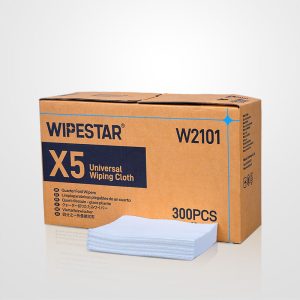
Most print shops run a three-tier wipe strategy: cellulose wipes for general floor and spill cleanup, standard synthetics for routine press maintenance, and sealed-edge premium synthetics for blanket wash-up and colour-critical applications. The tier system keeps consumable costs in check without compromising the areas where contamination control determines whether a job ships or gets rejected.
5 Cleaning Mistakes That Cause Reprints
After working with commercial printers across the UK and Europe, these are the cleaning mistakes that show up again and again—and every one is preventable with the right wipe and the right process.
1. Using one rag type for everything. The same cotton rag that wiped the ink fountain is now wiping the blanket. Every surface has different contamination and different sensitivity. Separate your wipe supplies by application. Label them. Make it part of the press setup checklist.
2. Skipping the dry wipe pass after solvent wash-up. The solvent dissolves the ink, but the dissolved residue is still sitting on the blanket surface in a thin film. If you don’t follow the solvent wipe with a dry wipe, that film dries back onto the blanket as a microscopic ink layer. One extra wipe, thirty seconds, prevents the most common ghost image cause.
3. Not wiping impression cylinders between jobs. “It looked clean” isn’t good enough. Ink mist is often invisible until it transfers to a substrate. Wipe the impression cylinder between every job, every time.
4. Using the wrong wipe on digital printheads. An inkjet nozzle plate is a precision surface measured in microns. A wipe that works fine on an offset blanket can scratch a printhead, leave fibres that block nozzles, or introduce chemicals that cause permanent clogging. Use only manufacturer-specified or equivalent wipes for printhead cleaning.
5. Ignoring substrate dust. You spend hours setting up the press, calibrating colour, and getting registration dialed in. Then you run sheets covered in paper dust from the cutter. The dust contaminates the ink system, causes spots in solid fills, and interferes with coating adhesion. Wipe or vacuum the feed area before every run.
Who You’ll Work With at WIPESTAR
We supply cleaning consumables to commercial printers and packaging converters running offset, flexo, and digital presses. Our team understands ink chemistry, press cleaning requirements, and the contamination challenges that cause rejected print runs.

Lee — Key Account Sales Manager
Lee manages key accounts across the printing and packaging sector, helping print shops build press-specific cleaning consumable programmes with reliable supply schedules and volume pricing.

Carolina — Product Specialist
Carolina matches wipe specifications to press type and ink chemistry—whether it’s sealed-edge synthetics for offset blanket wash-up, solvent-compatible wipes for flexo anilox cleaning, or lint-free wipes for digital printhead maintenance.

Daisy — Sales Support
Daisy coordinates orders and logistics, ensuring production-schedule-aligned delivery so your press room always has the right wipes on hand—no emergency runs to the trade supplier at midnight.
Get Started with Commercial Printing Wiping Cloths
Whether you’re running a single offset press or managing a multi-press facility with offset, flexo, and digital lines, the right wiping cloths are a critical part of your contamination control programme. We’ll match the right wipe to each press type, each cleaning application, and each quality standard you need to meet.
- Browse All Wiping Cloths — Full range with specs, certifications, and material data sheets for every press application.
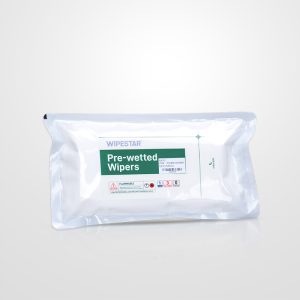
- Pre-Wetted Wipes — Factory-sealed wipes with verified solvent purity for digital printhead and critical surface work.
- Wiper Selection Guide — Technical guidance on matching wipe material and specification to your specific cleaning needs.
- Request Technical Consultation — Need help matching a wipe to your press type and ink chemistry? Our team can recommend the right product.
Browse Full Wiping Cloths Range → Request a Custom Quote
Frequently Asked Questions