English
 Chinese



Back in 2023, a Tier 2 composite structures supplier in Wichita scrapped a carbon fiber/epoxy skin panel — one of twelve for a narrowbody fuselage section — after a 40mm disbond showed up between the skin and the honeycomb core. Material cost: about $38,000. But the real hit was the autoclave run itself — 12 hours at 180°C and 0.69 MPa, shared with eleven other parts. The whole cycle was suspect.
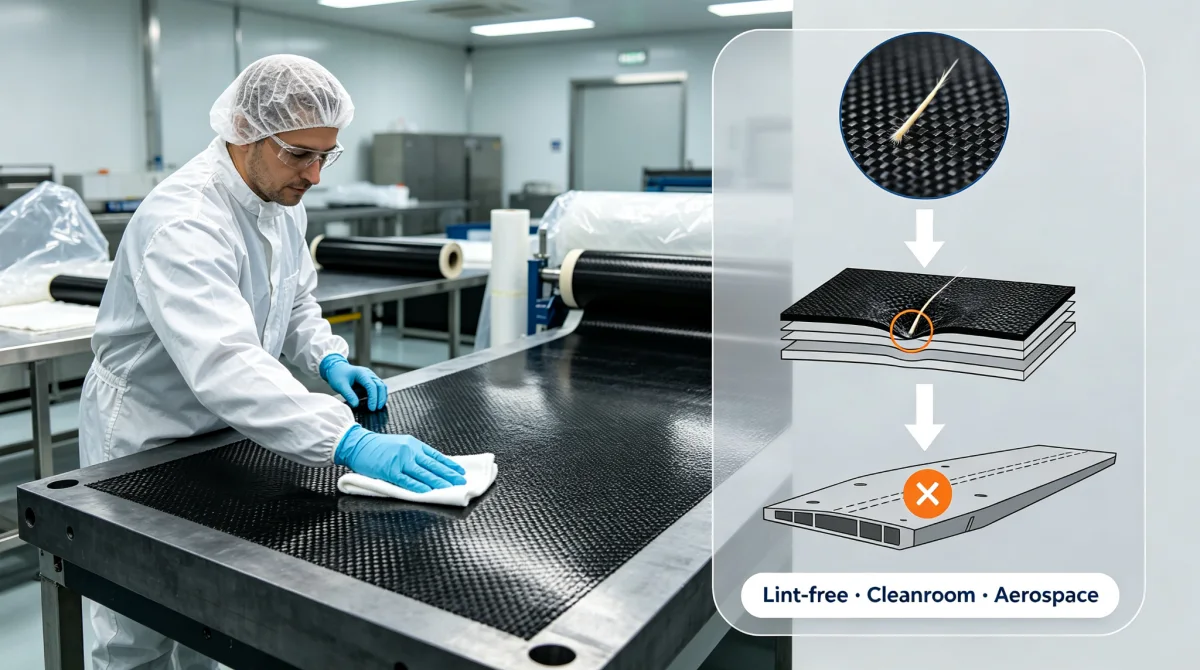
Thermal profiling checked out. The autoclave wasn’t the problem. The problem was a polyester fiber, roughly 12 microns in diameter and 3mm long, trapped at the bondline during layup. That fiber kept the adhesive from flowing into the honeycomb cell wall fillets. No fillet, no load transfer, no bond. One fiber. From a wipe someone used to clean the layup tool surface.
Composite manufacturing engineers deal with this kind of thing constantly. Unlike aviation MRO — where you’re working on cured, stable structures — manufacturing means building from scratch, one ply at a time, in environments where a 10-micron contaminant can reject a part worth more than most people’s annual salary.
You probably already know the stakes. What you might not have fully considered is how much your wipe selection contributes to the outcome.
Manufacturing Is Not MRO — Why the Wipe Requirements Are Different
We’ve written about aviation maintenance consumables before — that’s a different conversation. MRO is about cleaning, inspecting, and repairing existing structures. The surfaces you’re wiping are cured, stable, relatively forgiving. You’re removing hydraulic fluid, fuel residue, paint overspray. Contamination risk is real but manageable.
Composite manufacturing is fundamentally different: you’re working with uncured materials that permanently trap any contaminant present at the time of cure. A fiber, a fingerprint, a moisture droplet — once the autoclave cycle starts and the resin gels, whatever was on that surface is locked in. You can’t clean it out later. You can’t repair it without grinding back to clean material, which on a flight-critical structure usually means scrapping the part or doing a bonded repair that itself has to meet structural allowables.
That’s why composite manufacturing cleanrooms exist. It’s not aesthetics — it’s process physics. Your cleaning consumables — the wiping cloths you use to prep tools, clean layup surfaces, prepare bond surfaces, and wipe down autoclave tooling — are a direct input to that physics.
Get them right, and your reject rate sits in the 1–3% range that aerospace OEMs budget for. Get them wrong, and you’re looking at a systematic quality escape that triggers a Supplier Corrective Action Request (SCAR) from Boeing or Airbus.
Cleanroom Classes in Composite Manufacturing
Not every composite operation needs ISO 5 (Class 100). Most don’t. The trick is knowing which areas need which class — and matching your wipe program to each zone.
Layup rooms for flight-critical structures — This is where it matters most. Boeing’s BAC 5351 and Airbus’s AIPI 03-01-007 define cleanliness requirements for composite bond surfaces. Typical layup room: ISO 7 (Class 10,000) with ISO 6 (Class 1000) at the layup table via laminar airflow hoods. Some advanced programs — engine nacelle components, flight control surfaces — require ISO 6 throughout.
Autoclave loading and tooling prep — ISO 7 to ISO 8. The autoclave itself isn’t a cleanroom (it’s a pressure vessel), but the loading area needs to maintain cleanliness during the transition from layup room to autoclave cart. That transport moment is when the part is most exposed.
RTM and VARTM — ISO 7 typically. The dry fiber preform picks up anything on the mold surface during injection. Residual release agent from the previous cycle contaminates the next part if not fully removed.
NDT inspection areas — ISO 7 to ISO 8. Surface prep for ultrasonic inspection needs to be clean enough that the couplant interface doesn’t get attenuated or scattered by contaminants.
Machining and trimming — ISO 8 (Class 100,000) works. Parts are cured and tough at this stage. But the carbon fiber dust from CNC trimming is electrically conductive, abrasive, and a FOD hazard for everything else in the facility. Wipe selection here is about dust containment.
Autoclave Prep: The Last Line of Defense Before a $200K Cycle
An autoclave cycle for a large composite structure — fuselage barrel section, wing skin, nacelle panel — runs $50,000 to $200,000 depending on part size, cycle time, and whether the autoclave is shared. That covers energy, inert atmosphere gas, consumables, and the opportunity cost of an autoclave that could be running another cycle.
You don’t want to scrap a part after that. So the cleaning and inspection steps before the part goes in are your last chance.
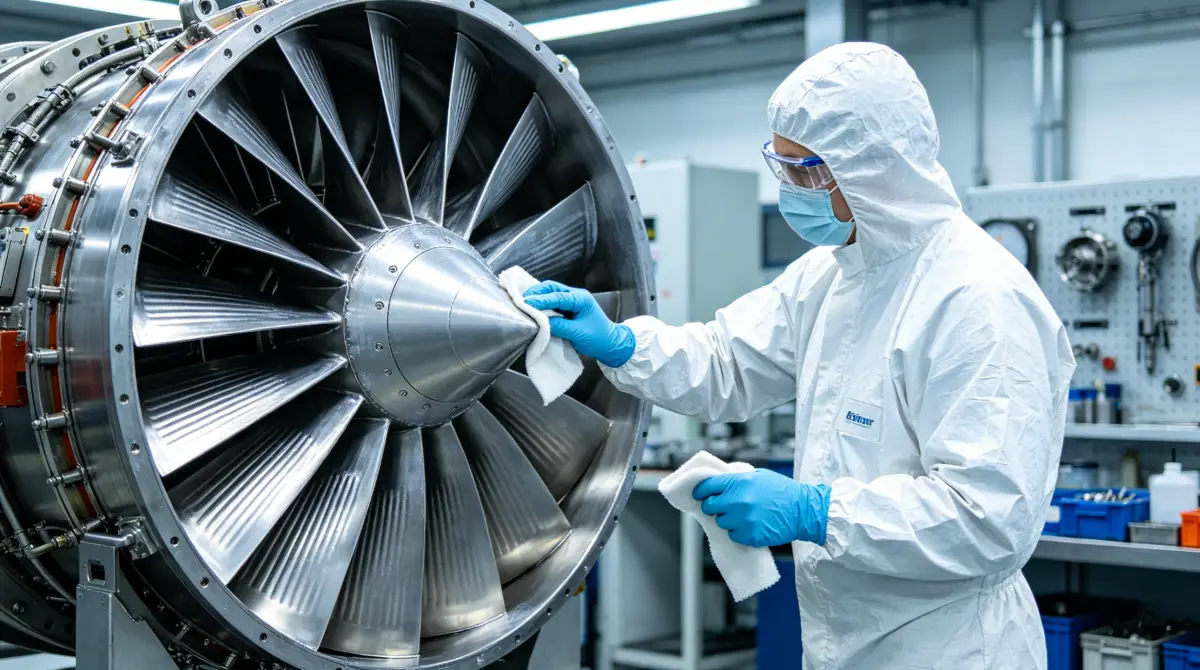
Tool surface cleaning. The mold or mandrel must be spotless. Release agent residue from the previous cycle has to come off completely — incomplete removal causes adhesive failure at the tool-part interface. Wipe with a clean, lint-free wipe saturated with the release agent manufacturer’s recommended solvent. Fresh wipe for each pass. Don’t redistribute the residue.
Vacuum bag integrity. Bag film, sealant tape, breather/bleeder cloths — all clean, no pinholes. A contaminated bag introduces particles during cure when differential pressure pushes air through leaks. Wipe bag contact surfaces with a lint-free wipe. Skip cellulose wipes — the fibers perforate bag film at folds and creases, creating micro-leaks that don’t show up until the vacuum decay test fails.
Final layup inspection. Before bagging, scan for FOD — fibers, tool fragments, tape backing, anything out of place. Bright light at a shallow angle (same technique as automotive paint inspection). Any reflective speck or shadow is suspect.
Layup Room Cleanliness: One Ply at a Time
Hand layup of composite prepreg still dominates for complex, low-to-medium rate structures. AFP and ATL handle larger, simpler geometries — fuselage barrels, wing skins — but for complex contours, doublers, and details, a trained technician with a roller and a debulking bag is the standard.
Every ply is an opportunity to trap contamination. The prepreg is tacky at room temperature — that’s the uncured epoxy doing its job. Anything that touches that surface stays.
A hair from the technician’s head. A fiber from their garment sleeve. A particle from the HVAC. A fingerprint — skin oils contaminate the bond surface and create a disbond initiation site. Boeing’s BAC 5351 specifically calls out fingerprint contamination as rejectable.
First ply needs a clean, properly prepared tool surface. And any inter-ply pause longer than the out-time limit (typically 14–30 days at room temp for standard epoxy prepregs) requires surface prep before the next ply goes down — wiping with a solvent-saturated cleanroom wipe, typically acetone or the prepreg manufacturer’s approved solvent.
Use a wipe that won’t shed fibers onto the tacky surface. We’ve been in layup rooms where operators were using standard industrial wipes — the kind that leave visible fibers when you pull them apart. Those fibers end up in the layup. The layup goes in the autoclave. The autoclave cures whatever you put in it, fibers and all.
Honeycomb Core Cleaning: A Special Problem
Nomex and aluminum honeycomb cores show up everywhere in aerospace — floor panels, fairings, control surfaces, nacelle inner barrels. The stiffness-to-weight ratio is unbeatable. But bonding a composite skin to honeycomb is one of the most contamination-sensitive operations in the entire process.
The bond area is tiny — you’re bonding to cell walls measured in fractions of a millimeter. A 150mm × 150mm Nomex core sample with 3.2mm cells has roughly 2,200 cells, each wall about 0.08mm thick. Any contamination at the cell wall tip — particle, fiber, release agent residue, moisture — prevents the adhesive from forming a proper fillet. No fillet, no bond.
Cleaning is delicate. Cell walls are thin and easily damaged. No scrubbing. No aggressive solvents that swell aramid fiber. The standard approach: gentle wipe with a lint-free, non-abrasive wipe dampened with approved solvent — acetone or IPA for Nomex, mild alkaline cleaner for aluminum core per MIL-C-7438.
Replace wipes frequently. Cell geometry traps particles in the fabric, and a loaded wipe redistributes contamination instead of removing it.
Three rules to follow: One, always wipe in one direction across cell walls — circular wiping rolls wall material and causes fiber damage. Two, use a wipe with enough rigidity to contact cell wall tips but enough conformability to follow the hex geometry. Three, inspect after cleaning — 10× magnification minimum catches particles and damage the naked eye misses.
Resin Transfer Molding: The Mold Surface Is Everything
In RTM and VARTM, you’re placing a dry fiber preform into a closed mold (or onto a single-sided mold under vacuum bag), then injecting resin. The resin flows through the preform, displaces air, fills the cavity. Any contamination on the mold or preform surface gets carried by the resin flow and deposited wherever the flow front takes it — which could be a critical bond surface, a ply interface, or the part exterior.
Mold cleaning between cycles matters because of the release agent system. Aerospace RTM molds typically use semi-permanent release agents (Frekote, Zyvax, or similar) that form a chemically bonded film on the mold surface. After demold, that film is partially depleted. Fresh coat goes on before the next cycle.
But if the previous cycle left resin residue, fiber debris, or silicone contamination, the new release agent bonds to the contaminant — not the mold. Next part may stick. Cutting a stuck part out of an RTM mold damages the surface, which means mold repair and production downtime. At a Tier 1 running three RTM cycles per day, a damaged mold costs $50,000+ in lost production and repair.
Wipe the mold with a lint-free wipe saturated with the release agent manufacturer’s solvent between cycles. Then apply fresh release agent per instructions. Don’t skip the cleaning step.
NDT Surface Prep: The Inspection That Catches What You Missed
Non-destructive testing — ultrasonic inspection (pulse-echo, through-transmission, phased array), thermography, shearography — verifies that the part you just cured doesn’t have the defects you were trying to prevent. For aerospace composites, NDT is mandatory. Boeing’s BSS 7094 and Airbus’s AIPI 03-01-009 define acceptance criteria for voids, porosity, delaminations, disbonds, and foreign object inclusions.
UT inspection needs a clean surface for the couplant interface. Surface contamination — dust, release agent residue, handling oils — attenuates or scatters the signal. You get false indications, missed defects, or both.
Before UT, wipe the part surface with a clean, lint-free wipe dampened with IPA. Fresh wipe for each area — dragging a dirty wipe across the inspection surface spreads contamination. This is a step where a lot of facilities cut corners because it feels like “just cleaning.” It’s not. It’s the foundation of your inspection quality.
FOD Prevention: Carbon Fiber Particles Are Everywhere
Foreign Object Damage in composite manufacturing has a specific flavor. Carbon fiber particles are electrically conductive, mechanically abrasive, and practically invisible on a dark composite surface. A carbon fiber FOD fragment trapped in a layup creates a local conductive path that can cause electrical arcing in lightning strike scenarios (per AC 20-53B and SAE ARP 5414). It also creates a stress concentration that initiates delamination under fatigue loading.
FOD prevention is a culture, not a checklist. But the checklist matters:
Segregate machining from layup. Carbon fiber dust from CNC trimming is a FOD source for nearby layup rooms. Positive pressure differentials — layup rooms at higher pressure than machining areas — push contamination away. Use dedicated wiping cloths for each area and never cross-contaminate.
Wipe everything entering the layup room. Tools, fixtures, vacuum bag hardware, thermocouple wires, breather cloth, cleanroom garments. The garment isn’t clean just because it came from the laundry. Verify with particle counts. Wipe cuffs and zipper areas with a tacky wipe before entry.
Inspect after every layup step. Quick visual scan under angled light. Takes 30 seconds. A missed FOD finding after cure costs hours of NDT investigation, days of repair, and potentially a scrapped part.
Comparison Table: Wipe Requirements by Composite Manufacturing Stage
| Manufacturing Stage | Recommended Wipe Type | Key Requirement | Typical Cleanroom Class |
|---|---|---|---|
| Layup — tool surface prep | Sealed-edge polyester knit, lint-free | Zero fiber release on tacky prepreg; solvent compatible | ISO 6–7 |
| Layup — inter-ply surface prep | Microfiber polyester/nylon, ultra-low particle | No fiber contamination on uncured resin | ISO 6 |
| Honeycomb core cleaning | Soft, non-abrasive microfiber | Cell geometry conforming; no wall damage; lint-free | ISO 7 |
| Autoclave tooling prep | Heavy-duty polyester knit, sealed edge | Release agent removal; high absorbency | ISO 7 |
| RTM mold cleaning | Polyester knit, low NVR | Release agent compatible; no blocking residue | ISO 7 |
| NDT surface prep (UT) | Lint-free polyester, IPA pre-saturated | No couplant interference; no lint on surface | ISO 7–8 |
| Machining / trimming | Non-woven, high-absorbency | Carbon dust containment; conductive particle pickup | ISO 8 |
OEM Material Specs: What Boeing and Airbus Actually Require
Every material touching the manufacturing process — including cleaning consumables — must be traceable to an approved spec. Here’s what the major OEMs require:
Boeing — BAC 5351 (Cleaning of Composite Surfaces) defines approved solvents, methods, and surface cleanliness verification. Wipes used in Boeing-approved processes must come from materials on the Boeing Qualified Products List (QPL) or be approved through the supplier’s material review board. BSS 7094 covers NDT acceptance criteria and, by extension, surface prep for inspection.
Airbus — AIPI 03-01-007 (Cleaning and Surface Preparation of Composite Parts) is the Airbus equivalent. It specifies approved cleaning agents, application methods, and cleanliness verification. The AIMS (Airbus Internal Material Specification) program covers consumable qualification. Compliance with the relevant AIMS spec is typically required for wipes in Airbus supply chain operations.
SAE AMS — SAE AMS 3819 (Cloth, Cleaning, for Aircraft Primary and Secondary Structural Surfaces) is the general aerospace cleaning cloth spec. It defines fiber content, particle generation, solvent extractables, and other properties. Wipes qualified to AMS 3819 are accepted across most aerospace OEMs, though each may have additional requirements.
If you’re a Tier 2 or Tier 3 supplier, ask your Tier 1 customer which spec governs their cleaning consumable requirements. Don’t assume. The wrong wipe can trigger a SCAR, and SCARs follow you around in aerospace supply chain databases. They don’t expire quietly.
Who You’ll Work With at WIPESTAR
We supply cleaning consumables to aerospace composite manufacturing facilities where FOD prevention and surface cleanliness are critical to structural integrity. Our team understands Boeing, Airbus, and NADCAP material specs — and we’ve helped suppliers at every tier find the right wipe for their process.

Ethan — Sales Director
Ethan has over 20 years of experience in the industrial wiping cloth and cleanroom consumables industry. He leads the global sales team and provides high-quality cleanroom solutions for worldwide customers.

Lee — Key Account Sales Manager
Lee has 7 years of sales experience in the cleanroom consumables industry, having served international companies such as Foxconn, Samsung, and Apple. He focuses on solving problems for customers.

Carolina — Product Specialist
Carolina has many years of experience in the cleanroom consumables industry, focusing on product quality and performance. She communicates closely with production teams to continuously optimize products.
Get Started with Aerospace Composite Manufacturing Wipes
Whether you’re qualifying wipes for a new layup line, upgrading consumables for a Boeing or Airbus program, or troubleshooting a disbond issue linked to contamination, we can help. Full documentation including COA, ionic analysis, and compliance data per SAE AMS 3819.
- Browse All Wiping Cloths — Full range of sealed-edge polyester knit, microfiber, and heavy-duty options with specs and certifications.
- Pre-Wetted Wipes — Factory-sealed wipes with known solvent purity, ideal for critical layup surface prep.
- Aerospace Industry Solutions — See our full range of cleanroom consumables for aerospace manufacturing and MRO.
- Request Technical Consultation — Need help matching a wipe to your layup room class and material system? Our team can help.
Browse Wiping Cloths → Request a Quote
Frequently Asked Questions