English
 Chinese



Nobody plans to fail a spill response. They fail it at 2 a.m., in poor light, reaching for whichever box is closest. I’ve audited a metal-finishing shop where that exact reflex turned a four-liter drip into a reportable mess.
A phosphoric acid tote in the chemical store developed a slow weep at the valve fitting. Night maintenance saw the puddle, grabbed the dark gray universal pads from the janitor cart — the only absorbents in the room — and laid them down. Universal polypropylene tolerates oils and coolants; concentrated acid is a different conversation. The pads darkened, softened at the edges, and one got kicked into the aisle, where a pallet jack tracked acidic residue twenty meters toward the shipping dock. Nobody was hurt, which is the only reason the story has a manageable ending. The yellow chemical pads that were actually rated for the spill were locked in the EHS cage on the other side of the building, behind a badge the night contractor didn’t carry.
The failure wasn’t the pad. It was the placement and the matching: the correct absorbent has to be closer than the wrong one, and the person on shift has to know which is which without reading a spec sheet. Color-coded product families, pads versus socks, staged stations, and a response sequence short enough to remember — that’s spill control. This guide walks through all four.
The Three Absorbent Families and Why the Colors Exist
Industrial absorbents are sorted by the liquids they’re engineered to take, and the industry color convention exists specifically so nobody has to make a materials decision during an emergency:
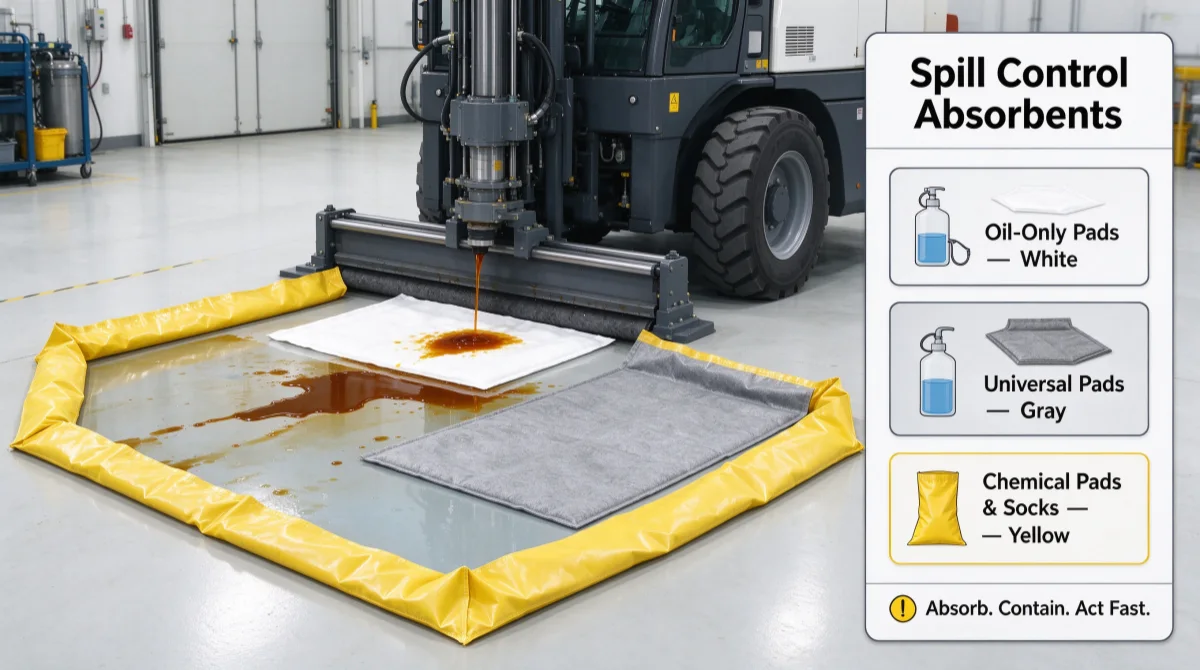
- Oil-only — white/light gray. Hydrophobic thermally bonded polypropylene wicks hydrocarbons (hydraulic oil, fuel, cutting fluid, lubricants) while repelling water. It floats, which makes it the only sane choice for leaks on water or in wet sumps. It is the wrong tool for water-miscible coolants — they’ll bead off it.
- Universal — dark gray. Takes oils, coolants, solvents and water alike for non-corrosive, non-aggressive spills. The dark color hides soil so the pad stays visually serviceable. This is the generalist for mixed machine shops and warehouses — not for acids and bases.
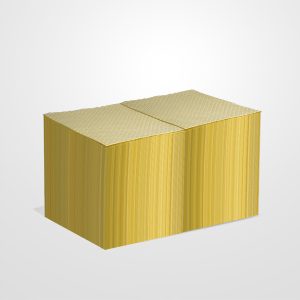
- Chemical/hazmat — yellow. Engineered for acids, bases and corrosive or unidentified liquids. Yellow is a wearable warning label: whatever comes out of that box is going into a hazardous waste stream afterward.
Every substitution failure I’ve seen came from treating absorbents as interchangeable: oil-only under a water-based coolant that never gets absorbed, universal under corrosive that starts degrading it, expensive chemical pads wasted on a rain puddle. The rule that prevents all three is deliberately boring: identify the liquid before touching the box. If identification isn’t possible, it’s a chemical spill until proven otherwise.
Pads vs Socks: Containment Before Absorption
People buy boxes of pads and treat socks as optional. That’s backwards for any leak with a perimeter. Socks contain; pads absorb.
A sock — a flexible tube of absorbent fill in a stitch-bonded polypropylene skin — bends around machine bases, drums, walls and corners. Laid ring-fashion around an active leak, it stops the liquid spreading and keeps absorbing while saturated; the bonded skin resists bursting under foot traffic. Pads go inside the ring afterward to take up what the socks held. Dropping pads onto a spreading puddle first just moves the leading edge around and guarantees someone steps in it. For static drip points, pads in trays under valves and disconnects are exactly right; for anything mobile or on the floor, the perimeter gets a sock first.
The Product Lineup by Liquid Type
WIPESTAR’s absorbent family follows the same color logic, with fine-fiber construction and a dimple emboss that spreads wicking across the full sheet instead of pooling at the contact point. Standard pads run 40cm × 50cm, 200 per box; match light weight to drip trays and routine wipe-ups, heavy weight to standing pools and press-down volumes.
| Product | Family / Build | Format | Assign It To |
|---|---|---|---|
| L1101 / L1102 Oil-Only Pads | 100% PP thermal-bonded, light / heavy weight | 40×50cm pads, 200/box | Hydraulic and fuel drips, cutting oil; wet sumps and water surfaces |
| L1105 Oil-Only Socks | Absorbent fill in stitch-bonded PP skin | φ8cm × 1.2m, 12/box | Perimeter containment around machine bases and drums (oils only) |
| L1201 / L1202 Universal Pads | Fine-fiber, light / heavy weight | 40×50cm pads, 200/box | Mixed non-corrosive drips: oils, coolants, solvents, water |
| L1301 / L1302 Chemical Pads | Chemical-resistant, light / heavy weight | 40×50cm pads, 200/box | Acids, bases, corrosives, unidentified aggressive liquids |
One caution that belongs in the table but is usually left out of it: the L1105 sock is an oil-only product. Do not ring an acid or base leak with it — corrosive containment uses the yellow chemical family, which is compatible with the chemistry instead of just absorbent in the generic sense.
Placement: Building Stations Around Your Liquid Map
- At every active source. Pre-positioned socks around pumps, tote valves and drum racks. A leak contained at the machine is a maintenance item; the same leak on the aisle floor is an incident report waiting for a forklift.
- Under drip points. Pads in trays under valves, quick disconnects and transfer hoses, color-matched to the fluid — oil-only for hydrocarbons, universal for coolant and mixed lines.
- At transfer stations. Decanting and dilution points get chemical pads within an arm’s reach, with appropriate PPE mounted at the same station. Absorbent you have to walk to get isn’t staged — it’s stored.
- Along traffic routes. If a leak can be tracked, pad stations follow the path to the maintenance room. The phosphoric-acid story above was a placement failure on exactly this axis.
Mark the stations to match the boxes — white, gray, yellow brackets or shelf labels — and post the liquid map beside each cabinet. A contractor on night shift should be able to read the room correctly with zero verbal briefing. Check and restock monthly and immediately after any use; an empty station is always discovered the moment it’s needed.
Response Sequence and the Regulatory Paper Trail
The response procedure has to be short enough to recall under stress:
- Stop the source when it’s safe — close the valve, upright the container. Absorbents manage consequences, not causes.
- Protect people. PPE matched to the GHS hazard on the SDS, bystanders cleared, ventilation where vapors warrant it. Larger or unknown spills go to trained responders under your HAZWOPER procedures, not the nearest operator.
- Contain the perimeter with socks, outside-in.
- Absorb with the matched family until the surface is dry to inspection.
- Dispose and document. This is where the paperwork earns its keep.
Three regulatory frameworks sit behind step five. In the US, 40 CFR 112 (the SPCC rule) requires written oil spill prevention and containment plans at facilities with aggregate aboveground oil storage above 1,320 gallons (or certain underground quantities) — staged oil-only absorbents and documented placement belong inside that plan. Used absorbents can become characteristic hazardous waste under RCRA — an ignitable solvent-soaked pad can be a D001 waste, a pad wet with corrosive liquid a D002 waste — so disposal follows the liquid’s SDS and your hazardous-waste procedures, not the general trash. And OSHA’s walking-working surface housekeeping rule, 29 CFR 1910.22, is what makes a spreading puddle a compliance issue before anyone even falls. Keep absorbent types, locations, inspection dates and disposal routes in the same document set as the spill response SOP; inspectors ask for all of them together.
The Ledger: Why Capacity Beats the Cheapest Box
Pads look like a commodity on the purchase order. They don’t behave like one on the floor. A pad that wicks across its full surface and holds its structure when saturated handles more liters per sheet than one that loads only at the contact point and tears apart during pickup — so compare cost per liter contained, not price per box. Then add the line items nobody puts on the PO: contaminated waste weight you’re paying to dispose of, slip near-miss reports, housekeeping overtime, and the audit observation that follows an unlabeled, unmatched station. Cheap pads lose that arithmetic at almost every facility that bothers to do it.
If you’re standardizing across a site or a network, we map pads, socks and stations to your actual liquid inventory — the full range is in the spill control catalog, and talking to the team starts with your floor plan, not a catalog dump.
Who You’ll Work With at WIPESTAR
We supply absorbents and cleaning consumables to plants, labs and warehouses worldwide — including multi-site programs where specs, placement standards and restock cadence have to match across facilities.

Ethan — Sales Director
Ethan has over 20 years in the industrial wiping cloth and cleanroom consumables industry and leads the global team, including framework supply for multi-site EHS standardization.

Lee — Key Account Sales Manager
Lee has served accounts including Foxconn, Samsung and Apple since 2018 and coordinates the consistent specs and timed replenishment that make spill stations work across plants.

Daisy — Sales Support
Daisy handles order follow-up and day-to-day communication so monthly station checks never turn into surprise stockouts on any of the three color families.
Get Started with Spill Readiness
Whether you’re kitting one machine shop or standardizing absorbent inventory across a facility network, send the liquid map and we’ll spec the pads, socks and station placement to match.
- L1105 Oil-Only Socks — perimeter containment before the puddle spreads.
- L1201 Universal Pads — the generalist for mixed non-corrosive drips.
- Request a Technical Consultation — send the liquid inventory and floor plan.
Browse Spill Control → Request a Custom Quote
Frequently Asked Questions