English
 Chinese



A flexographic printing plant in Wenzhou tracked their makeready time for six months and found something they didn’t expect. Their press operators were spending 22 minutes per color change on blanket and plate cleaning—not because the ink was hard to remove, but because their wiping cloths were leaving lint and residue that required a second pass. They switched wipes and cut makeready to 14 minutes per color change. Across a 6-color press running 8 job changes per shift, that saved 38 minutes of press time per shift. At their hourly press rate, the wipe upgrade paid for itself in three days.
We supply industrial wiping cloths to offset printers, flexo houses, gravure operations, and packaging machine lines across Asia. This guide covers what we’ve learned about specifying wipes for the printing and packaging industry—where the wipe affects not just cleaning speed, but print quality, static control, and in food packaging, regulatory compliance.
Why Printing and Packaging Have Unique Wipe Requirements
Printing and packaging operations sit at the intersection of three contamination-sensitive processes, and your wipe affects all three:
- Print quality — Lint, fibers, and particles from the wipe land on blankets, plates, and substrates. On a 175 LPI (lines per inch) print, a 50μm fiber creates a visible defect. On a 300 LPI stochastic screen, even a 20μm particle causes a dot void that the customer sees with a loupe.
- Static management — Paper, film, and board substrates generate static during transport through the press. Static attracts airborne particles to the substrate surface and causes feeding, stacking, and sheet-separation problems. Your wipe’s static properties interact with this system—either helping or making it worse.
- Regulatory compliance — If you print food packaging, pharmaceutical labels, or cosmetics packaging, your wipe contacts surfaces that contact the product. FDA, EU, and brand-owner compliance requirements apply to every consumable in your production chain.
A general-purpose shop rag doesn’t address any of these. A cleanroom wipe rated for semiconductor applications addresses the first two but is over-specified and over-priced for printing. You need a wipe designed for the printing and packaging environment—where ink chemistry, substrate handling, and production speed define the specification.
Ink Removal: Matching Wipe Material to Ink Chemistry
The most common question we get from printers: “Why won’t this wipe clean my ink?” The answer is almost always a chemistry mismatch between the wipe material and the ink system.
| Ink System | Solvent Carrier | Best Wipe Material | Key Requirement |
|---|---|---|---|
| UV-curable ink | Monomers/oligomers (no solvent) | Polyester or polyester/cellulose blend | Must remove uncured resin without dissolving the wipe; IPA-compatible |
| Solvent-based flexo/gravure | IPA, ethyl acetate, toluene, MEK | 100% polypropylene or polyester | Chemical resistance to aggressive solvents; won’t degrade or shed fibers when saturated |
| Water-based flexo | Water / water-alcohol blend | Wood pulp/polypropylene blend | High absorption for water-based residue; good wet strength |
| Offset (oil-based) | Mineral oil, vegetable oil | Cellulose/polyester blend | High absorption capacity for oily residue; mechanical scrubbing action |
| Electron beam (EB) ink | Similar to UV but EB-cured | Polyester, sealed-edge | Low-lint for high-resolution work; IPA-compatible for uncured resin removal |
One mistake we see constantly: printers using cellulose wipes to clean up solvent-based ink. Cellulose dissolves or disintegrates in strong solvents like toluene and MEK, leaving paper pulp residue on the surface you just cleaned. Now you have two contaminants instead of one. Match the wipe material to your ink solvent system—this is the first filter in your selection process.
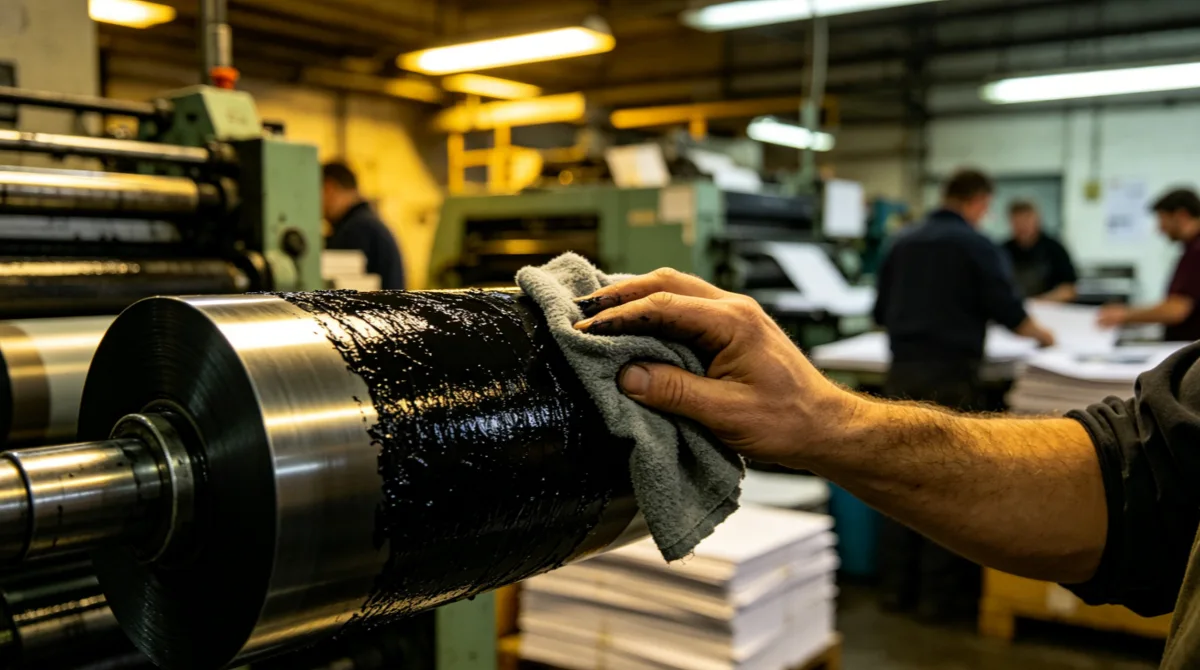
Blanket and Plate Cleaning: The Wipe That Affects Print Quality
Offset printing blankets and flexographic plates are precision surfaces. The blanket’s surface texture determines ink transfer uniformity, dot sharpness, and color consistency. Your wipe-down process directly affects these print quality parameters.
Offset Blanket Cleaning
Between print jobs, blankets need cleaning to remove residual ink, paper dust, and spray powder. The wipe must:
- Absorb ink solvent quickly without over-saturating the blanket (excess solvent swells the blanket surface and changes its ink-release properties).
- Remove paper dust and spray powder particles without embedding them in the blanket surface—embedded particles cause hickies (print defects) that repeat across thousands of impressions.
- Leave no lint or fiber residue on the blanket surface—fibers on the blanket transfer to every subsequent impression until the blanket is re-cleaned.
For offset blanket cleaning, we recommend a medium-weight cellulose/polyester blend wipe. The cellulose provides absorption and mechanical scrubbing action. The polyester adds wet strength so the wipe doesn’t tear when saturated with wash solvent. Sealed edges are important—cut-edge wipes shed fibers that embed in the blanket surface.
Flexo Plate Cleaning
Photopolymer flexo plates are softer than offset blankets (Shore A hardness 30-50) and more sensitive to abrasive cleaning. The wipe must be soft enough not to erode the plate surface during wipe-down but firm enough to remove dried ink from the relief areas. A low-abrasion rayon/polyester blend wipe works well for plate cleaning—the rayon is soft against the plate surface, and the polyester provides cleaning mechanical action.
Never use a stiff or abrasive wipe on a flexo plate. Plate erosion from aggressive wipe-down shortens plate life and causes gradual print quality degradation that’s hard to diagnose—you’ll chase ink viscosity and impression pressure settings when the real problem is a worn plate surface.
Static Control on Press: Why Anti-Static Wipes Matter for Print Defects
Static electricity is the invisible variable in print quality. When paper or film substrate passes through a press at high speed, triboelectric charging generates static on the substrate surface. This static causes:
- Particle attraction — Charged substrates pull dust, lint, and fibers from the surrounding environment onto the print surface. These particles cause spots, voids, and adhesion failures in subsequent coating or lamination steps.
- Sheet feeding problems — Static causes sheets to stick together (double-feeding) or resist separation from the stack (misfeeding). Both cause press stoppages and waste.
- Registration errors — On multi-color presses, charged sheets can shift position on the feed table between impressions, causing color misregistration that appears as fuzzy edges or color fringing.
Your wiping cloth interacts with this system in two ways. First, the wipe itself can be a static generator—a non-dissipative wipe creates charge on the surface it contacts. Second, the wipe can be a static neutralizer—an anti-static wipe transfers charge to ground through the operator’s hand. For printing applications, specify wipes with surface resistivity in the dissipative range (10⁶–10¹¹ ohms/square). This allows the wipe to neutralize static on the surface it contacts without generating its own charge.
We’ve seen printers eliminate double-feeding problems on their sheeter by switching from standard rags to anti-static wipes for feed table cleaning. The rags were generating static during wipe-down; the dissipative wipes were removing it.
Food Packaging Compliance: When Your Wipe Touches the Product Surface
If you print food packaging—flexible packaging, folding cartons, labels, or corrugated boxes for direct food contact—the wipe you use on your printing press is part of your food safety chain. Here’s why:
- Indirect food contact — The printed surface of food packaging contacts the food product (or contacts a material that contacts the food). Your wipe contacts the printing blanket, which contacts the substrate, which contacts the food. That’s a two-step indirect food contact chain, and every consumable in that chain must be food-contact compliant.
- Migration testing — Your wipe supplier should provide migration testing data showing that substances from the wipe don’t transfer to the printed substrate at levels that could migrate to food. This is a regulatory requirement in both the US (FDA 21 CFR) and the EU (Regulation (EC) No 1935/2004).
- Brand-owner requirements — Major food brands (Nestlé, Unilever, P&G, Mars) have their own packaging material specifications that often exceed regulatory requirements. Your wipe must comply with the brand owner’s specification, not just the law.
A printing plant in Suzhou lost a major food brand contract because their blanket wash wipes had no food-contact compliance documentation. The print quality was perfect. The ink was approved. The wipes weren’t. The brand auditor found the gap during a packaging supplier audit. Don’t let this happen to you.
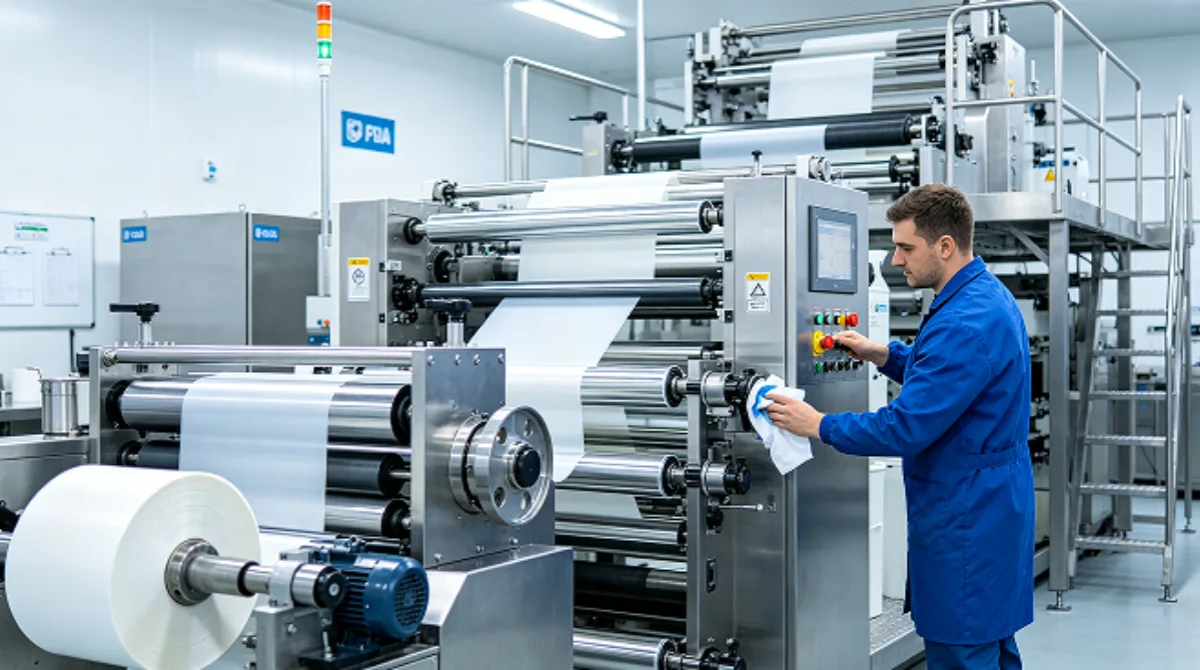
Packaging Machine Wipe-Down: Filling, Sealing, and Labeling Equipment
Beyond the printing press, packaging machine lines have their own wipe requirements driven by the equipment type and the product being packaged.
Filling and Dosing Equipment
Liquid filling machines for beverages, sauces, and personal care products require wipe-down of filling nozzles, valve assemblies, and drip trays between product changeovers. The wipe must be compatible with the product residue (food, chemical, or cosmetic) and the cleaning solvent used for changeover. For food and beverage filling, FDA food-contact compliance is mandatory.
Heat Seal and Vacuum Seal Stations
Seal bars and vacuum chambers accumulate residue from packaging films—adhesive from lamination layers, slip agents from PE films, and ink residue from printed areas. The wipe must remove these residues without leaving fibers or chemical contaminants that compromise seal integrity. A weak seal from a contaminated seal bar is a package failure that reaches the consumer—your wipe is part of your seal quality control.
Labeling Equipment
Label applicators, glue rollers, and tamp pads accumulate adhesive residue that causes label misapplication—crooked labels, flagging edges, or adhesive bleed. Wipe-down requires a solvent-compatible wipe that removes adhesive residue without leaving fibers on the tamp pad surface. Fibers on the tamp pad transfer to every subsequent label, causing application defects across the entire production run.
Cost per Good Sheet: A Better Metric Than Cost per Wipe
Printing procurement teams evaluate wipes on unit cost. Press managers should evaluate wipes on cost per good printed sheet. Here’s the math:
- Makeready time — A wipe that requires two passes instead of one adds 5-8 minutes per color change. On a 6-color press with 8 changeovers per shift, that’s 40-64 minutes of lost press time per shift. At a press rate of ¥800-2,000 per hour, the “cheap” wipe costs you ¥500-2,100 per shift in lost capacity.
- Waste sheets — Lint and fiber defects from the wipe show up as waste sheets. On a high-quality print run, the first 50-100 sheets after makeready are waste while the operator clears blanket defects. A lintier wipe means more waste sheets per changeover.
- Customer returns — A fiber embedded in a pharmaceutical label or a food package print is a customer return. The cost of a return—replacement printing, repackaging, logistics, and the relationship damage—dwarfs years of wipe savings.
The wipe that costs 30% more per unit typically delivers 15-25% lower cost per good sheet when you account for faster makeready, fewer waste sheets, and zero fiber-related customer complaints. We run this analysis with every new printing customer—ask us to run it for your operation.
Your Printing Industry Consumables Team at WIPESTAR
Printing and packaging accounts get a team that understands press chemistry and production speed—not generalists applying cleanroom specs to a printing environment.

Vicky — Foreign Trade Sales Supervisor
Vicky handles overseas printing industry accounts with the scheduling precision that pressroom operations demand. She coordinates order timing with your production schedule—changeover wipes need to arrive before the next job change, not after. She manages inventory programs for high-volume printing customers and ensures compliance documentation is current for food packaging accounts.

Juan — Purification Industry Specialist
Juan understands contamination control in industrial manufacturing environments—including printing. He helps match wipe specifications to your ink chemistry, substrate type, and print quality requirements. For food packaging printers, he coordinates the compliance documentation chain from wipe material through migration testing to FDA/EU conformity.

Zac — Customer Service
Zac manages day-to-day order coordination for printing customers with high-frequency ordering patterns. Print shops don’t order monthly—they order based on job schedules, seasonal peaks, and new contract starts. He handles rapid turnaround on orders, tracks shipment schedules, and coordinates emergency stock when a press run outlasts the wipe inventory forecast.

Zhen — Account Manager
Zhen manages ongoing account relationships and handles the pricing, volume planning, and quality follow-up that printing customers need. He tracks your consumption patterns, recommends inventory optimization, and handles any quality issues with the urgency that a stopped press demands. First call when something goes wrong on the production floor.
Meet the full team: WIPESTAR Team Page →
Frequently Asked Questions About Industrial Wiping Cloths for Printing and Packaging
Request Printing Industry Wiping Cloth Samples
We supply industrial wiping cloths for printing and packaging operations—ink-matched materials, anti-static options, and FDA-compliant wipes for food packaging printers. ISO 9001:2015 certified production. Free samples with ink compatibility testing for qualified printing facilities.
Browse our wiping cloth range →
Request Samples with Ink Compatibility Test →