English
 Chinese


Last year a Tier 2 aerospace supplier in Suzhou lost their NADCAP chemical processing accreditation. The finding: their wiping cloths for pre-treatment surface preparation had no material traceability documentation. The wipes worked fine—the surfaces were clean, the adhesion tests passed, the parts flew. But the auditor asked for the chain of custody from fiber to finished wipe, and the supplier couldn’t produce it. Three months of corrective action, a re-audit, and $40,000 in consultant fees later, they got their accreditation back. All because nobody asked the wipe supplier for traceability paperwork.
We supply industrial wiping cloths to aerospace OEMs, Tier 1 aerostructure manufacturers, and MRO (Maintenance, Repair, and Overhaul) facilities across Asia and Europe. This guide covers what we’ve learned about specifying wipes for aerospace applications—where the documentation requirements are as strict as the performance requirements, and where “it passed the test” isn’t enough if you can’t prove how.
NADCAP and AS9100: What They Actually Require for Consumables
There’s a misconception in aerospace procurement that NADCAP only applies to processes—chemical processing, heat treating, NDT, welding. Consumables are just purchased items, right? Wrong. NADCAP chemical processing audits evaluate the entire surface preparation chain, and that includes every wipe, solvent, and cleaning material that touches your parts.
Here’s what the auditor is actually checking:
- Material traceability — Can you trace your current wipe lot back to the raw material source? The auditor wants to see fiber lot numbers, manufacturing dates, and production facility identification. If your supplier can’t provide this, you have a gap.
- Specification compliance — Is the wipe you’re using actually the wipe that was qualified? We’ve seen facilities where the purchasing team switched wipe suppliers to save 8% on unit cost, but didn’t re-qualify the new product against the surface preparation specification. The auditor found the wipe didn’t match the approved material list.
- Change control — Does your supplier notify you when they change raw materials, manufacturing processes, or production locations? If they changed their polyester fiber supplier six months ago and didn’t tell you, your qualification data is stale—and your auditor will catch it.
- Handling and storage — Are your wipes stored in controlled conditions? Are opened packages resealed or discarded? Is your FIFO rotation documented? Auditors walk the floor and check.
AS9100 quality management requirements add another layer: your approved supplier list must include consumable suppliers, and those suppliers must be evaluated and monitored with the same rigor as your component suppliers. Your wiping cloth supplier is on your AS9100 audit scope whether you like it or not.
Turbine Component Cleaning: The Most Demanding Wipe Application in Aerospace
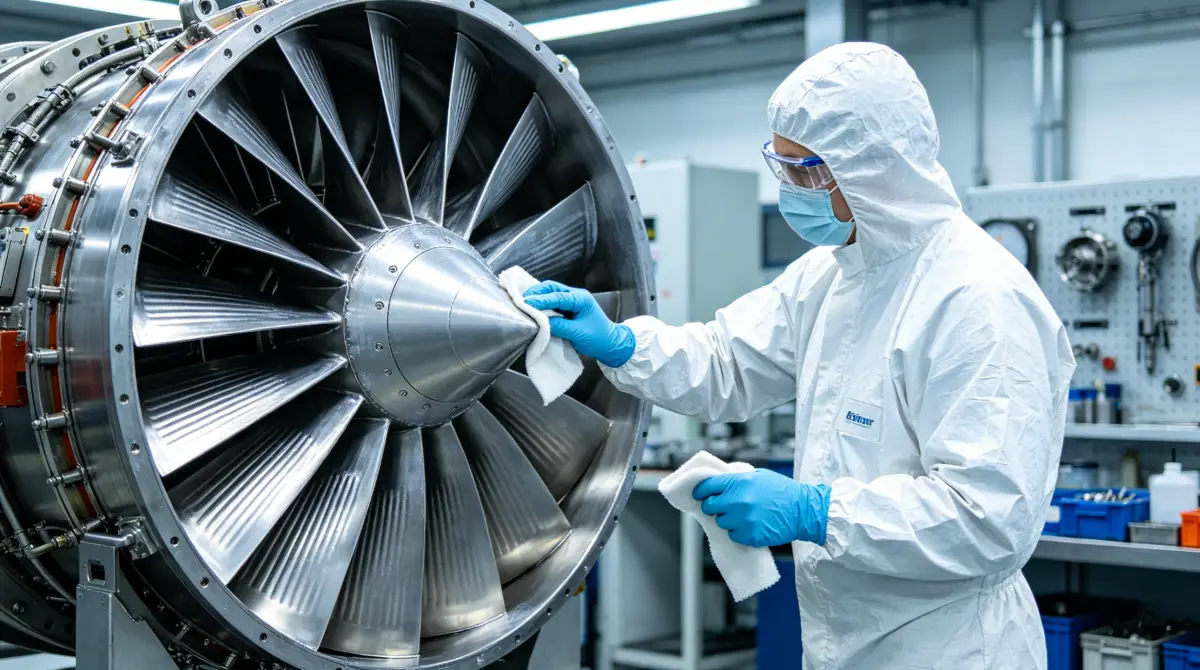
Gas turbine blades, vanes, and combustion chamber components operate at temperatures exceeding 1,000°C and under centrifugal loads that push material limits. Surface cleanliness before thermal barrier coating (TBC) application, braze processing, or welding is not negotiable—and the wipe you use is part of that process validation.
TBC Surface Preparation
Before applying thermal barrier coatings, the turbine blade surface must be free of organic contamination, oxide residue, and particulate matter. The surface preparation wipe must:
- Be lint-free at the fiber level—any fiber left on the surface becomes a coating adhesion failure site that can cause TBC spallation in service.
- Be compatible with your surface preparation solvent (typically acetone, IPA, or proprietary aerospace cleaning solutions).
- Have documented traceability from raw material to finished product—your TBC process specification requires it.
Braze and Weld Preparation
Brazing and welding of nickel superalloy components require surfaces free of carbon contamination, sulfur, and halogens. Your wipe must not introduce any of these contaminants. Standard industrial wipes may contain silicone-based release agents or halogenated processing aids from their manufacturing process—both are braze poisoners that cause joint failures.
Request a wipe chemistry certification showing absence of silicone, sulfur, and halogenated compounds. If your supplier can’t provide it, that wipe doesn’t belong in your braze shop.
Precision Grinding and Lapping
Turbine blade root forms and seal surfaces are ground to tolerances below 5μm. Surface contamination from wiping cloths—particles, fibers, chemical residue—can cause dimensional measurement errors and surface finish defects. Use ultra-low-lint wipes with sealed edges and verified chemical cleanliness for all post-grinding wipe-down operations.
Composite Surface Preparation: Wipe Selection for CFRP and Honeycomb Structures
Carbon fiber reinforced polymer (CFRP) and honeycomb composite panels are the structural backbone of modern aircraft. Surface preparation before bonding, painting, or lightning strike mesh application is a critical process step—and your wipe choice directly affects bond strength.
Pre-Bond Surface Preparation
Composite bond surfaces must be wiped within a controlled time window after surface activation (typically plasma treatment, peel ply removal, or chemical etch). The wipe must:
- Not recontaminate the activated surface with fibers, particles, or chemical residues.
- Be compatible with your activation process—some wipes leave organic films that reduce bond strength by 30–40%.
- Provide consistent surface energy after wipe-down—measured by water break-free test or dyne pen.
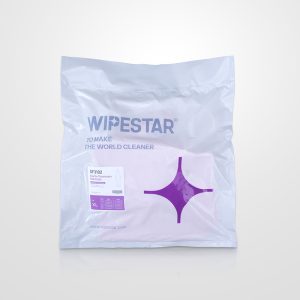
We’ve worked with aerostructure manufacturers who switched from general-purpose cleanroom wipes to our W3501 Heavy Duty Surface Preparation Wipes for composite bond prep and saw bond strength improvements of 12–18% on peel tests. The difference wasn’t the wipe’s cleaning ability—it was the absence of organic residue that the general-purpose wipe left behind.
Paint and Primer Surface Prep
Aircraft exterior painting specifications (e.g., AMS 3095, BAC 5736) require surface preparation that removes all fingerprint residue, hydraulic fluid, and atmospheric contamination. The wipe must be compatible with your paint system solvents and must not leave fibers that telegraph through the finish coat. In aerospace paint shops, fiber contamination from wipes is the number one cause of paint nib defects.
Precision Assembly Wiping: Bearings, Actuators, and Hydraulic Components
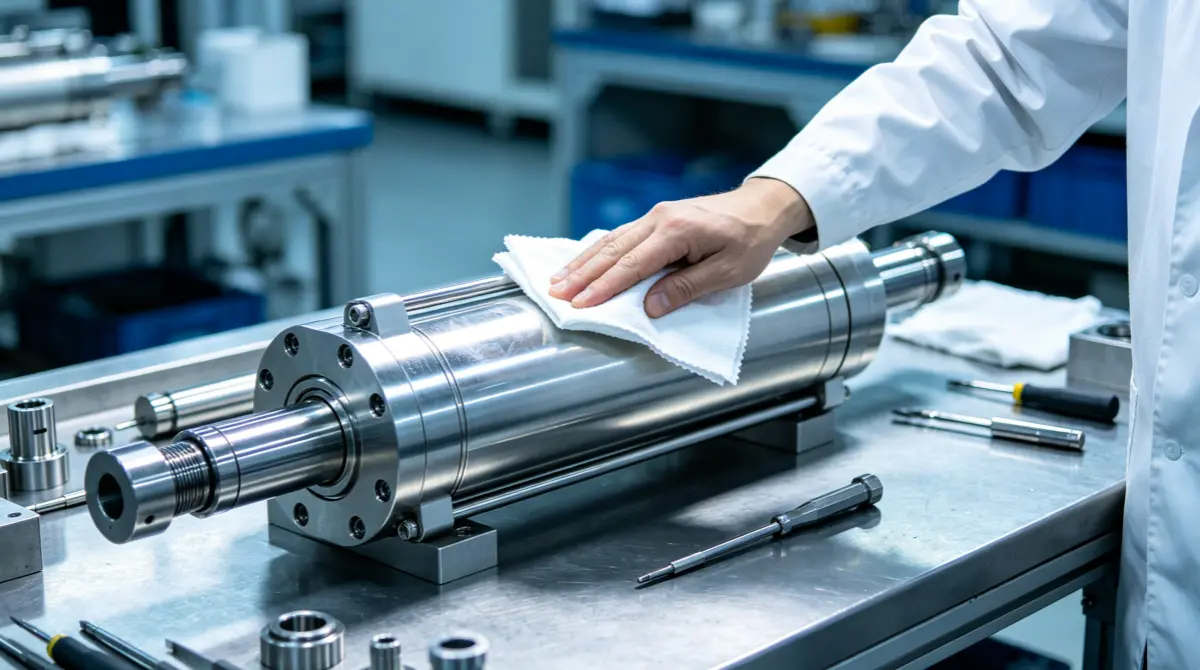
Aerospace precision assemblies operate under extreme conditions—hydraulic pressures above 3,000 PSI, bearing speeds above 20,000 RPM, and actuator response times measured in milliseconds. Surface cleanliness at assembly directly affects component life and flight safety.
Bearing Assembly Cleanliness
Rolling element bearings in aerospace applications are precision-ground to ABEC 7 or ABEC 9 tolerances. A single particle between the raceway and rolling element can cause a spall that propagates into a bearing failure. Your assembly wipe must be ultra-low-lint, compatible with your bearing lubricant, and free of any abrasive particles from its own manufacturing process.
Hydraulic System Assembly
Hydraulic fluid contamination from particles or fibers causes valve sticking, servo instability, and seal degradation. The wipe used to clean hydraulic component surfaces before assembly must meet NAS 1638 or ISO 4406 cleanliness class requirements. We provide wipes with documented particle counts per NAS 1638 Class 4 or better for aerospace hydraulic applications.
Seal and Gasket Surfaces
Fluorocarbon and silicone seals in aerospace systems are sensitive to hydrocarbon contamination. Your wipe must remove machining oils and fingerprint residue without introducing its own chemical contaminants. Silicone-containing wipes are prohibited in most aerospace seal applications—specify silicone-free on your purchase order and verify with your supplier’s chemistry certification.
The Documentation Package Your Aerospace Auditor Demands
For aerospace-grade wiping cloths, your supplier must provide the following documentation with every lot. If any document is missing, quarantine the lot until it’s resolved.
- Certificate of Conformance (CoC) — Product identification, lot number, specification reference, and statement of compliance. This is the baseline document that says “this product meets its published specification.”
- Certificate of Analysis (CoA) — Lot-specific test data: particle counts, extractable residue levels, material composition, and physical properties (basis weight, thickness, tensile strength).
- Material Traceability Document — Raw material source (fiber manufacturer, lot number), production facility, manufacturing date, and process parameters. This is the document most aerospace suppliers fail on—ask for it before you need it.
- Chemistry Certification — Absence of silicone, sulfur, halogenated compounds, and other contaminants that affect aerospace process compatibility. Required for braze, weld, and seal applications.
- ISO 9001:2015 / AS9100 Certificate — Current quality management certificate covering the manufacturing site. For aerospace applications, AS9100 certification of your wipe supplier is a competitive advantage—but ISO 9001 is the minimum.
- Change Notification Agreement — Written commitment from the supplier to notify you before changing raw materials, manufacturing processes, or production locations. This should be in your quality agreement, not just a verbal promise.
We maintain complete documentation packages for every aerospace customer. When your NADCAP auditor walks in, you hand them a binder with lot-level traceability from fiber to finished wipe. No scrambling, no gaps, no findings.
Material Traceability: From Fiber to Finished Wipe
This is where most wipe suppliers fail aerospace audits. Material traceability means you can follow the chain backward from the wipe in your hand to the fiber bale at the textile mill. Here’s what that chain looks like:
- Fiber source — Polyester, polypropylene, cellulose, or blended fiber. Manufacturer name, fiber lot number, production date, and material specification.
- Fabric production — Knitting or weaving facility, fabric lot number, process parameters (gauge, knit structure, basis weight).
- Wipe converting — Cutting, edge sealing, and packaging facility. Converting lot number, edge construction method, and cleanroom classification of the converting environment.
- Packaging and labeling — Package lot number, cleanroom packaging environment classification, and labeling verification against the CoC.
Each link in this chain must be documented and retrievable. If your wipe supplier sources fiber from one mill, converts at another facility, and packages at a third—all of which is common—the traceability chain spans three organizations. Your supplier must connect those dots for you.
We’ve built our traceability system to cover the full chain. When an aerospace auditor asks “where did this fiber come from?”, we can answer with lot-level specificity within minutes. If your current supplier takes days to respond to that question, that’s a gap in your audit readiness.
Receiving Inspection Protocols for Aerospace-Grade Wipes
Aerospace receiving inspection goes beyond the 10-minute visual check that works for general manufacturing. Here’s the protocol we recommend for aerospace wipe lots:
- Documentation verification — Confirm CoC, CoA, traceability document, and chemistry certification are all present and reference the correct lot number. Check that all documents are signed and dated. Fifteen minutes.
- Visual inspection under controlled lighting — Open one bag per lot. Inspect for uneven texture, discoloration, tears, foreign particles, and edge integrity. Compare against your approved reference sample. Five minutes.
- Weight and dimension verification — Weigh five random wipes and measure dimensions. Compare against the spec sheet. Confirm basis weight (gsm) is within tolerance. Five minutes.
- Lint test on witness coupon — Wipe a clean stainless steel witness coupon and inspect under magnification. Count fibers and particles against your acceptance criteria. Ten minutes.
- Solvent compatibility spot test — Apply your primary cleaning solvent to a wipe sample. Confirm absorption rate, physical integrity, and absence of residue. Five minutes.
- Lot traceability cross-check — Verify that the lot number on the physical product matches the CoA, CoC, and traceability document. Log all documentation in your quality system. Ten minutes.
That’s 50 minutes per lot—not 10. For aerospace applications, the extra 40 minutes prevents the three-month corrective action project that follows a NADCAP finding. Worth it every time.
Total Cost Thinking: Why Aerospace Wipe Procurement Can’t Be Commoditized
We’ve seen aerospace procurement teams run competitive bids on wiping cloths the same way they buy shop rags for general maintenance. Here’s why that approach fails:
- Scrap cost — A single turbine blade costs $5,000–$80,000 depending on alloy and complexity. Surface contamination from the wrong wipe can scrap the blade after all machining and finishing operations are complete. Your wipe cost is 0.001% of the blade value—using a cheaper wipe to save $0.50 risks a $50,000 loss.
- Process revalidation — Switching wipe suppliers requires revalidation of your surface preparation process. For aerospace chemical processing, that means new adhesion tests, new coupon testing, and potentially a NADCAP re-audit. The revalidation cost dwarfs years of premium wipe pricing.
- Production disruption — When a wipe lot fails incoming inspection and you don’t have qualified backup stock, your production line stops. Aerospace production schedules are tight—a one-day delay on a delivery milestone can trigger contractual penalties that cost more than your entire annual wipe budget.
The right aerospace wipe isn’t the cheapest one. It’s the one with complete documentation, consistent lot-to-lot quality, and a supplier who notifies you before they change anything. That’s what you’re paying for.
Your Aerospace Consumables Team at WIPESTAR
Aerospace accounts get a team that understands the documentation and compliance requirements—not just the product specs.

Lee — Key Account Sales Manager
Lee manages our aerospace key accounts with the kind of detail orientation that NADCAP compliance demands. He’s worked with clients like Foxconn, Samsung, and Apple—companies with quality standards that mirror aerospace requirements. He handles multi-site supply agreements, manages your quality agreement, and ensures every lot ships with the full documentation package your auditors expect.

Juan — Purification Industry Specialist
Juan’s background is in contamination control and cleanroom design. He understands how your cleanroom classification, airflow patterns, and process environment interact with your consumable choices. For aerospace surface preparation applications, he helps match wipe specifications to your specific process requirements—TBC prep, composite bond prep, or precision assembly—and can advise on handling protocols that maintain wipe cleanliness through your production flow.

Guan — Cleanroom Consumables Sales Specialist
Guan focuses specifically on cleanroom consumable applications across aerospace, defense, and precision manufacturing. He knows the difference between a wipe that passes general quality checks and one that passes a NADCAP chemical processing audit. He handles your RFQ process, coordinates sample evaluation, and manages the qualification documentation trail from first order through ongoing supply.
Meet the full team: WIPESTAR Team Page →
Frequently Asked Questions About Industrial Wiping Cloths for Aerospace Component Cleaning
Request Aerospace-Grade Wiping Cloth Samples
We supply industrial wiping cloths for aerospace applications direct from our factory—full NADCAP-ready documentation, material traceability from fiber to finished wipe, chemistry certifications, and lot-level CoA data. ISO 9001:2015 certified production. Free sample lots with complete documentation for qualified aerospace facilities.
Browse our wiping cloth range →
Request Documentation Package →