English
 Chinese


Every foundry engineer has a war story about contamination. This one starts with a pellicle.
A 3nm customer tape-out was bleeding yield—12% loss on a critical metal layer, repeating defect on every 26th die. The overlay checked out. Etch profile, on spec. Film thickness, within tolerance. But the defect kept showing up, lot after lot, for six weeks straight.
Root cause: contaminated pellicle support frame in the EUV scanner. Not the pellicle membrane itself—that degrades on schedule, everyone knows that. The problem was a crevice in the frame that the standard cleaning protocol never reached. The technician had been using a polyester wipe that was simply too thick to get into the gap. Visible surfaces got cleaned. The crevice didn’t. Over weeks, deposits built up, shed particles onto the pellicle, and created the repeating pattern that torched $2.1 million in scrapped wafers.
A thinner wipe—about $0.40 per sheet instead of $0.15—would have prevented the whole thing. That math stings once you know the answer.
This guide is for foundry process engineers, lithography teams, and cleanroom managers who need to spec wipes for EUV bays, mask handling, CMP post-polish, and wet bench operations. If you run a general fab rather than a foundry, our wafer fab wipe guide covers front-end-of-line cleaning more broadly.
EUV Lithography Area Cleaning
EUV runs at 13.5 nm wavelength—roughly 1/14th of the 193nm DUV systems most fabs grew up with. At that scale, a particle invisible to your inspection tool can still print as a defect. The pellicle is thinner and fussier than its DUV ancestor. And because EUV photons get absorbed by just about everything—including air—the whole optical path sits in vacuum, which means any outgassing from a wipe becomes a contamination source inside the exposure chamber.
What that means for your wipes:
- Particle counts need to hit single digits per wipe—tested per IEST-RP-CC004 at ≥0.05µm, not the ≥0.5µm that works for general cleanroom use.
- Ionic contamination below 0.1 ppm for sodium, potassium, and calcium.
- Outgassing minimized—volatile organics from the wipe can deposit on pellicle or mirror surfaces, forming a film that absorbs EUV photons and wrecks your exposure dose.
- The wipe needs to come in thin enough configurations to reach pellicle frame crevices, reticle stage gaps, and optics housing geometries.
Continuous filament polyester is the go-to for EUV area work. Lowest particle generation (≤20 particles/m³ ≥0.5µm on Helmke, sub-0.5µm counts verified separately), lowest ionic contamination (<0.5 ppm total), and the lowest outgassing profiles you'll find. Available in standard weight (~130 g/m²) and ultra-thin (~50 g/m²) for the tight spots.
Based on what we’ve seen work at leading foundries in Hsinchu, Pyeongtaek, and Magdeburg, here’s the spec we recommend for EUV area wipes:
- Particle generation: ≤20 particles/m³ ≥0.5µm (Helmke drum), ≤5 particles/wipe ≥0.05µm (LBPC in DI water)
- Ionic contamination: <0.5 ppm total, <0.05 ppm individual for Na⁺, K⁺, Ca²⁺
- Outgassing: verified via thermal desorption GC-MS, total VOC <50 ng/g
- ESD: surface resistivity 10⁶–10⁹ ohms/square per ANSI/ESD S20.20
- Material: continuous filament polyester, laser-cut or ultrasonically sealed edges (no raw-cut edges that shed)
- Thickness: standard (130 g/m²) and ultra-thin (50 g/m²) options
Mask and Reticle Handling Wipes
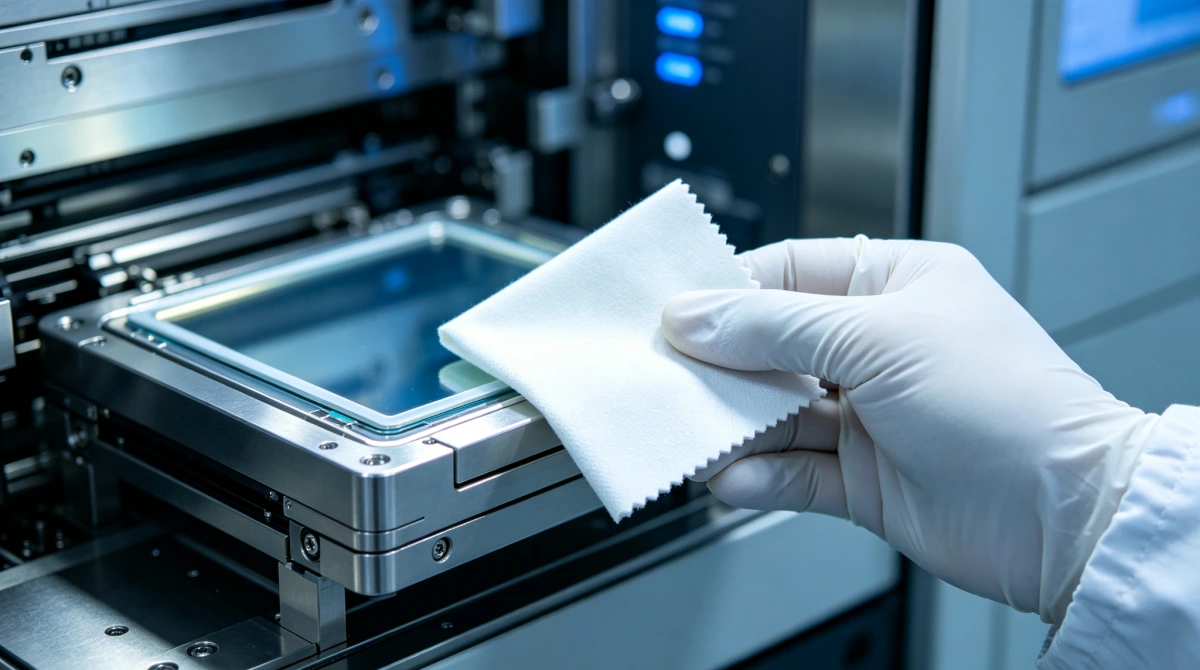
A single EUV reticle runs $150,000–$300,000 depending on complexity and pellicle setup. It’s also the most contamination-sensitive component in the exposure chain—a defect on the reticle prints on every wafer that passes through the tool.
Reticle handling involves several cleaning touchpoints:
- The reticle pod (EUV Pod or SMIF, depending on tool generation) needs interior cleaning during maintenance windows.
- The reticle stage—the mechanical chuck holding the reticle—needs wipe-down between reticle exchanges.
- The pellicle mounting area needs cleaning before a new pellicle goes on.
- The reticle itself, when cleaned outside the pellicle tool, needs a wipe certified for direct contact with the patterned surface.
For pod and stage cleaning, the requirements mirror EUV area cleaning—ultra-low particle, ultra-low ionic, ESD-safe, thin profiles. The added constraint is dimensional precision. Reticle pods have tight internal geometries with small crevices, alignment pins, and kinematic mounts. A standard 9×9 inch wipe folded into quarters doesn’t fit. You need smaller formats—4×4 inch or 2×2 inch—sized for reticle pod maintenance.
For direct reticle surface cleaning, the wipe must be verified for zero-scratch performance on the absorber layer. EUV reticle absorbers use tantalum-based compounds (TaN or TaBN) with a ruthenium capping layer—harder than chrome-on-glass DUV absorbers, but still susceptible to micro-scratches from aggressive wiping. Look for verified surface roughness (Ra < 0.1µm on the wipe surface), tested via AFM on every lot.
Photolithography Bay Contamination Control
The photo bay is the cleanest real estate in any foundry. Class 1 (ISO Class 1)—10 particles ≥0.1µm per cubic meter, maximum. Every surface, every consumable, every person walking in is a contamination source that needs managing.
Wipe use in the photo bay breaks into three tiers:
1. Tool maintenance — track cup, dispense nozzle, edge bead removal ring, wafer chuck, developer tray. These surfaces touch photoresist and developer directly; anything the wipe leaves behind gets baked into the resist film during post-apply bake.
2. Bay infrastructure — bench tops, FOUP load ports, interbay transfer surfaces, floor near tools. These don’t contact wafers directly, but particles from them can go airborne and settle during load/unload.
3. Gowning area — gowning bench, sticky mat area, air shower interior. Typically Class 10 or Class 100, not Class 1.
Each tier needs a different wipe grade. Tool maintenance demands the highest spec—continuous filament polyester, sealed edges, verified particle and ionic performance. Bay infrastructure can run standard polyester knit (≤100 particles/m³ ≥0.5µm works for bench tops and FOUP ports). Gowning area handles nonwovens fine.
Photoresist compatibility is another foundry-specific consideration. Modern EUV resists are chemically amplified resists (CARs) based on polymer-bound photoacid generators—sensitive to trace base contamination. Amines, NMP vapors, even ammonia from cleaning products can poison them. Wipes in the photo bay need amine-free certification with dedicated testing for volatile amine content (<1 ppb outgassing). If your supplier can't provide that, keep their wipes out of the photo bay.
CMP Post-Polish Cleaning for Foundry Processes
Foundry CMP is a different animal from memory fab CMP. Foundries run more CMP steps—STI, copper damascene, tungsten plug, cobalt liner, plus the increasingly complex multi-patterning planarization for 5nm and 3nm. Each step brings its own slurry chemistry, pad condition, and post-clean recipe.
Foundry CMP slurries span a wide pH range: colloidal silica (pH 10–11 for oxide), acidic alumina (pH 3–4 for some metal steps), and ceria-based slurries (pH 7–8 for STI and advanced oxide). The wipes cleaning the CMP tool contact slurry residue on the polishing head, retaining ring, carrier membrane, slurry delivery lines, and wafer transfer mechanism—all at different concentrations and pH levels.
For CMP post-polish wipe-down, go with a polyester knit wipe verified across the full pH range you run—typically pH 3 to pH 11 for most foundry CMP operations. You need solid particle-holding capacity (absorbency data at your actual slurry concentrations, not just DI water numbers) and sealed edges to prevent fiber shedding.
CMP areas typically run Class 10 or Class 100—somewhat relaxed compared to the photo bay, but still strict enough that a general-purpose industrial wipe won’t cut it. See our cleanroom wiper selection guide for matching wipe specs to cleanroom classes.
Wet Bench Operations
The wet bench is the workhorse of foundry cleaning. HF dip, SC-1, SC-2, piranha, SPM, and the increasingly common dilute chemistries (dHF, dSC-1, dSC-2) that cut chemical use while keeping cleaning performance. Every foundry runs wet benches. Every wet bench needs regular wipe-down.
Wet bench cleaning means wiping tank lips, overflow weirs, chemical delivery piping, wafer cassette interfaces, and the surrounding deck. Critical surfaces—anything contacting the wafer or process chemistry—need the same cleanliness as the photo bay. Non-critical surfaces (deck, piping exterior) can use a lower-grade wipe.
Chemical compatibility is the big concern here:
- HF (hydrofluoric acid) at 0.5–50% concentration attacks glass, metals, and most organic materials—including some wipe binder systems. For HF-contact surfaces, specify wipes with verified HF resistance: material and binders must hold up after prolonged exposure.
- Piranha and SPM (concentrated sulfuric acid + hydrogen peroxide) are even more aggressive—highly oxidizing at up to 130°C. Wipes near piranha processes need to tolerate strong oxidizers at elevated temperature.
PTFE-based wipes handle HF best but are expensive with limited absorbency. Polyester knit with HF-resistant binders works as a practical compromise for most wet bench wipe-down. Most polyester wipes survive brief piranha contact at room temperature, but extended exposure at process temperature will degrade them—test at your actual process conditions, not ambient.
For a deeper dive on matching wipe materials to your cleanroom class, see the WIPESTAR Cleanroom Wiper Selection Guide.
Wipe Type Comparison for Foundry Applications
Foundry cleanroom wipes fall into four categories, each matched to a specific contamination level and application.
| Property | Continuous Filament Polyester (Ultra-Clean) | Polyester Knit (Sealed Edge) | Polyester/Cellulose Nonwoven | PTFE Composite (HF-Resistant) |
|---|---|---|---|---|
| Cleanroom Class Suitability | Class 1 | Class 1 – Class 10 | Class 10 – Class 100 | Class 1 – Class 10 |
| Particle Generation (Helmke ≥0.5µm) | ≤ 20 particles/m³ | ≤ 50 particles/m³ | 200–500 particles/m³ | ≤ 40 particles/m³ |
| Ionic Contamination (Total) | < 0.5 ppm | < 5 ppm | 5–20 ppm | < 1 ppm |
| ESD-Safe Available | Yes (inherently dissipative) | Yes (carbon-loaded) | Limited | Yes |
| HF Resistance | Good (verify binder) | Good (verify binder) | Poor — cellulose degrades | Excellent |
| Piranha/Sulfuric Acid Resistance | Moderate (brief contact) | Moderate (brief contact) | Poor | Excellent |
| Outgassing (VOC) | Very Low (< 50 ng/g) | Low | Moderate | Very Low |
| Best Foundry Application | EUV area, mask/reticle handling, photo bay tool cleaning | Wet bench, CMP tool, general photo bay maintenance | Gowning area, equipment exterior, non-critical surfaces | HF wet bench, piranha-adjacent surfaces, aggressive chemistry areas |
| Relative Cost | $$$ | $$ | $ | $$$$ |
Cost context: continuous filament polyester runs $0.30–$0.60 per wipe. PTFE composite runs $1.50–$3.00. That sounds steep until you price the alternative. A contaminated EUV reticle replacement: $200,000. A wet bench contamination event on a 3nm customer lot: $500,000–$2,000,000 depending on lot size and wafer value.
The wipe is the cheapest thing in the foundry. It should be the last thing you compromise on.
Most foundries run a four-tier wipe strategy: ultra-clean continuous filament for the EUV bay and mask handling; sealed-edge polyester knit for wet bench and CMP; nonwovens for gowning and non-critical areas; PTFE composite specifically for HF and piranha-adjacent surfaces. The tier boundaries should map to your cleanroom class zones and process chemistry exposure map. We can help you design the tier structure based on your specific tool layout and process flows—talk to our team or browse the full wiping cloths range.
Who You’ll Work With at WIPESTAR
We supply cleaning consumables to semiconductor foundries where EUV lithography and advanced node processing demand the highest levels of contamination control. Our team understands foundry-specific cleaning requirements—from Class 1 EUV bays to aggressive wet bench chemistries.

Vicky — Foreign Trade Sales Supervisor
Vicky leads client communication and sales coordination for our global foundry accounts, maintaining long-term cooperative relationships with semiconductor manufacturers worldwide.

Carolina — Product Specialist
Carolina brings years of cleanroom consumables experience to product quality and performance optimization, working directly with production teams to meet foundry-grade specifications.

Juan — Purification Industry Specialist
Juan specializes in clean products and purification process equipment, with deep experience designing contamination control solutions for semiconductor manufacturing environments.
Get Started with Foundry-Grade Cleanroom Wipes
Whether you’re qualifying wipes for a new EUV lithography bay, upgrading consumables for advanced node processing, or tracking down a contamination event linked to cleaning materials, we can help. Full qualification documentation including COA, ionic analysis, outgassing profiles, and IEST-RP-CC004 compliance data—lot-traceable and foundry-ready.
- Cleanroom Wiper Selection Guide — Full technical guide covering wipe materials, particle specs, and cleanroom class matching. Start here if you’re evaluating options.
- Browse All Wiping Cloths — Full product range with specs, certifications, and material data sheets for foundry-grade wipes.
- Microelectronics Industry Solutions — See how WIPESTAR serves semiconductor and microelectronics manufacturers with tailored cleaning consumables.
- Request Technical Consultation — Need help matching a wipe to your specific process chemistry? Our team provides ionic analysis and compatibility data for your foundry.
Browse Full Wiping Cloths Range → Request a Custom Quote
Frequently Asked Questions