English
 Chinese



Last February, a BRC auditor walked into a 12,000-pallet frozen distribution center outside Rotterdam and found something the facility’s QA team had overlooked for months: wipe fragments. Tiny, brittle pieces of polyester scattered across frozen product packaging. The wipes had been stored inside a -25°C freezer room for three weeks. They’d gone stiff, cracked during use, and shed fragments every time an operator folded or wiped with them. The auditor didn’t flag the wipes themselves—she flagged the fragments as a physical contamination risk under BRC Storage & Distribution clause 4.14.
The facility passed the audit eventually, but it cost them two weeks of corrective action, a revised SOP, and a complete consumable requalification. All because nobody checked whether their wipes could actually survive freezer temperatures.
Here’s what most cold chain operators don’t realize: standard cleaning consumables were engineered for room temperature. At -25°C, the polymer chains that keep a wipe flexible at 20°C lose their molecular mobility. Absorbency drops. Condensation cycles create alternating wet and frozen surfaces that trap contaminants under ice. And the food safety requirements? Those don’t change with temperature—your wipes still need to be food-contact compliant, documented, and traceable, same as any ambient-temperature food facility.
This guide covers how wipe materials behave at freezer temperatures, condensation management, food safety compliance for the cold chain, and the mistakes I keep running into at frozen food warehouses. It’s written for cold storage facility managers, QA teams, and food safety professionals—anyone responsible for keeping a freezer operation clean and audit-ready.
Standard Wipes and Freezer Temperatures Don’t Mix
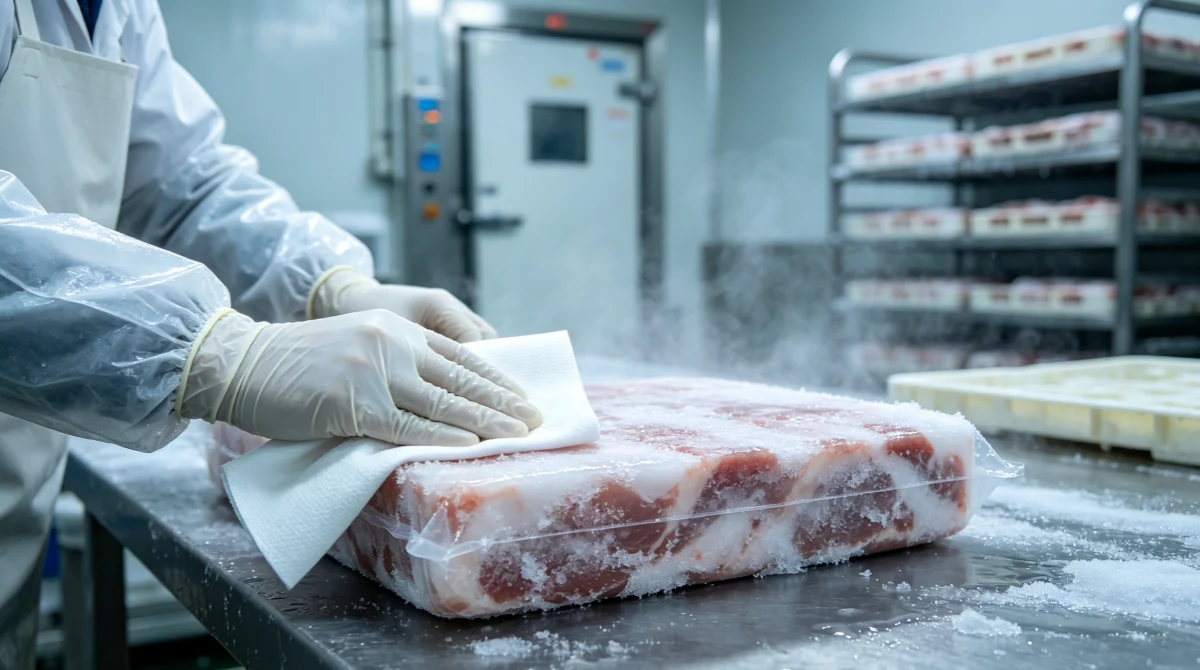
Take a polyester wipe that works perfectly at room temperature. Fold it, wipe with it, scrub a surface—it does exactly what it’s supposed to. Now put that same wipe in a -25°C freezer room for 24 hours and try again. It’s stiff. It cracks along the fold line. The fibers at the cut edge snap and shed. It’s not that the wipe stopped working—it stopped being a wipe.
This comes down to basic polymer physics. Below -18°C, the molecular chains in most synthetic fibers lose the flexibility they have at ambient temperature. The wipe goes brittle. And every performance characteristic you depend on—flexibility, absorbency, lint resistance, conformability to surfaces—goes with it.
Flexibility takes the biggest hit. A wipe that cracks at freezer temperature can’t conform to surfaces, can’t fold into crevices, and fragments during use. Those fragments land on frozen product packaging—exactly what happened in Rotterdam. Absorbency drops too. Water-based cleaning solutions freeze on contact with the wipe surface below -5°C, and oil-based agents get too viscous to penetrate the fibers. Lint release gets worse: cold fibers break at the cut edge more easily than warm ones, so if your wipe isn’t sealed-edge at room temperature, it’s going to shed even more at -25°C.
Then there’s operator handling. Workers in freezer rooms wear insulated gloves that reduce dexterity. A stiff, cold wipe becomes even harder to manage with bulky gloves on. Dispensing, folding, wiping—everything that’s effortless at room temperature turns into a struggle in the cold.
Temperature Zones and Wipe Selection
Not all cold storage environments are equal. A chiller room at 2°C is a completely different problem from a blast freezer at -40°C. The wipe that works in one will fail in the other. Here’s how to think about it:
Chiller Rooms (0–4°C)
Chillers are the easiest cold environment for consumables. Standard wipe materials hold onto most of their flexibility and absorbency at 0–4°C—you’re not fighting polymer brittleness yet. The real challenge is condensation. Every door opening pushes warm, humid air onto cold surfaces, and that moisture freezes, thaws, and refreezes with every cycle. You need wipes with solid absorbency for condensation management, and they still need food-contact compliance for any surface that touches product or packaging. But the material science is forgiving at this range.
Freezer Rooms (-18 to -25°C)
This is where things break down—sometimes literally. At -25°C, polyester gets stiff but remains usable if you’re careful. Polypropylene holds more flexibility and is generally the better bet for sustained freezer use. Cotton and cellulose? Forget it. They go rigid and practically unusable below -10°C. If you’re running a -25°C freezer room, go with polypropylene-based wipes or polyester blends with low-temperature flexibility additives. And test them at your actual freezer temperature—don’t assume the spec sheet applies below -18°C, because in my experience, it often doesn’t.
Blast Freezers (-35 to -45°C)
Blast freezers are the extreme end. At -40°C, most wipe materials are rigid and essentially non-functional. Trying to clean with a wipe at these temperatures is like trying to wipe a surface with a piece of cardboard. The practical move is to schedule cleaning during defrost cycles, when temperatures rise above -10°C. Keep your wipes outside the blast freezer entirely—store them in a warm office, a heated corridor, or an enclosed vestibule—and bring them in only during defrost windows. Use polypropylene-based wipes that retain flexibility at the lowest temperature you’ll actually encounter.
Condensation: The Problem That Never Goes Away
Every cold storage facility deals with condensation. It’s physics—warm humid air hits cold surfaces, moisture condenses, and then it freezes. Door openings, product transfers, ambient temperature swings, even the heat from a forklift engine—all of these create condensation cycles on walls, ceilings, floors, racking, and equipment.
The trouble with condensation is that it doesn’t just sit there. It freezes, thaws, and refreezes with every cycle, trapping dust, fiber, and microbial contamination under layers of ice. Standard cleaning doesn’t work here. A wet wipe on a frozen surface freezes almost immediately—the cleaning solution solidifies before it can dissolve anything. A dry wipe on a condensation-covered surface absorbs the water but not the soil underneath.
So what actually works? A protocol designed for the reality of frozen surfaces:
First, remove the bulk ice. Use a plastic scraper (never metal—it damages surfaces) during defrost cycles when the ice is soft. Then dry-wipe for loose debris—a lint-free wipe picks up ice shavings and loose contamination. Next, damp-wipe with a sub-zero-rated cleaning solution. Alcohol-based solutions stay liquid above about -20°C, which gives you a working window. Apply and wipe quickly before the solution has time to freeze. Finally, dry-wipe again to remove residual moisture. The surface should be dry to the touch before the room returns to operating temperature—any moisture left behind will freeze and start the whole cycle over again.
Wipe Materials at Freezer Temperatures: A Comparison
I put together this comparison based on real-world performance data and testing at actual freezer temperatures—not room-temperature spec sheets. The differences between materials are significant, and picking the wrong one for your temperature zone is one of the most common (and most expensive) mistakes I see.
| Material | Flexibility at -25°C | Absorbency at -25°C | Best For | Don’t Use For |
|---|---|---|---|---|
| Polypropylene | Good — retains flexibility | Moderate — reduced but functional | Freezer rooms, blast cells | Heavy oil absorption |
| Polyester | Fair — stiff but usable | Moderate — reduced but functional | Chillers, freezer rooms (with care) | Sharp folding at -25°C |
| Cellulose/polyester blend | Poor — cellulose component rigid | Low — cellulose fibers freeze | Chillers only | Any freezer application |
| Cotton | Poor — rigid, cracks | Very low — fibers freeze solid | Ambient-temperature areas only | Anything below 0°C |
| Microfiber | Fair — depends on base polymer | Good — fiber structure retains function | Chillers, freezer rooms (polyester microfiber) | Blast freezers (check base polymer) |
Our wiping cloths range includes polypropylene and polyester products suitable for cold storage applications. Our technical team can recommend specific products based on your operating temperature and provide flexibility test data at your actual storage conditions.
Food Safety Compliance Doesn’t Take a Holiday in the Cold
Cold storage facilities are part of the food chain—full stop. The same food safety regulations that govern food processors apply to warehouses and distribution centers, regardless of temperature. FDA FSMA, EU Regulation 852/2004, and third-party standards like BRC Storage & Distribution, SQF, and FSSC 22000 all require documented consumable control.
What does that mean in practice? Five things:
Your wipes need food-contact compliance for any surface that touches product or product packaging. That means an FDA letter or EU Declaration of Compliance—not just a marketing claim on the box. You need a current, GHS-compliant safety data sheet (SDS) on file for every consumable in the facility. Lot traceability is required—link wipe lots to cleaning records, because your auditor will ask for this and “we didn’t track that” is not an answer they want to hear.
Physical contamination control is critical. Wipe fragments, fibers, and debris must not contaminate product, which means sealed-edge, freezer-verified materials—not whatever’s cheapest on the procurement list. And you need temperature-verified performance documentation: evidence that the wipe actually performs at your operating temperature, not just at the 20°C the supplier tested it at.
Forklifts, Conveyors, and Equipment in the Freezer
You can clean cold storage equipment inside the freezer, but it takes planning. Forklifts, conveyors, pallet jacks, racking systems—they all accumulate grime, condensation, and the occasional product spill. These surfaces don’t contact food directly, but they contact food packaging and they’re part of your facility’s hygiene program.
Forklift cleaning in freezer environments is tricky because you’re dealing with hydraulic fluid, grease, and diesel exhaust residue on surfaces that are well below freezing. Standard industrial wipes that work fine at ambient temperature don’t cut it here—they stiffen up and lose absorbency. My recommendation: store forklift cleaning consumables in the operator’s warm break room and carry them into the freezer for use. Same principle as everything else in cold storage—warm storage, cold use, warm return.
What Your Auditor Actually Wants to See
Facing a BRC, SQF, or FSSC 22000 audit? Here’s the consumable documentation checklist your auditor expects. This isn’t optional—these are the items that show up in findings when they’re missing.
Product specification with temperature performance data. Your wipe supplier should provide flexibility and absorbency data at your operating temperature, not just at room temperature. Food contact compliance documentation—FDA letter or EU Declaration of Compliance for any wipe used on product-contact surfaces. A physical contamination risk assessment documenting that the wipe doesn’t create fiber shedding, cracking, or fragmentation risk at your operating temperature. A current, GHS-compliant SDS. And storage conditions documentation showing where wipes are stored relative to cold rooms, because consumables stored inside freezer rooms must be verified for temperature performance.
Mistakes That Keep Showing Up in Cold Storage Facilities
After working with cold chain operations globally, these are the mistakes I see over and over. They’re all preventable, and they all cost more to fix after the fact than they would to prevent upfront.
Storing standard wipes inside freezer rooms. This is the big one. Wipes stored at -25°C go brittle and crack during use, creating physical contamination on product packaging. The fix is simple: store consumables in ambient-temperature areas and carry them into the freezer only when needed. It takes five seconds of thought and prevents the most common cold-storage consumable failure.
No temperature performance verification. The wipe spec sheet says “suitable for cold environments” but doesn’t specify a temperature. “Cold” could mean 0°C or -30°C—it’s meaningless without a number. Test at your actual operating temperature before committing to a bulk order.
Using cotton rags for forklift cleanup in freezers. Cotton goes rigid at freezer temperatures and doesn’t absorb anything useful. It’s like trying to clean with a frozen dishcloth. Use synthetic wipes and store them in the warm area.
Wipe fragments on frozen product—the Rotterdam finding. Brittle wipes that crack during use leave fragments on packaging. Switch to materials verified for flexibility at your temperature, and discard any wipe that shows cracking during use.
No defrost cycle cleaning protocol. Cleaning during active freezer operation is inefficient because cleaning solutions freeze before they can work. Schedule deep cleaning during defrost cycles when surfaces are above -10°C. Use the defrost window strategically—it’s your best opportunity for thorough cleaning.
Who You’ll Work With at WIPESTAR
We work with cold storage and frozen food warehouse operators who need wipes that perform in extreme temperatures. Our team understands the unique challenges of cleaning in sub-zero environments.

Zac — Customer Service
Zac focuses on professional and efficient customer service, dedicated to responding to inquiries quickly, handling orders smoothly, and providing reliable after-sales support.

Yunyun — ESD Project Manager
Yunyun is a dedicated ESD prevention professional with rich experience in static control technology research, application, and solution implementation for cleanroom environments.

Ethan — Sales Director
Ethan has over 20 years of experience in the industrial wiping cloth and cleanroom consumables industry. He leads the global sales team and provides high-quality cleanroom solutions for worldwide customers.
Ready to Stop Losing Wipes to the Freezer?
Whether you’re qualifying wipes for a new freezer warehouse, upgrading consumables for a BRC Storage & Distribution audit, or solving a physical contamination issue from brittle wipes, we can help. Temperature-verified performance data available for all cold storage products.
Browse our wiping cloths range or contact our technical team to discuss your cold storage requirements.
Frequently Asked Questions