English
 Chinese



What’s the most overlooked piece of equipment in a commercial kitchen? It’s not the combi oven or the blast chiller. It’s the cleaning cloth.
A UK restaurant chain learned this the hard way. Environmental health investigators linked a Salmonella outbreak—47 customers sick, three locations affected—to a single practice: staff were using the same cloth for raw chicken prep surfaces and ready-to-eat salad counters.
The cloth was laundered between uses, sure, but at 60°C. Salmonella needs 80°C to die. So the cloth was effectively incubating and redistributing live bacteria across every surface it touched. The chain got shut down for two weeks, fined £200,000, and permanently lost about 30% of its customer base.
That’s not a freak accident. It’s what happens when cleaning cloths are treated as an afterthought. Restaurant operators pour money into food storage, cooking temps, staff hygiene—and then buy the cheapest cloths from the nearest supplier without a second thought.
This guide is for restaurant operators, food service managers, catering companies, and food safety consultants. We’ll walk through color-coded cleaning systems, cross-contamination prevention, single-use vs. reusable cloths, and the cloth mistakes that actually cause outbreaks.
Your Kitchen at Home vs. a Commercial Kitchen: Different Rules
At home, one cloth does everything—wipe the counter, clean the stove, dry the dishes. If it gets contaminated, the risk is limited to your household. In a commercial kitchen, a single contaminated cloth can affect hundreds of meals per shift.
The volume, the speed, the variety of food prep happening simultaneously—these create cross-contamination opportunities that simply don’t exist at home.
And then there’s the regulatory side. HACCP plans, local health codes, food safety management systems like ISO 22000, FSSC 22000, and BRC—they all include requirements for cleaning consumable management. Your cleaning cloth isn’t a convenience item. It’s a documented part of your food safety system. Treat it like one.
Color-Coded Cleaning: The System That Actually Works
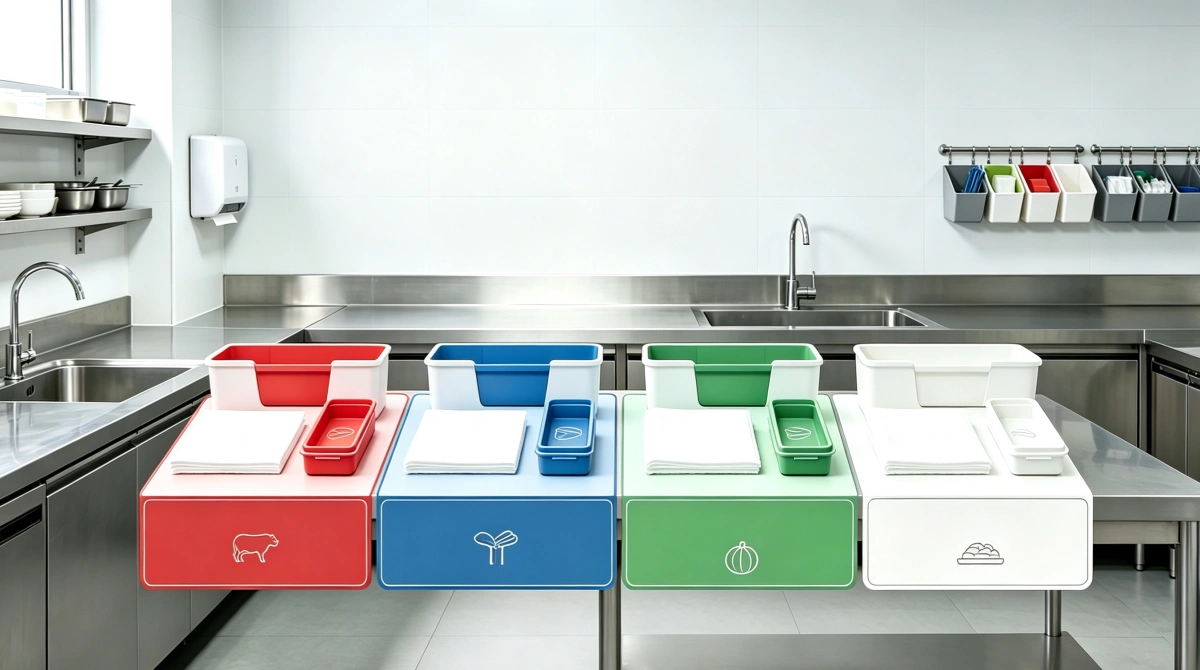
The concept is dead simple: assign different cloth colors to different food zones, so the cloth that wiped raw chicken never touches the salad counter. It’s the most widely adopted cross-contamination prevention measure in commercial food service, and it works—when people actually follow it.
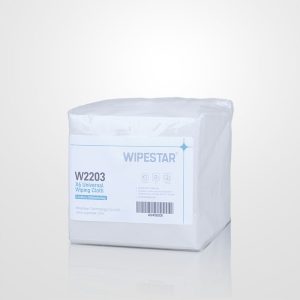
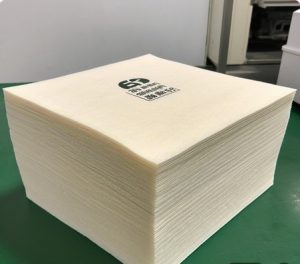
The standard color code (widely adopted in the UK, EU, Australia, and increasingly in North America) assigns zones by color. If you’re using white cloths like our universal wiping cloths, implement the system with color-coded storage bins, labeled dispensers, or colored tape on handles—the principle is the same: dedicated cloth per zone, never mix.
| Color | Zone | Examples |
|---|---|---|
| Red | Raw meat and poultry | Butcher blocks, raw meat prep surfaces, raw meat storage areas |
| Blue | General food contact (low risk) | General counters, non-food-contact equipment, general wipe-down |
| Green | Fruit, vegetables, and salads | Salad prep counters, produce washing areas, ready-to-eat prep |
| Yellow | Cooked food and hot-holding | Cooked food prep surfaces, hot-holding equipment, service counters |
| White | Dairy and bakery | Dairy prep areas, bakery surfaces, allergen-sensitive zones |
Look, the chart on the wall means nothing if people ignore it. Every staff member needs to know the color code. Every cloth needs to live in its designated zone. And mixing colors between zones? That’s a food safety violation, not a minor slip-up. Train, audit, enforce. Repeat.
The Cross-Contamination Chain (And How to Break It)
There’s a predictable pattern to how cloth-mediated cross-contamination works in a kitchen.
Raw protein—chicken, beef, fish—gets prepared on a surface. The surface gets wiped with a cloth. Then that same cloth (or a laundered cloth that wasn’t thermally disinfected properly) ends up on a ready-to-eat surface. Bacteria from the raw protein transfer to the ready-to-eat food. Customers eat it. Some of them get sick.
The cloth is the vector. That’s the whole story. Break the chain at the wipe step or the reuse step, and the outbreak doesn’t happen.
Single-use wipes eliminate the risk entirely—each one gets used once and tossed. Reusable cloths can work too, but only with a documented thermal disinfection protocol (80°C wash, verified) and strict color-code enforcement. No shortcuts.
Sanitizers and Cloths: Which Combinations Work?
Commercial kitchens use a range of sanitizers, and your cloth needs to be compatible with whatever you’re using. Here’s the breakdown:
Quaternary ammonium compounds (QACs) are the most common commercial kitchen sanitizer. They work well with most wipe materials—you apply the QAC solution to the cloth, then wipe the surface. The cloth needs to absorb and release the solution effectively. Pretty straightforward.
Chlorine-based sanitizers (sodium hypochlorite) are effective but harsh on cotton and cellulose fibers. If your kitchen uses chlorine, go with synthetic or synthetic-blend cloths. Cotton degrades faster than you’d expect under repeated chlorine exposure.
Heat disinfection is the gold standard for reusable cloths—but the cloth has to survive it. You need 80°C minimum in the wash cycle for thermal disinfection. Cotton handles heat fine. Some synthetic fibers shrink or deform at 80°C, so verify your cloth’s heat resistance before committing to a laundering protocol. Get this wrong and you’re replacing cloths constantly.
Peroxide-based sanitizers are gaining popularity in food service. They’re compatible with most materials, but check with your supplier to be sure—especially if you’re switching sanitizer systems mid-stream.
Single-Use or Reusable? Let’s Look at the Evidence
This debate has been studied extensively. The data points in a clear direction:
Microbial load. Studies consistently show reusable cloths harbor bacteria even after laundering, particularly when the laundering protocol doesn’t hit 80°C. And let’s be honest—how many kitchen laundries actually verify their wash temperature every cycle? Single-use wipes arrive with controlled bioburden (or sterile), get used once, and go in the bin. No laundering compliance to worry about.
Compliance simplicity. With single-use, there’s no laundering protocol to document, no temperature to verify, no risk of color zones mixing in the wash. Use once, discard, grab a fresh one. For food safety auditors, that’s a clean, simple story.
Cost. Single-use wipes cost more per unit, sure. But factor in laundering costs—water, energy, labor, detergent, equipment maintenance—and the total cost of ownership is surprisingly close. And the cost of an actual foodborne outbreak? Fines, closure, reputation damage, lost customers. That dwarfs either option by orders of magnitude.
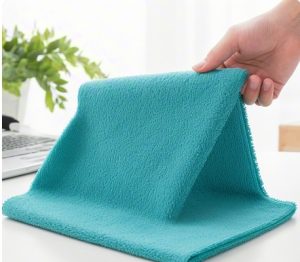
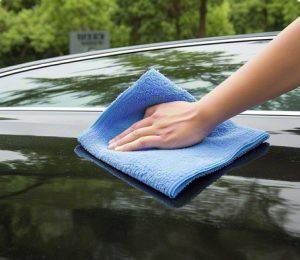
Our wiping cloths range includes products for both approaches. For single-use, we recommend individually wrapped or pop-up dispenser wipes. For reusable, we offer synthetic-blend products specifically designed to survive repeated 80°C laundering cycles.
What Auditors Want to See in Your File
When a food safety auditor walks into your kitchen, they’re going to ask about your cleaning consumables. Be ready with:
Color-code chart — displayed in the kitchen, showing which color goes where. This is part of your HACCP prerequisite program. If it’s not posted, that’s a finding.
SDS — for the cleaning cloth product. Required by OSHA and by food safety auditors. Keep it current.
Food contact compliance — FDA or EU declaration for cloths used on food-contact surfaces. If you can’t produce it, expect a non-conformance.
Laundering protocol (for reusable cloths) — documented wash temperature (80°C minimum), detergent specification, and drying procedure. Include verification records—temperature logs from the washing machine. If you’re claiming thermal disinfection, you need to prove it happened.
Supplier qualification — your cloth supplier should be on your approved supplier list. It’s a standard part of any food safety management system.
Single-Use vs. Reusable: Side-by-Side
| Factor | Single-Use Wipes | Reusable Cloths |
|---|---|---|
| Cross-contamination risk | Eliminated (use once, discard) | Requires 80°C thermal disinfection protocol |
| Compliance simplicity | No laundering verification needed | Must document wash temp, detergent, drying |
| Cost per unit | Higher | Lower (but laundering adds cost) |
| Total cost of ownership | Comparable when laundering factored in | Comparable when laundering factored in |
| Color-code enforcement | Easy (fresh color each time) | Risk of color mixing in laundry |
| Environmental impact | More waste per shift | Less waste, but water/energy for laundering |
5 Cloth Practices That Lead to Outbreaks
1. One cloth for everything. The classic mistake. Same cloth wipes raw chicken, then the salad counter, then the cutting board. It’s the most common and the most dangerous practice in commercial kitchens. Color-coded single-use or zone-dedicated reusable cloths fix this completely.
2. Reusing cloths without thermal disinfection. Laundering at 60°C does not kill Salmonella, E. coli, or Listeria. You need 80°C. If your washing machine doesn’t reach 80°C and you’re not adding chemical disinfection to the cycle, your “clean” cloths aren’t clean. Period.
3. Storing damp cloths in a bucket. A damp cloth sitting in warm water in a warm kitchen is a bacterial incubator. Bacteria double every 20 minutes at room temperature—after 2 hours, you’ve got 6 doublings, meaning 64 times the original bacterial load. Store cloths in sanitizer solution at the correct concentration, or switch to single-use and skip the problem entirely.
4. Zone mixing. A cloth from the raw meat zone ends up on the salad counter. It happens fast in a busy kitchen. If you’re using white cloths, enforce zone separation through color-coded storage bins, labeled dispensers, or colored tape on handles. Regular staff training and spot audits keep it a habit, not a suggestion.
5. No allergen zone separation. If your kitchen handles allergens—gluten, nuts, shellfish, dairy—the cloth that wiped an allergen-containing surface can’t touch an allergen-free surface. Consider a separate color (white or purple) for allergen zones and document the assignment in your food safety plan.
Who You’ll Work With at WIPESTAR
We work with textile and garment manufacturers who need wipes that won’t contaminate their production environment. Our team understands the lint control, dye transfer prevention, and machine maintenance challenges unique to textile operations.

Juan — Purification Industry Specialist
Juan has rich experience in the purification industry, with professional command of clean products and purification process equipment, committed to providing optimized clean solutions.

Guan — Cleanroom Consumables Sales Specialist
Guan has 4.5 years in the semiconductor industry and over 5 years in cleanroom consumables sales, with deep understanding of semiconductor production cleanroom requirements.

Zhen — Account Manager
Zhen has rich experience in cleanroom consumables and contamination control solutions, proficient in WIPESTAR’s full product line across industries including microelectronics, optics, and aerospace.
Get Started with Commercial Kitchen Cleaning Consumables
Whether you’re implementing a color-coded cleaning system, upgrading from reusable to single-use wipes, or qualifying consumables for a food safety audit, we can help. Our wiping cloths are available in multiple materials and sizes to match your kitchen’s needs.
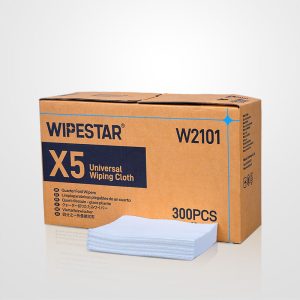
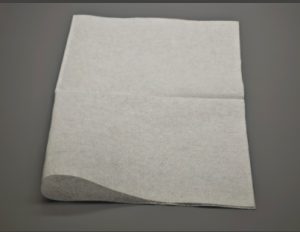
- W2101 Universal Cloth (X5) — Wood pulp/PP blend, 12″, cut edge. The go-to choice for general kitchen wipe-down. Absorbent, low-lint, cost-effective for high-volume use.
- W2201 Universal Cloth (X6) — Wood pulp/PP blend, 12″, cut edge. Heavier weight for tougher grease and grime. Ideal for end-of-shift deep cleaning.
- W2301 Universal Cloth (X7) — Wood pulp/PP blend, 9″, cut edge. Compact size for tight spaces and quick wipe-downs between tasks.
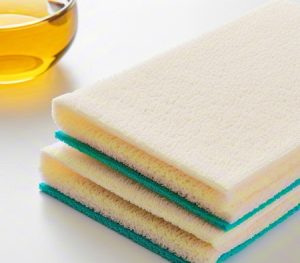
- W3501 Surface Prep Wipes — Cellulose/Polyester, 12″, high-friction surface. Built for heavy-duty grease removal and equipment cleaning.
Browse Full Wiping Cloths Range → Request a Custom Quote
Frequently Asked Questions