English
 Chinese



Here’s a number that should keep every gigafactory process engineer up at night: a single metal particle—iron, copper, aluminum, even zinc—larger than 25 microns on a lithium-ion battery electrode can cause an internal short circuit. Not might. Can.
Given the right conditions during cycling, that particle punctures the separator, creates a localized thermal event, and starts a chain reaction that leads to thermal runaway. In a dry room where the dew point is held at -40°C and a single moisture excursion can scrap an entire electrode coating run, the wipe you use to clean the coating head isn’t a consumable. It’s a safety-critical component.
I visited a battery plant in Hefei last year—mid-sized operation, about 8 GWh of annual capacity. Their quality manager showed me a failure analysis report from a cell that had gone into thermal abuse testing. The root cause? A 40-micron copper fragment embedded in the anode coating.
Traced back to a maintenance cloth that shed a fiber carrying metallic contamination from a previous wipe-down of a copper current feed roller. The cloth had been reused. It was supposed to be single-use. Someone cut a corner.
That single corner-cut cost them a batch recall. Twelve hundred cells. And it could have been worse—if those cells had already been in vehicles, the recall would have been measured in thousands of cars, not hundreds of cells.
This guide is for battery plant process engineers, quality managers, and the procurement teams who spec consumables for gigafactory cleanrooms. It covers dry room wipe selection, electrode coating line cleaning, cell assembly consumables, electrolyte filling station wipes, and the compliance framework—primarily IATF 16949—that governs all of it.
The Dry Room Problem: Why Humidity Changes Everything
If you’ve ever walked into a battery plant dry room for the first time, the sensation is immediate. Your skin tightens. Your lips crack within minutes. Your eyes sting. The air feels wrong—because it is wrong, at least for human comfort.
Dry rooms for lithium-ion battery manufacturing typically operate at less than 1% relative humidity, with dew points held between -40°C and -60°C. Some critical zones push even lower.
Why? Moisture is the enemy of lithium-ion cell performance. Water reacts with the lithium salt (LiPF₆) in the electrolyte, producing hydrofluoric acid—HF—which corrodes the electrode materials and generates gas inside the sealed cell.
A cell assembled in even slightly humid conditions will have reduced capacity, increased internal resistance, and a significantly shorter cycle life. Worst case: gas generation leads to cell swelling, venting, or in extreme scenarios, thermal runaway during use.
Every consumable that enters the dry room is a potential moisture source. Gloves. Gowns. And wipes. A standard industrial cloth can carry 200–400% of its weight in absorbed moisture. Bring that into a -40°C dew point environment and you’ve just introduced a localized humidity spike that can take hours to recover from—hours during which every electrode and cell being processed in that zone is potentially compromised.
Dry room wipes need to be low-moisture by design. Pre-baked or vacuum-dried to residual moisture levels below 0.1% by weight. Packaged in moisture-barrier bags with desiccant packs. And stored in the dry room’s staging area—not brought in from a humid warehouse.
Metal Particle Contamination: The Thermal Runaway Trigger
This is the one that causes thermal runaway. Not moisture degradation, not electrolyte decomposition—metallic particle contamination. It’s the most dangerous failure mode in lithium-ion battery manufacturing, and your cleaning wipes are directly in the chain of causation.
The mechanism is straightforward. A metallic particle—iron, copper, aluminum, nickel, zinc, even chromium from stainless steel—lands on the electrode surface during coating or calendering. The cell is assembled around it.
During charging, the particle creates a localized high-current-density region that punctures the separator (typically 12–20 microns of polyethylene or polypropylene). The puncture creates an internal short circuit. The short circuit generates heat. The heat decomposes the cathode material (especially NMC and NCA chemistries, which release oxygen above 200°C). The oxygen feeds the reaction. Temperature climbs. Thermal runaway begins.
For NMC 811 cells—the chemistry used in most long-range EVs—thermal runaway onset can occur above 200°C, and once it starts, cell temperatures can exceed 1,000°C in seconds. In a module or pack, this triggers cascading thermal propagation to adjacent cells. The result is a battery fire that’s extraordinarily difficult to extinguish.
Your wipes contribute to this risk in two ways. First, a wipe that sheds fibers can release particles onto electrode surfaces. Sealed-edge, low-lint construction is non-negotiable for any wipe used in the coating, calendering, or assembly areas. Second, a wipe used on metallic components—current collector foils, coating die lips, calendering rollers—can pick up metallic particles and redistribute them if reused. Single-use wipes eliminate the redistribution risk entirely.
The particle cleanliness specification for battery manufacturing wipes should reference IEST-RP-CC004 testing methods, with NVR (non-volatile residue) and particle counts verified per lot. For metallic contamination specifically, ask your supplier for ICP-MS (inductively coupled plasma mass spectrometry) data on extractable metals.
NMP Solvent Resistance: Surviving the Coating Line
N-Methyl-2-pyrrolidone—NMP—is the dominant solvent for cathode electrode slurry coating in lithium-ion battery manufacturing. It’s used to dissolve the PVDF binder (polyvinylidene fluoride) that holds the cathode active material particles together on the aluminum current collector.
The slurry gets coated onto the foil, then dried in a series of heated ovens that evaporate the NMP. The NMP is recovered via condensation and recycled—it’s expensive stuff, roughly $3–4 per kilogram, and a typical gigafactory uses hundreds of tons per year.
Here’s where your wipes come in. NMP is an aggressive organic solvent. It attacks many common polymer fibers. A polyester wipe exposed to NMP will swell, lose structural integrity, and shed particles—the exact thing you’re trying to prevent on the coating line.
Polypropylene holds up better, but not all polypropylene wipe constructions are equal. The fiber diameter, bonding method, and fabric density all affect NMP resistance.
Cellulose and cotton are out. NMP degrades cellulose rapidly. If you’re using any natural fiber wipe on or near the cathode coating line, you’re introducing a failure point. And the wipe doesn’t need to be soaked in NMP—even residual NMP vapor in the coating area degrades susceptible fibers over time. A wipe that’s been sitting on a coating line cart for a few hours may have already started degrading before you pick it up.
Specify solvent-resistant synthetic wipes for all cathode coating line cleaning tasks. Your supplier should provide chemical compatibility data for NMP exposure—at minimum, weight change and tensile strength retention after 24-hour immersion at 25°C and 80°C. If they can’t provide that, the product hasn’t been validated for your application.
Zone-by-Zone Wipe Selection for Battery Manufacturing
Electrode Coating Lines
The coating area is where slurry meets foil—both cathode (NMC/LFP on aluminum) and anode (graphite/silicon on copper). Wipes here must be low-lint, NMP-resistant (cathode side), and free of metallic contaminants.
The coating die lips, doctor blades, and backup rolls need precision cleaning with wipes that won’t leave particles or fibers on the foil surface. A single fiber on the coating die can create a streak defect that runs for meters of coated foil—expensive scrap.
Single-use, sealed-edge synthetic wipes are the standard. For anode lines using water-based binders, NMP resistance is less critical, but particle cleanliness requirements are identical.
Calendering and Slitting
After coating and drying, electrodes are compressed (calendered) to achieve target density and then slit to width. The calendering rolls are precision-ground surfaces—any particle between the roll and the electrode creates a pressure point that can crack the active material layer or puncture the foil.
Wipe the calendering rolls with low-particle, non-abrasive wipes. Slitting generates foil edge debris—metallic particles from the cutting blades. Clean the slitter area frequently with wipes that capture and retain metallic particles rather than redistribute them.
Cell Assembly (Stacking/Winding)
Electrode sheets are stacked (pouch and prismatic cells) or wound (cylindrical cells) with separator layers between them. This is the last step before the cell is sealed—it’s your final chance to remove any particle that might have been introduced upstream.
Assembly environments are typically ISO Class 7 or 8, with some critical zones at ISO Class 6. Wipes must be low-lint, low-particle, and compatible with the dry room environment. Any moisture in the wipe gets sealed inside the cell. Use pre-dried, moisture-barrier-packaged wipes only.
Electrolyte Filling
Electrolyte filling is done in inert atmosphere (argon or nitrogen glove boxes, or dry rooms with integrated filling equipment). The electrolyte—a lithium salt dissolved in organic carbonates (EC, DMC, DEC)—is highly moisture-sensitive and moderately corrosive.
Wipes used for spill cleanup and equipment wipe-down must be chemically compatible with the electrolyte solvents and capable of absorbing organic liquids without releasing fibers or particles. Polypropylene melt-blown wipes work well here. And once a wipe contacts electrolyte, it’s hazardous waste—dispose of it according to your facility’s waste protocol.
Formation and Testing
During formation cycling, cells are charged and discharged for the first time, generating gas that’s vented or recombined. Formation rooms need clean, low-particle environments but are less humidity-critical than the upstream dry rooms (cells are already sealed at this point).
Standard cleanroom wipes work for general area cleaning. For external cell terminal cleaning before welding or tab attachment, use lint-free wipes that won’t leave residue on the electrical contact surfaces.
IATF 16949 and What It Means for Your Consumables
IATF 16949 is the automotive quality management system standard—built on ISO 9001 but with additional requirements specific to the automotive supply chain. Every major EV OEM (Tesla, BYD, Volkswagen, Hyundai, GM, Ford, BMW) requires their battery cell suppliers to hold IATF 16949 certification. And the standard doesn’t just cover your product—it covers your processes, your suppliers, and your consumables.
For cleaning wipes specifically, IATF 16949 requires that consumables affecting product quality be controlled under your quality management system. That means your wipes need to be on your approved supplier list, specified by product and lot number in your process documentation, and subject to incoming inspection or verification.
The standard’s section on supplier management (Section 8.4) requires you to evaluate and monitor external providers—including consumable suppliers—based on their ability to meet your quality requirements.
What does this look like in practice? Your wipe supplier needs to provide: SDS (Safety Data Sheet), lot-level Certificates of Analysis (COA) with particle counts and NVR data, chemical compatibility documentation for your specific process chemicals (NMP, electrolyte solvents, cleaning agents), and traceability from raw materials to finished product.
For wipes used in critical zones, gamma sterilization validation may be required—particularly for cell assembly environments where sterility isn’t the goal but validated cleanliness is.
IATF 16949 also requires process FMEA (Failure Mode and Effects Analysis), and your cleaning process—including consumable selection—should appear in your FMEA. What happens if the wrong wipe is used? What happens if a wipe sheds particles? What happens if a wipe introduces moisture into the dry room?
These aren’t hypothetical questions. They’re the questions your OEM customer’s quality auditor will ask during the next IATF surveillance audit. If your answers are “we haven’t considered that,” you have a gap.
Battery Manufacturing Wipe Comparison
| Zone / Application | Recommended Wipe Type | Key Requirements | Avoid |
|---|---|---|---|
| Cathode coating line | Sealed-edge polypropylene melt-blown, single-use | NMP-resistant, low-lint, NVR <0.05%, metal-free extract | Cotton, cellulose, polyester (NMP attack), reused cloths |
| Anode coating line | Sealed-edge synthetic blend, single-use | Low-lint, low-particle, compatible with water-based binders | Cotton, high-shed fibers, non-sealed-edge |
| Calendering / slitting | Low-particle non-woven, single-use | Non-abrasive, captures metallic particles, lint-free | Abrasive wipes, reusable cloths that redistribute debris |
| Cell assembly (dry room) | Pre-dried sealed-edge synthetic, moisture-barrier packaged | Residual moisture <0.1%, ISO Class 6–7 compatible, low-lint | Standard cleanroom wipes without moisture validation |
| Electrolyte filling | Polypropylene melt-blown, absorbent | Compatible with EC/DMC/DEC solvents, fiber-retaining, single-use | Cotton, cellulose, wipes that shed in organic solvents |
| Formation / testing | Standard cleanroom non-woven | Low-lint for terminal cleaning, general absorbency for area cleaning | High-lint wipes near cell terminals |
Quick note on cost: the cheapest wipe in that table—standard non-woven for formation areas—runs about $0.05–$0.10 per wipe. The most expensive pre-dried, sealed-edge synthetic for dry room cell assembly is $0.25–$0.50. That gap looks significant on a purchasing spreadsheet until you run the real numbers.
One contaminated electrode roll at a major gigafactory costs $5,000–$15,000 in scrap. A single thermal runaway event traced to metallic contamination from a reused wipe can trigger a recall measured in millions. Cost-per-wipe is the wrong metric. Cost-per-clean-cell is what matters.
Most battery plants run a two-tier approach: premium sealed-edge synthetics for coating, calendering, and cell assembly zones, and standard non-woven wipes for formation rooms, corridors, and general maintenance areas. Some add a third tier—polypropylene melt-blown dedicated to electrolyte handling—because electrolyte contamination is its own waste stream and you don’t want those wipes mixed into general cleaning inventory.
Whatever your approach, document the wipe spec in your cleanroom SOP and qualify the product before bringing it onto the production floor. “Qualification” means testing in your actual environment—your solvents, your dry room conditions, your wiping technique—not just trusting the supplier’s datasheet.
Five Wipe Mistakes That Cause Battery Failures
1. Bringing standard wipes into the dry room. This is the most common and most expensive mistake. A standard cleanroom wipe can carry 200–400% of its weight in moisture. Introduce it into a -40°C dew point dry room and you’ve created a localized humidity spike that can take 30–60 minutes to dissipate—during which every exposed electrode and cell component in the area absorbs moisture.
The result: cells with higher moisture content, reduced cycle life, and increased gas generation. Use only wipes validated for dry room use, with documented residual moisture below 0.1% and moisture-barrier packaging.
2. Reusing wipes on the coating line. A wipe used on a coating die lip has picked up slurry residue, metallic particles from the doctor blade, and possibly NMP. Reuse it on another surface and you’re transferring all of that contamination.
Single-use is the standard on coating lines for a reason. The cost of a fresh wipe is measured in fractions of a cent. The cost of a contaminated electrode roll is measured in thousands of dollars.
3. Using polyester wipes near NMP. NMP swells polyester fibers within minutes. The fiber structure weakens, particles detach, and the wipe starts shedding exactly the kind of debris you’re trying to prevent on the cathode surface.
Polypropylene is the standard for NMP-exposed areas. If your current wipe spec doesn’t specify the fiber type for cathode line cleaning, check it now.
4. Skipping ICP-MS data on wipe metallic content. “Low-particle” and “lint-free” are not the same as “metal-free.” A wipe can pass particle count testing and still contain extractable iron, copper, or aluminum above safe thresholds.
For battery manufacturing, you need ICP-MS data on extractable metals—specifically iron, copper, aluminum, zinc, chromium, and nickel—all below 1 ppm. If your supplier can’t provide this data per lot, the product hasn’t been qualified for your application.
5. Ignoring wipe storage conditions. Even a properly packaged dry room wipe degrades if stored incorrectly. Moisture-barrier bags need to remain sealed until use. Once opened, the wipe should be used within the time window specified in your SOP—typically 4–8 hours in a dry room staging area.
Leaving an opened bag on a cart overnight defeats the entire moisture-control purpose. Document the storage protocol. Train the operators. Audit compliance.
Who You’ll Work With at WIPESTAR
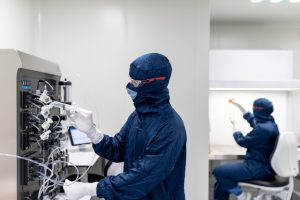
We supply cleaning consumables to EV battery manufacturing plants where moisture control and metal particle contamination are critical concerns. Our team understands dry room requirements and the cleanliness standards of gigafactory operations.

Vicky — Foreign Trade Sales Supervisor
Vicky plays a key role in the foreign trade sales team, responsible for client communication, sales coordination, and maintaining cooperative relationships with global clients.

Carolina — Product Specialist
Carolina has many years of experience in the cleanroom consumables industry, focusing on product quality and performance. She communicates closely with production teams to continuously optimize products.

Juan — Purification Industry Specialist
Juan has rich experience in the purification industry, with professional command of clean products and purification process equipment, committed to providing optimized clean solutions.
Get Started with EV Battery Manufacturing Cleanroom Consumables
Whether you’re commissioning a new gigafactory dry room, qualifying wipes for IATF 16949 compliance, or solving a metallic contamination issue on your coating line, we can help. Dry room-validated wipes with moisture-barrier packaging, ICP-MS metallic content data, and NMP chemical compatibility reports available per lot.
- Cleanroom Wiper Selection Guide — Our full technical guide covering wipe materials, particle specs, and cleanroom class matching. Start here if you’re evaluating options.
- Browse All Wiping Cloths — Full product range with specs, certifications, and material data sheets for battery-grade wipes.
- Request Technical Consultation — Need help matching a wipe to your specific coating chemistry or dry room requirements? Our team can provide NMP compatibility data and moisture validation for your plant.
Browse Full Wiping Cloths Range → Request a Custom Quote
Frequently Asked Questions